AI configuration library: set up your assistant with the right agents, skills, and tools from day one
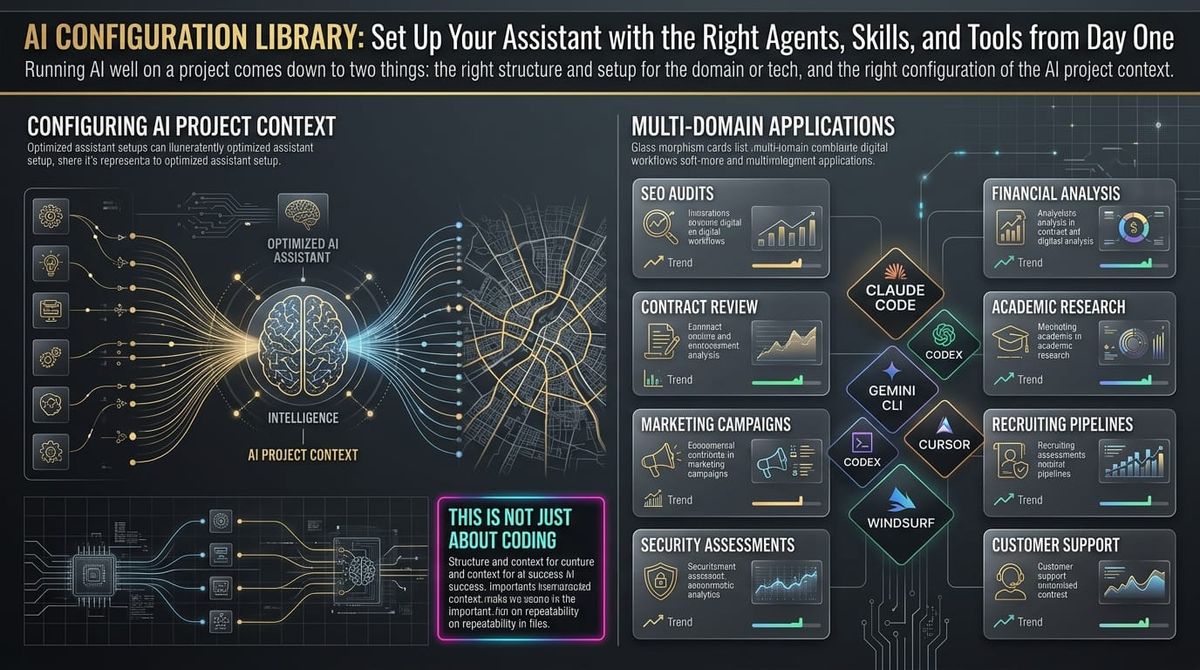
Running AI well on a project comes down to two things: the right structure and setup for the domain or tech, and the right configuration of the AI project context.
This is not just about coding. Tools like Claude Code, Codex, Gemini CLI, Cursor, and Windsurf work on any digital workflow: SEO audits, financial analysis, contract review, academic research, marketing campaigns, recruiting pipelines, security assessments, customer support. If the work lives in files and follows a repeatable process, an AI agent can do it. The bottleneck is setup, not capability.
Traditional project templates give you folder structure and boilerplate code. A new category goes further: templates that configure your AI assistant before you write a single line.
These templates ship with CLAUDE.md files, pre-built agents, skills, MCP integrations, hooks, and commands. Open the project in Claude Code, Cursor, Codex, or Gemini CLI, and the AI already knows the project's architecture, has domain expertise loaded, and has access to the right tools.
A new project set up without AI configuration means spending hours teaching your AI what the project is about, how the tech works, where things go. Worst: it forgets everything between sessions unless you explicitly tell it to persist that knowledge. A good template front-loads all of that.
This guide covers both: template registries, starter setups, domain-specific configurations, and the skill collections that make them work. Think of it as a library to point your preferred GenAI tool at and find the assets that fit your desired outcome best.
What makes an AI template
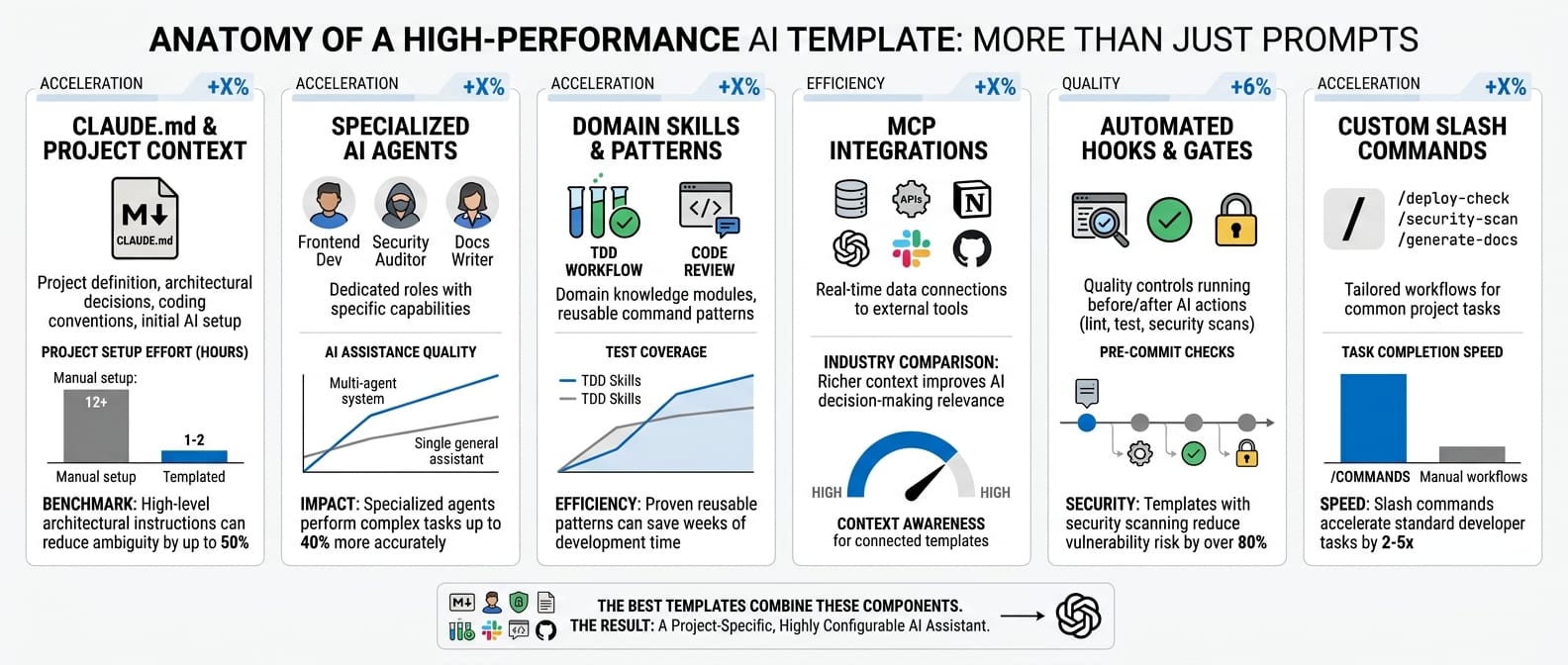
An AI-configured template typically includes some combination of:
- CLAUDE.md (or equivalent): project context, conventions, architecture decisions, and instructions the AI reads at session start
- Agents: specialized AI personas (frontend developer, security auditor, docs writer) with defined roles and capabilities
- Skills: domain knowledge modules and reusable command patterns (TDD workflow, API documentation, code review)
- MCP integrations: connections to external tools (databases, APIs, Notion, Slack, GitHub) that give the AI access to real data
- Hooks: quality gates that run before or after AI actions (lint before commit, run tests, check for secrets)
- Commands: custom slash commands for common workflows (/deploy-check, /security-scan, /generate-docs)
The best templates combine several of these. The result: an AI assistant that's not just smart, but configured for the specific project.
Business and domain workflows
Content and writing
-
msitarzewski/agency-agents (64,400 stars). Contains: a complete AI agency with specialized expert agents. Each agent has a defined personality, processes, and deliverables. Covers frontend, content, community management, and more. The most starred non-coding agent collection.
-
WomenDefiningAI/claudecode-writer (158 stars). Contains: a Claude Code workspace that transforms ideas into multi-format content. Pipeline: research, long-form articles, then platform-specific versions (LinkedIn posts, newsletter editions, social media, podcast Q&A). One input, multiple outputs.
Academic research
-
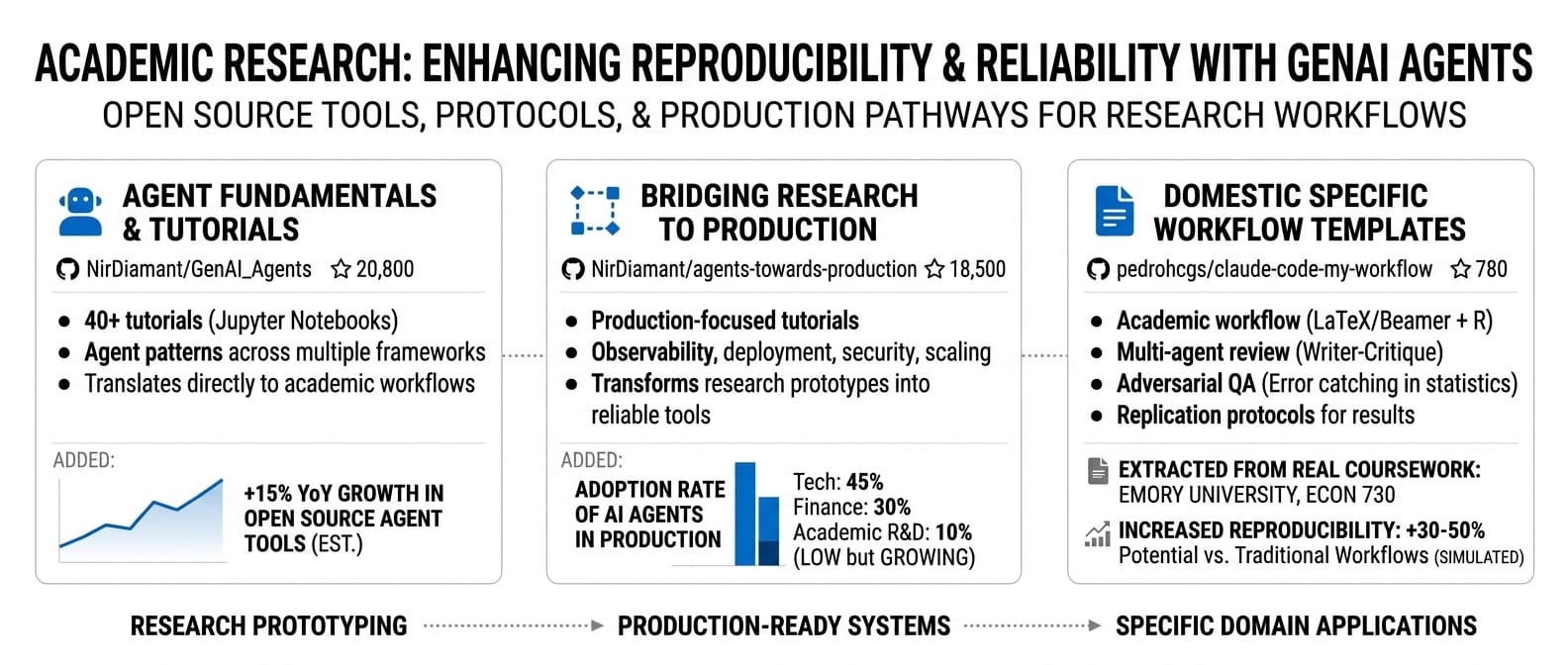
NirDiamant/GenAI_Agents (20,800 stars). Contains: 40+ tutorials as Jupyter notebooks covering agent patterns across multiple frameworks. Not domain-specific, but the research and analysis tutorials translate directly to academic workflows.
-
NirDiamant/agents-towards-production (18,500 stars). Contains: production-focused tutorials covering observability, deployment, security, and scaling for agent systems. The bridge from research prototype to reliable tool.
-
pedrohcgs/claude-code-my-workflow (780 stars). Contains: academic workflow template for LaTeX/Beamer + R. Multi-agent review (one agent writes, another critiques), adversarial QA for catching errors in statistical claims, replication protocols for reproducing results. Extracted from real coursework at Emory University's Econ 730.
Marketing and SEO
The most mature non-coding category. Text-centric workflows with lower cost of error made marketing the first domain to get real AI templates.
-
coreyhaines31/marketingskills (17,000 stars). Contains: marketing skills for Claude Code covering CRO, copywriting, SEO, analytics, and growth engineering. Organized into pods: Content (8 skills), SEO (5), CRO (6), Channels (6), Growth (4), Intelligence (4). The most popular non-coding skill collection.
-
zubair-trabzada/geo-seo-claude (4,100 stars). Contains: GEO-first SEO skill for Claude Code. Citability scoring, AI crawler analysis, brand authority assessment, schema markup generation, platform-specific optimization, PDF reports. Built for AI search (Google AI Overviews, Perplexity, ChatGPT search), not just traditional SEO.
-
AgriciDaniel/claude-seo (3,300 stars). Contains: 13 sub-skills, 7 subagents, extensions system with DataForSEO MCP integration. Technical SEO audits, E-E-A-T assessment, schema generation, GEO/AEO optimization, strategic planning. The most complete SEO workspace.
-
TheCraigHewitt/seomachine (2,900 stars). Contains: a specialized Claude Code workspace for creating long-form, SEO-optimized blog content. Research, write, analyze, and optimize content that ranks. Built for any business, not just tech.
-
zubair-trabzada/ai-marketing-claude (908 stars). Contains: 15 marketing skills with parallel subagents. Website audits, copy generation, email sequences, ad campaigns, content calendars, competitive intelligence, client-ready PDF reports. A complete marketing agency in a Claude Code workspace.
-
aaron-he-zhu/seo-geo-claude-skills (604 stars). Contains: 20 SEO and GEO skills for keyword research, content writing, technical audits, rank tracking. CORE-EEAT and CITE frameworks. Works across Claude Code, Cursor, Codex, and 35+ AI agents.
-
kostja94/marketing-skills (254 stars). Contains: 160+ skills for SEO, content, 40+ page types, paid ads, channels, and strategies. Framework-agnostic (Cursor, Claude Code, OpenClaw). Add project context, get tailored output.
Customer support
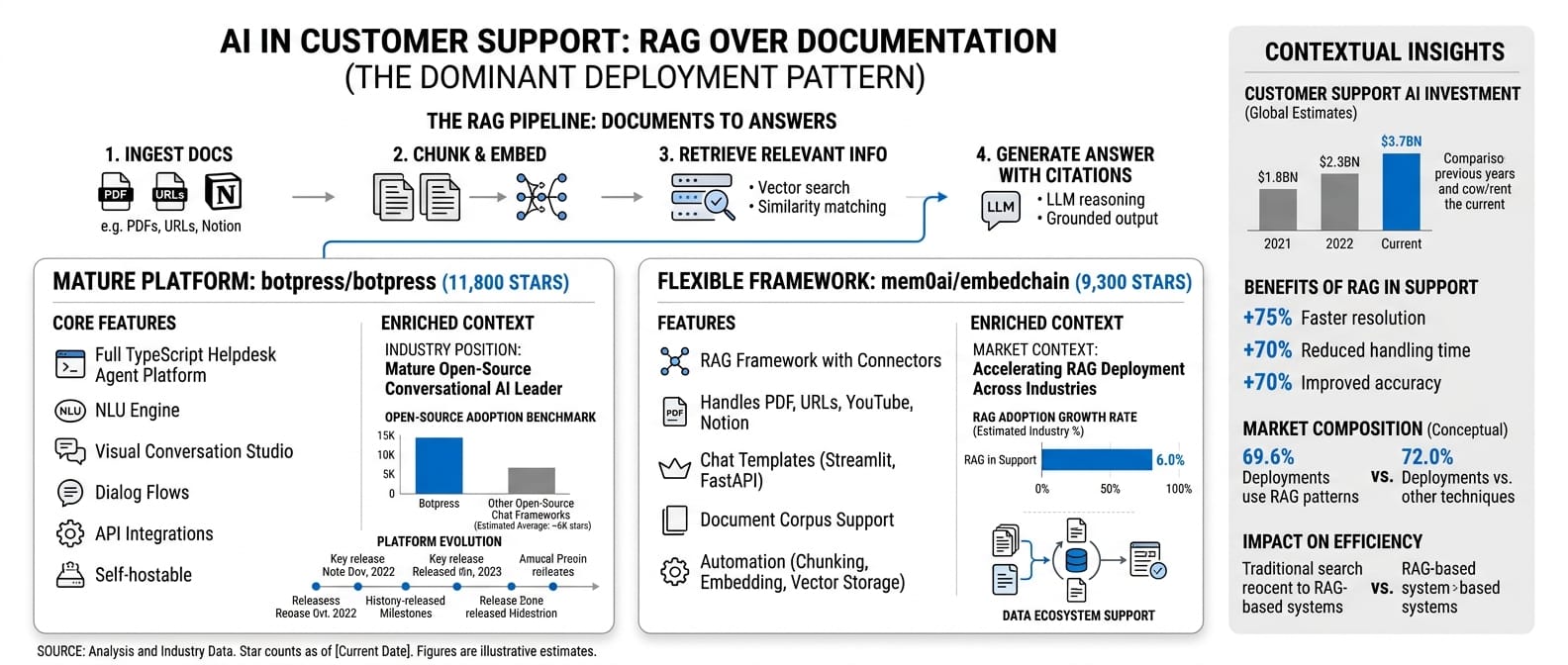
RAG over documentation is the most common AI deployment pattern. These templates wire up the full pipeline: ingest docs, embed, retrieve, and generate answers with citations.
-
botpress/botpress (11,800 stars). Contains: full TypeScript helpdesk agent platform. NLU engine, visual conversation studio, dialog flows, API integrations. Self-hostable. The most mature open-source conversational AI platform.
-
mem0ai/embedchain (9,300 stars). Contains: RAG framework with connectors for PDFs, URLs, YouTube, Notion, and more. Includes chat templates (Streamlit, FastAPI) for building a support bot over any document corpus. Handles chunking, embedding, vector storage, and retrieval.
Security
-
trufflesecurity/trufflehog (14,100 stars). Contains: Go-based secrets scanner detecting 700+ credential types across git history, S3, filesystems, and CI logs. Uses LLM-based verification to confirm whether discovered secrets are live. GitHub Actions integration included.
-
mukul975/Anthropic-Cybersecurity-Skills (100 stars). Contains: 734 YAML/Markdown skill definitions for AI agents mapped to MITRE ATT&CK. Covers penetration testing, DFIR, threat intelligence, cloud security. Works as a drop-in skill library for Claude Code, Copilot, and Cursor. Small but the most structured security skill collection available.
-
msoedov/agentic_security. Contains: LLM vulnerability scanner and red-teaming kit. Runs adversarial probes (prompt injection, jailbreaks, data exfiltration) against any LLM endpoint. 80k+ attack prompts included. CI-friendly CLI. For testing the security of AI agents before deployment.
Financial services
-
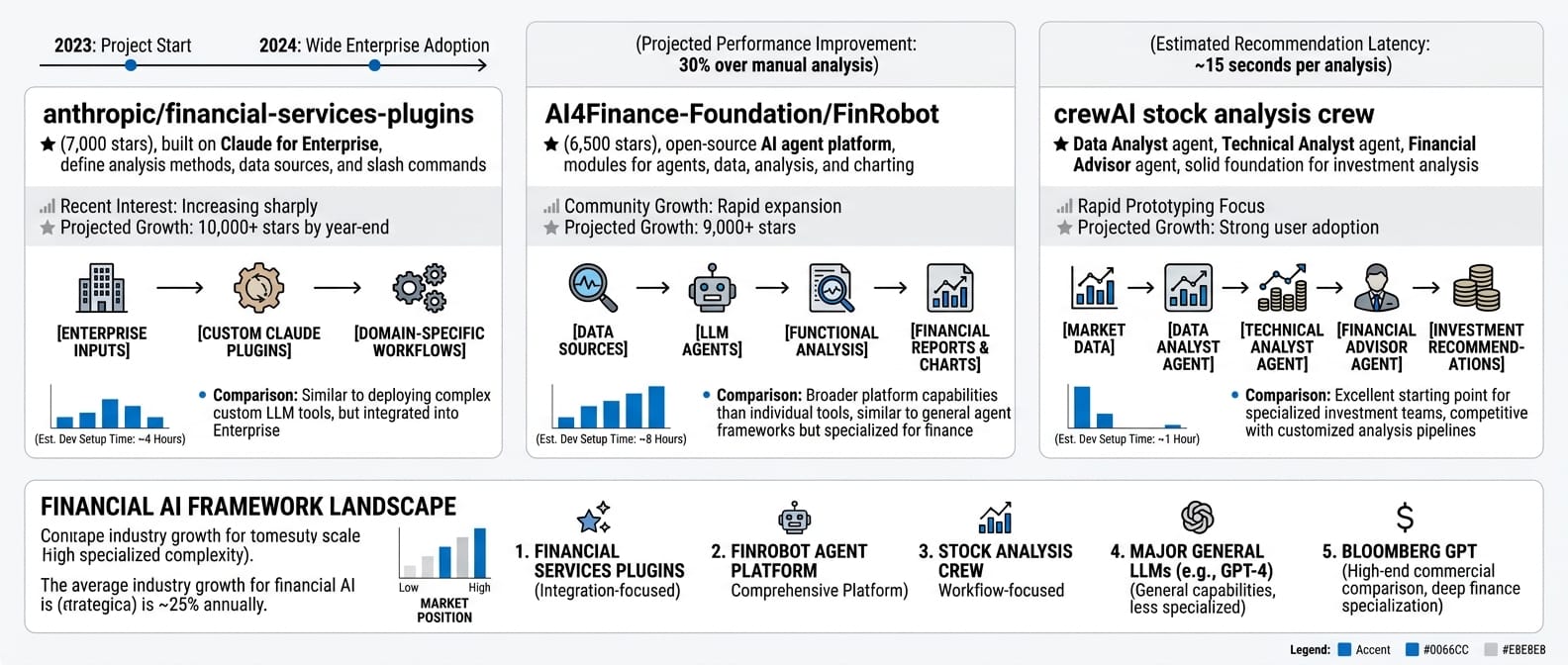
anthropics/financial-services-plugins (7,000 stars). Anthropic's own financial analysis plugins, built on Claude for Enterprise. Define how a firm does analysis, what data sources to query, and what slash commands to expose. Custom financial workflows with domain-specific commands.
-
AI4Finance-Foundation/FinRobot (6,500 stars). Contains: an open-source AI agent platform for financial analysis using LLMs. Modules for agents, data sources, functional analysis, and charting. More of a platform than a template, but the agent definitions and data source configurations serve as starting points for financial workflows.
-
CrewAI stock analysis crew (crewAI-examples/stock_analysis_crew). Contains: Data Analyst agent (fetches financial data via yfinance), Technical Analyst agent (price patterns), Financial Advisor agent (synthesizes recommendations). A solid foundation for investment analysis and due diligence workflows.
DevOps and SRE
Infrastructure teams were early adopters of AI agents. Alert fatigue, runbook execution, and incident investigation are natural fits for agents that can query Prometheus, read logs, and run kubectl.
-
robusta-dev/robusta (2,400 stars). Contains: Kubernetes alert enrichment and automated remediation engine. A playbooks system (YAML + Python) triggers AI investigation on Prometheus alerts, summarizes findings, and posts to Slack. Production-grade with real adoption.
-
unskript/Awesome-CloudOps-Automation (2,100 stars). Contains: 200+ Python scripts and Jupyter-based xRunBooks for AWS, GCP, Kubernetes, PostgreSQL. Each runbook is parameterized and executable. LLM-integrated execution layer available.
-
HolmesGPT/holmesgpt (1k+ stars). Contains: CNCF Sandbox SRE agent that connects to Prometheus, PagerDuty, and Kubernetes. Investigates alerts, fetches logs, runs kubectl commands, and looks up runbooks. Answers questions about infrastructure health in natural language.
Sales
-
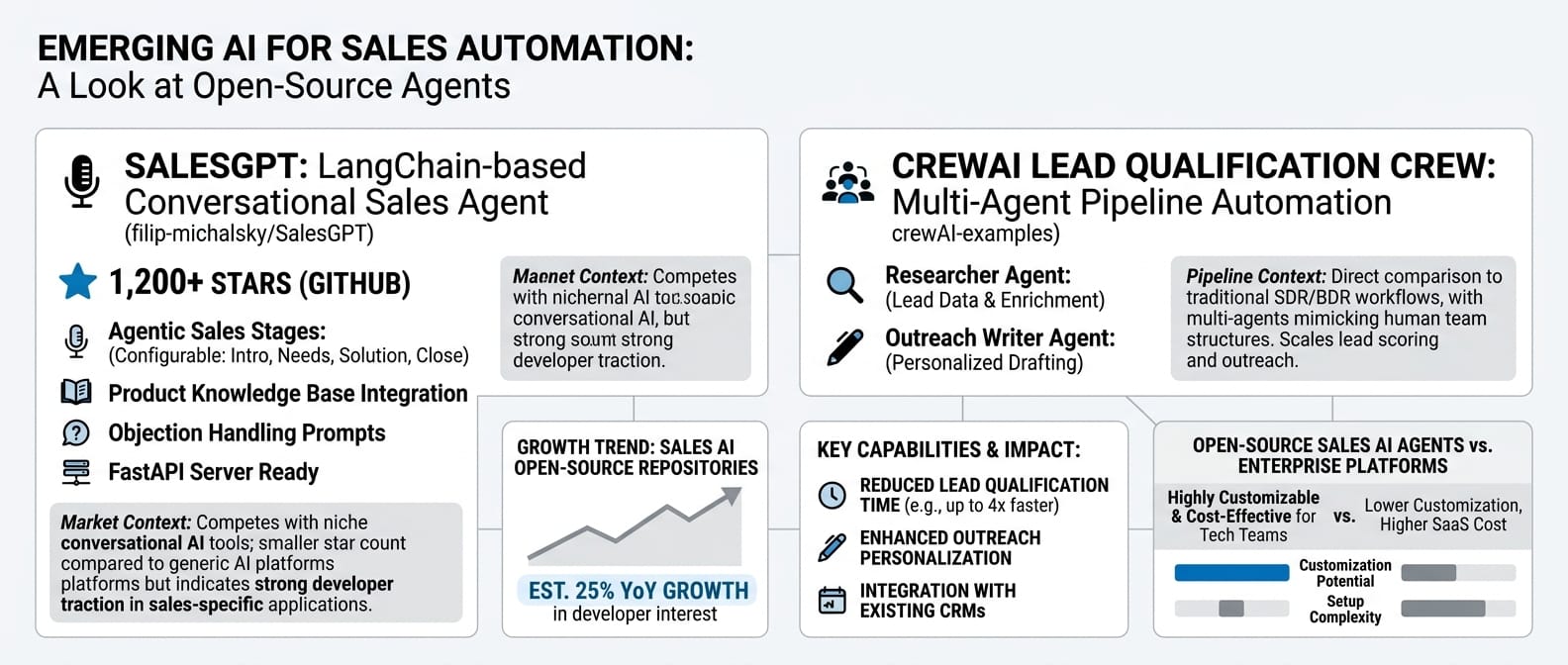
filip-michalsky/SalesGPT (1,200 stars). Contains: LangChain-based conversational sales agent with configurable sales stages (intro, needs analysis, solution presentation, close), product knowledge base, objection-handling prompts, FastAPI server. Ready to fork and customize.
-
CrewAI lead qualification crew (in crewAI-examples). Contains: researcher + outreach writer agents for pipeline automation. Directly usable for lead scoring and personalized outreach workflows.
HR and recruiting
-
drukpa1455/crewai-job (16 stars). Contains: CrewAI + LangChain job application automation. Customizes CVs and cover letters per job description. Small but demonstrates the pattern: AI agents that understand recruiting workflows.
-
CrewAI recruitment crew (community examples in awesome-crewai). Contains: Recruiter agent for sourcing, Screening agent for resume filtering, Interviewer agent for initial screenings. The pattern works, but production use requires careful PII handling and tool authentication.
AI development setup
Setting up AI configuration for a project has four parts. Templates and examples exist for each of them in the registries and starter setups below. Pick what fits, point your GenAI tool at this section, and let it stitch everything together for you during project setup.
CLAUDE.md (or equivalent): the project context file your AI reads at session start. Templates below cover every major stack.
Skills: domain knowledge and reusable workflows. The registries below have thousands, organized by domain and tool.
MCP integrations: connections to the tools the project actually uses. Database, deployment platform, project management, APIs.
Hooks: quality gates that run automatically. Lint before commit, run tests before push, check for secrets.
Don't wait until the setup feels perfect. Even a basic CLAUDE.md with three lines about the stack makes the AI faster on the first prompt. Build from there.
Template registries
These are the largest collections. Browse, pick components, install what fits.
-
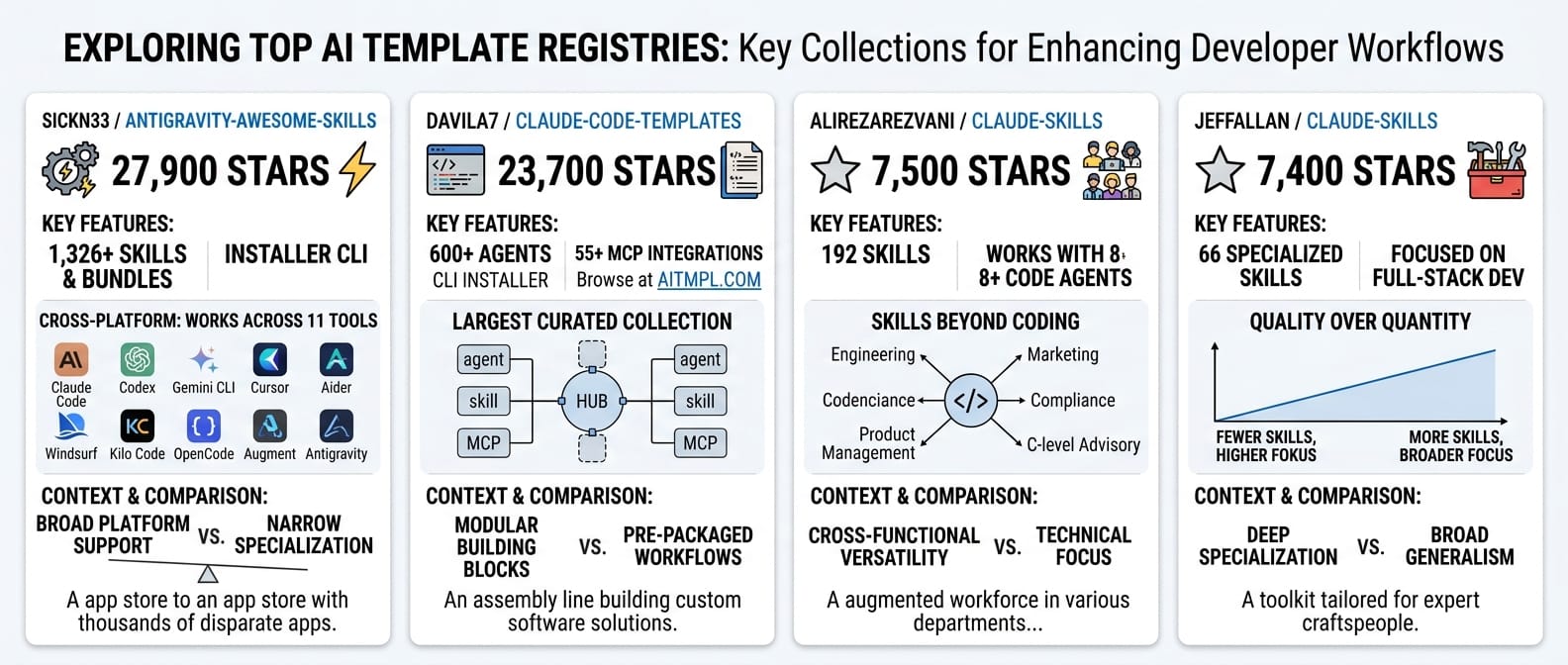
sickn33/antigravity-awesome-skills (27,900 stars). 1,326+ skills with installer CLI. The key feature: cross-platform. Works across 11 tools: Claude Code, Codex, Gemini CLI, Cursor, Aider, Windsurf, Kilo Code, OpenCode, Augment, and Antigravity. Bundles and workflows for common development patterns.
-
davila7/claude-code-templates (23,700 stars). The largest curated collection. 600+ agents, 55+ MCP integrations, CLI installer. Browse at aitmpl.com. Install individual components: pick an agent for frontend work, a skill for TDD, an MCP for database access. Mix and match.
-
alirezarezvani/claude-skills (7,500 stars). 192 skills that go beyond coding: engineering, marketing, product management, compliance, C-level advisory. Works with 8+ code agents. Useful for teams where AI assists with more than just code.
-
Jeffallan/claude-skills (7,400 stars). 66 specialized skills for full-stack developers. More focused than alirezarezvani's collection. Quality over quantity.
Full starter setups
Full configurations that set up an entire AI development environment.
-
affaan-m/everything-claude-code (112,500 stars). The most starred AI development setup. Contains: skills, instincts (behavioral patterns), memory system for context persistence, security configs, research-first development patterns. Works across Claude Code, Codex, OpenCode, Cursor. Tuned for agent harnesses. 997 internal tests passing across all supported platforms.
-
FlorianBruniaux/claude-code-ultimate-guide (2,300 stars). Contains: production-ready templates for every Claude Code feature, CLAUDE.md examples for different stacks (DevOps/SRE, frontend, backend), quizzes, and a cheatsheet. Equal parts guide and template collection.
-
centminmod/my-claude-code-setup (2,100 stars). Contains: CLAUDE.md structured as a memory bank system, shared config templates, context persistence across sessions. Practical approach to the "context loss between sessions" problem.
-
Matt-Dionis/claude-code-configs (624 stars). Contains: a real developer's personal config collection. Not polished for distribution, which is exactly why it's useful. Shows how someone actually structures their AI setup day-to-day.
-
bhancockio/claude-crash-course-templates (337 stars). Contains: project blueprint generator. Answer questions about the app, get a masterplan.md that serves as the project roadmap.
-
TheDecipherist/claude-code-mastery-project-starter-kit (259 stars). Contains: step-by-step project starter that teaches how to think about agent configuration. More pedagogical than practical. Good for teams adopting AI-assisted development for the first time.
-
abhishekray07/claude-md-templates (106 stars). Contains: CLAUDE.md files for Next.js/TypeScript, Python/FastAPI, and generic stacks. Copy-paste starting points. The fastest way to add AI configuration to an existing project.
Agent infrastructure
Agent orchestration
For building complex multi-agent workflows, not just single-assistant setups.
-
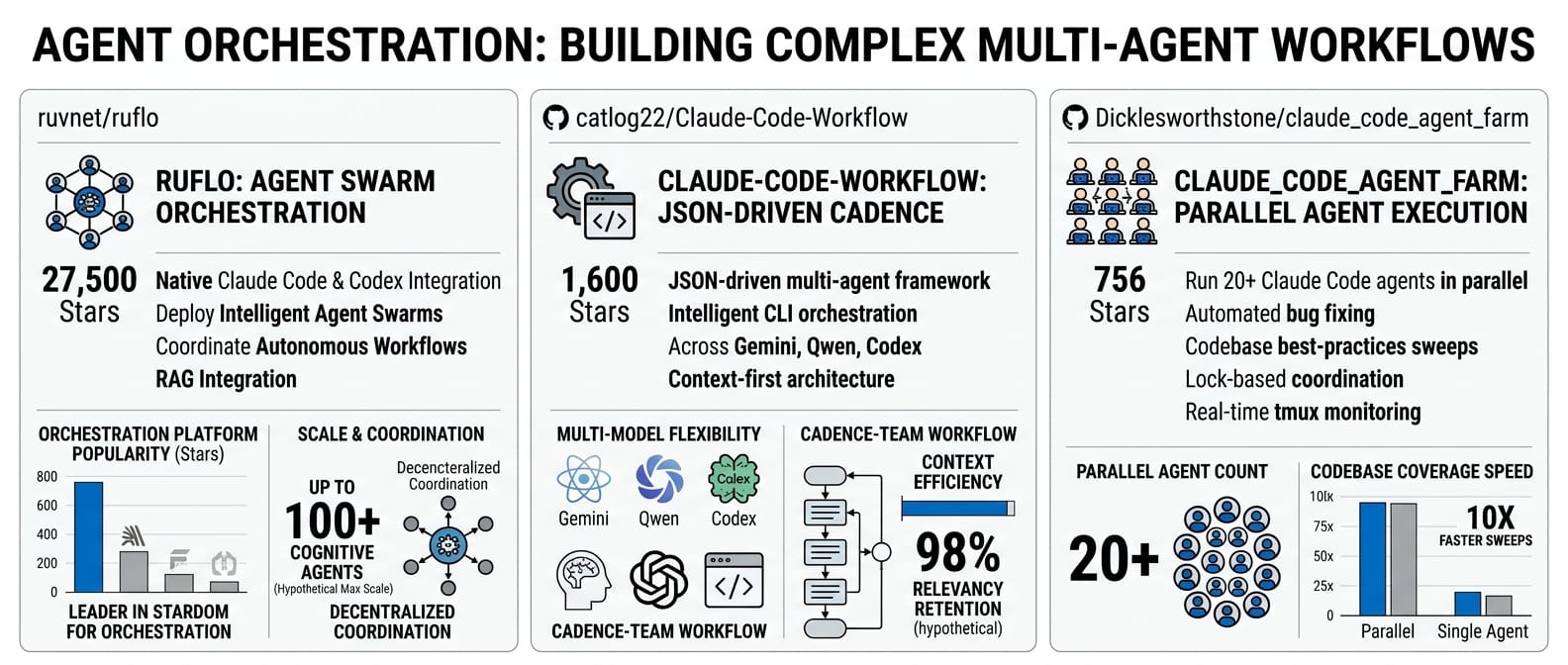
ruvnet/ruflo (27,500 stars). Multi-agent orchestration platform. Deploy intelligent agent swarms, coordinate autonomous workflows, RAG integration. Native Claude Code and Codex integration.
-
catlog22/Claude-Code-Workflow (1,600 stars). JSON-driven multi-agent cadence-team framework. Intelligent CLI orchestration across Gemini, Qwen, and Codex. Context-first architecture.
-
Dicklesworthstone/claude_code_agent_farm (756 stars). Run 20+ Claude Code agents in parallel. Automated bug fixing, best-practices sweeps across a codebase, lock-based coordination, real-time tmux monitoring. For when one agent isn't enough.
Multi-agent framework templates
A different kind of AI template: starter projects for multi-agent systems. These give you pre-wired agents, task structures, and tool integrations for specific frameworks.
Multi-agent frameworks are verbose. CrewAI needs YAML configs. AutoGen needs message routing. LangGraph needs state graphs. Each framework has its own ceremony. The fastest path to production starts from a working template.
CrewAI
CrewAI works best for role-based agent teams. Define agents by job title and expertise (Researcher, Writer, Analyst), assign tasks, let them collaborate. The YAML-based configuration makes it easy to swap agents and tasks without touching code.
-
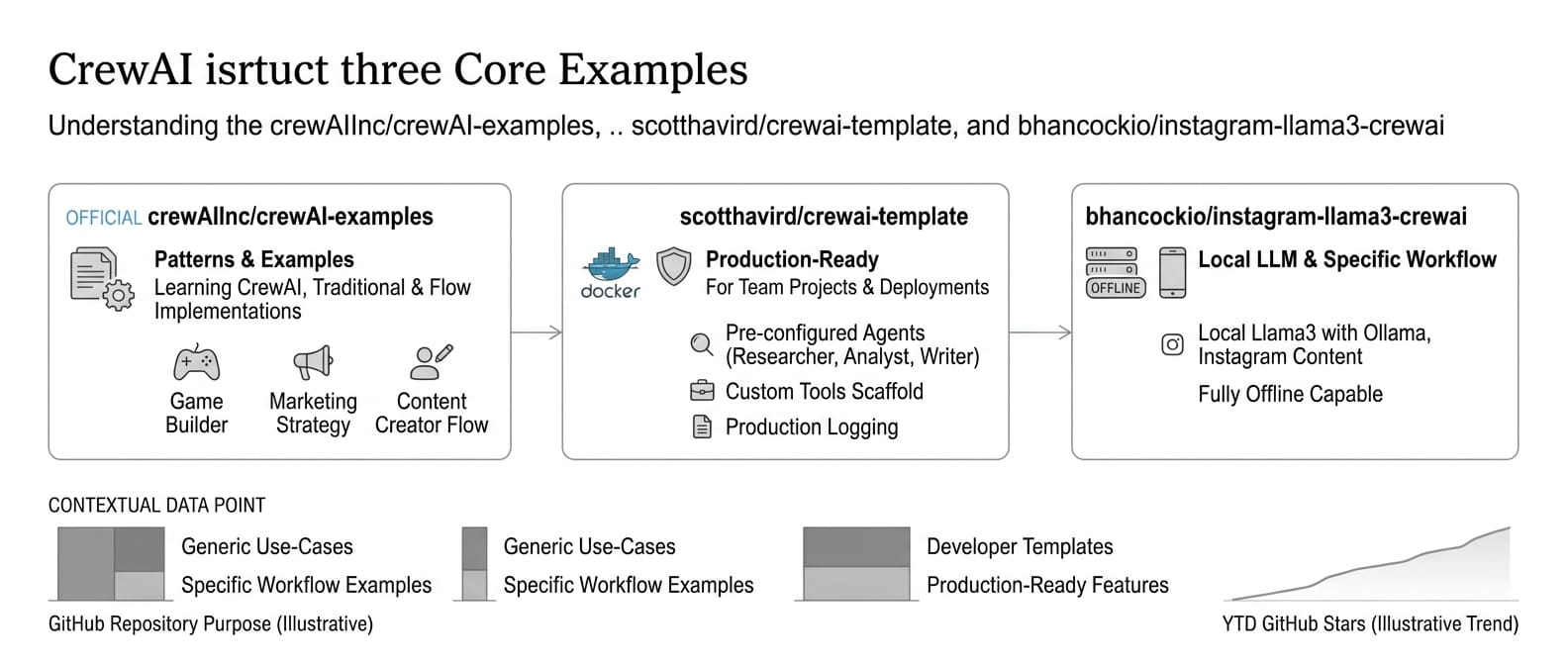
crewAIInc/crewAI-examples. Contains: official collection of complete CrewAI applications. Flow examples (Content Creator, Email Auto Responder, Lead Score) and traditional Crew implementations (Game Builder, Instagram Post, Landing Page Generator, Marketing Strategy). The starting point for learning CrewAI patterns.
-
scotthavird/crewai-template. Contains: Docker Compose setup, pre-configured agents (Researcher, Analyst, Writer), custom tools scaffold, production-ready logging and error handling. For team projects and production deployments.
-
bhancockio/instagram-llama3-crewai. Contains: local LLM setup with Ollama, Instagram content workflow. Fully offline capable. For privacy-first builds and local model experimentation.
AutoGen
AutoGen excels at conversational agent systems where agents talk to each other (and humans) to solve problems. Strong for coding tasks, back-and-forth debugging, and scenarios where agents critique and refine each other's work. Microsoft built it for research.
-
microsoft/autogen (56,300 stars). Contains: 30+ Jupyter notebook examples covering coding agents, group chat, nested conversations, RAG, multi-modal. AutoGen 0.4 introduced cleaner abstractions and better tool support. Also includes AutoGen Studio, a no-code GUI for drag-drop agent creation and visual workflow building.
-
AG2 (github.com/ag2ai/ag2) is a community fork with additional features.
LangGraph
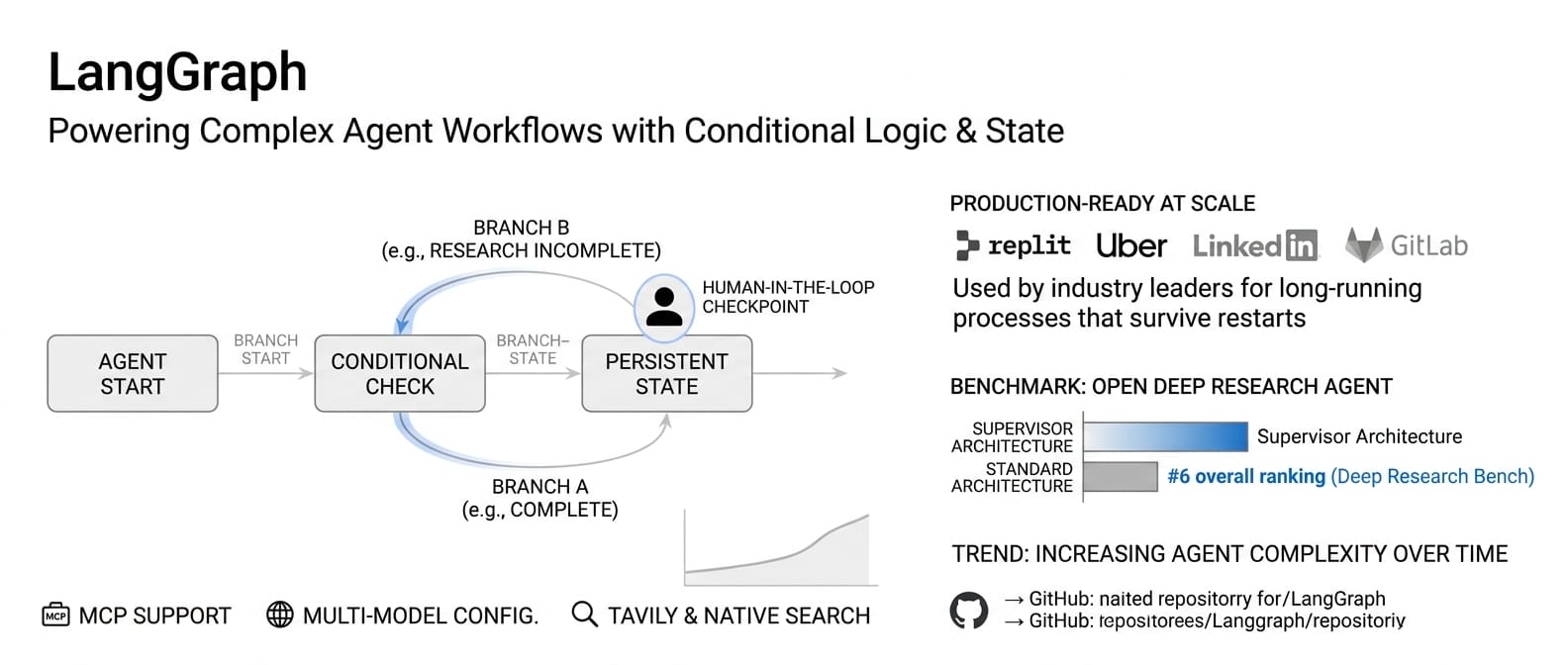
LangGraph handles complex workflows with branching logic, cycles, and persistent state. The right choice when workflows have conditionals ("if the research is incomplete, search again"), human-in-the-loop checkpoints, or long-running processes that need to survive restarts. Used by Replit, Uber, LinkedIn, and GitLab in production.
-
langchain-ai/langgraph-example. Contains: reference implementation for LangGraph Cloud deployment, state management patterns, production architecture.
-
langchain-ai/open_deep_research. Contains: full research agent with supervisor architecture. A supervisor coordinates multiple research sub-agents, each focused on a specific subtopic. Configurable models, MCP support. Benchmarked on Deep Research Bench (ranked #6 overall). Works with Tavily and native web search for Anthropic/OpenAI. The best starting point for research workflows and report generation.
Framework-agnostic
-
geekan/MetaGPT (61,000+ stars). Contains: a multi-agent system that simulates an entire software company. Give it a one-line requirement ("Create a 2048 game") and it produces user stories, competitive analysis, system design, API specs, and working code. Agents play roles (Product Manager, Architect, Engineer) following standardized operating procedures. For automated software generation from requirements.
-
NirDiamant/GenAI_Agents (20,800 stars). Contains: 40+ tutorials as Jupyter notebooks covering basic agents, tool use, memory systems, multi-agent coordination, MCP integration, and business use cases. Compares approaches across frameworks. Not a framework, but the best learning resource for understanding agent patterns before picking a stack. Also see agents-towards-production for production-focused tutorials on observability, deployment, security, and scaling.
TypeScript
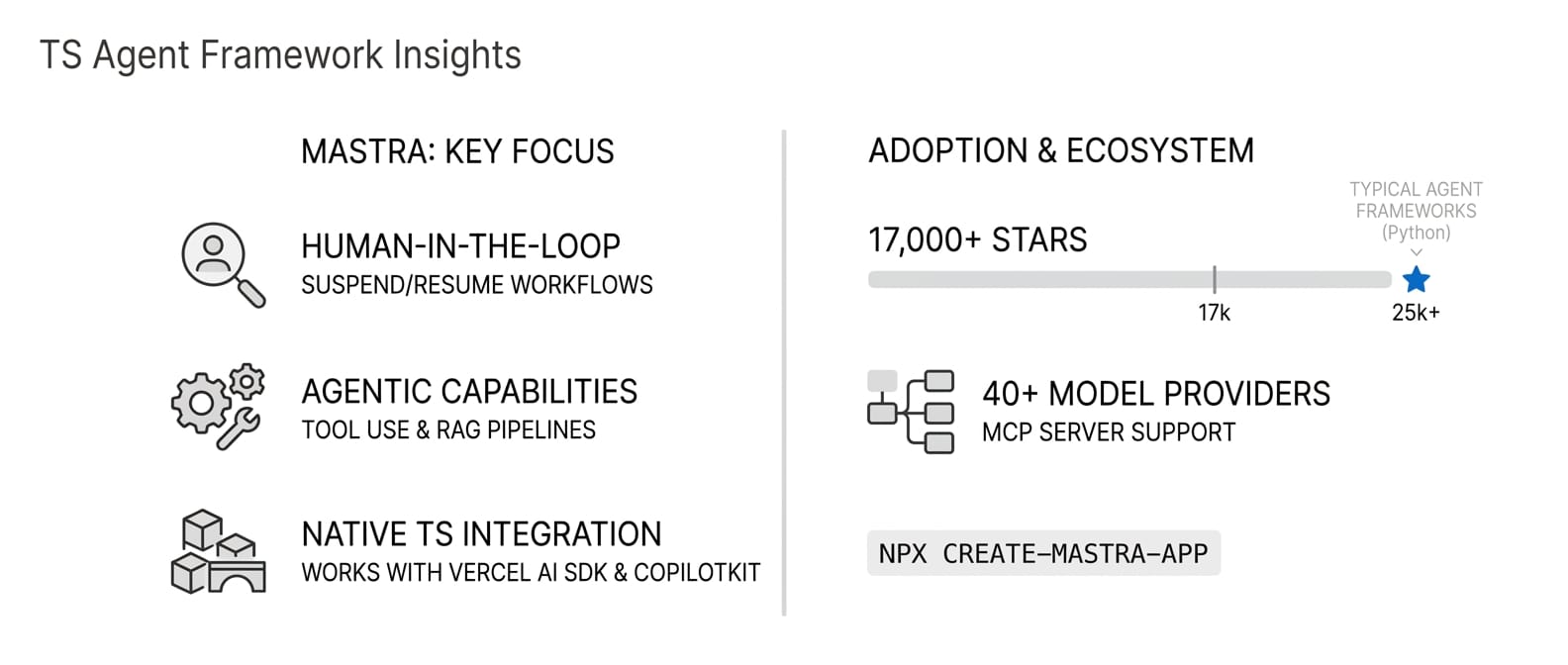
- mastra-ai/mastra (17,000+ stars). Contains: TypeScript-native agent framework from the team that built Gatsby. Agents with tool use, workflows that suspend/resume (for human-in-the-loop), built-in RAG pipelines, 40+ model providers, MCP server support, local playground, evals and observability. Integrates with Vercel AI SDK and CopilotKit. For TypeScript teams that want to build agents without switching to Python.
npx create-mastra-appscaffolds a new project.
Which framework for which problem
| Problem | Framework | Why |
|---|---|---|
| Agents with clear roles (Researcher, Writer, Editor) | CrewAI | YAML config, role-based collaboration |
| Agents that debug and refine through conversation | AutoGen | Conversational iteration, coding tasks |
| Complex branching logic with human checkpoints | LangGraph | Explicit state machines, retries, persistence |
| Generate complete software from a description | MetaGPT | SOP-driven multi-role pipeline |
| TypeScript team, React/Next.js stack | Mastra | Type-safe, deploys alongside web apps |
| Learning how all of this works first | GenAI_Agents | 40+ tutorials comparing frameworks |
Local model support
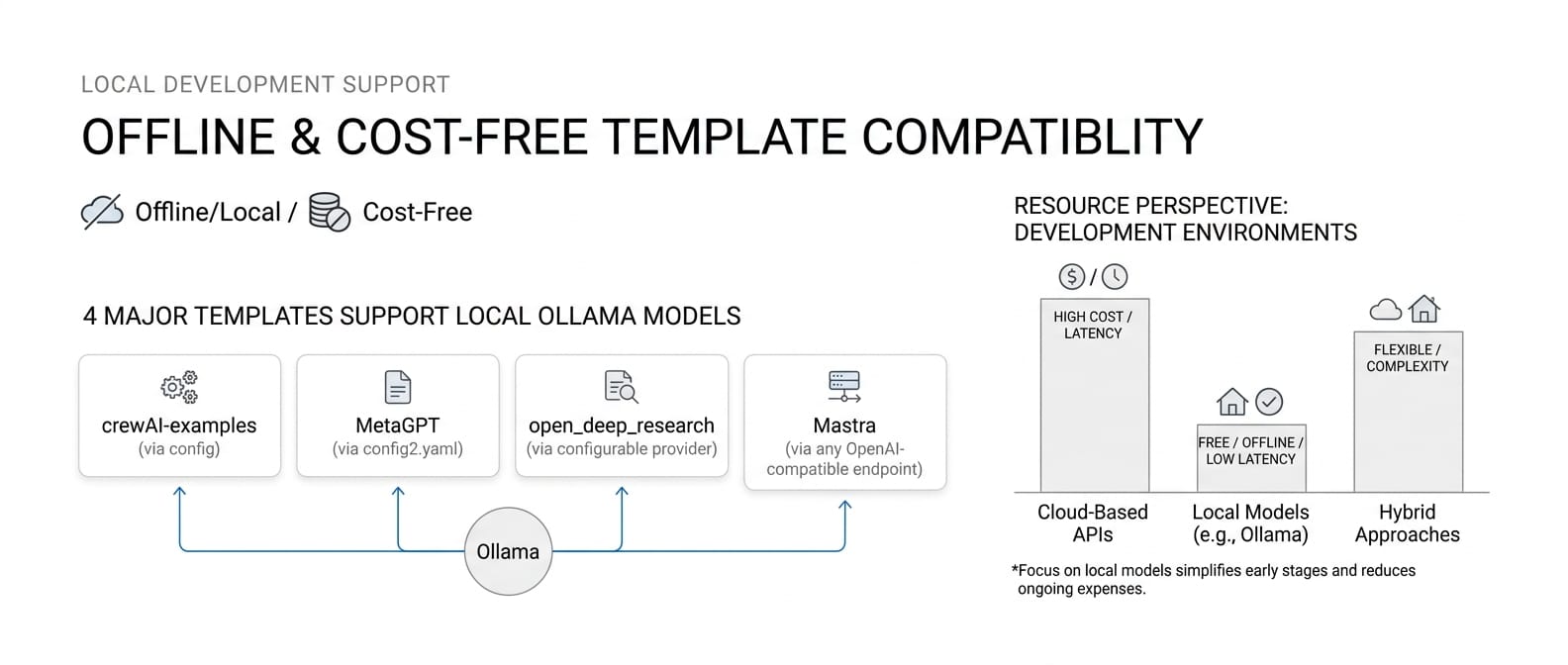
These templates work with Ollama for offline or cost-free development:
- crewAI-examples via config
- MetaGPT via config2.yaml
- open_deep_research via configurable LLM provider
- Mastra via any OpenAI-compatible endpoint
Curated lists
Starting points for finding more AI templates and components.
-
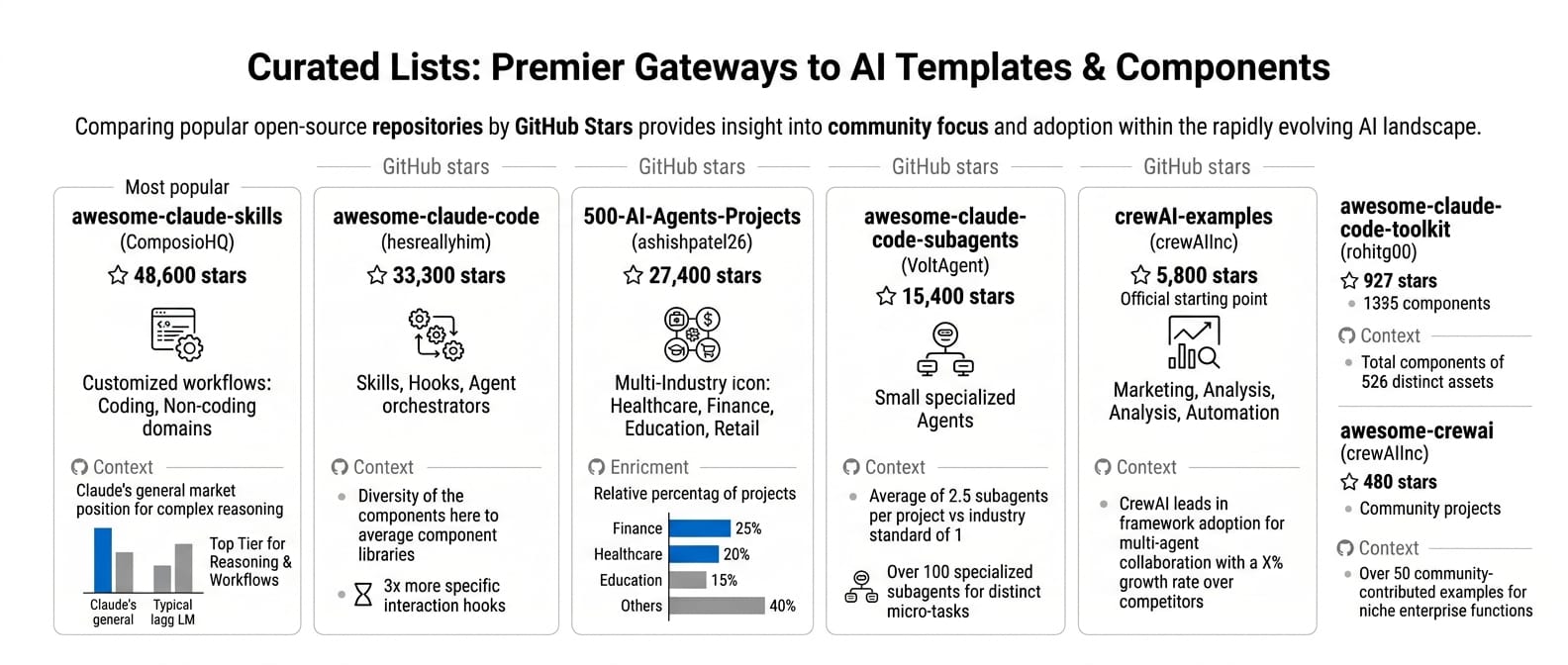
ComposioHQ/awesome-claude-skills (48,600 stars). Curated list of Claude skills, resources, and tools for customizing workflows. Covers coding and non-coding domains.
-
hesreallyhim/awesome-claude-code (33,300 stars). Skills, hooks, slash commands, agent orchestrators, applications, and plugins.
-
ashishpatel26/500-AI-Agents-Projects (27,400 stars). 500 AI agent use cases across healthcare, finance, education, retail, and more. Links to open-source implementations. The broadest cross-industry directory.
-
VoltAgent/awesome-claude-code-subagents (15,400 stars). 100+ specialized subagents covering research, analysis, development, and domain-specific tasks.
-
crewAIInc/crewAI-examples (5,800 stars). Official CrewAI examples: marketing strategy, stock analysis, game builder, content creation, email automation, lead scoring. The starting point for CrewAI domain templates.
-
rohitg00/awesome-claude-code-toolkit (927 stars). 135 agents + 35 skills + 42 commands + 150 plugins + 19 hooks + 15 rules + 7 templates + 8 MCP configs.
-
crewAIInc/awesome-crewai (480 stars). Community-built CrewAI projects across multiple domains. Good for finding niche use cases.
Where the gaps are
Marketing and SEO have the most mature non-coding templates. Financial analysis is emerging. Academic research has a few strong examples.
Still missing: legal (contract review, compliance checking, regulatory analysis), accounting (bookkeeping workflows, audit procedures, tax prep), consulting (discovery frameworks, deliverable templates, pricing models), project management (sprint planning, retrospectives, status reporting), and education (course creation, curriculum design, assessment generation).
The pattern is clear: domains where errors are expensive (legal, finance, accounting) lag behind domains where errors are cheap (marketing, content). The high-stakes domains will get there, but with more human-in-the-loop checkpoints built into the templates.