Anthropic's New 'Cowork' Feature Signals Where Enterprise AI Agents Are Actually Heading
The Real Significance of Anthropic's Cowork Launch
Anthropic didn't set out to build Cowork. They stumbled onto it.
When Claude Code launched, Anthropic expected developers to use it for what the name suggested: coding. But something strange showed up in the usage data. Engineers were using this terminal-based coding tool to do... everything else.
They were asking Claude Code to research competitors. To summarize long documents. To search the web and synthesize findings. To draft emails and organize information. Developers had discovered that an AI agent with autonomy and persistence was more valuable for general knowledge work than the chat-based Claude interface they were "supposed" to use for those tasks.
Anthropic was watching users route around their own product design. That's the kind of signal you don't ignore.
From Accident to Strategy
Cowork is Anthropic's response: take what developers accidentally discovered and build it intentionally for everyone. Strip away the terminal interface and coding orientation. Keep the autonomous, persistent, tool-using agent architecture. Package it for knowledge workers who've never opened a command line.
But here's what makes this genuinely significant: Anthropic learned something about human-AI interaction that their competitors haven't figured out yet.
The lesson wasn't about features. It was about mode of engagement. Users don't want a smarter search engine. They don't want a better Q&A bot. They want something that can take a problem, go away, work on it, and come back with something useful, the way a human colleague would.
Chat interfaces, no matter how sophisticated the underlying model, trap users in a ping-pong dynamic. You prompt. AI responds. You prompt again. The human remains the project manager, the synthesizer, the one holding context across turns. That's exhausting.
Claude Code users discovered that an agent architecture, even one designed for coding, freed them from that burden. They could say "figure this out" and actually step away. The AI maintained context, made intermediate decisions, used tools, and produced integrated output.
Cowork is Anthropic betting that this mode of interaction is what knowledge workers actually need.
The Economics of Synthesis
Here's where the strategic implications get interesting.
Knowledge work, at its core, is synthesis. You gather inputs from multiple sources, identify patterns, make connections, and produce outputs that are more valuable than the sum of their parts. A market analysis synthesizes competitor data, customer feedback, and industry trends. A legal brief synthesizes case law, statutes, and facts. A product spec synthesizes user research, technical constraints, and business requirements.
For decades, we've built tools to make parts of this process faster. Better search engines. Smarter databases. Faster communication. But the synthesis step, the part where a human brain integrates everything into coherent output, remained stubbornly manual.
Cowork attacks the synthesis bottleneck directly.
An autonomous agent that can search the web, pull from documents, cross-reference sources, and produce integrated analysis doesn't just speed up research. It potentially commoditizes an entire category of professional work: the "gather and organize" labor that junior analysts, associates, and researchers have always done.
This isn't speculative. Early Claude Code users were already treating the tool this way, offloading the synthesis work that used to require human attention.
What Anthropic Understands That Others Don't
The $20/month Pro subscription pricing looks accessible, but what Anthropic is actually buying is high-quality training data from serious users solving real problems.
The people who subscribe and actively use Cowork will be professionals with genuine synthesis-heavy workflows, exactly the users whose interaction patterns Anthropic needs to study.
Every Cowork session generates data about how humans want to collaborate with AI. What tasks they delegate. Where they set guardrails. When they intervene. What output formats they find useful. What causes them to lose trust. What builds it back.
This is proprietary research that competitors can't easily replicate. OpenAI and Google have more users, but those users are mostly chatting. Anthropic is building a dataset of agentic collaboration patterns, a different kind of signal that may prove more valuable as AI capabilities advance.
The Competitive Implications
OpenAI already tried this. Their Operator agent, the browser-based autonomous assistant, was supposed to be the breakthrough product for agentic AI. But Operator felt clunky, limited in scope, and never quite delivered on the promise of an AI that could truly work independently on complex tasks.
Cowork is a different level entirely.
Where Operator struggled with basic web navigation and task completion, Cowork integrates autonomous browsing as just one capability within a broader synthesis engine. The difference isn't incremental. It's architectural.
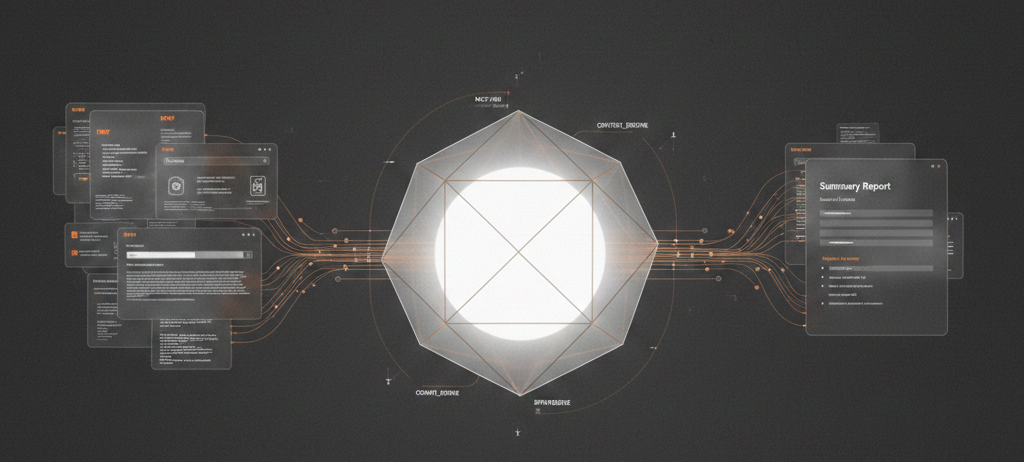
This is where Cowork's browser MCP (Model Context Protocol) becomes significant. MCP provides a standardized way for Claude to interact with external tools and data sources, including web browsers. Rather than building brittle, task-specific browser automation, Anthropic created a protocol layer that allows Claude to use browsing the way a human would: as one tool among many in service of a larger goal.
The browser MCP means Cowork can seamlessly move between searching the web, reading documents, querying databases, and synthesizing findings, all within a single coherent workflow. It's not "browser agent" or "document agent" or "research agent." It's an agent that uses whatever tools the task requires, with the browser being just one instrument in the orchestra.
This architectural advantage compounds over time. As more MCP integrations are built, connecting to internal company tools, specialized databases, and APIs, Cowork becomes more capable without Anthropic having to build each integration themselves. They've created a platform, not just a product.
OpenAI now faces an uncomfortable choice: try to catch up on the protocol layer (which takes time and ecosystem buy-in), or continue building one-off integrations that will always feel more limited than Anthropic's approach.
The more interesting question is what happens to the broader software ecosystem. How many B2B SaaS products exist primarily to help knowledge workers synthesize information? Competitive intelligence tools. Research platforms. Analytics dashboards. Report generators.
If AI agents can handle synthesis autonomously, the value proposition of these tools shifts dramatically. They either become data sources that agents query, or they become obsolete. There's not much middle ground.
The Organizational Challenge
Here's what most analysis of Cowork misses: the technology isn't the hard part anymore.
The hard part is organizational. Most companies have no idea how to work with AI rather than just use it. They lack frameworks for:
- Task decomposition: What work should humans do versus delegate to AI?
- Guardrail design: What boundaries define the AI's autonomous scope?
- Verification practices: How do you check AI work without redoing it?
- Trust calibration: When should you trust AI output, and when should you verify?
These aren't technical questions. They're management questions, workflow questions, organizational design questions. And most companies haven't even started thinking about them.
The organizations that develop these muscles now, while the stakes are relatively low and the technology is still emerging, will have a massive advantage when agentic AI becomes table stakes. They'll have institutional knowledge that can't be acquired quickly.
The organizations that wait will find themselves trying to learn basic collaboration patterns while competitors are already optimizing advanced workflows.
The Window Is Closing
Cowork is a research preview. It's Mac-only, subscription-only, and explicitly experimental. Most companies will ignore it, waiting for the polished version.
That's a mistake.
The value isn't in the tool itself. It's in learning how human-AI collaboration actually works in your specific context. What tasks can you delegate? Where do you need human judgment? How do you verify output efficiently? These answers are organization-specific, and discovering them takes time.
Eighteen months from now, agentic collaboration will be a standard capability across multiple AI platforms. The companies that experimented early will know exactly how to deploy it. The companies that waited will be starting from scratch while competitors operate at a different speed.
The insight that matters: Anthropic stumbled onto Cowork by watching what users actually did with Claude Code. The users who experiment with Cowork now will stumble onto workflow innovations that become their competitive advantage later.
The question isn't whether to pay attention to Cowork. It's whether your organization is building the observational muscle to learn from what your people discover when they use it.
Source: The Verge