Boilerplate template library: clone and start working with the right structures in place
Every project starts at zero. Getting from 0 to 0.3 (the structure, the wiring, the boilerplate) shouldn't take hours. It should take minutes. That's true whether the project is a marketing campaign, a financial model, a contract review workflow, a SaaS app, or a DevOps pipeline.
A good template gives your GenAI tool something real to work with from the first prompt. Not a blank folder. A working structure with auth, routing, database, CI, and deployment already wired. The AI reads the codebase, understands the patterns, and starts producing useful output immediately instead of guessing at conventions.
This guide is a library. Point Claude Code, Codex, Cursor, Gemini CLI, or any AI assistant at it and find the template that fits the outcome you need. Every entry is real, linked, and verified. Each section starts with what matters for that category, then lists specific templates and what they actually contain.
The catch: there are thousands of templates on GitHub. Most are abandoned after a conference talk, half-finished after a weekend hackathon, or built for a tutorial that was never updated past v1. The ones listed here passed the filter.
Business software
SaaS starters
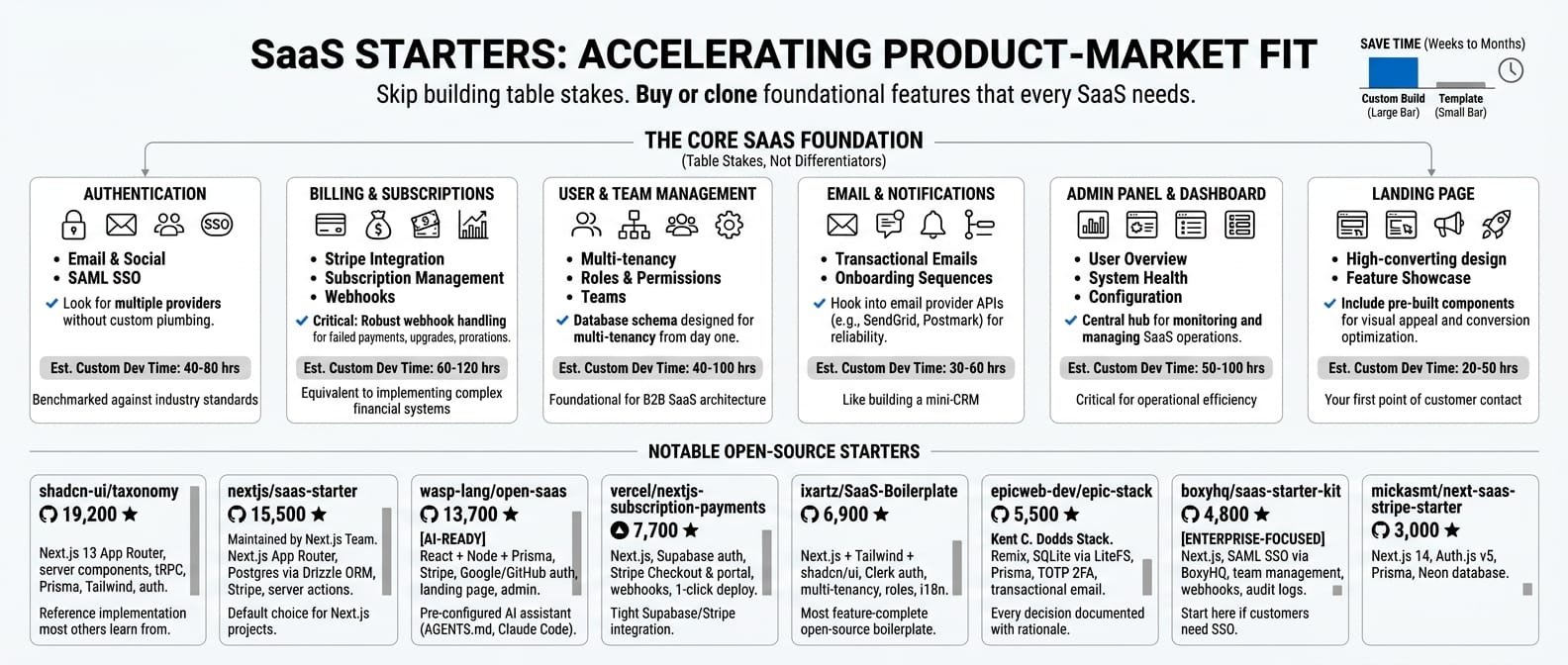
A good SaaS template saves you the most time of any category. The reason: every SaaS app needs the same foundation. Auth (email, social, SSO). Billing (Stripe integration, subscription management, webhooks). User management (teams, roles, permissions). Email (transactional, onboarding sequences). Landing page. Admin panel. These are table stakes, not differentiators.
What to look for: Stripe webhook handling that covers edge cases (failed payments, subscription upgrades, prorations). Auth that supports multiple providers without custom plumbing. A database schema that handles multi-tenancy from day one, not bolted on later.
-
shadcn-ui/taxonomy (19,200 stars). Contains: Next.js 13 App Router, server components, tRPC, Prisma, Tailwind, auth. Not a SaaS template, but the reference implementation most other Next.js starters learn from. Study this even if you don't clone it.
-
nextjs/saas-starter (15,500 stars). Maintained by the Next.js team. Contains: Next.js App Router, Postgres via Drizzle ORM, Stripe billing with webhook handlers, shadcn/ui components, server actions for mutations. The default choice for Next.js SaaS projects.
-
wasp-lang/open-saas (13,700 stars). [AI-ready] Contains: React + Node + Prisma, Stripe and Polar.sh payments, Google/GitHub/email auth, landing page, admin dashboard, email sending via provider hooks, background jobs, S3 file upload. Ships with
AGENTS.mdand a Claude Code plugin. One of the few SaaS starters where the AI assistant is pre-configured for the codebase. -
vercel/nextjs-subscription-payments (7,700 stars). Contains: Next.js, Supabase auth, Stripe Checkout and customer portal, webhook handling, one-click Vercel deploy. Vercel's official subscription starter. Tight integration between Supabase and Stripe.
-
ixartz/SaaS-Boilerplate (6,900 stars). Contains: Next.js + Tailwind + shadcn/ui, Clerk auth, Drizzle ORM across Postgres/SQLite/MySQL, multi-tenancy, roles and permissions, i18n, logging, testing. The most feature-complete open-source SaaS boilerplate.
-
epicweb-dev/epic-stack (5,500 stars). Contains: Remix, SQLite via LiteFS, Prisma, auth with TOTP 2FA, transactional email, image hosting, monitoring, error tracking. Kent C. Dodds' stack. Every decision is documented with rationale.
-
boxyhq/saas-starter-kit (4,800 stars). Contains: Next.js, SAML SSO via BoxyHQ, team management, webhooks, audit logs, directory sync. Enterprise-focused. Start here if your customers need SSO.
-
mickasmt/next-saas-stripe-starter (3,000 stars). Contains: Next.js 14, Auth.js v5, Prisma, Neon serverless Postgres, Stripe, admin panel with user roles. A lean option when you don't need the full enterprise feature set.
E-commerce
Headless commerce separates the storefront from the backend. The backend handles inventory, orders, and payments. The template gives you the storefront: product pages, cart, checkout, search.
What to look for: server-side rendering for SEO (product pages must be indexable). Cart state management that survives page refreshes. Checkout flow that handles Stripe/PayPal without custom integration. Image optimization (product images are the heaviest assets on any store).
-
vercel/commerce (14,000 stars). Contains: Next.js 14, App Router, multiple backend connectors (Shopify, Saleor, BigCommerce, Medusa), ISR for product pages, edge caching, image optimization via next/image. The reference headless storefront. Swap backends without rewriting the frontend.
-
Shopify/dawn (3,000 stars). Contains: Shopify Liquid templates, Online Store 2.0 sections, performance-optimized assets, accessibility built in. Shopify's own reference theme. If you sell on Shopify, start here and customize rather than building from scratch.
-
medusajs/nextjs-starter-medusa (2,700 stars). Contains: Next.js 15 storefront, Medusa v2 backend integration, cart, checkout, customer accounts, search. For teams that want full control over both frontend and backend (Medusa is open-source).
-
saleor/react-storefront (1,400 stars). Contains: Next.js App Router, GraphQL client for Saleor API, TypeScript, Tailwind, checkout with Stripe/Adyen. Strong typing end-to-end thanks to GraphQL codegen.
Admin dashboards
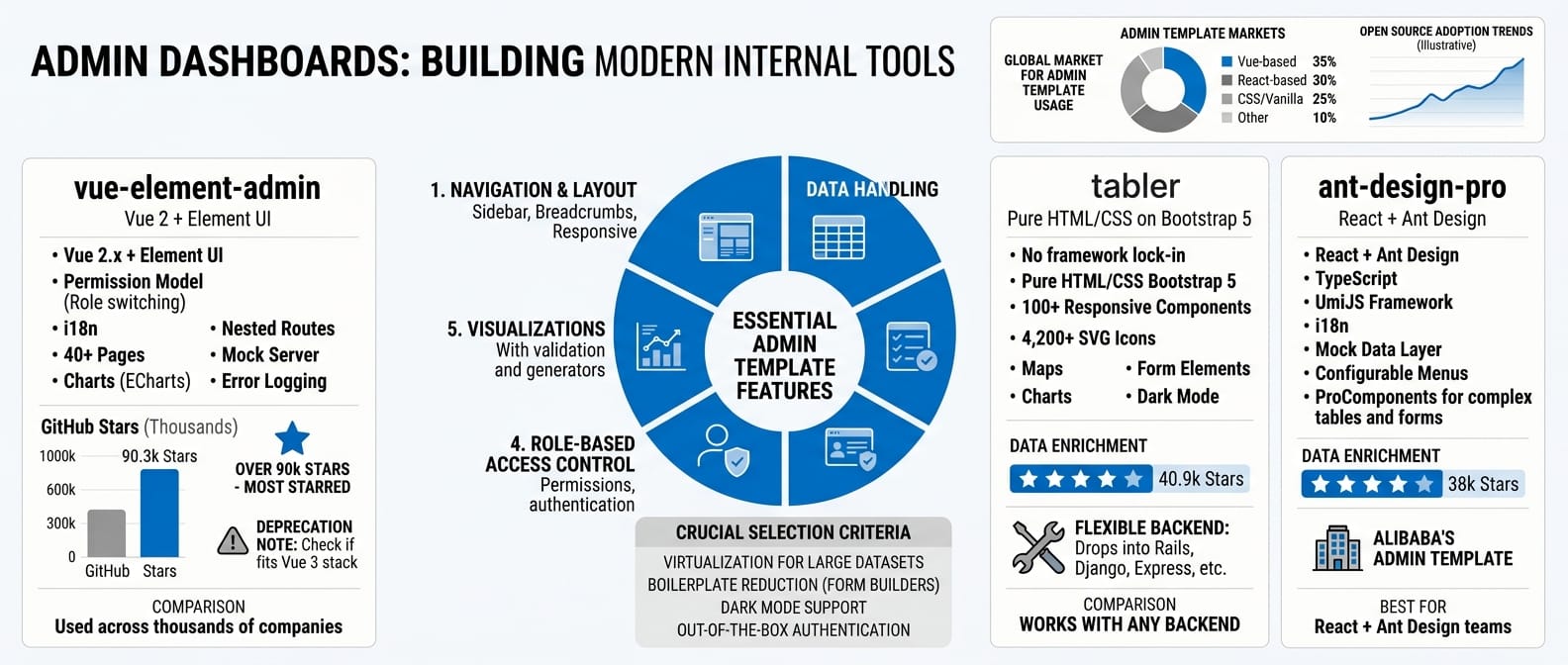
Internal tools don't need to be beautiful, but they need to be fast to build and easy to extend. A good admin template gives you: sidebar navigation, data tables with sorting/filtering/pagination, forms with validation, charts, role-based access control.
What to look for: table components that handle large datasets without custom virtualization. Form generators or builders that reduce boilerplate. Dark mode (developers stare at admin panels all day). An authentication layer that works out of the box.
-
PanJiaChen/vue-element-admin (90,300 stars). Contains: Vue 2 + Element UI, 40+ pages, permission model with role switching, i18n, charts (ECharts), nested routes, breadcrumbs, mock server, error logging. The most starred admin template on GitHub. Used across thousands of companies. Vue 2, so check if that fits your stack.
-
tabler/tabler (40,900 stars). Contains: pure HTML/CSS on Bootstrap 5, 100+ responsive components, 4,200+ SVG icons, maps, charts, form elements, dark mode. No framework lock-in. Works with any backend. Drop it into a Rails, Django, or Express app.
-
ant-design/ant-design-pro (38,000 stars). Contains: React + Ant Design, TypeScript, UmiJS framework, internationalization, mock data layer, layout system with configurable menus, ProComponents for complex tables and forms. Alibaba's admin template. Best choice for React teams already using Ant Design.
Knowledge management
Templates for personal and team knowledge systems.
-
voidashi/obsidian-vault-template (281 stars). Contains: two-level folder hierarchy, properties system, tagging conventions, daily notes, templates folder. A structured starting point for building a second brain in Obsidian.
-
gokhanarkan/minimal-second-brain (11 stars). [AI-ready] Contains: 3-folder Obsidian structure, MANIFEST.md with auto-update hooks for Claude/Copilot, automated maintenance. Small but notable: it shows how knowledge management templates are evolving to include AI agent configuration.
Software development
Frontend framework starters
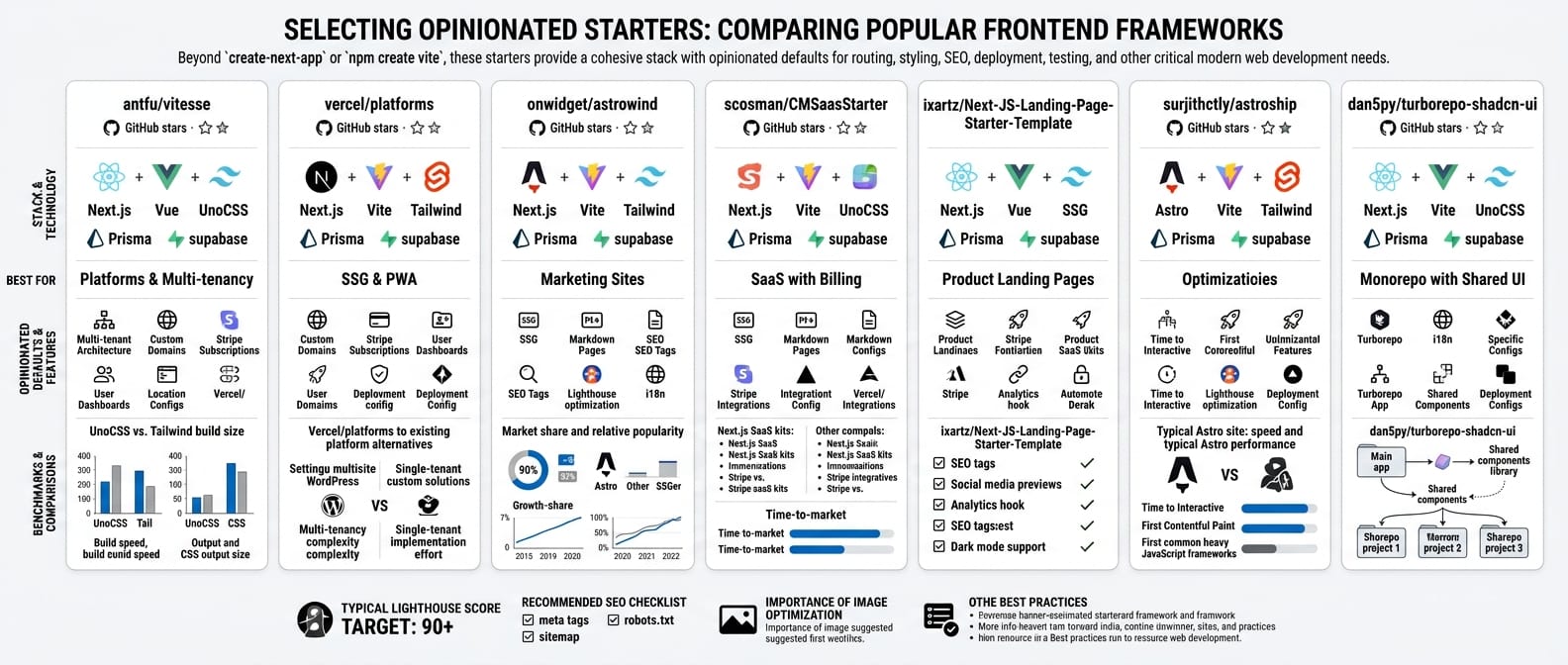
When create-next-app or npm create vite isn't enough. These starters add opinionated defaults: routing, styling, SEO, deployment configs, testing.
What to look for: SEO configuration (meta tags, sitemap, robots.txt). Image optimization. Analytics integration. Lighthouse score (the template should score 90+ out of the box). Mobile responsiveness.
-
antfu/vitesse (9,400 stars). Contains: Vue 3 + Vite, file-based routing, auto-imports, UnoCSS, SSG, PWA support, i18n, Markdown pages, Netlify/Vercel deploy configs. Anthony Fu's opinionated Vue stack. The default choice for Vue starters.
-
vercel/platforms (6,600 stars). Contains: Next.js, multi-tenant architecture with custom domains, user-generated content, Prisma, Vercel edge functions. The template for building platforms (your own Substack, Notion, or Hashnode).
-
onwidget/astrowind (5,500 stars). Contains: Astro 5, Tailwind, MDX blog, SEO tags, sitemap, responsive design, dark mode, analytics hooks. For marketing sites and landing pages.
-
scosman/CMSaasStarter (2,300 stars). Contains: SvelteKit + Tailwind + Supabase, auth (sign-up, OAuth, email verification), marketing pages, SEO blog, Stripe subscriptions, user dashboard, billing portal, Cloudflare Pages deployment. Perfect Google PageSpeed score. The SvelteKit equivalent of the Next.js SaaS starters above.
-
ixartz/Next-JS-Landing-Page-Starter-Template (2,100 stars). Contains: Next.js 14, Tailwind, TypeScript, ESLint, Prettier, Husky pre-commit hooks, Netlify deploy. A clean starting point for product landing pages.
-
surjithctly/astroship (1,900 stars). Contains: Astro, Tailwind, hero sections, feature grids, pricing tables, CTA blocks. Startup and SaaS landing page template.
-
dan5py/turborepo-shadcn-ui (669 stars). Contains: Turborepo monorepo with a Next.js app and a shared
@repo/uicomponent library pre-wired with shadcn/ui. Add components across the repo withpnpm ui add <component>. For teams managing multiple apps and shared packages from one repo.
Node.js backends
What to look for: proper error handling middleware (not try-catch in every route). Request validation (Zod or Joi). Structured logging (not console.log). Rate limiting and CORS configuration. A test setup that includes integration tests against a real database.
-
oclif/oclif (9,300 stars). Contains: CLI framework and generator.
oclif generatescaffolds a full TypeScript CLI with commands, hooks, plugins, bin scripts, tests, and ESM/CJS support. The standard starting point for Node.js CLI tools. -
hagopj13/node-express-boilerplate (7,600 stars). Contains: Express, Mongoose, JWT auth with refresh tokens, request validation (Joi), centralized error handling, API pagination, Docker, ESLint + Prettier, Jest tests, PM2 for process management. The most complete Express API starter.
-
remix-run/indie-stack (1,100 stars). Contains: Remix, SQLite via Prisma, user auth, Fly.io deployment, GitHub Actions CI, Tailwind, Cypress E2E tests, Vitest unit tests. Good for solo projects and MVPs.
-
remix-run/blues-stack (975 stars). Contains: same as indie-stack but with PostgreSQL instead of SQLite, multi-region Fly.io deployment. For production apps that need a real database.
Python backends
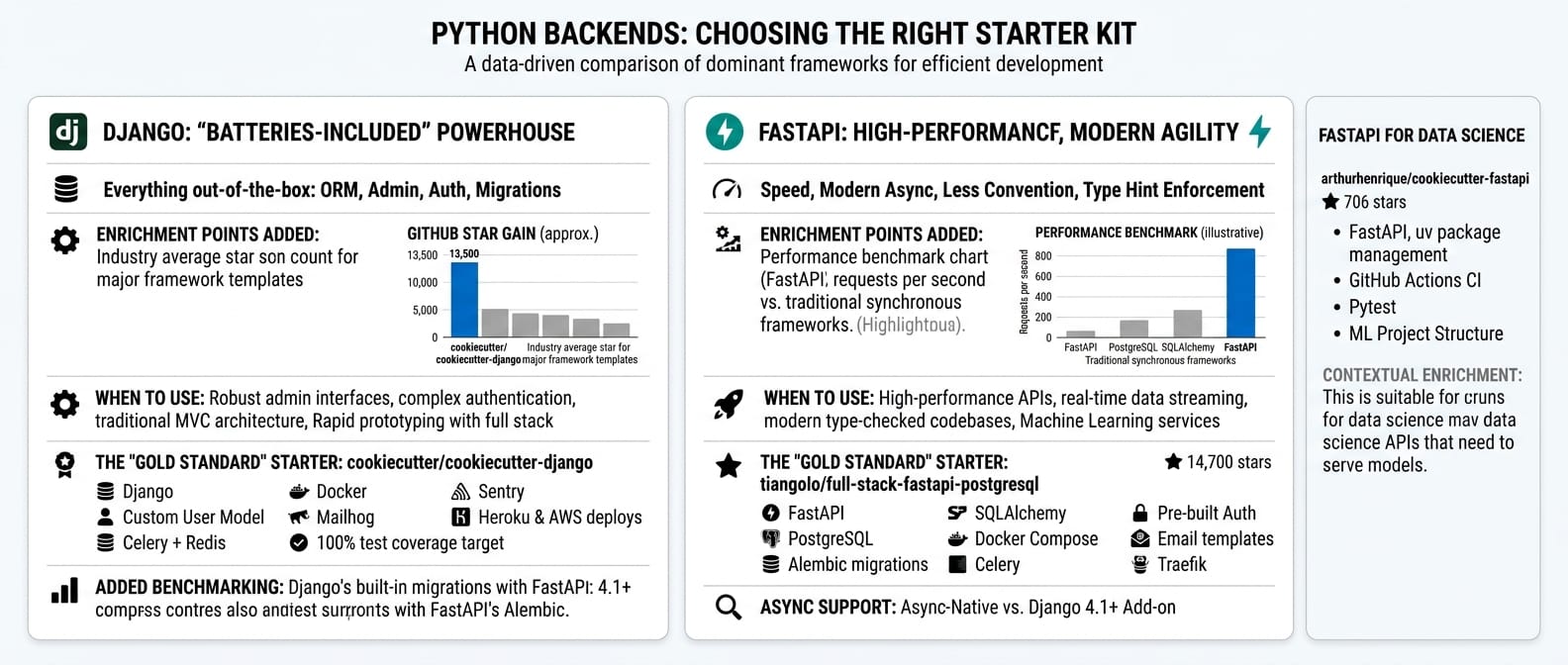
Python has two dominant web frameworks. Django gives you everything out of the box (ORM, admin, auth, migrations). FastAPI gives you speed and modern async with less convention.
What to look for: async support if you need it (FastAPI is async-native, Django added it in 4.1+). Database migrations via Alembic (FastAPI) or Django's built-in system. Type hints throughout (FastAPI enforces this, Django benefits from it). Celery or equivalent for background tasks. Docker setup with proper health checks.
-
tiangolo/full-stack-fastapi-postgresql (14,700 stars). Contains: FastAPI, PostgreSQL, SQLAlchemy, Alembic migrations, Docker Compose, Celery for background tasks, pre-built auth, email templates, Traefik for HTTPS. Created by the FastAPI author. The gold standard for Python API starters.
-
cookiecutter/cookiecutter-django (13,500 stars). Contains: Django, custom user model, Celery + Redis, Docker, Mailhog for email testing, Sentry integration, Heroku and AWS deploy configs, 100% test coverage target, Whitenoise for static files. The Django community's default starting point. Cookiecutter prompts let you toggle features on/off during generation.
-
arthurhenrique/cookiecutter-fastapi (706 stars). Contains: FastAPI, uv for package management, GitHub Actions CI, Pytest, ML project structure. Good for data science APIs that need to serve models.
Java and Spring Boot
The Java world runs on Spring Boot. Most enterprise backend services start here. A good Spring Boot template gives you: layered architecture (controller/service/repository), security configuration (JWT or OAuth2), database migration setup, API documentation, Docker support, and CI.
What to look for: proper separation of concerns (not everything in the controller). A security setup that goes beyond basic auth (JWT refresh tokens, role-based access). Database migrations via Flyway or Liquibase, not manual schema changes. Health checks and actuator endpoints for production monitoring. Test coverage that includes integration tests, not just unit tests.
-
jhipster/generator-jhipster (22,400 stars). Contains: Spring Boot backend, choice of Angular/React/Vue frontend, JPA with Hibernate, Liquibase migrations, Spring Security with JWT/OAuth2, Docker and Kubernetes configs, CI/CD for GitHub Actions/GitLab/Jenkins, microservice support with Netflix OSS or Consul. The most full-featured Java application generator. Generates a complete production-ready app from a JDL definition. Opinionated, but covers more ground than any other Java starter.
-
microservices-patterns/ftgo-application (3,700 stars). Contains: Spring Boot, event-driven architecture with Eventuate Tram, CQRS, Saga pattern for distributed transactions, API Gateway, Docker Compose. The companion code for Chris Richardson's "Microservice Patterns" book. Not a starter kit, but a complete reference architecture.
-
thombergs/buckpal (2,500 stars). Contains: Spring Boot with Hexagonal Architecture (Ports and Adapters), clear separation between domain logic and infrastructure, test examples for each layer. The reference implementation for Tom Hombergs' "Get Your Hands Dirty on Clean Architecture" book. Study-grade code.
-
ali-bouali/spring-boot-3-jwt-security (2,000 stars). Contains: Spring Boot 3, Spring Security 6, JWT authentication with refresh tokens, role-based authorization, JPA with PostgreSQL, OpenAPI docs. Focused starter for when you need auth done right without the full JHipster stack.
-
rohitghatol/spring-boot-microservices (1,800 stars). Contains: API Gateway (Zuul), OAuth 2.0 auth server, service discovery (Eureka), circuit breaker (Hystrix), multiple resource servers, Angular frontend. A reference microservices architecture. Shows how the pieces fit together.
-
SaiUpadhyayula/spring-boot-microservices (1,000 stars). Contains: Spring Boot 3, Spring Cloud Gateway, Keycloak for auth, Kafka for async messaging, distributed tracing with Zipkin, Docker Compose for local development. More modern than the rohitghatol version. Uses current Spring Cloud stack.
C# and .NET
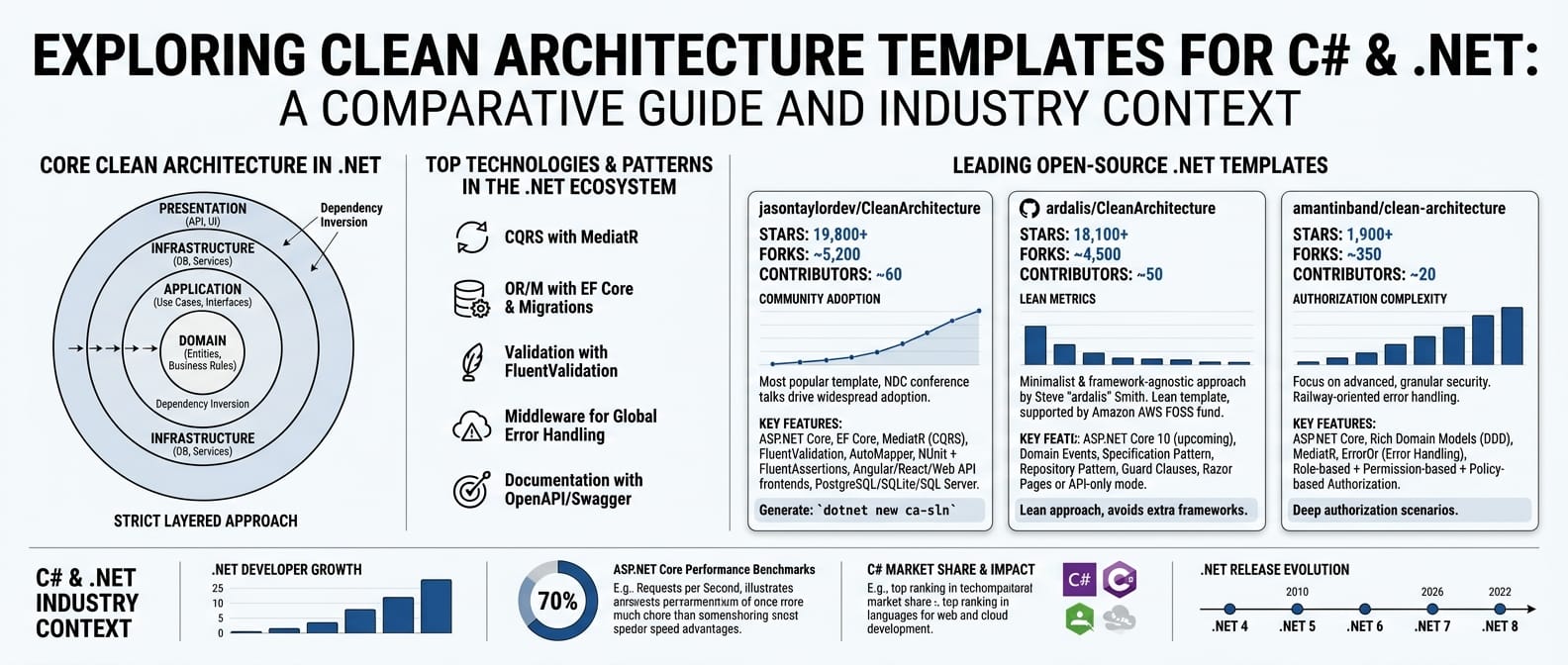
The .NET world takes Clean Architecture seriously. The top templates follow a strict layered approach: Domain (entities, business rules), Application (use cases, interfaces), Infrastructure (database, external services), and Presentation (API controllers, UI).
What to look for: proper dependency inversion (infrastructure depends on application, not the other way around). MediatR or similar for CQRS pattern. Entity Framework Core with migrations. FluentValidation for request validation. Global error handling middleware. OpenAPI/Swagger docs generated from code.
-
jasontaylordev/CleanArchitecture (19,800 stars). Contains: ASP.NET Core, Entity Framework Core, MediatR for CQRS, FluentValidation, AutoMapper, NUnit + FluentAssertions for testing, Angular/React/Web API frontend options, PostgreSQL/SQLite/SQL Server support. The most popular .NET template on GitHub.
dotnet new ca-slngenerates the full solution. Jason Taylor's talks at NDC conferences drove widespread adoption. -
ardalis/CleanArchitecture (18,100 stars). Contains: ASP.NET Core 10, domain events, specification pattern for queries, repository pattern, guard clauses, Razor Pages or API-only mode. Steve "ardalis" Smith's take on Clean Architecture. More minimalist than Jason Taylor's version. Deliberately avoids every possible framework to keep the template lean. Supported by the Amazon AWS FOSS fund.
-
amantinband/clean-architecture (1,900 stars). Contains: ASP.NET Core, domain-driven design with rich domain models, MediatR, ErrorOr for railway-oriented error handling, role-based + permission-based + policy-based authorization. Focuses on complex authorization scenarios that the other templates skip.
PHP and Laravel
Laravel dominates PHP development. The framework itself is essentially a template (run laravel new and you get auth, routing, ORM, queues, and more). But the official starter kits and community boilerplates go further, giving you pre-built UI, admin panels, and SaaS features.
What to look for: Laravel version compatibility (12 is current). Proper use of Eloquent relationships, not raw SQL. Queue and job configuration for background tasks. Proper CSRF and XSS protection (Laravel handles most of this, but templates can misconfigure it). Test suite with feature tests, not just unit tests.
-
laravel/laravel (84,000 stars). Contains: the Laravel framework itself as an application scaffold. Routes, controllers, migrations, seeders, middleware, Blade templates, Artisan console. Every Laravel project starts here. As of Laravel 12, the installer lets you choose a fully-featured template before scaffolding.
-
filamentphp/filament (30,000 stars). Contains: TALL stack (Tailwind, Alpine.js, Livewire, Laravel) admin panel builder. Form builder, table builder, notifications, dashboard widgets, multi-tenancy, roles and permissions. Not a project template, but the fastest way to build a Laravel admin panel. Drop it into any Laravel project.
-
rappasoft/laravel-boilerplate (5,600 stars). Contains: Laravel + Bootstrap, user/role/permission management, social auth (GitHub, Facebook, Google, etc.), two-factor auth, CRUD generators, admin dashboard, activity logging. A complete admin-panel-ready boilerplate. Batteries included for projects that need user management immediately.
-
laravel/jetstream (4,100 stars). Contains: login, registration, email verification, 2FA, session management, API via Sanctum, optional team management. Choose Livewire or Inertia (Vue/React) for the frontend. The official "full-featured" Laravel starter.
-
laravel/breeze (3,000 stars). Contains: basic auth (login, registration, password reset, email verification), profile page. Blade + Tailwind, or Vue/React + Inertia. The official "minimal" Laravel starter. Pick this when Jetstream has more than you need.
Ruby on Rails
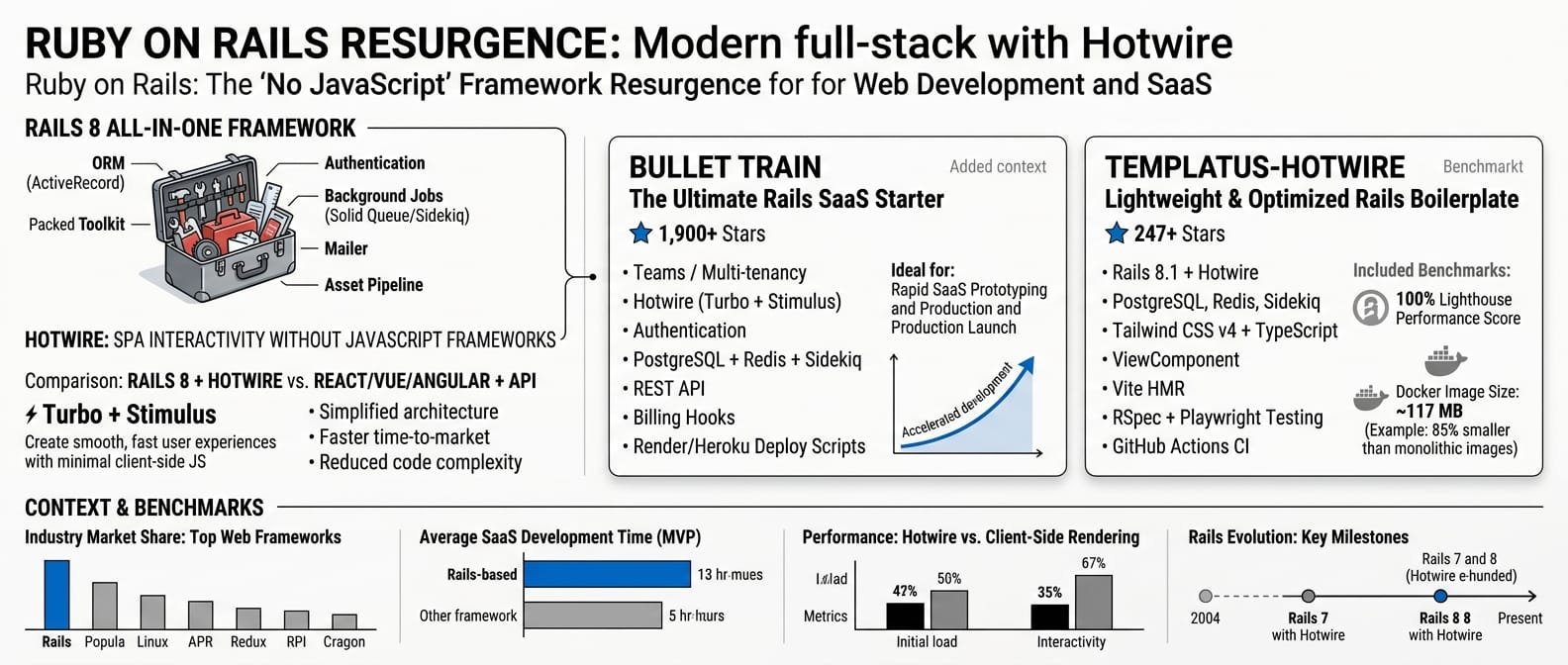
Rails has had a resurgence. The framework ships with everything (ORM, auth, jobs, mailer, asset pipeline), so the question isn't "what do I need" but "what's the best starting configuration." Rails 8 with Hotwire (Turbo + Stimulus) gives you single-page-app-like interactivity without a JavaScript framework.
What to look for: Hotwire integration (not just API-mode). Multi-tenancy if you're building SaaS. Background jobs via Sidekiq or Solid Queue. Proper test suite (RSpec or Minitest). Docker setup that keeps images small.
-
bullet-train-co/bullet_train (1,900 stars). Contains: Rails SaaS framework with teams/multitenancy, Hotwire (Turbo + Stimulus), authentication, PostgreSQL + Redis + Sidekiq, REST API, billing hooks, Render/Heroku deploy scripts. The most complete open-source Rails SaaS starter.
-
templatus/templatus-hotwire (247 stars). Contains: Rails 8.1 + Hotwire, PostgreSQL, Redis, Sidekiq, Tailwind CSS v4, TypeScript, ViewComponent, Vite HMR, RSpec + Playwright, Docker (117 MB image), GitHub Actions CI. 100% Lighthouse score.
Go
Go enforces simplicity by design, but project structure is one thing the language doesn't prescribe. The community filled that gap with conventions and templates.
What to look for: the /cmd, /internal, /pkg layout (or a deliberate departure from it with good reasons). Makefile or Taskfile for common operations (build, test, lint, run). Proper error handling patterns (not just log.Fatal). Context propagation through the stack. Structured logging (slog or zerolog). Docker multi-stage builds for small images.
-
golang-standards/project-layout (55,700 stars). Contains: directory structure only.
/cmdfor entrypoints,/internalfor private code,/pkgfor public libraries,/apifor OpenAPI specs,/deploymentsfor Docker/K8s configs. Not runnable code, but the convention that most Go templates follow. Read this first. -
Melkeydev/go-blueprint (8,800 stars). Contains: a CLI generator. Pick your HTTP framework (Gin, Echo, Fiber, Chi, standard library), database (Postgres, MySQL, SQLite, Mongo, Redis), and get a structured project.
go-blueprint createwalks you through the options interactively. -
evrone/go-clean-template (7,500 stars). Contains: Clean Architecture layers (entity, usecase, controller, repo), Gin HTTP framework, PostgreSQL, RabbitMQ integration, Swagger docs, structured logging, Docker Compose. A production-ready Go API with clear boundaries between layers.
-
ThreeDotsLabs/wild-workouts-go-ddd-example (6,300 stars). Contains: DDD + CQRS + Clean Architecture, gRPC and HTTP APIs, Firestore and MySQL storage, pub/sub messaging, complete test suite. A full reference application, not just a skeleton. The companion code for Three Dots Labs' Go architecture guides.
-
ardanlabs/service (3,900 stars). Contains: production Go service structure, Kubernetes deployment configs, OpenTelemetry tracing, database migrations, auth middleware, structured logging, Makefile with build/test/deploy targets. Bill Kennedy's (Ardan Labs) production starter. Built for real deployments, not tutorials.
-
go-kratos/kratos-layout (472 stars). Contains: Kratos microservice framework layout, protobuf API definitions, gRPC + HTTP transport, wire dependency injection, config management, service discovery. The official template for Kratos, a Go microservice framework used at Bilibili.
-
wojciech12/my-ai-dev [AI-ready] Contains: CLAUDE.md with Go conventions, agent definitions, command templates, hooks for code quality, memory system for context persistence, PR review tools. A real-world example of how a Go developer configures AI-assisted development across projects.
For CLI tools specifically, FalcoSuessgott/golang-cli-template scaffolds a Cobra + Viper CLI with GoReleaser (builds .deb/.rpm packages, Docker images, manpages, shell completions), GitHub Actions CI, golangci-lint, and the standard cmd/, pkg/, internal/ layout.
Rust
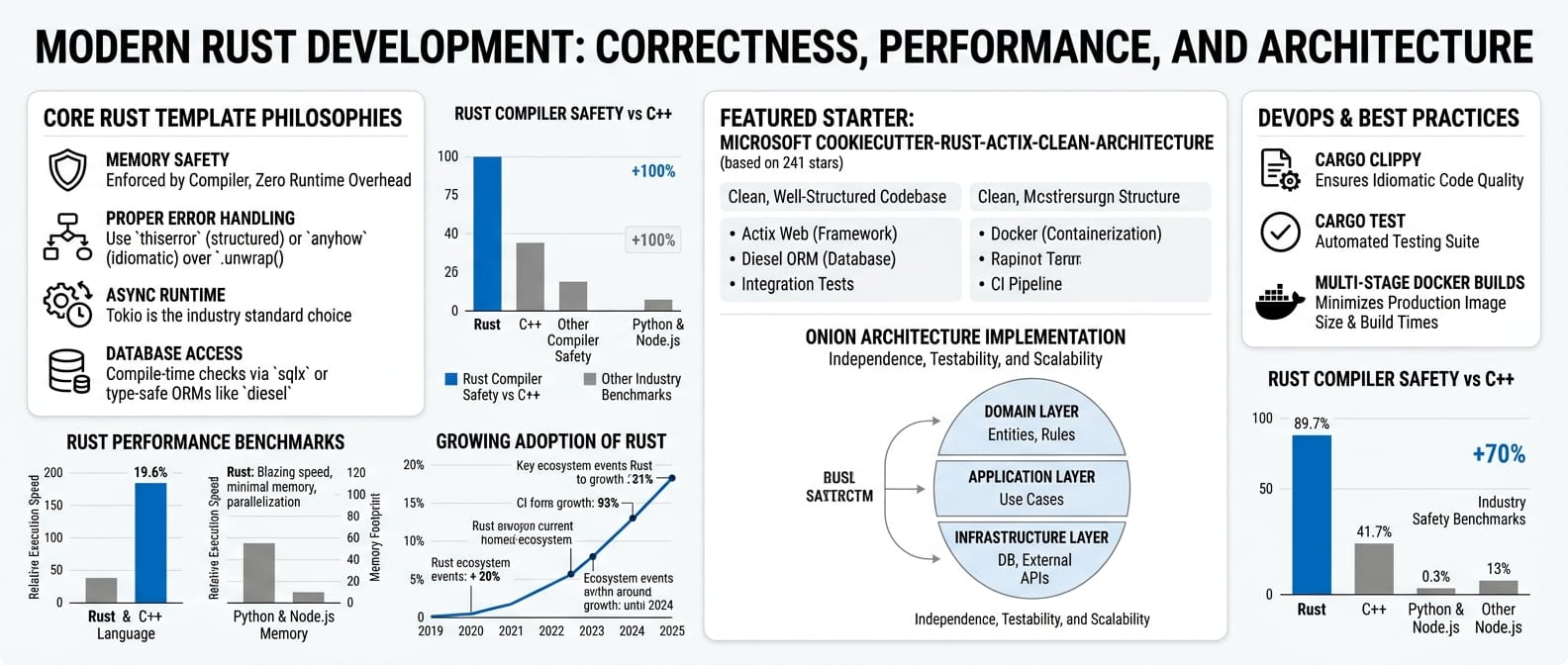
Rust templates focus on correctness and performance. The compiler enforces memory safety, but project structure, error handling patterns, and async runtime choices are left to you.
What to look for: proper error handling with thiserror or anyhow (not .unwrap() everywhere). Async runtime choice (Tokio is standard). Database access via sqlx (compile-time checked queries) or diesel (type-safe ORM). CI that runs cargo clippy and cargo test. Multi-stage Docker builds.
- microsoft/cookiecutter-rust-actix-clean-architecture (241 stars). Contains: Actix Web, Diesel ORM, Onion Architecture (domain/application/infrastructure layers), integration tests, Docker, CI pipeline. Microsoft-maintained. Small star count but clean, well-structured code. The best starting point for a Rust web service with proper architecture.
AI and LLM app templates
Building an AI-powered product is different from building a traditional web app. You need streaming responses, token management, model provider abstraction (so you can switch between OpenAI and Anthropic), and conversation state management.
What to look for: streaming support (SSE or WebSockets for real-time responses). Provider abstraction (not hardcoded to one model). Proper token counting and context window management. Rate limiting per user. Conversation history storage that scales.
-
vercel/ai-chatbot (20,000 stars). Contains: Next.js, Vercel AI SDK with multi-provider support (Anthropic, OpenAI, Google, Mistral), streaming UI components, chat history persistence, file uploads, code highlighting, auth. The standard chatbot starter. Fork this if you're building any chat-based AI product.
-
langchain-ai/langchain-nextjs-template (2,400 stars). Contains: Next.js, LangChain.js, examples for chatbot, retrieval QA, agents, structured output. Multiple use cases in one template. Good for learning LangChain patterns.
-
vstorm-co/full-stack-fastapi-nextjs-llm-template (953 stars). [AI-ready] Contains: FastAPI backend, Next.js frontend, PydanticAI/LangChain agent integration, WebSocket streaming, auth, 20+ integrations,
CLAUDE.mdandAGENTS.md. The most complete AI full-stack template with a Python backend.
Desktop apps
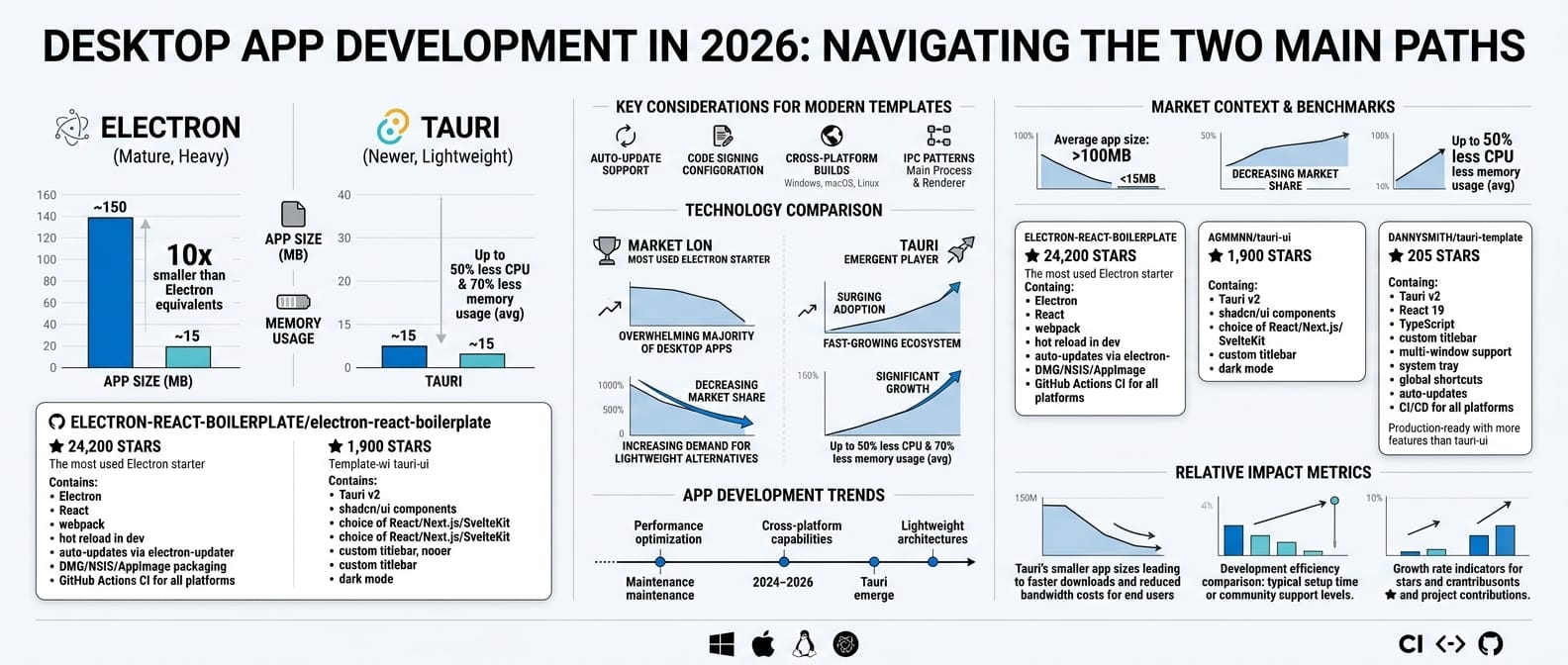
Desktop development has two main paths in 2026: Electron (mature, heavy, Chromium-based) and Tauri (newer, lightweight, uses the OS webview). Both need templates because the build tooling is complex.
What to look for: auto-update support. Code signing configuration. Cross-platform builds (Windows, macOS, Linux) from CI. IPC (inter-process communication) patterns between the main process and renderer.
-
electron-react-boilerplate/electron-react-boilerplate (24,200 stars). Contains: Electron, React, webpack, hot reload in dev, auto-updates via electron-updater, DMG/NSIS/AppImage packaging, GitHub Actions CI for all platforms. The most used Electron starter by a wide margin.
-
agmmnn/tauri-ui (1,900 stars). Contains: Tauri v2, shadcn/ui components, choice of React/Next.js/SvelteKit, custom titlebar, dark mode. Modern, lightweight. Tauri apps are typically 10x smaller than Electron equivalents.
-
dannysmith/tauri-template (205 stars). Contains: Tauri v2, React 19, TypeScript, custom titlebar, multi-window support, system tray, global shortcuts, auto-updates, CI/CD for all platforms. Production-ready with more features than tauri-ui.
Mobile apps
React Native dominates cross-platform mobile. The challenge: React Native's default init gives you a bare project. You need navigation, state management, testing, and build configs for both iOS and Android.
What to look for: navigation library pre-configured (React Navigation or Expo Router). State management (Zustand, Redux Toolkit, or MobX-State-Tree). Testing setup (Jest + Testing Library). EAS Build or Fastlane for CI/CD. Deep linking support. Push notification setup.
-
infinitered/ignite (19,700 stars). Contains: React Native, Expo, TypeScript, MobX-State-Tree, React Navigation, generators for components/models/screens, Reactotron debugging, demo app. 9 years of continuous development. CLI generators speed up daily work:
npx ignite-cli generate component Button. -
t3-oss/create-t3-turbo (6,000 stars). Contains: Turborepo monorepo, Expo React Native app + Next.js web app, tRPC for type-safe API, Drizzle ORM, shared packages for types and validation. The best option when you need a mobile app and web app sharing the same backend and types.
-
thecodingmachine/react-native-boilerplate (5,500 stars). Contains: React Native, TypeScript, Redux Toolkit, React Navigation, i18n, dark mode, environment configs. Clean architecture with clear separation between UI and business logic.
For native iOS: nalexn/clean-architecture-swiftui (6,500 stars) demonstrates SwiftUI + Clean Architecture with Combine, SwiftData, async/await networking, and ViewInspector UI tests. Widely forked as a starting point.
For native Android: cortinico/kotlin-android-template (1,900 stars) provides 100% Kotlin with four sample modules (Android app, Android library, Kotlin library, Compose Activity), Gradle Kotlin DSL, detekt + ktlint static analysis, GitHub Actions CI, and Maven Central publishing config.
Browser extensions
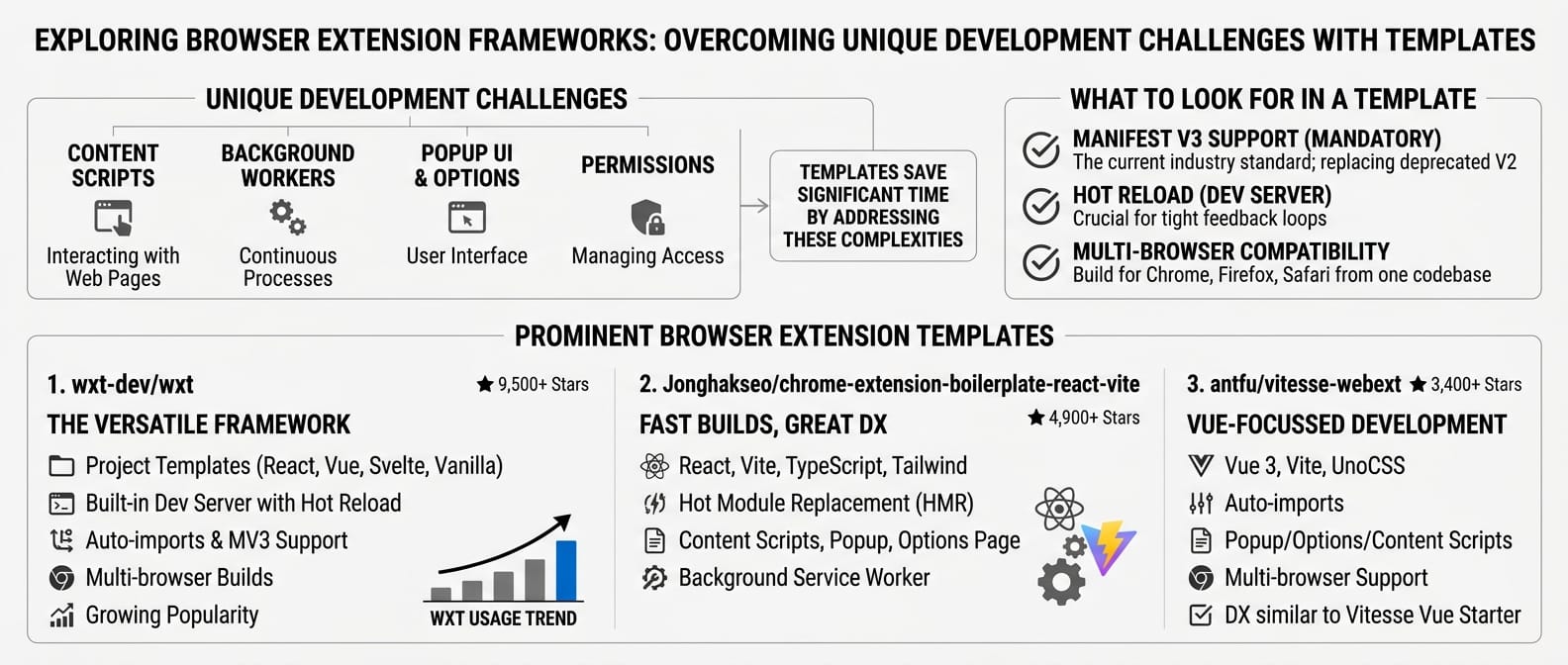
Browser extension development has unique challenges: content scripts, background workers, popup UI, permissions, and manifest v3 migration. Templates save significant time here.
What to look for: Manifest V3 support (V2 is being deprecated). Hot reload during development (otherwise the feedback loop is painful). Support for multiple browsers (Chrome, Firefox, Safari) from one codebase.
-
wxt-dev/wxt (9,500 stars). Contains: a framework with project templates for React/Vue/Svelte/Vanilla, built-in dev server with hot reload, auto-imports, MV3 support, multi-browser builds. Becoming the default choice for new extensions.
-
Jonghakseo/chrome-extension-boilerplate-react-vite (4,900 stars). Contains: React, Vite, TypeScript, Tailwind, hot module replacement, content scripts, popup, options page, background service worker. Fast builds, good DX.
-
antfu/vitesse-webext (3,400 stars). Contains: Vue 3, Vite, UnoCSS, auto-imports, popup/options/content scripts, multi-browser support. Same developer experience as the vitesse Vue starter.
Software-adjacent
Documentation sites
Every open-source project and internal tool needs docs. These templates give you search, versioning, sidebar navigation, and good typography out of the box.
What to look for: full-text search (built-in or Algolia integration). Versioned docs (so you can maintain docs for multiple releases). MDX support (so you can embed React components in docs). Good mobile experience. Fast builds for large doc sites.
-
facebook/docusaurus (64,300 stars). Contains: React, MDX, versioned docs, i18n, blog, search (Algolia), plugin system, dark mode. Meta's documentation framework. Used by React, Jest, Redux, and hundreds of other open-source projects.
npx create-docusaurusscaffolds a new site. -
squidfunk/mkdocs-material (26,400 stars). Contains: Python-based static site generator, Material Design theme, search, code highlighting, admonitions, tabs, content tabs, social cards, blog plugin. The best option for Python teams. Write docs in Markdown, build with
mkdocs build. -
vuejs/vitepress (17,400 stars). Contains: Vue 3, Vite, Markdown with Vue components, full-text search, sidebar from file structure, SSG. The Vue community's documentation tool. Faster builds than Docusaurus for pure doc sites.
-
withastro/starlight (8,200 stars). Contains: Astro, built-in search, i18n, sidebar navigation, component overrides, Tailwind integration, accessibility. The newest contender. Fast, modern, and growing quickly.
GitHub Actions and infrastructure
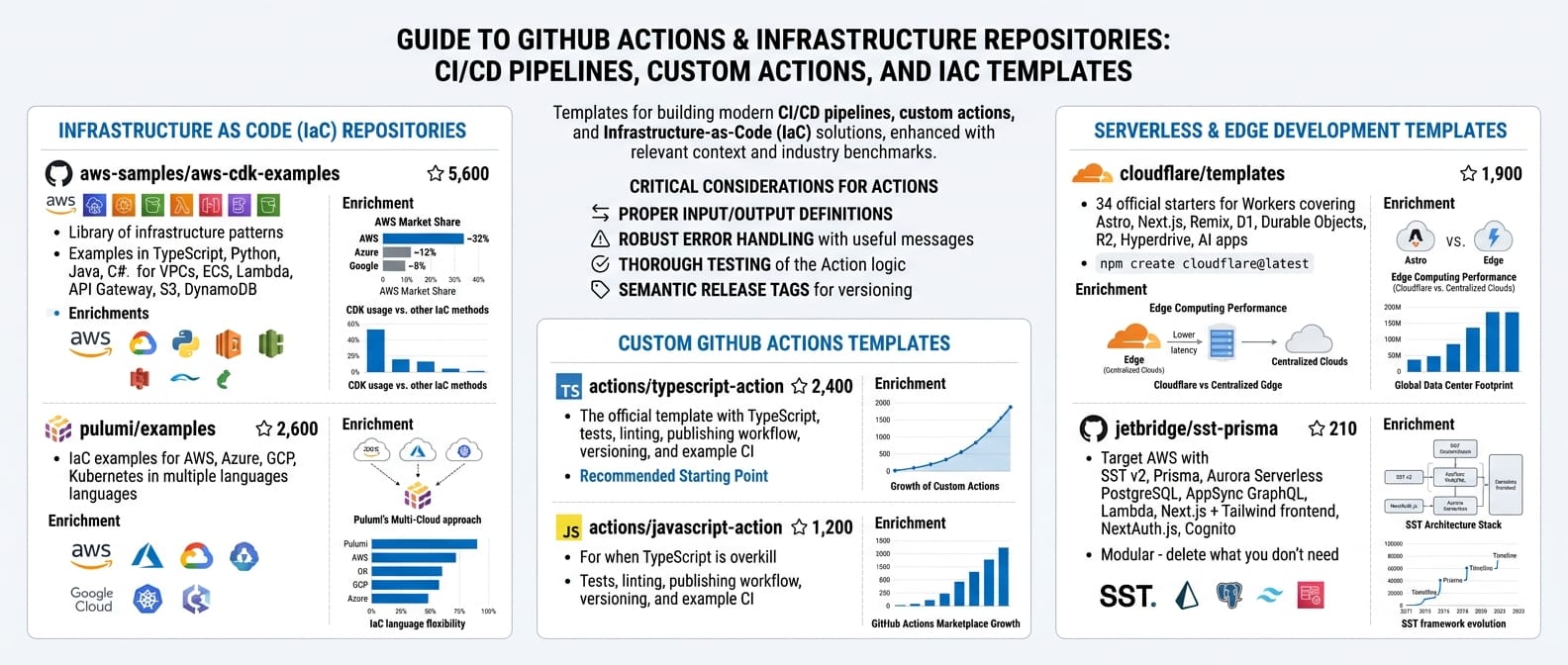
Templates for building CI/CD pipelines, custom actions, and infrastructure-as-code.
What to look for (Actions): proper input/output definitions. Error handling that surfaces useful messages. Testing the action itself (not just the code it runs). Versioning with semantic release tags.
-
aws-samples/aws-cdk-examples (5,600 stars). Contains: CDK examples in TypeScript, Python, Java, C# covering VPCs, ECS, Lambda, API Gateway, S3, DynamoDB. Not one template but a library of infrastructure patterns. Copy the example closest to your architecture.
-
pulumi/examples (2,600 stars). Contains: IaC examples for AWS, Azure, GCP, Kubernetes in TypeScript, Python, Go, C#, Java. Multi-cloud alternative to CDK examples.
-
actions/typescript-action (2,400 stars). Contains: TypeScript, Jest tests, ESLint, publishing workflow, versioning, example CI. GitHub's official template for creating custom Actions. Start here.
-
cloudflare/templates (1,900 stars). Contains: 34 official starters for Cloudflare Workers covering Astro, Next.js, Remix, D1 database, Durable Objects, R2, Hyperdrive (MySQL/Postgres), and AI apps. Scaffold via
npm create cloudflare@latest. The edge/serverless equivalent of Vercel's starter collection. -
actions/javascript-action (1,200 stars). Contains: same as above but JavaScript. For when TypeScript is overkill.
-
jetbridge/sst-prisma (210 stars). Contains: SST v2 + Prisma targeting AWS. Aurora Serverless PostgreSQL, AppSync GraphQL, Lambda functions, Next.js + Tailwind frontend, NextAuth.js, Cognito. Modular: delete what you don't need.
Data science
Data science projects have a reproducibility problem. Without structure, notebooks multiply, data versions get lost, and experiments become impossible to reproduce.
What to look for: clear separation between raw data, processed data, and outputs. Environment management (conda, venv, or uv). DVC or similar for data versioning. A Makefile or similar for running pipelines.
- drivendata/cookiecutter-data-science (9,800 stars). Contains:
/data(raw, interim, processed, external),/notebooks,/src(data, features, models, visualization), Makefile, environment.yml,setup.py. The standard. Every data science team should know this structure even if they customize it.
How to pick a template
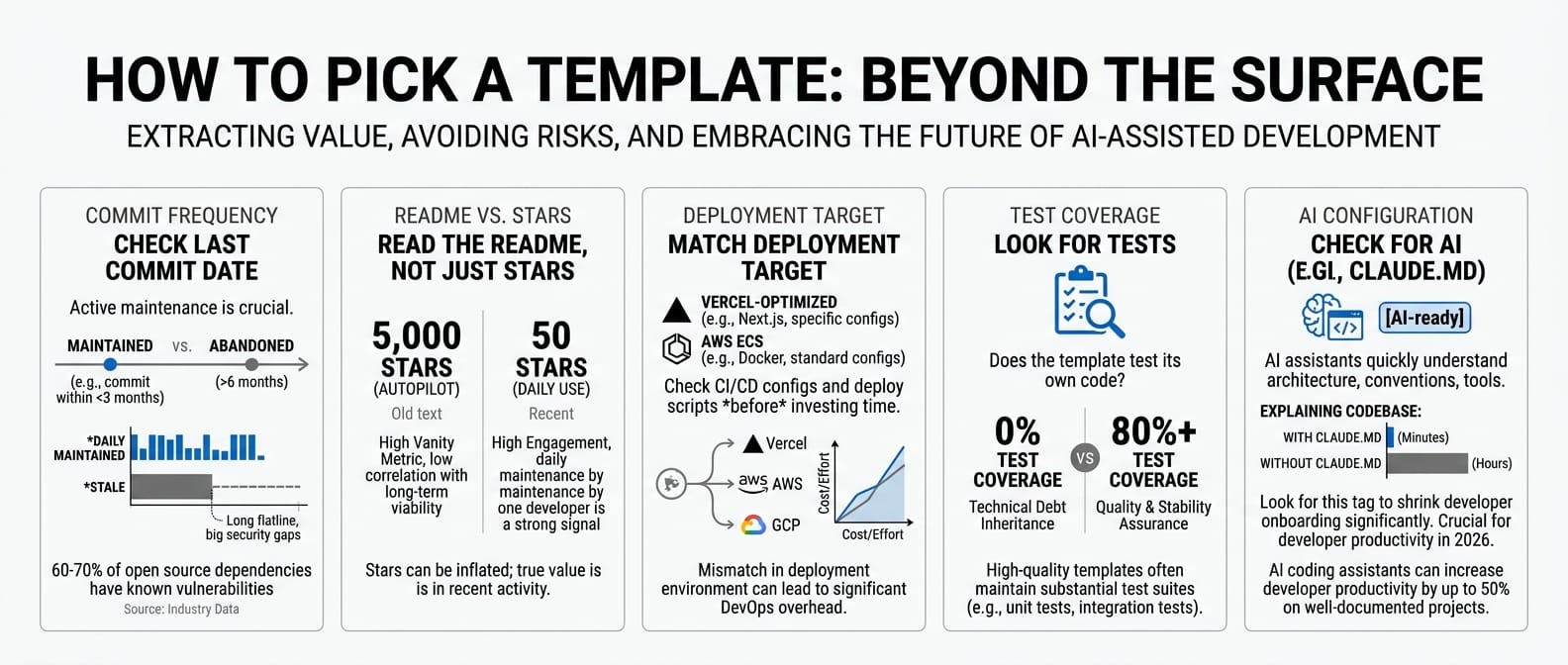
Check the last commit date. Templates abandoned for 6+ months are a liability. Dependencies drift, security patches pile up, and framework APIs change.
Read the README, not just the star count. A 50-star template maintained by one person who uses it daily beats a 5,000-star template that's been on autopilot for two years.
Match your deployment target. A Vercel-optimized template won't help if you're deploying to AWS ECS. Check the CI/CD configs and deploy scripts before you invest time.
Look for tests. If the template doesn't test its own code, you're inheriting someone else's tech debt.
Check for AI configuration. The best templates in 2026 include a CLAUDE.md or equivalent. When an AI coding assistant already knows the project's architecture, conventions, and tools, the "explain the codebase" phase shrinks from hours to minutes. Look for the [AI-ready] tag in this guide.
Finding more
- EinGuterWaran/awesome-opensource-boilerplates (1,800 stars). Curated list of production-ready SaaS boilerplates and starters.
- GitHub Topics. Browse
template-repository,starter-template,boilerplatetopics. Filter by language, sort by stars, check "recently updated."
Project setup is a solved problem. Pick a template that matches the stack and deployment target, check that it's maintained, and start building the thing that actually matters.
Methodology: every repo listed here was checked via GitHub for existence, activity, and README accuracy. Star counts are rounded and current as of March 2026. Templates were evaluated by reading the actual codebase, not just the README. Repos with no commits in 12+ months were excluded unless they remain the only option in their category.