GenAI Daily - April 10, 2026: Meta Launches Muse Spark, OpenAI Preps Retail IPO, Perplexity's Billion Dollar Build
Top Stories
Meta Debuts Muse Spark AI Model in Strategic Shift
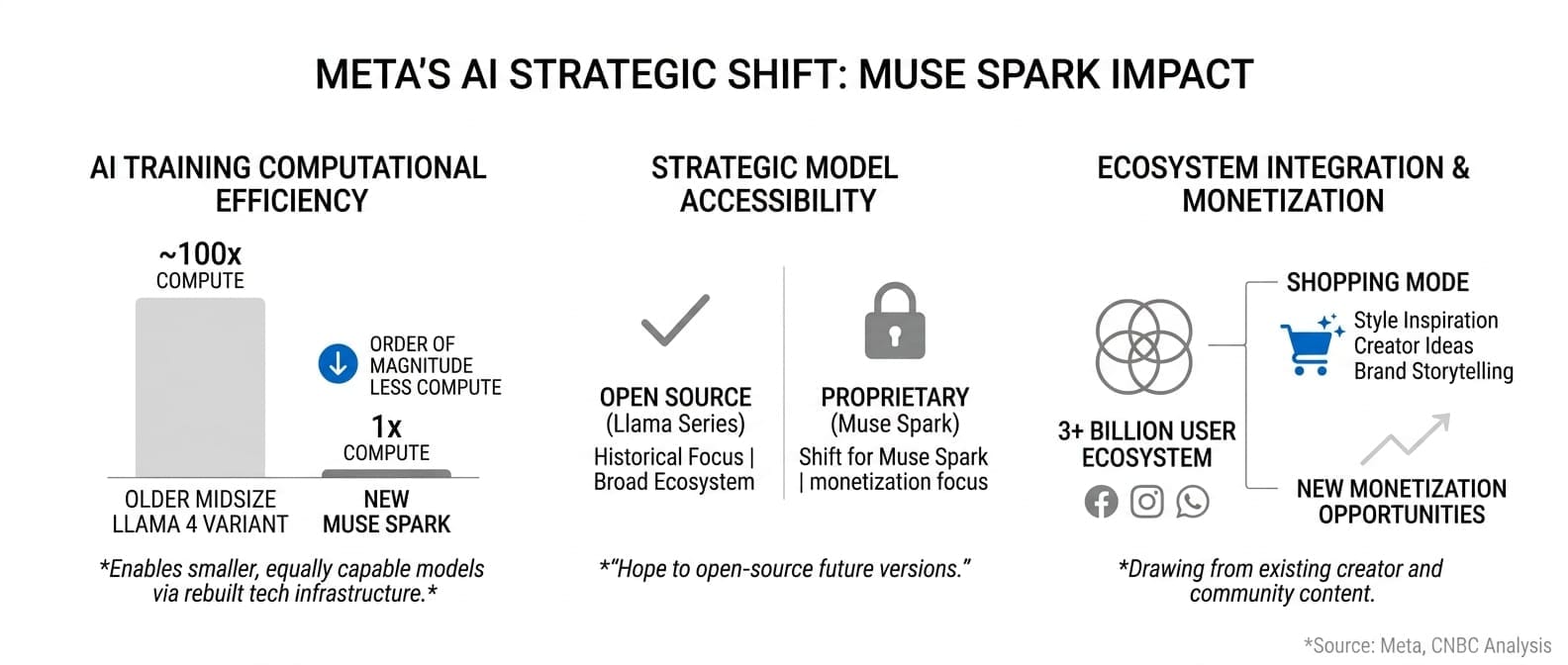
Meta launched Muse Spark, its first major AI model under chief AI officer Alexandr Wang, who joined nine months ago and leads Meta Superintelligence Labs. The company said improved AI training techniques along with rebuilt technology infrastructure has enabled the company to create smaller AI models that are as capable as its older midsize Llama 4 variant for "an order of magnitude less compute." Muse Spark offers competitive performance in multimodal perception, reasoning, health, and agentic tasks.
The new Muse Spark will be proprietary, with the company saying there is "hope to open-source future versions of the model." The company said the revamped Meta AI with Muse Spark will also contain a Shopping mode that will be able to help people buy clothes or decorate rooms. Shopping mode draws from the styling inspiration and brand storytelling already happening across our apps, surfacing ideas from the creators and communities people already follow.
Why it matters: Meta's pivot to proprietary AI signals a strategy shift away from open source, with immediate integration across its 3+ billion user ecosystem creating new monetization opportunities.
OpenAI Confirms IPO Retail Allocation Strategy
OpenAI plans to reserve a portion of shares for individual investors in what's expected to be a blockbuster initial public offering. Chief Financial Officer Sarah Friar told CNBC that the San Francisco-based artificial intelligence giant started testing the waters with retail in its latest funding round and saw "really strong demand" from individuals. OpenAI will "for sure" hold a slice for retail when it goes public.
Enterprise is now 40% of our revenue. It's on track to reach parity with consumer by the end of 2026, Dresser, who just wrapped up her first 90 days at the company, told CNBC Wednesday.
The company is widely expected to file with U.S. securities regulators in the second half of 2026. The firm closed a $122 billion funding round at a post-money valuation of $852 billion, the largest private raise in tech history.
Why it matters: OpenAI's retail allocation breaks Silicon Valley IPO norms and could reshape how mega-tech offerings handle public market access, with enterprise growth driving valuation toward $1 trillion.
Amazon's AI Revenue Hits $15B Annual Run Rate
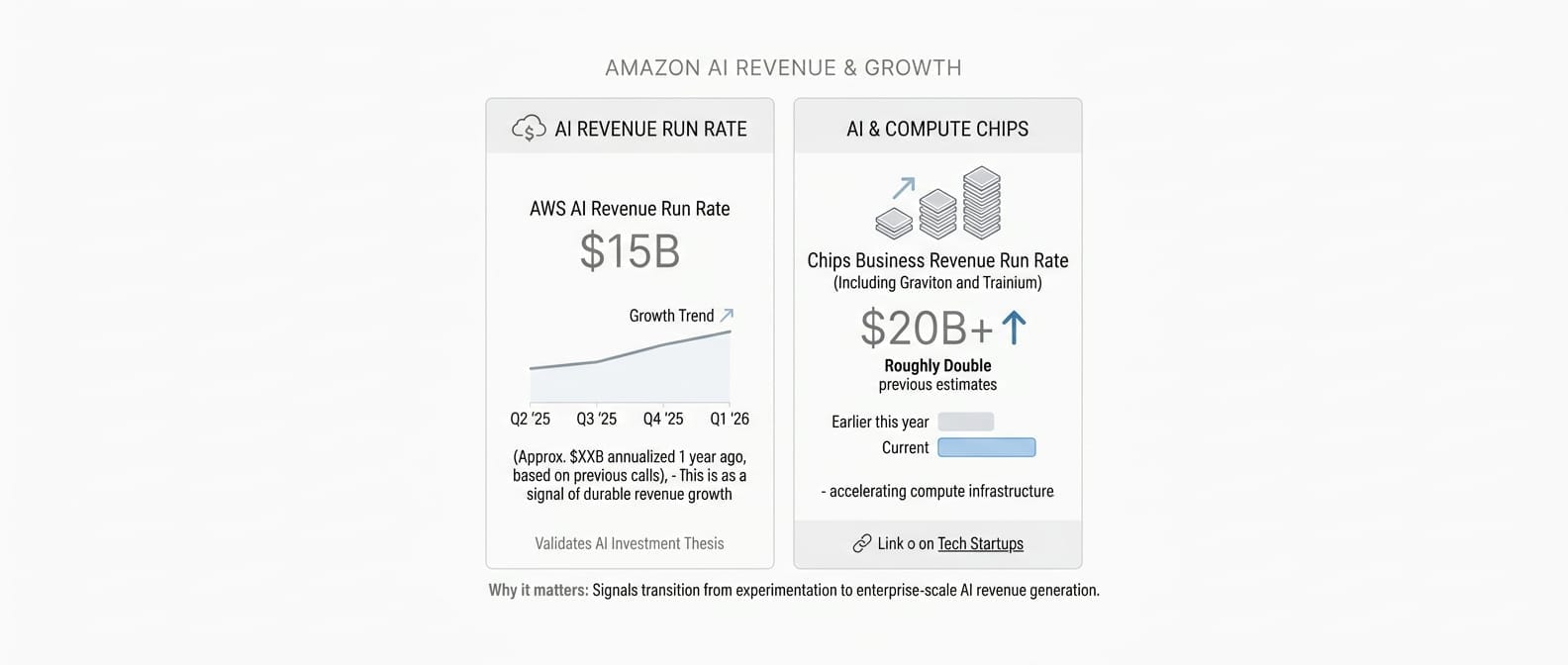
Amazon said its cloud unit's AI revenue run rate topped $15 billion in the first quarter, marking one of the clearest signals yet that hyperscaler AI spending is beginning to translate into measurable top-line growth. CEO Andy Jassy also said Amazon's chips business, which includes Graviton and Trainium, now has an annual revenue run rate above $20 billion, roughly double the figure the company cited earlier this year.
That matters because the market has spent the last year asking when AI infrastructure spending would stop looking like pure cost and start looking like durable revenue. Amazon is effectively arguing that the answer is now.
Why it matters: Amazon's concrete AI revenue figures validate the infrastructure investment thesis and signal the transition from AI experimentation to revenue generation at enterprise scale.
Key Developments
Perplexity Launches "Billion Dollar Build" Competition
Perplexity announced the Billion Dollar Build, an 8-week competition where teams will use Perplexity Computer to build a company with a path to $1B. Finalists have the opportunity to secure up to $1M in investment from the Perplexity Fund and up to $1M in Computer credits.
The competition represents Perplexity's strategy to build developer ecosystem momentum around its AI Computer platform, following the company's climb to a $22.6 billion valuation. The initiative targets early-stage entrepreneurs and developers looking to build AI-powered businesses with significant scale potential, offering both capital and compute resources to accelerate development timelines.
Impact: Creates direct incentive for developers to build on Perplexity's platform while potentially funding the next generation of AI-powered startups.
Microsoft Expands CoreWeave Partnership with $21B Deal
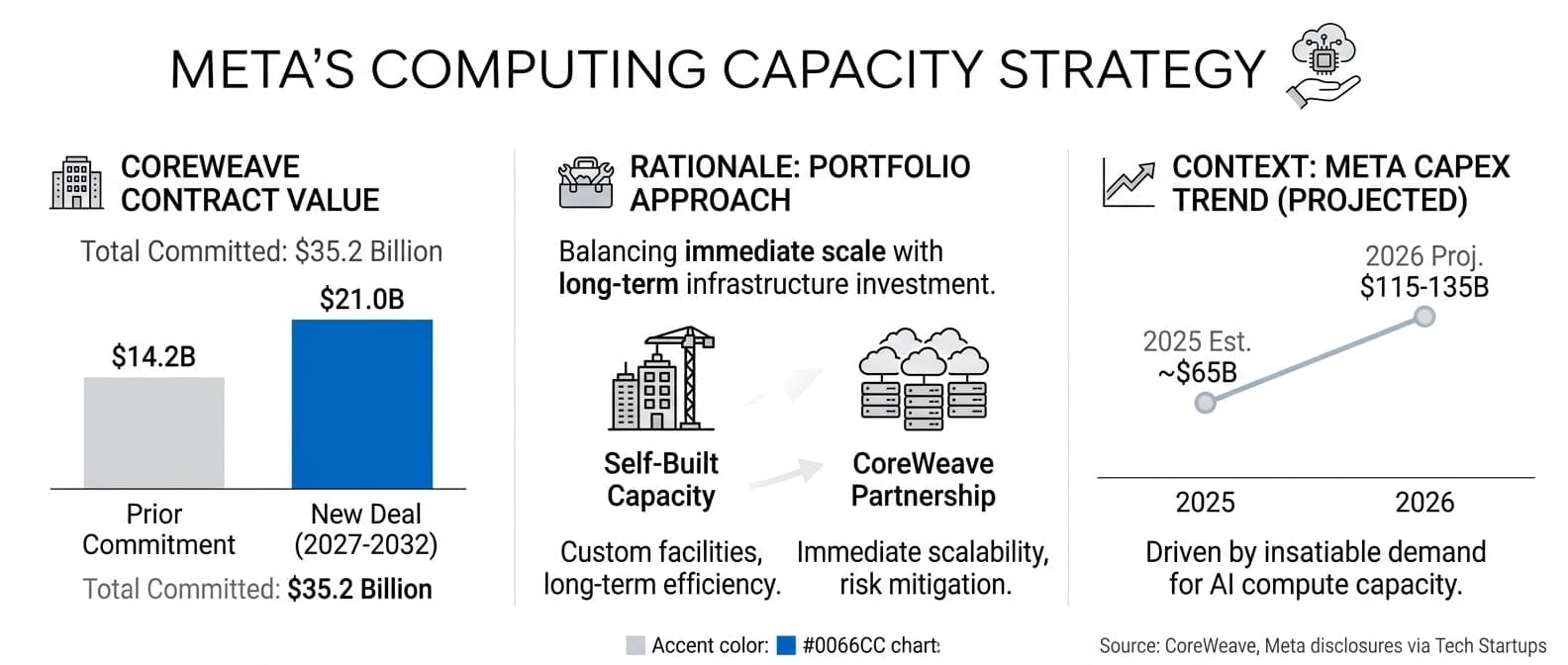
Meta has signed a new deal to spend an extra $21 billion with CoreWeave between 2027 and 2032, on top of a prior $14.2 billion commitment. CoreWeave's data centers, packed with hundreds of thousands of Nvidia GPUs, will support Meta's growing AI training and inference needs. The hyperscaler is pursuing a portfolio approach - building its own facilities, such as a major Texas data center, while relying on specialized providers like CoreWeave for immediate scalable capacity and risk mitigation.
This comes as Meta's 2026 capital expenditures are projected at $115-135 billion, nearly double 2025 levels, driven by insatiable demand for AI compute. CoreWeave benefits by diversifying beyond Microsoft, with no single customer now exceeding 35% of revenue.
Impact: Demonstrates the compute capacity crunch driving enterprise partnerships and validates the specialized GPU cloud business model.
Researchers Launch Agentic Risk Standard Framework
A cross-institutional team of researchers from Google DeepMind, Microsoft Research, Columbia University, t54 Labs, and Virtuals Protocol is releasing a new research paper proposing the Agentic Risk Standard (ARS), a framework that applies financial risk management principles to AI agent transactions. The paper introduces a settlement-layer protocol that uses escrow, underwriting, and collateralization to protect users from financial loss when autonomous AI systems execute tasks involving payments or assets.
Across all parameter configurations tested, the mechanism consistently reduced user losses compared to an ecosystem with no underwriting available, with loss reduction ranging from 24% to 61% depending on pricing and risk estimation settings. In addition, the collateral mechanism independently deterred 15-20% of risky transactions from executing in the first place.
Impact: Addresses the "guarantee gap" problem that's limiting enterprise AI agent adoption by providing financial accountability mechanisms similar to traditional insurance and bonding.
Anthropic Introduces Claude Managed Agents
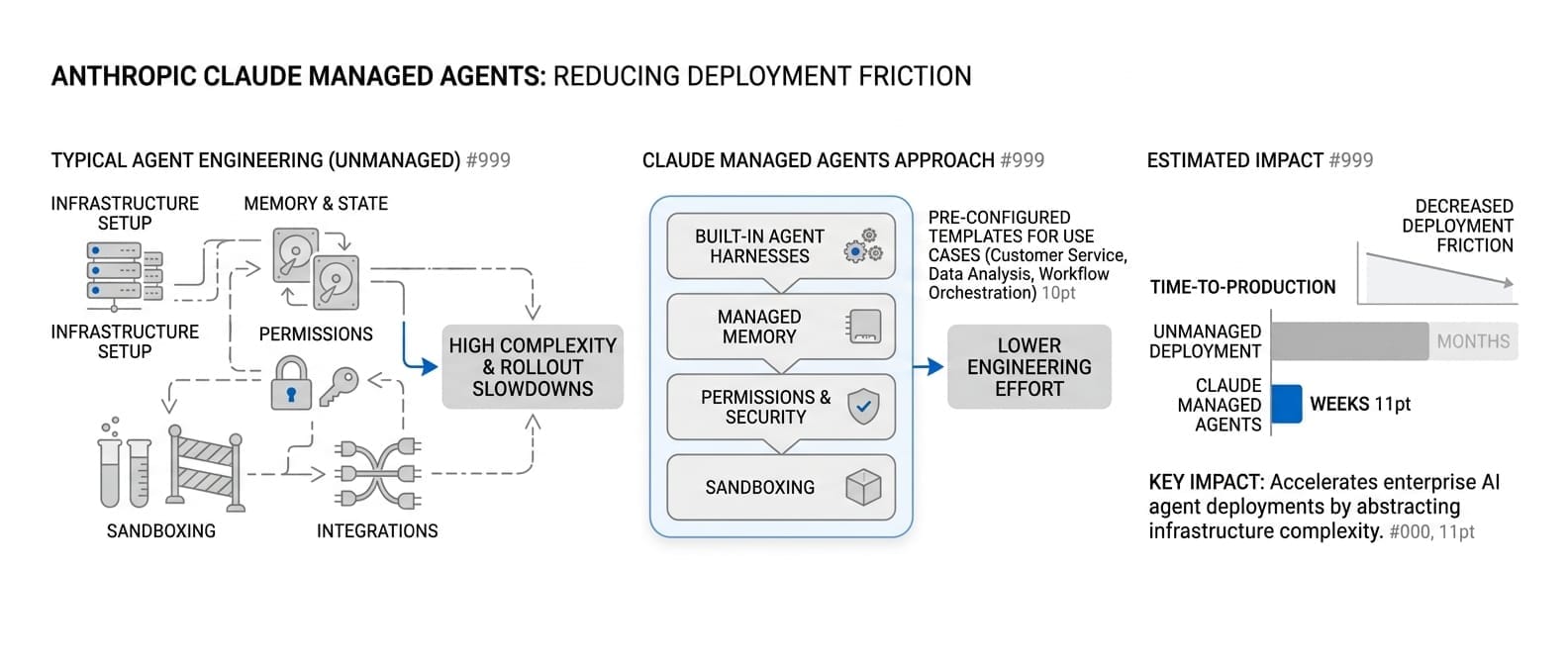
Anthropic introduced Claude Managed Agents, a new product designed to handle much of the messy infrastructure behind deploying autonomous AI agents in production. The offering includes built-in agent harnesses, memory, permissions, and sandboxing, letting companies skip a chunk of the engineering work that typically slows agent rollouts.
The managed service represents Anthropic's push to reduce enterprise deployment friction as companies move from AI experimentation to production workflows. The platform provides pre-configured templates for common business use cases including customer service automation, data analysis, and workflow orchestration, with enterprise-grade security and compliance features built in.
Impact: Simplifies enterprise AI agent deployment by abstracting away infrastructure complexity, accelerating time-to-production for business workflows.
Product Launches
Microsoft's Three In-House AI Models
Microsoft launched three new foundational AI models it built entirely in-house - a state-of-the-art speech transcription system, a voice generation engine, and an upgraded image creator - marking the most concrete evidence yet that the $3 trillion software giant intends to compete directly with OpenAI, Google, and other frontier labs on model development. The trio of models - MAI-Transcribe-1, MAI-Voice-1, and MAI-Image-2 - are available immediately through Microsoft Foundry and a new MAI Playground.
Why it matters: Signals Microsoft's strategic independence from third-party AI providers and positions the company to compete directly in the foundational model market.
Global AI Enterprise Platform Deployment
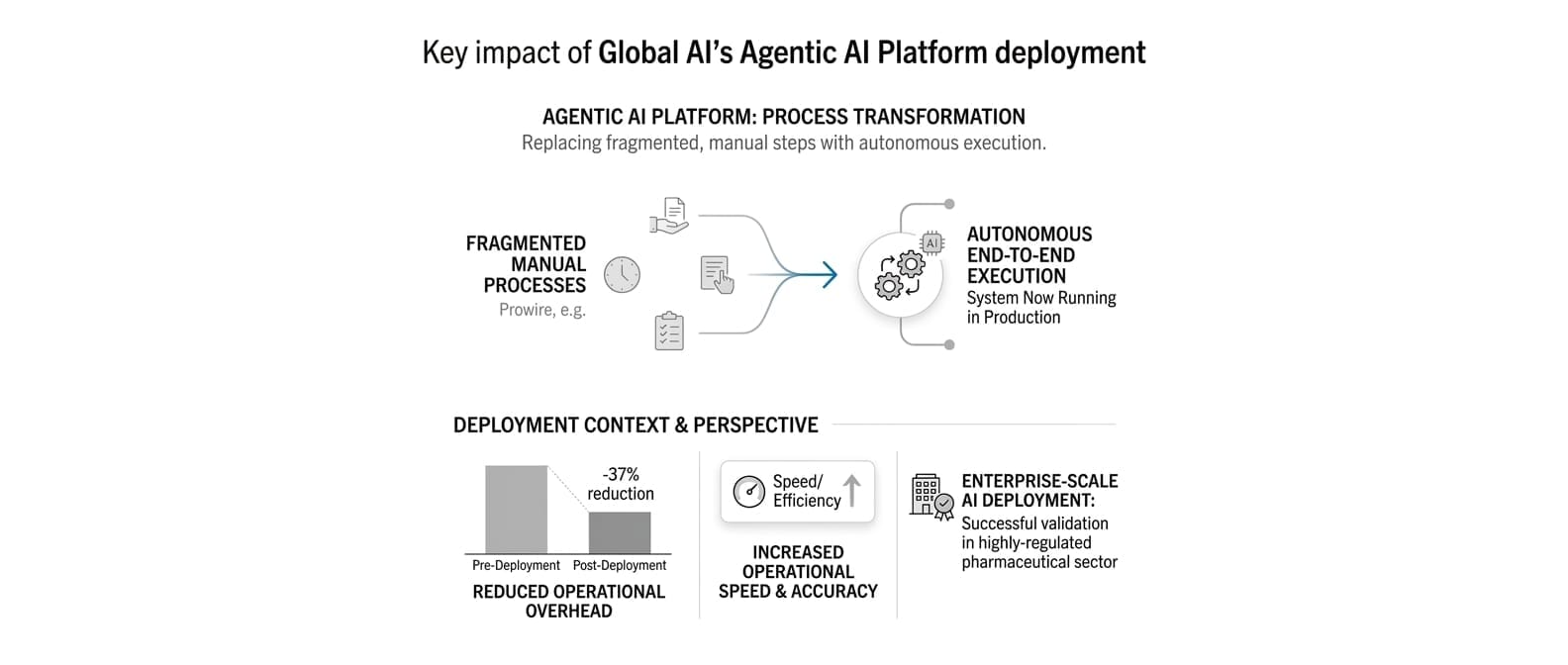
Global AI secured a major production deployment of its Agentic AI Platform with one of the largest pharmaceutical companies globally. With this deployment, Global AI is redefining how large enterprises operate - replacing fragmented, manual processes with autonomous, AI-driven execution. The system is now running end-to-end in production, significantly reducing operational overhead while increasing speed, accuracy, and compliance.
Why it matters: Demonstrates successful enterprise-scale AI agent deployment in heavily regulated industries, proving viability for complex operational automation.
Funding & Deals
Eclipse Raises $1.3 Billion Fund
Venture capital firm Eclipse has raised $1.3 billion to invest in startups working in physical industries such as artificial intelligence infrastructure, manufacturing and defense. The fund represents one of the largest pools of capital dedicated to AI infrastructure and physical world applications.
The new fund focuses specifically on companies building AI solutions for manufacturing, logistics, defense, and industrial automation, addressing the growing demand for AI applications beyond software. Eclipse has previously backed companies like Cerebras Systems and other hardware-focused AI startups, positioning itself as a key investor in the intersection of artificial intelligence and physical industry transformation.
Why it matters: Signals major capital allocation toward AI infrastructure and physical world applications, validating the industrial AI investment thesis.
Hermeus Achieves $1B Valuation
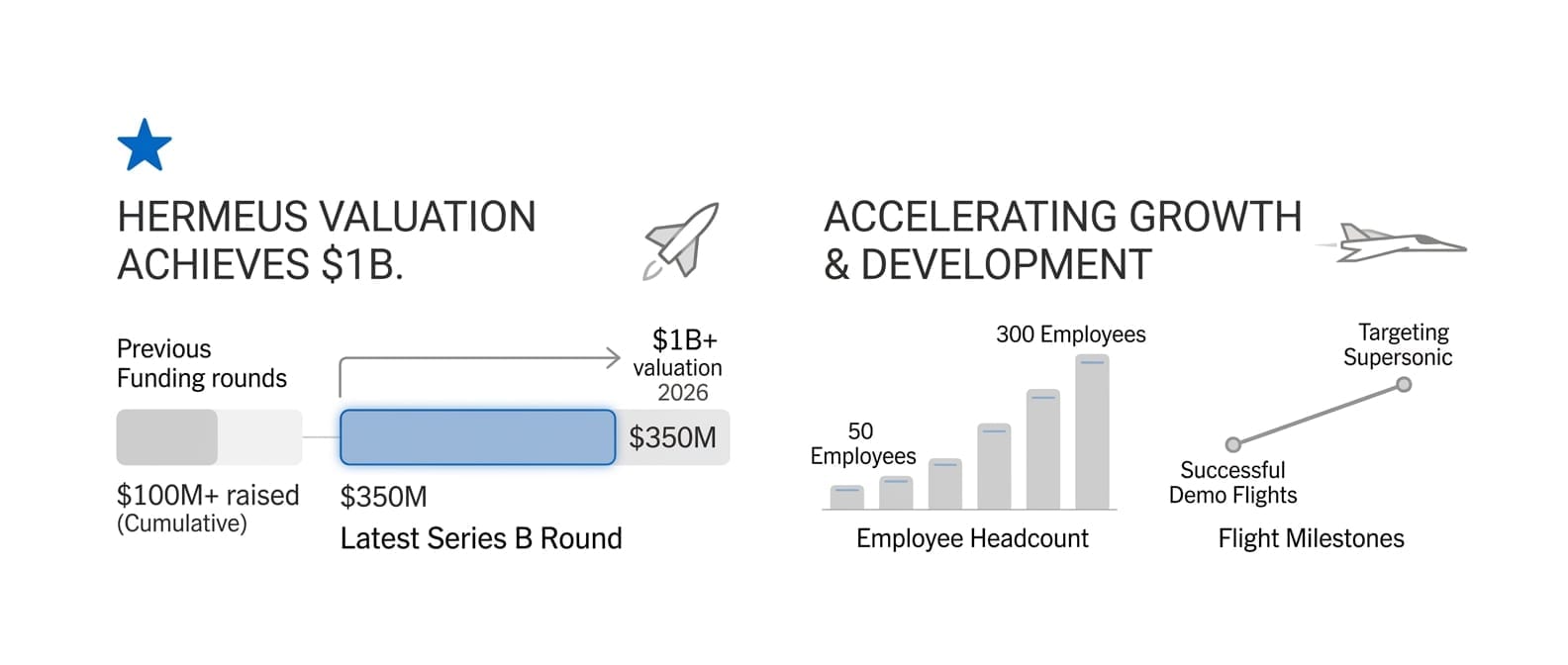
Defense startup Hermeus has raised $350 million to keep developing what it calls the "fastest unmanned aircraft," in a funding round that has pushed its valuation to $1 billion. The defense aviation startup is coming off two successful flight demonstrations, and with the next one, it's aiming to go supersonic. The new funding round will also help Hermeus continue to build out its staff, which is already approaching 300 employees.
Why it matters: Demonstrates growing investor confidence in defense technology startups and validates the market for advanced unmanned aviation systems.
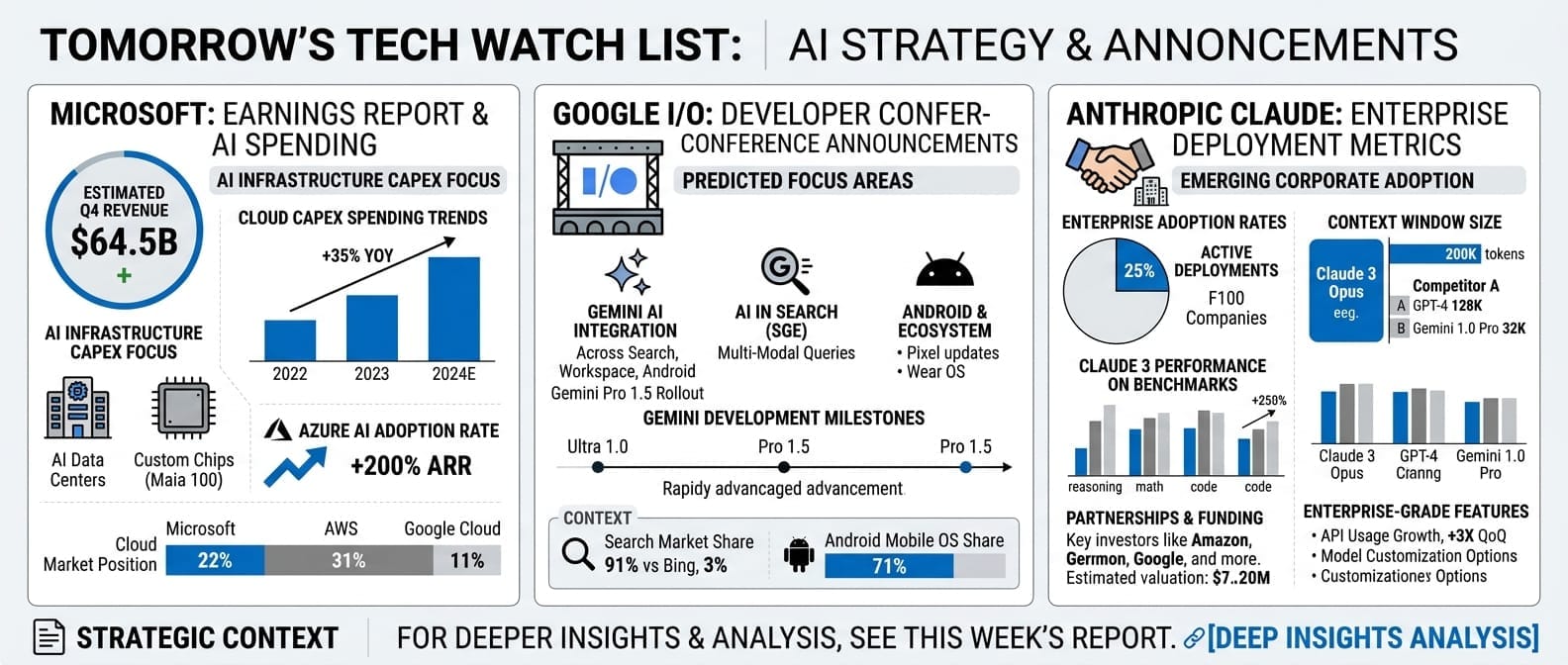
Tomorrow's Watch List
- Microsoft earnings report expected with AI infrastructure spending details
- Google I/O developer conference announcements likely
- Anthropic Claude enterprise deployment metrics
*Related reading: Check out this week's [Deep Insights analysis] for strategic context on these developments.