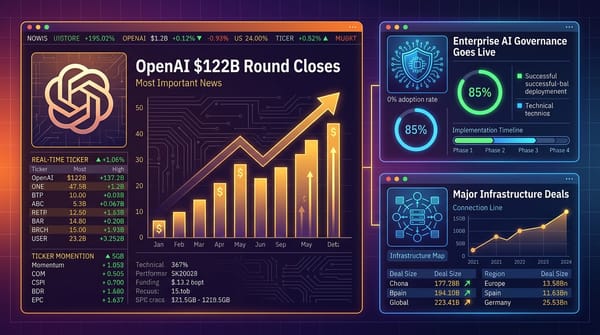
GenAI Daily - April 2, 2026: Perplexity Faces Data Sharing Lawsuit, Q1 Funding Hits Record $297B, Anthropic Source Code Leaks
Top Stories
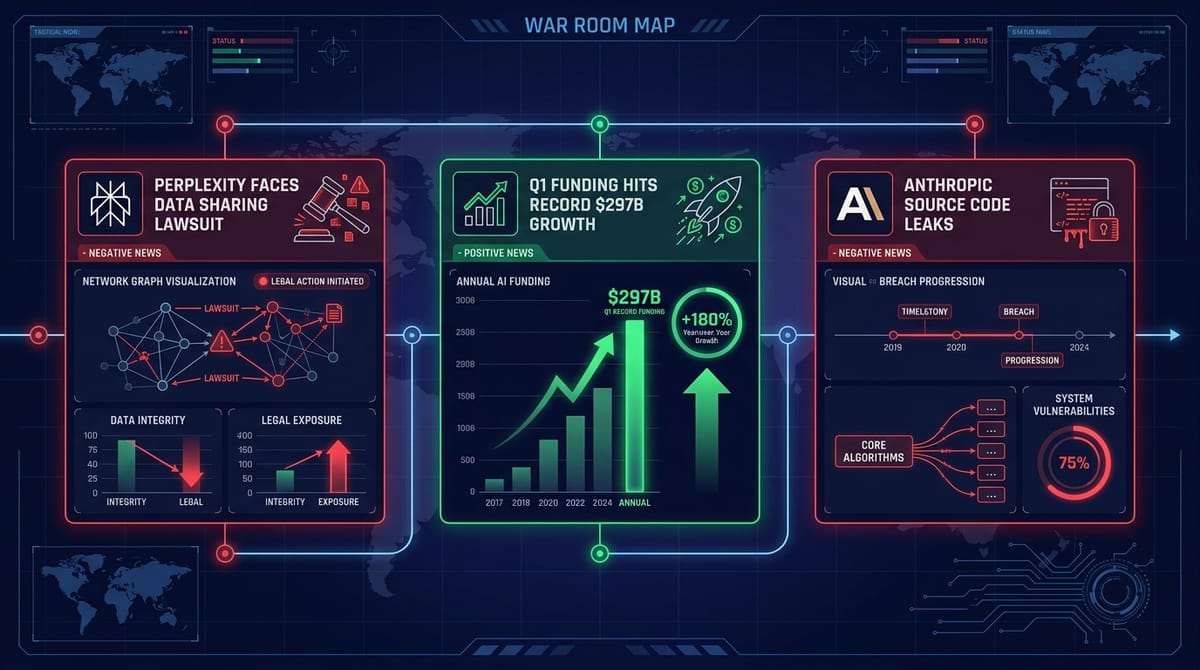
Perplexity AI Hit with Class-Action Lawsuit Over Data Sharing with Meta and Google
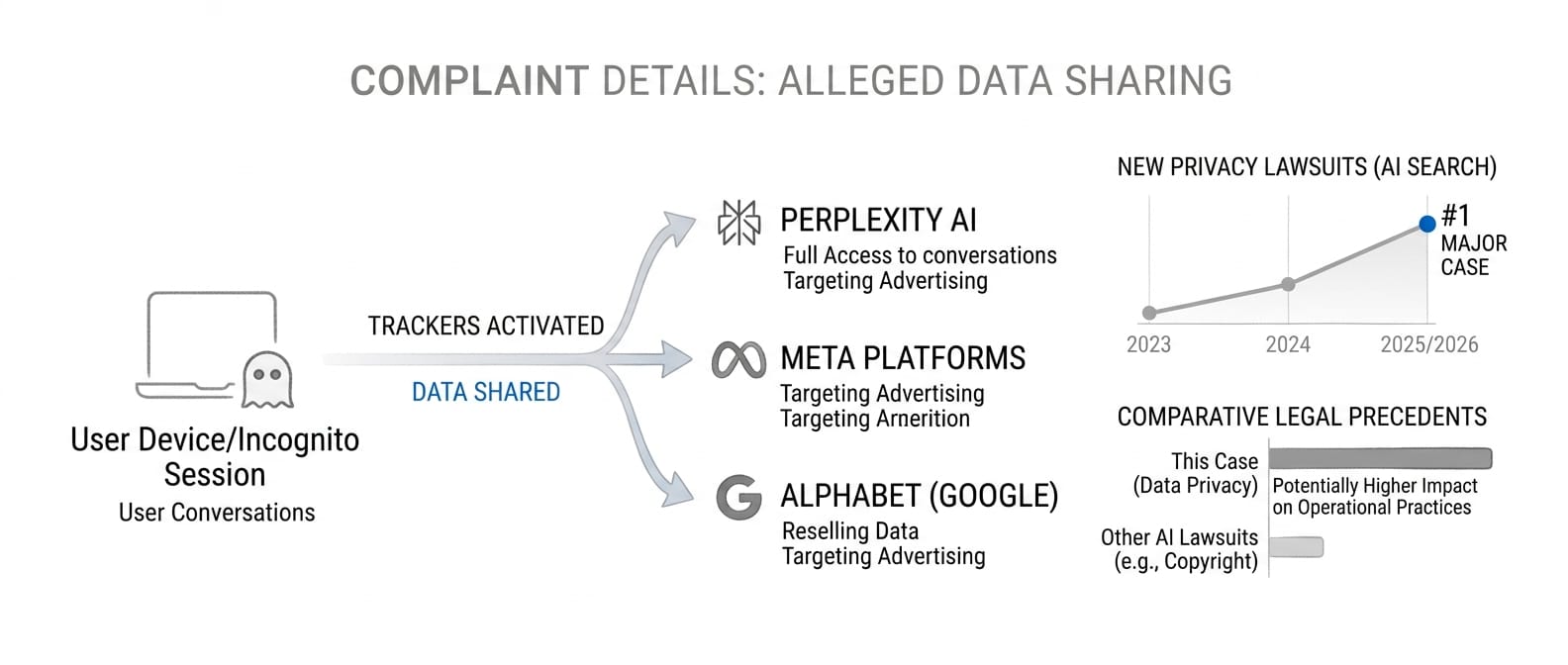
Perplexity AI Inc. was accused in a lawsuit of surreptitiously sharing the personal information of its users with Meta Platforms Inc. and Alphabet Inc.'s Google in violation of California privacy laws. As soon as users log into Perplexity's home page, trackers are downloaded onto their devices, giving Meta and Google full access to the conversations between them and Perplexity's AI Machine search engine, according to the proposed class-action complaint filed Tuesday in federal court in San Francisco.
This allows Meta and Google "to exploit this sensitive date for their own benefit, including targeting individuals with advertising and reselling their sensitive data to additional third parties," according to the complaint. Users' personal data is shared even when they sign up for Perplexity's "Incognito" mode. The suit was filed on behalf of a Utah man who says he shared financial and tax information with the chatbot.
"We have not been served any lawsuit that matches this description, so we are unable to verify its existence or claims," Jesse Dwyer, chief communications officer for Perplexity, wrote in a statement.
Why it matters: This represents the first major privacy lawsuit against an AI search platform, potentially setting legal precedents for how conversational AI handles user data and highlighting growing scrutiny of third-party tracking in AI applications.
Record-Breaking Q1 Venture Funding Driven by AI Boom
Global investing in startups hit $297 billion in Q1 2026, breaking all records, according to new Crunchbase data. That's a massive 2.5x increase over the $118 billion raised in the previous quarter.
Q1's startup investment largely went to AI startups and disproportionately to a handful of U.S.-based companies in record-setting deals. Four of the five largest venture rounds ever recorded were closed in Q1 2026, including OpenAI's $122 billion round at an $852 billion valuation and Anthropic's $30 billion raise.
These four rounds collectively raised $188 billion, accounting for more than 63% of total funding in the quarter. While it might appear that without them, fundraising appears to be on a more typical trajectory, anecdotal evidence implies otherwise.
Investors and founders say, for example, that seed-stage AI startups are commanding bigger dollars, and higher valuations at earlier stages than ever before.
Why it matters: The unprecedented funding levels signal that AI infrastructure investments are fundamentally reshaping venture capital, with implications for startup valuations, competition for talent, and enterprise adoption timelines across all sectors.
OpenAI Secondary Market Demand Drops as Anthropic Gains Favor
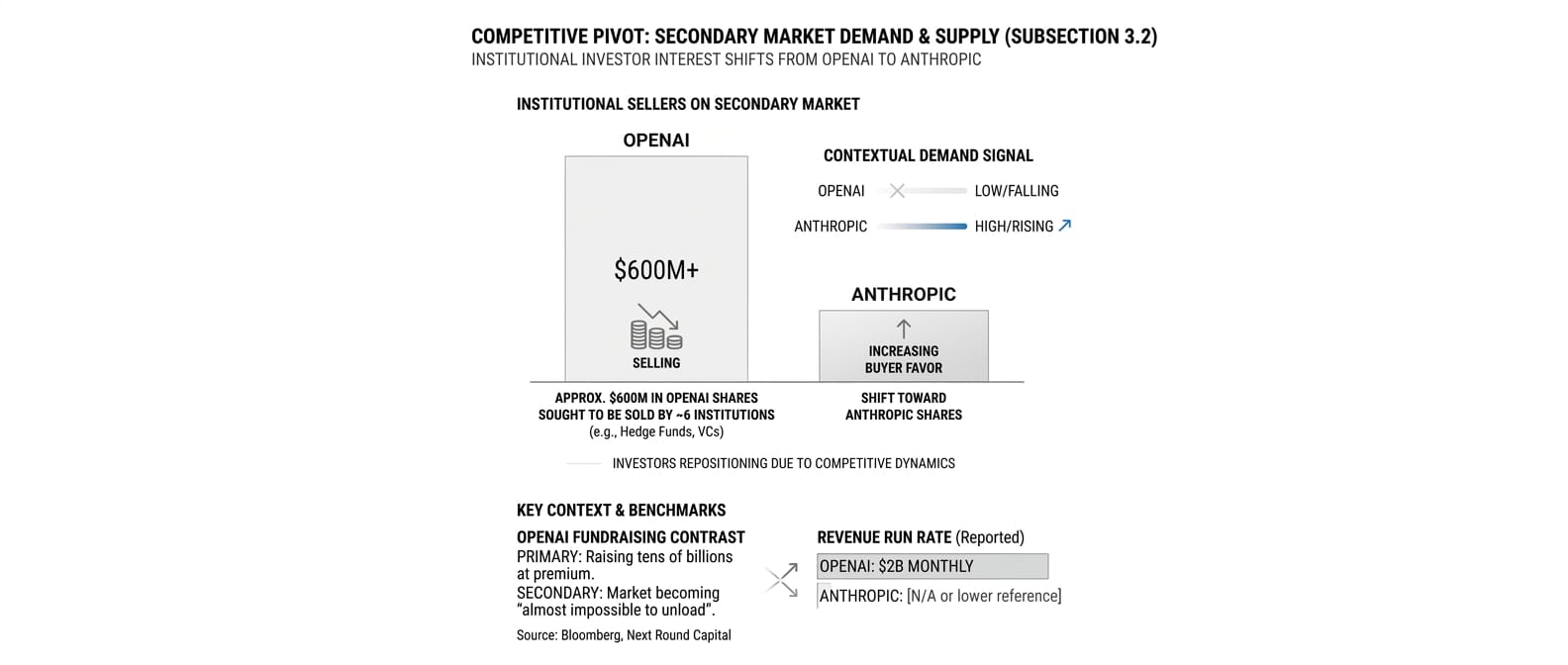
OpenAI shares have fallen out of favor on the secondary market - in some cases becoming almost impossible to unload - as investors pivot quickly to Anthropic, its biggest competitor. Even as OpenAI raced in recent months to raise tens of billions of dollars, Next Round Capital founder Ken Smythe said his secondary marketplace was seeing a drop in demand for shares of the artificial-intelligence giant.
About a half-dozen institutional investors - including hedge funds and venture capital firms that hold large stakes - approached his company in recent weeks looking to sell about $600 million of OpenAI shares. This shift comes despite OpenAI's record-breaking primary fundraising and its reported $2 billion monthly revenue run rate.
Why it matters: Secondary market sentiment often signals early institutional confidence shifts ahead of public markets, suggesting investors are repositioning based on competitive dynamics rather than just financial metrics.
Key Developments
Anthropic Accidentally Leaks Claude Code Source Code
Anthropic is racing to contain the fallout after accidentally leaking Claude Code source code, issuing copyright takedown requests to remove 8,000+ copies, according to reporting from the Wall Street Journal. The leak represents a significant security incident for the AI safety company as it competes with OpenAI and other major labs.
The incident highlights the challenges AI companies face in protecting proprietary algorithms and training methodologies as competition intensifies. Anthropic has been positioning itself as a safety-focused alternative to OpenAI, making this security breach particularly sensitive for the company's reputation.
Impact: This leak could accelerate competitive development by giving rivals insights into Anthropic's approach to code generation, potentially eroding some of their technical advantages in the enterprise coding market.
Google Vertex AI Updates Target Enterprise AI Deployment
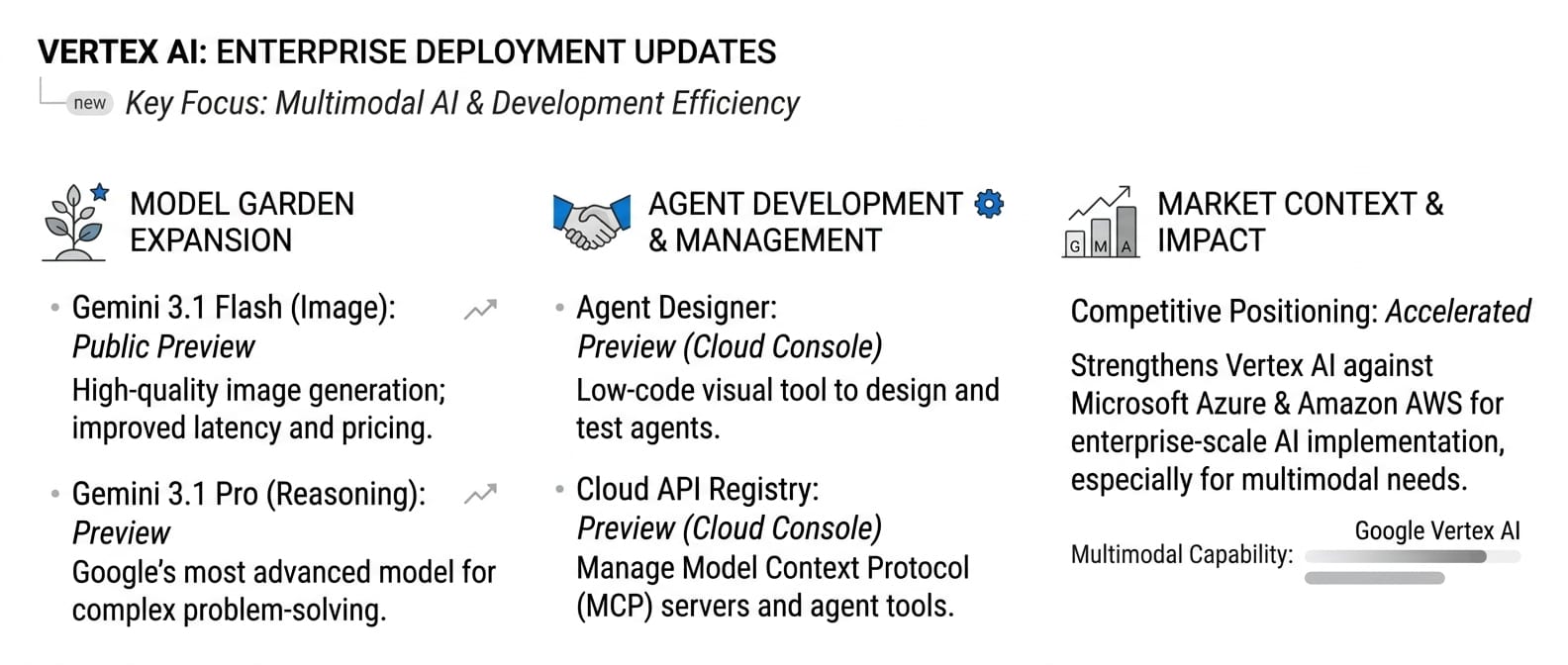
Gemini 3.1 Flash Image (gemini-3.1-flash-image) is available in public preview. This release enables high-quality image generation with improved pricing and latency.
Gemini 3.1 Pro is available in preview in Model Garden, offering enterprises access to Google's most advanced reasoning model for complex problem-solving across multiple information sources.
Agent Designer, a low-code visual designer that lets you design and test your agent, is now available in the Google Cloud console in Preview. The update also includes Cloud API Registry is available in the Google Cloud console in Preview. Use Cloud API Registry in the Google Cloud console to view and manage the MCP servers and tools your agent has access to.
Impact: These enterprise-focused updates position Google to compete more directly with Microsoft and Amazon in the enterprise AI platform space, particularly for organizations needing multimodal AI capabilities.
Amazon Polly Launches Bidirectional Streaming API
Today, we're excited to announce the new Bidirectional Streaming API for Amazon Polly, enabling streamlined real-time text-to-speech (TTS) synthesis where you can start sending text and receiving audio simultaneously. This new API is built for conversational AI applications that generate text or audio incrementally, like responses from large language models (LLMs), where users must begin synthesizing audio before the full text is available.
The API addresses a key bottleneck in real-time conversational AI applications, where traditional text-to-speech requires waiting for complete text before starting audio synthesis. This improvement enables more natural, responsive voice interactions in enterprise applications.
Impact: This infrastructure upgrade enables enterprises to deploy more responsive voice AI applications, potentially accelerating adoption of voice interfaces in customer service and internal productivity tools.
Product Launches
Austin-Based Coder Raises $90M Series C
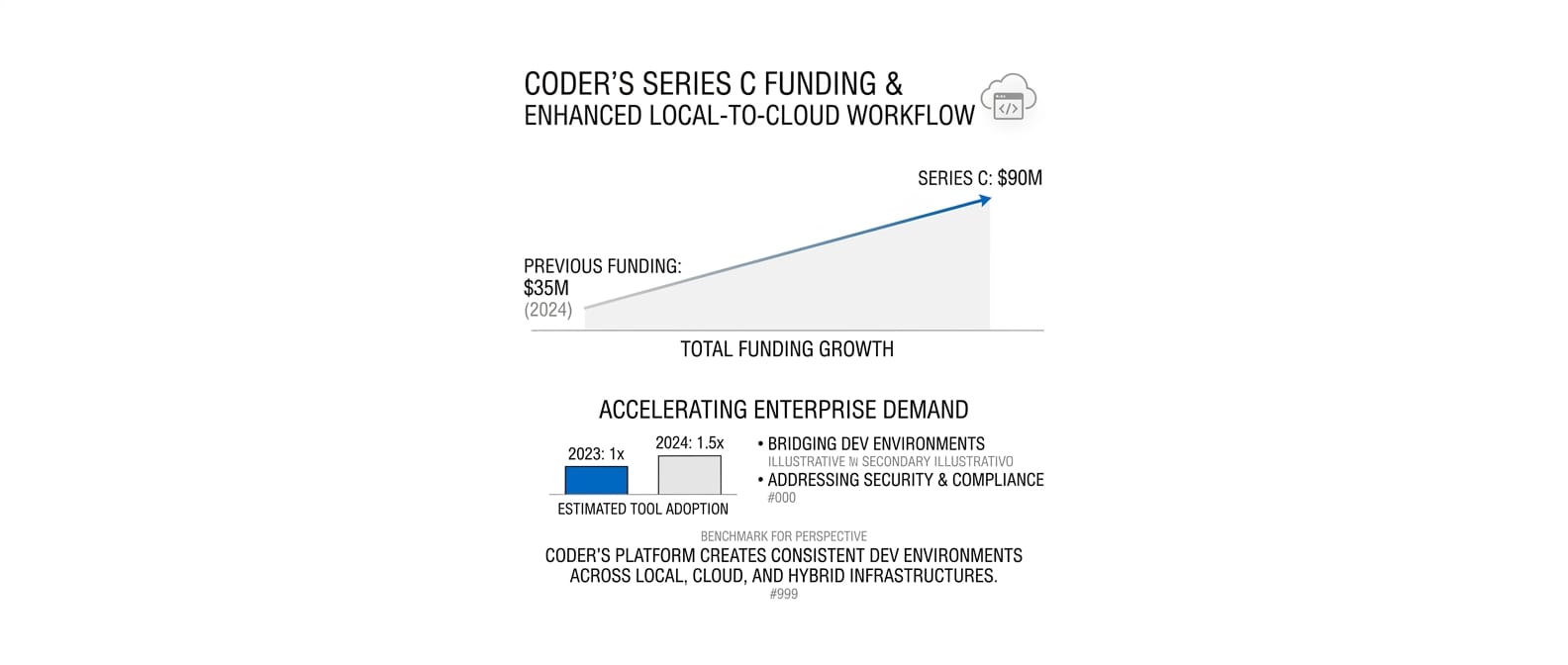
Austin-based Coder, which helps developers build and run code from local devices to the cloud, raised a $90M Series C led by KKR, after raising $35M in 2024. The platform enables developers to create consistent development environments across local, cloud, and hybrid infrastructures.
The funding reflects growing enterprise demand for developer productivity tools that bridge on-premises and cloud development workflows. Coder's approach addresses security and compliance concerns while enabling flexible development environments.
TCS Launches Rapid Outcome AI Platform with NVIDIA
Tata Consultancy Services (TCS) today launched, a new enterprise platform designed to help organizations accelerate their journey from AI experimentation to production deployment powered by NVIDIA. By leveraging predictive analytics, generative AI, computer vision, and agentic and Physical AI blueprints tailored for industry-specific processes, TCS and NVIDIA will help enterprises achieve higher levels of autonomy across their enterprise workflows.
TCS Rapid Outcome AI enables organizations across sectors such as manufacturing, telecommunications, banking, retail, life sciences, and engineering services to run AI applications at scale. These applications help automate decisions, increase operational visibility, reduce manual interventions, and improve productivity across enterprise processes and operational environments.
Funding & Deals
LMArena Rebrands to "Arena" Following $150M Series A
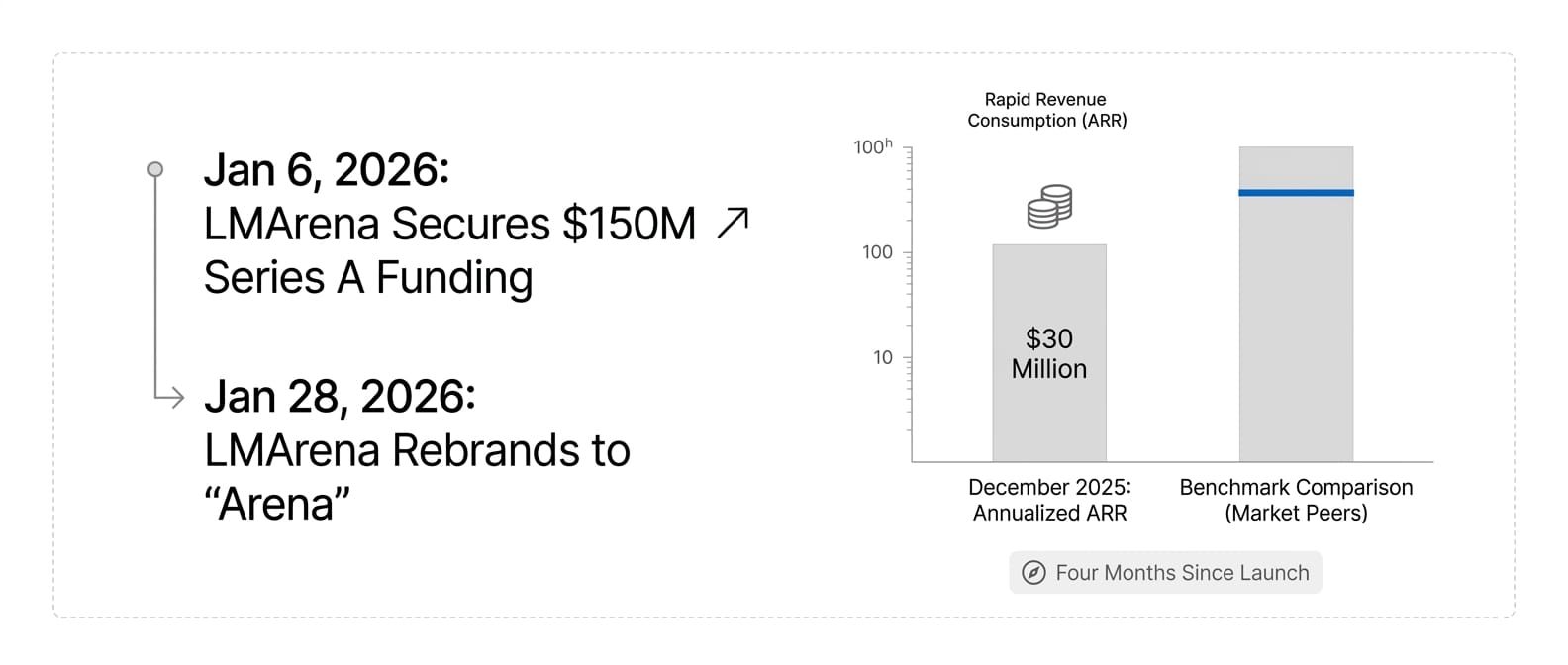
On January 6, 2026, LMArena announced the closing of a $150 million Series A funding round, bringing the company's post-money valuation to approximately $1.7 billion. The round was led by Felicis and UC Investments (University of California), with participation from Andreessen Horowitz, The House Fund, LDVP, Kleiner Perkins, Lightspeed Venture Partners, and Laude Ventures.
On January 28, 2026, LMArena rebranded to "Arena".
The AI evaluation platform has become the de facto standard for model comparisons, with its community-driven approach to testing AI models. This gave LMArena an annualized "consumption rate" - as the company describes its annual recurring revenue (ARR) - of $30 million as of December, less than four months after launch.
Normal Semiconductor Raises $23M Series A
Samsung Catalyst led the round as part of Samsung's $73B+ 2026 investment plan in AI semiconductors. Samsung Catalyst led the round as part of Samsung's $73B+ 2026 investment plan in AI semiconductors. The company's physics-based ASICs work with natural thermal dynamics rather than fighting them, unlocking fundamentally new architectures for AI workloads.
Normal Semiconductor develops AI-native chip design tools and thermodynamic computing hardware targeting up to 1,000× energy efficiency gains for generative AI inference. AI-native semiconductor design startup building the Normal EDA platform - already used by more than half of the world's top 10 chip companies - plus developing thermodynamic computing hardware (CN101 chip taped out August 2025).
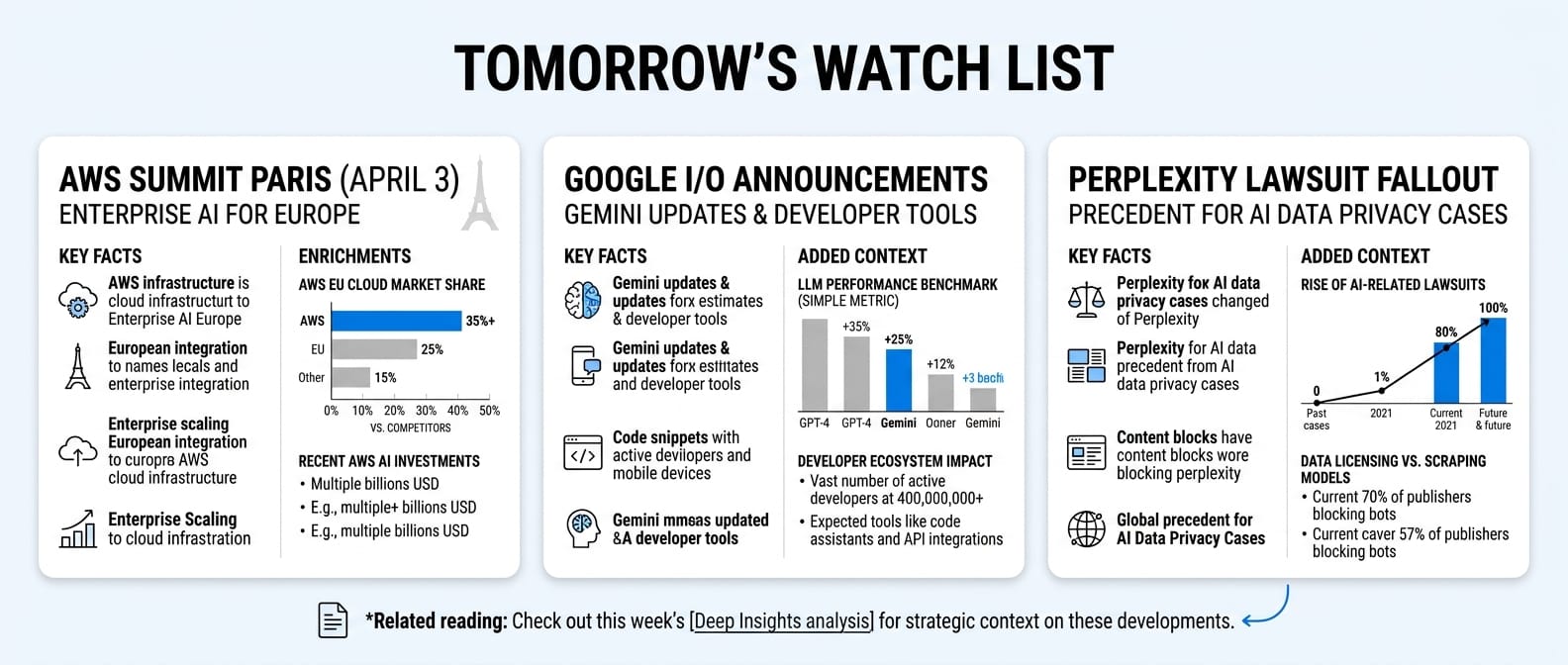
Tomorrow's Watch List
- AWS Summit Paris (April 3) - Expect enterprise AI announcements focused on European markets
- Google I/O announcements - Potential Gemini updates and new developer tools
- Continued fallout from Perplexity lawsuit - May set precedent for AI data privacy cases
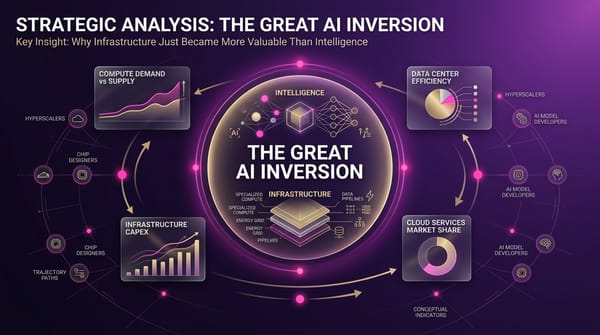
*Related reading: Check out this week's [Deep Insights analysis] for strategic context on these developments.