GenAI Daily - April 6, 2026: NVIDIA Agent Toolkit Expands Enterprise Reach, Google Workspace Launches AI-Powered User Purchases, OpenAI Releases Agents SDK
Top Stories
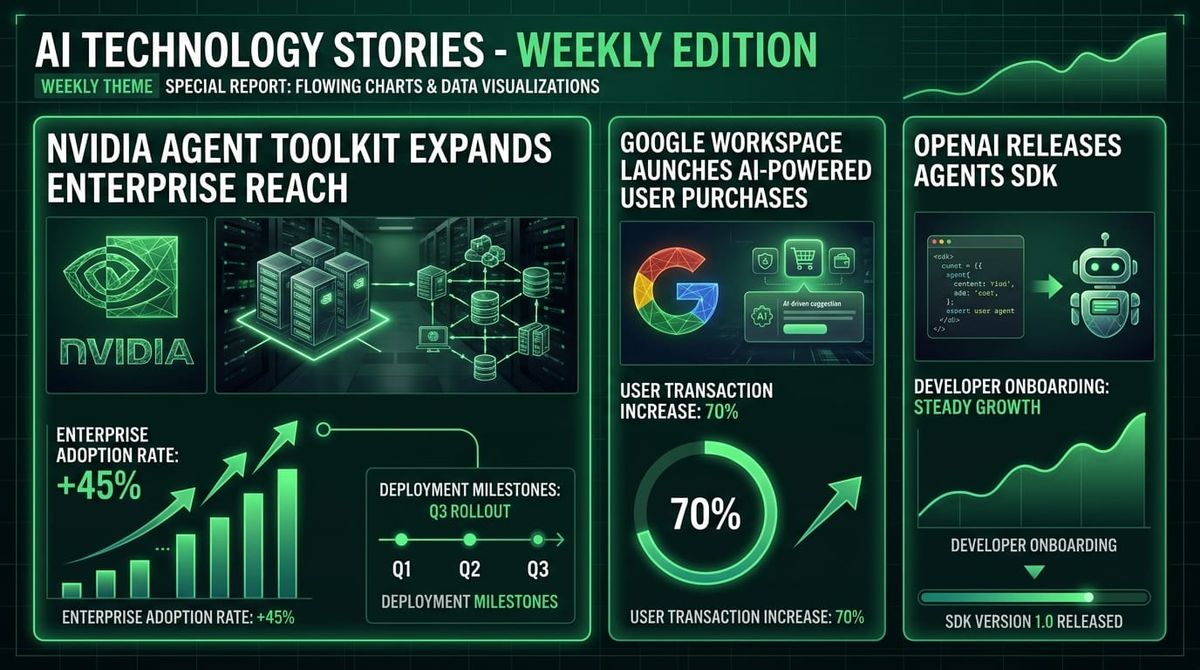
NVIDIA Agent Toolkit Gains 17 Enterprise Partners Including Adobe, Salesforce, and SAP
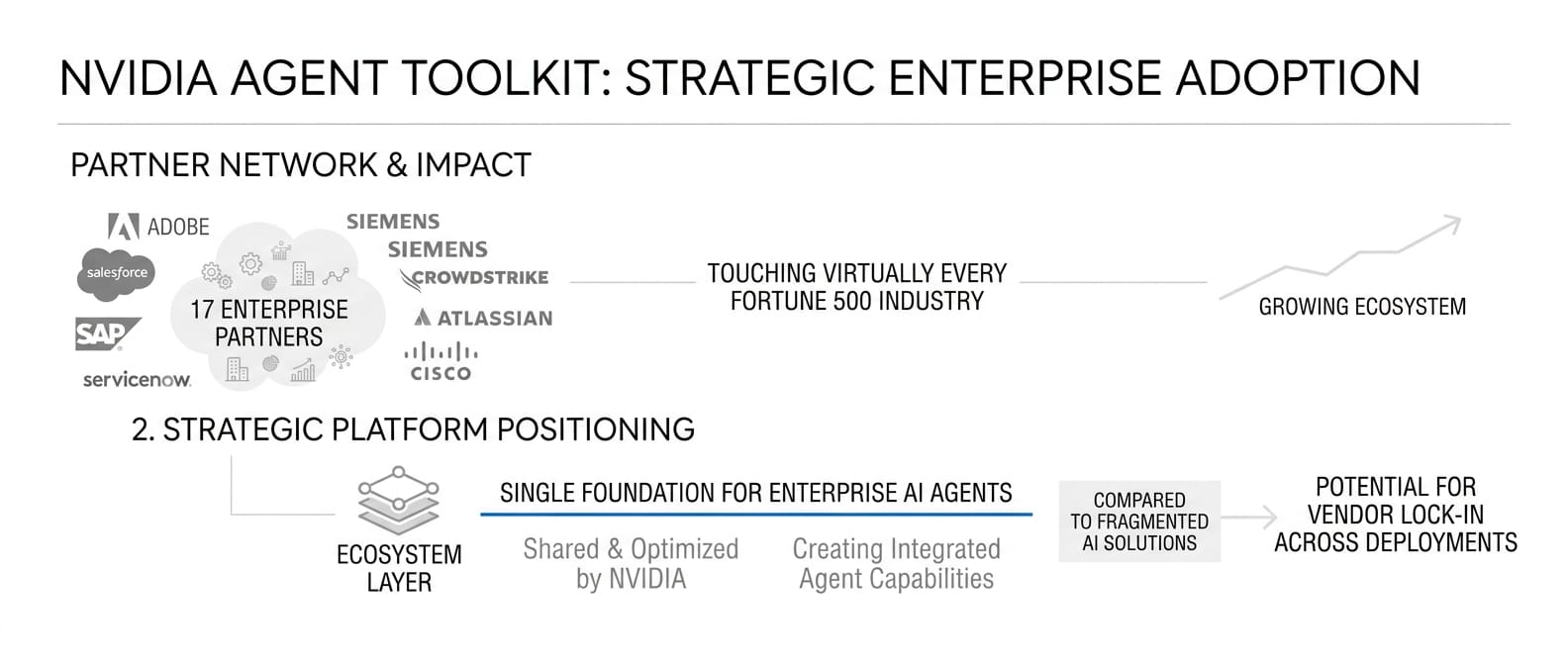
NVIDIA CEO Jensen Huang unveiled the Agent Toolkit, an open-source platform for building autonomous AI agents, with adoption from Adobe, Salesforce, SAP, ServiceNow, Siemens, CrowdStrike, Atlassian, Cadence, Synopsys, IQVIA, Palantir, Box, Cohesity, Dassault Systèmes, Red Hat, Cisco and Amdocs.
Seventeen enterprise software companies, touching virtually every industry and every Fortune 500 corporation, all agreeing to build their next generation of AI products on a shared foundation that NVIDIA designed, NVIDIA optimizes and NVIDIA maintains.
The toolkit provides the models, the runtime, the security framework and the optimization libraries that AI agents need to operate autonomously inside organizations - resolving customer service tickets, designing semiconductors, managing clinical trials, orchestrating marketing campaigns. For enterprise buyers, for Salesforce, it means Agentforce agents that can draw from both cloud and on-premises data through a single Slack interface. For Adobe, it means creative AI pipelines that span image, video, 3D and document intelligence. For SAP, it means agents woven into the transactional fabric of global commerce.
Why it matters: NVIDIA's platform strategy positions it to own the agent ecosystem layer the same way it dominates AI hardware, potentially creating vendor lock-in across enterprise AI deployments.
Google Workspace Enables User-Initiated AI Add-on Purchases Starting April 7
Google is introducing a new capability that allows end users to purchase Google Workspace add-ons directly, starting with the AI Expanded Access add-on for users in the United States and Canada with a Google Workspace Business edition. This feature is designed to help organizations and admins address the growing demand for AI tools while simplifying how users can get higher access to the latest advanced AI tools in Workspace.
Currently, users who want more access to advanced AI capabilities - such as higher usage in the Gemini app and NotebookLM, or specialized tools like Veo 3 or Avatar creation in Google Vids - must rely on their IT administrators to procure and assign add-on licenses. This can create bottlenecks for motivated users who have adopted these tools and are eager to further boost their productivity with Google Workspace.
Why it matters: This self-service model could accelerate enterprise AI adoption by removing procurement friction, but also creates potential budget control challenges for IT departments.
ServiceNow Now Assist Reaches $1 Billion Run Rate, Fastest Product Launch in Company History
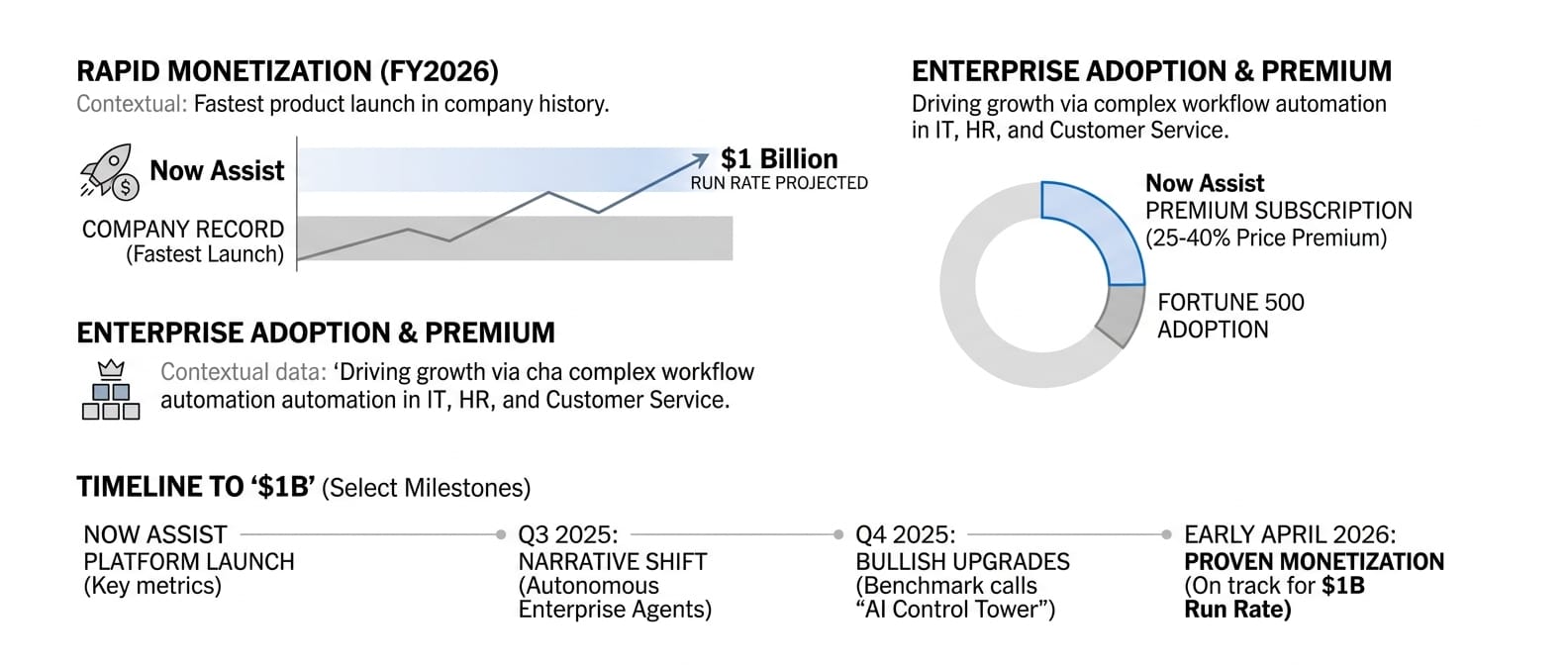
As of early April 2026, the product is on a confirmed trajectory to reach a $1 billion run rate by the end of the fiscal year, making it the fastest-growing product launch in the company's history. Key stakeholders, led by CEO Bill McDermott, have spent the last two quarters pivoting the company's narrative away from simple automation and toward the concept of "autonomous enterprise agents".
This high-end subscription, which carries a 25% to 40% price premium over standard versions, has seen massive uptake among Fortune 500 companies looking to automate complex workflows in IT, HR, and customer service. The catalyst for the surge was a combination of record-breaking internal metrics for the company's "Now Assist" platform and a series of bullish upgrades from major institutions, most notably Benchmark, which highlighted ServiceNow as the "AI Control Tower" for the modern enterprise. The timeline leading to this moment is defined by a rapid acceleration of AI adoption within the ServiceNow ecosystem.
Why it matters: ServiceNow's success demonstrates that enterprise AI monetization has moved beyond experimentation to real revenue generation at scale.
Key Developments
OpenAI Releases Agents SDK and Built-in Tools for Responses API
OpenAI released a set of built-in tools for the Responses API: web search, file search, and computer use. Released the Agents SDK, an orchestration framework for designing, building, and deploying agents. The company also announced new models: gpt-4o-search-preview, gpt-4o-mini-search-preview, computer-use-preview, and announced plans to bring all Assistants API features to the easier to use Responses API, with an anticipated sunset date for Assistants in 2026 (after achieving full feature parity).
Impact: The Agents SDK standardizes OpenAI's approach to enterprise agent development, while API consolidation simplifies developer workflows.
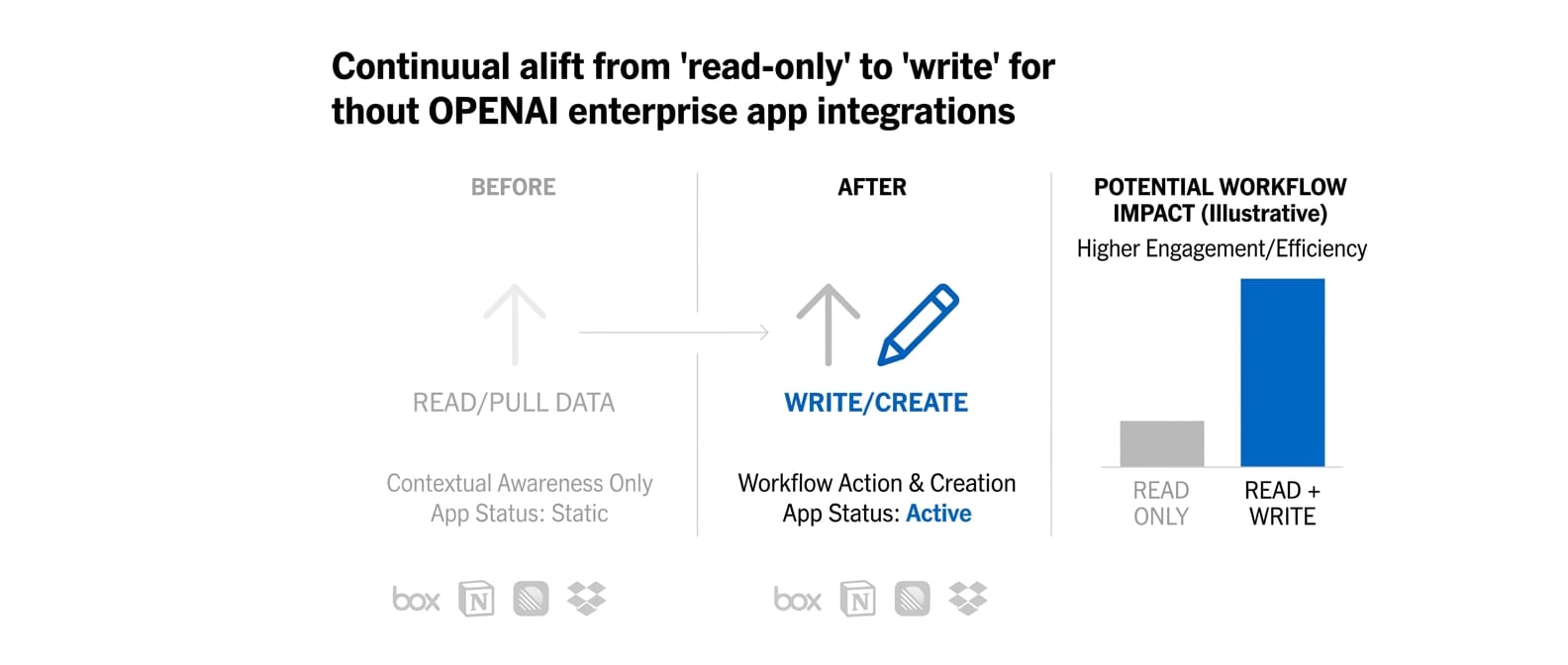
OpenAI Updates Enterprise App Integrations with Write Capabilities
OpenAI is rolling out updated Box, Notion, Linear, and Dropbox apps in ChatGPT. These updates add new app actions, including new write capabilities where supported, and bring the latest app experience into ChatGPT. If you already use these apps in ChatGPT, reconnect the app to start using the updated experience.
Impact: Write capabilities transform ChatGPT from a read-only assistant to an active workflow participant in enterprise productivity tools.
Google Forms AI Creation Expands to 21 Additional Languages
Google announced Help me create in Google Forms and then expanded access to the feature to seven more languages. Help me create in Google Forms drafts your questions 3x faster than doing it manually. Now, this feature is also available to users in 21 more languages including Arabic, Catalan, Czech, Danish, Dutch, English, Finnish, French, German, Greek, Hebrew, Hungarian, Indonesian, Italian, Japanese, Korean, Malay, Mandarin, Norwegian, Polish, Portuguese, Romanian, Russian, Spanish, Swedish, Thai, Turkish, Ukrainian and Vietnamese.
Impact: Global language expansion accelerates enterprise Gemini adoption beyond English-speaking markets.
Product Launches
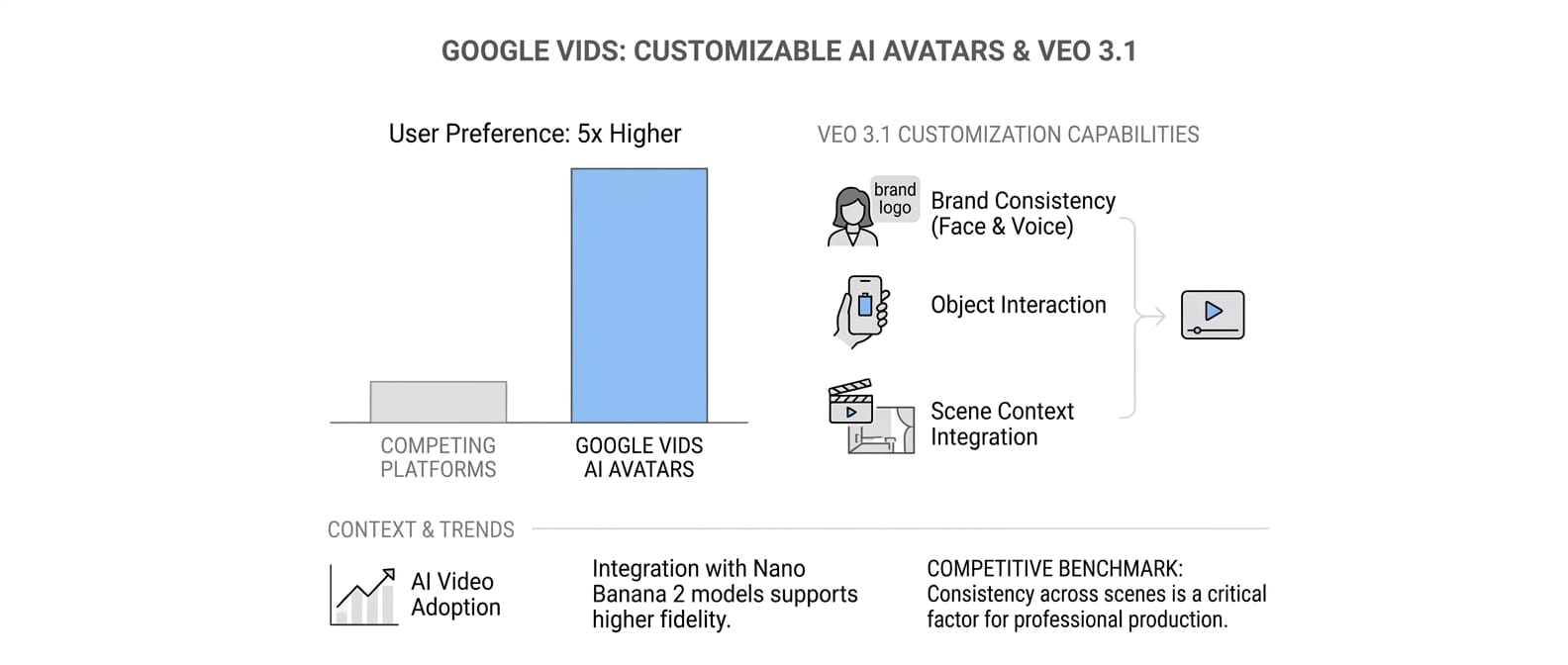
Google Vids AI Avatars with Veo 3.1 Customization
AI Avatars in Google Vids provide high-quality speakers preferred five times more often than those on other platforms. Now you can customize and refine these avatars to match your brand and message, with Nano Banana 2. Users can now place avatars in different scenes and have them interact with objects you specify, like your newly released product or a piece of safety equipment. Their faces and voices will remain consistent as you generate different scenes.
Google Vids Screen Recorder Chrome Extension
Users can now quickly record their screen from any browser window using the new Google Vids Screen Recorder Chrome extension. Instead of having to open Google Vids to access recording functionality, you can now initiate a recording with a single click right from the Chrome extensions toolbar. This is available at no additional cost to Google Workspace customers and anyone with a personal Google account.
Funding & Deals
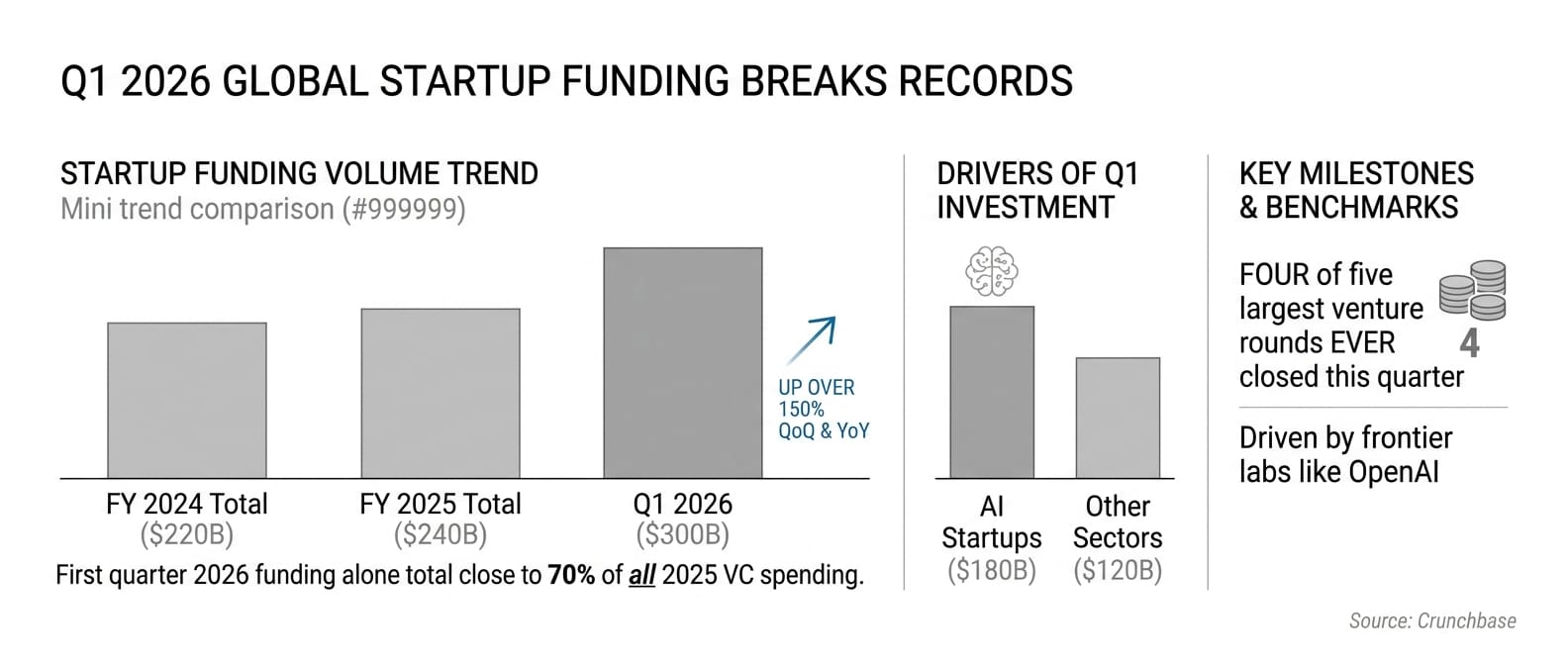
Q1 2026 Global Startup Funding Reaches Record $300 Billion
Crunchbase data shows investors poured $300 billion into 6,000 startups globally in the quarter, up over 150% quarter over quarter and year over year. That marks an all-time high for global venture investment not approached by any other quarter on record. In fact, startup investment in the first quarter of 2026 alone totaled close to 70% of all venture capital spending in 2025. Q1's startup investment largely went to AI startups and disproportionately to a handful of U.S.-based companies in record-setting deals. Four of the five largest venture rounds ever recorded were closed in Q1 2026, with frontier labs OpenAI.
OpenAI Closes $122 Billion Round at $852 Billion Valuation - UPDATE
OpenAI has closed a deal to raise $122 billion at an $852 billion valuation, its largest funding round to date as the company is expected to hit the public markets this year. The round will add to OpenAI's war chest as it spends enormous amounts of money on AI chips, data center buildouts, and hiring top talent. SoftBank co-led the round alongside Andreessen Horowitz, D.E. Shaw Ventures, MGX, TPG, and T. Rowe Price Associates, with participation from Amazon, Nvidia, and Microsoft. About $3 billion came from individual investors via bank channels.
Tomorrow's Watch List
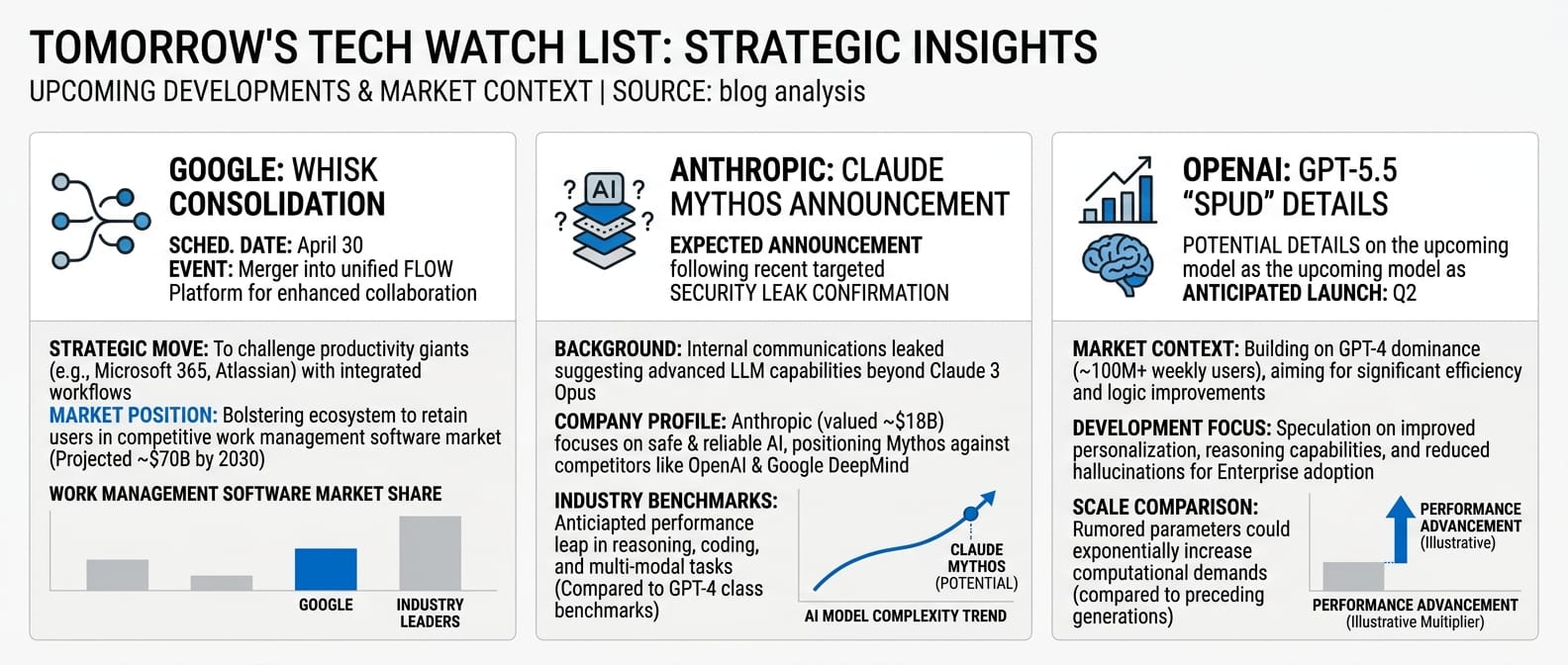
- Google Whisk consolidation into Flow platform scheduled for April 30
- Expected announcement of Claude Mythos following recent security leak confirmation
- Potential GPT-5.5 "Spud" model details as Q2 launch approaches
*Related reading: Check out this week's [Deep Insights analysis] for strategic context on these developments.