GenAI Daily - February 19, 2026: AI Scare Trade Rocks Markets, Anthropic Ships Sonnet 4.6, Cadence Revolutionizes Chip Design
Top Story
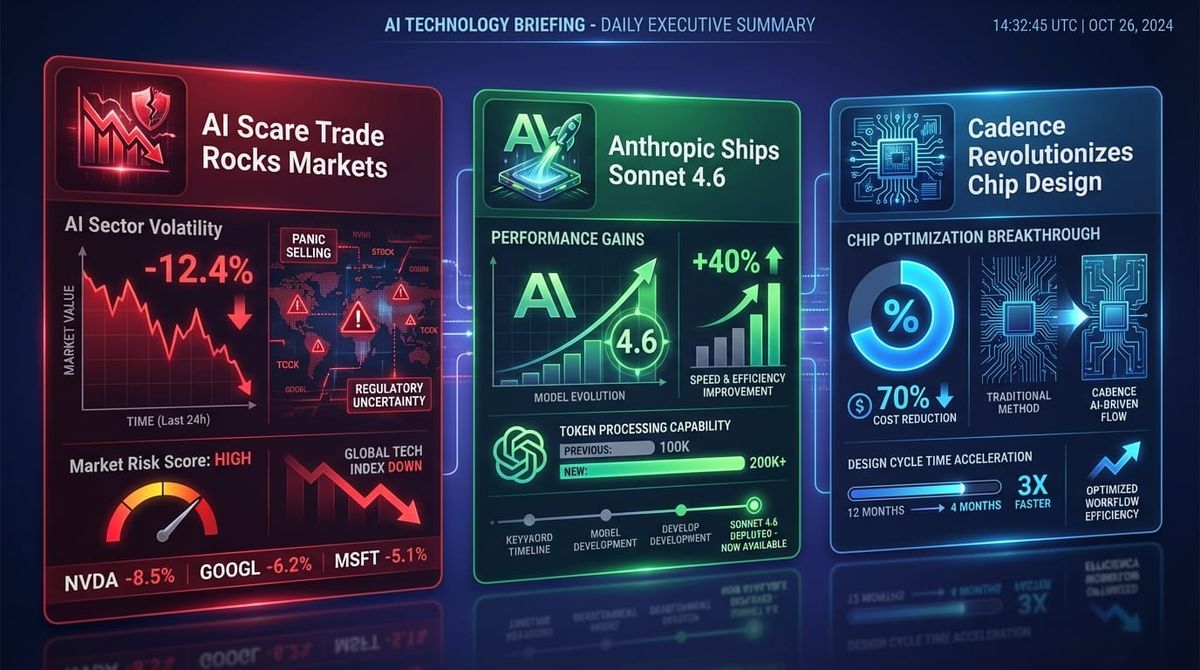
The "AI Scare Trade" reached a crescendo yesterday as global markets witnessed what analysts called a "violent rotation of capital" away from service-oriented sectors including wealth management, financial services, and real estate. The catalyst was a convergence of technological breakthroughs, specifically the launch of "Hazel" by fintech firm Altruist - an autonomous AI platform capable of generating complex tax and estate strategies without human intervention. By market close on February 18, Charles Schwab (NYSE: SCHW) dropped over 7%, while Raymond James (NYSE: RJF) and LPL Financial (NASDAQ: LPLA) plummeted more than 8%.
However, infrastructure players emerged as clear winners. Cadence Design Systems (NASDAQ: CDNS) surged over 9% following its release of the world's first agentic AI solution for chip design, which claims to improve engineering productivity by 10x. This highlighted a key market theme: investors are favoring companies with "AI-defensibility" - those that own proprietary data or create the tools that enable AI development - while punishing "information brokers" whose value relies on human-mediated processing.
Why it matters: Enterprise technology leaders must now consider not just how AI will improve their operations, but whether their core business models are vulnerable to AI-native competitors offering similar services at dramatically lower costs.
Key Developments
Anthropic Ships Claude Sonnet 4.6 as New Default Model
Anthropic released Claude Sonnet 4.6 yesterday, calling it their "most capable Sonnet model yet" with full upgrades across coding, computer use, long-context reasoning, agent planning, knowledge work, and design. The model features a 1M token context window in beta.
For Free and Pro plan users, Sonnet 4.6 is now the default model in claude.ai and Claude Cowork. Improvements in consistency and instruction following led developers with early access to prefer Sonnet 4.6 over its predecessor by a wide margin, often even preferring it to Claude Opus 4.5, their smartest model from November 2025.
Impact: Sonnet-class performance now matches what previously required premium Opus models, potentially accelerating enterprise AI adoption by making advanced capabilities more accessible and affordable.
GitHub and AWS Deploy Claude Sonnet 4.6 for Developers
Claude Sonnet 4.6 is now rolling out in GitHub Copilot, where early testing shows the model excels at agentic coding and is particularly successful in search operations.
Amazon Bedrock also supports Claude Sonnet 4.6, which offers frontier performance across coding, agents, and professional work at scale. According to Anthropic, it's their best computer use model yet, allowing organizations to deploy browser-based automation across business tools with near-human reliability.
Impact: Major cloud platforms are rapidly integrating latest AI capabilities, giving enterprises immediate access to advanced agentic workflows without infrastructure overhead.
Cadence Launches World's First Agentic AI for Chip Design
Cadence announced the ChipStack AI Super Agent, which they claim is the world's first agentic workflow for automating chip design and verification. The system provides up to 10X productivity improvements for coding designs and testbenches, creating test plans, orchestrating regression testing, debugging and automatically fixing issues.
The system is in early deployment with several top chip companies, including Altera, NVIDIA, Qualcomm and Tenstorrent. Altera reports the system has "significantly reduced our verification effort in some areas by approximately 10X."
Impact: Addresses critical semiconductor industry bottleneck where engineering teams spend up to 70% of their time writing and testing code, potentially accelerating chip development cycles significantly.
Record AI Funding Pace Continues - 17 Companies Raise $100M+ in Two Months
Seventeen U.S.-based AI startups have already secured funding rounds exceeding $100 million each in the first two months of 2026, maintaining the explosive growth trajectory from 2025's $76 billion in mega-round funding.
Three U.S.-based AI companies raised rounds larger than $1 billion so far in 2026. Media-generation platform Runway raised a $315 million Series E round that valued the company at $5.3 billion, led by General Atlantic with participation from Nvidia, Fidelity, and Felicis.
Impact: Sustained mega-round activity demonstrates investor conviction that AI represents generational transformation, but also heightens competitive pressure and valuation expectations.
Product Launches
- Figma Code to Canvas: Partnership with Anthropic converts Claude-generated code into fully editable designs inside Figma, streamlining design-to-development workflow (source)
- Microsoft Advertising AI Features: Enhanced ad preview hub for Audience ads plus AI-generated negative keywords to automatically block unwanted search traffic (source)
Funding & Deals
- Goodfire - $150M Series B: AI research lab focused on interpretability platform, led by B Capital with participation from Juniper Ventures, Lightspeed, and Menlo Ventures at $1.25B valuation (source)
- Fundamental - $255M Series A: AI research company at $1.4B valuation, with investors including Oak HC/FT, Salesforce Ventures, Valor Equity Partners, and QP Ventures (source)
- ElevenLabs - $500M Series D: Voice AI company led by Sequoia at $11B valuation, demonstrating continued investor appetite for multimodal AI capabilities (source)
Tomorrow's Watch List
- Monitor market reaction to continued "AI Scare Trade" developments and which sectors face additional pressure
- Samsung Galaxy Unpacked on February 25 promises "personal and adaptive" AI innovations
- Watch for enterprise responses to Anthropic's Sonnet 4.6 deployment across major platforms
Related reading: Today's market dynamics demonstrate AI's transition from enabler to disruptor, with clear winners and losers emerging across traditional service industries.