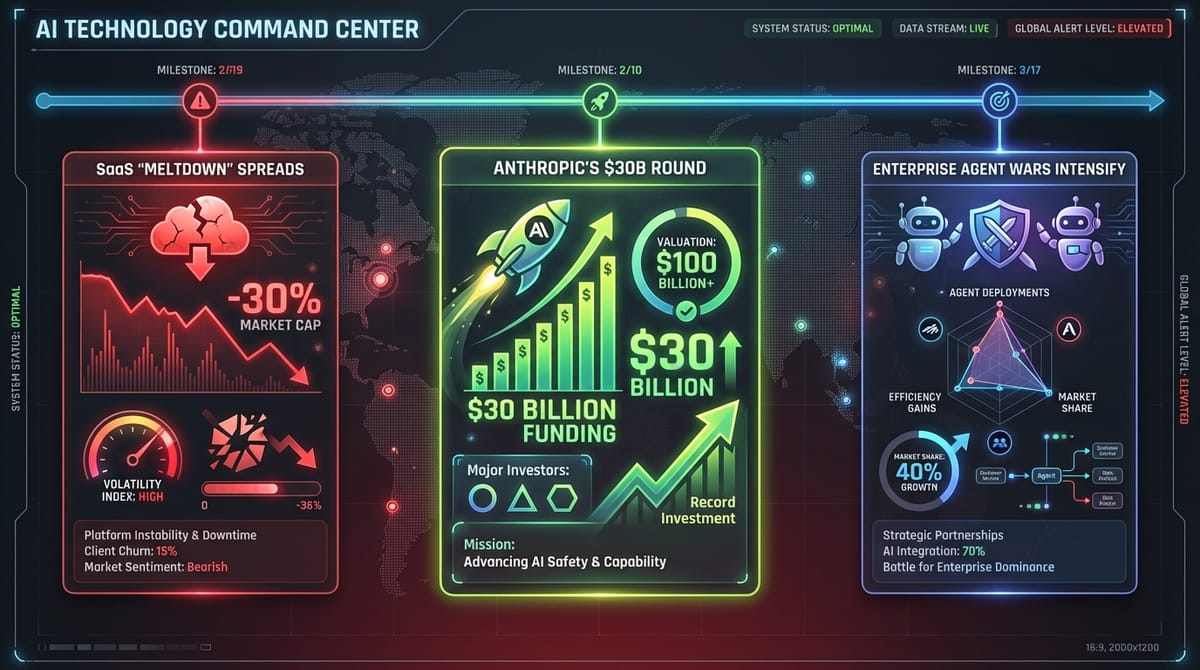
GenAI Daily - February 24, 2026: SaaS "Meltdown" Spreads, Anthropic's $30B Round, Enterprise Agent Wars Intensify
Top Story
The enterprise software market is weathering its most volatile period since the 2022 rate hikes, as a massive sell-off - now being dubbed the "SaaSpocalypse" - wipes out nearly $1 trillion in market value. On February 23, 2026, the bloodletting reached a fever pitch, with major indices seeing double-digit slides in high-growth software names as investors flee toward "AI-native" disruptors.
This dramatic recalibration of the technology sector has been catalyzed by fears that OpenAI's rapid expansion into autonomous enterprise agents will render the traditional Software-as-a-Service (SaaS) business model obsolete. As OpenAI launches its "Frontier" platform and secures massive implementation partnerships with global consulting giants, the market is betting that specialized workflow tools will soon be bypassed by autonomous "AI Coworkers."
ServiceNow (NYSE: NOW) saw its shares plunge over 20% year-to-date by mid-February, with a further 4.39% drop on February 23. Meanwhile, CrowdStrike (NASDAQ: CRWD) experienced a 9.37% plunge on February 23, largely due to "guilt by association" within the high-multiple software group.
Why it matters: Enterprise buyers are witnessing a fundamental shift from traditional per-seat SaaS models to AI-agent-based automation - forcing immediate strategic decisions about which platforms will survive the transition.
Key Developments
Anthropic Closes Record $30B Series G at $380B Valuation
On February 12, 2026, Anthropic announced that it had raised $30 billion in a Series G funding round, bringing its post-money valuation to $380 billion.
In February 2026, Anthropic released Claude Opus 4.6, followed by Sonnet 4.6.
Anthropic on Tuesday rolled out Claude Sonnet 4.6, its second major artificial intelligence model launch in less than two weeks. The startup said Claude Sonnet 4.6 is better at using computers, coding, design, completing knowledge work tasks and processing large amounts of data.
Anthropic says its latest model, Claude Opus 4.6, represents a fundamental shift in how AI handles complex workplace tasks. The company highlighted use cases including financial modeling that synthesizes complicated regulatory filings and market data, plus document and presentation outputs that require minimal refinement.
(TechCrunch) | (CNN)
Impact: The largest AI funding round to date signals investors' conviction that Anthropic can compete directly with OpenAI for enterprise dominance, especially in safety-conscious sectors.
AI Model "February Reset" Fragments Market Leadership
February 5th, 2026. Anthropic ships Claude Opus 4.6. Same day, OpenAI drops GPT-5.3-Codex. Twelve days later, Anthropic follows with Sonnet 4.6. Two days after that, Google fires back with Gemini 3.1 Pro.
When the dust settled, something genuinely new had happened: no single model won. For the first time in the frontier AI race, the leaderboard fractured into distinct lanes, and the "which model is best?" question stopped having a coherent answer.
Introducing Gemini 3.1 Pro: A smarter model for your most complex tasks – Today, Google is announcing a step forward in core reasoning building on the Gemini 3 series: Gemini 3.1 Pro – a noticeably smarter, more capable baseline for complex problem-solving. On ARC-AGI-2, a benchmark that evaluates a model's ability to solve entirely new logic patterns, 3.1 Pro achieved a verified score of 77.1%. This is more than double the reasoning performance of 3 Pro. Why it matters for enterprises: Gemini 3.1 Pro is designed to solve tougher problems, giving customers the reasoning depth their business needs.
(Medium) | (Radical Data Science)
Impact: No single "best" model means enterprises must now choose specialized AI for different use cases rather than relying on one dominant platform.
Salesforce-ServiceNow "Agent War" Escalates with New Licensing Models
Enter the agentic AI enterprise license. Salesforce's Miquel Milano, president chief revenue officer, laid out the rationale behind Salesforce's AELA, Agentic Enterprise License Agreement. "AELA is for customers that have already experimented. They're ready to scale. They want to go all in so we agree on a flat fee, and then it's a shared risk," said Milano. ALEA is all you can eat with Agentforce or whatever other cloud is thrown in.
The "Agent War" between Salesforce and ServiceNow is more than a corporate rivalry; it is a fundamental restructuring of how work is performed in the modern corporation. Salesforce's Agentforce has redefined the "Front Office" by making customer interactions more intelligent and autonomous, while ServiceNow's Zurich release has turned the "Back Office" into a high-speed engine of automated execution.
ServiceNow is sharpening its strategic focus, preparing to launch new capabilities on February 28th that signal a decisive pivot towards AI-executed workflows. This initiative moves the company beyond merely assisting human productivity to enabling autonomous AI agents to handle routine enterprise tasks across IT, HR, and finance, aiming to drive significant efficiency gains and potential margin expansion for its clients.
(Constellation Research) | (WhalesBook)
Impact: Traditional per-seat pricing is being replaced by consumption-based "agent licenses," fundamentally changing how enterprises budget for AI capabilities.
Product Launches
- Snowflake-OpenAI Partnership:
$200 million partnership makes OpenAI models natively available to Snowflake's 12,600 global customers across all three major cloud providers. OpenAI models like GPT-5.2 will be accessible within Snowflake Intelligence, the trusted enterprise intelligence agent that empowers every employee to securely access, analyse, and act on all their organisation's knowledge using natural language.
Funding & Deals
- Taalas - $169M Series B:
Toronto-based chip startup announced a massive $169 million funding round on Feb. 19, 2026, to accelerate development of its AI inference chips. Taalas is building specialized silicon that prints parts of AI models onto chips, trading off generality for speed. CEO Ljubisa Bajic said the bespoke design – customizing chips to specific AI models – lets Taalas run inference faster and more cheaply than traditional methods.
- Jump - $80M Series B:
Salt Lake City–based Jump closed an $80 million Series B to expand its AI software for financial advisors. Jump's cloud platform uses AI assistants to automate tasks like meeting prep, note-taking, and follow-ups for financial advisors. The startup reports rapid adoption – its AI assistant now serves 27,000 advisors, about one in ten U.S. advisors, and adds over 2,000 new advisors each month. This round, led by Insight Partners with participation from F-Prime, Allianz Life Ventures, TIAA Ventures, and others, brings Jump's total funding to $105 million.
- Stacks - $23M Series A:
London-based Stacks announced a $23 million Series A led by Lightspeed Venture Partners on Feb. 19. Stacks offers an AI-powered platform that automates accounting and financial close processes for mid- to large-sized enterprises. Its software integrates with ERPs and tools like Excel or Slack to handle reconciliations, journal entries, variance analysis, and reporting, cutting the time to close books by roughly half.
Tomorrow's Watch List
- ServiceNow's February 28th AI-executed workflow capabilities launch
- OpenAI IPO filing expected in Q2-Q3 2026 window
- Continued software stock volatility as agent adoption accelerates
Related reading: Check out this week's [Deep Insights analysis] for strategic context on these developments.