GenAI Daily - February 25, 2026: MatX Secures $500M for Nvidia Challenge, OpenAI's Enterprise Reality Check, Gartner Predicts 40% AI Agent Adoption
Top Story
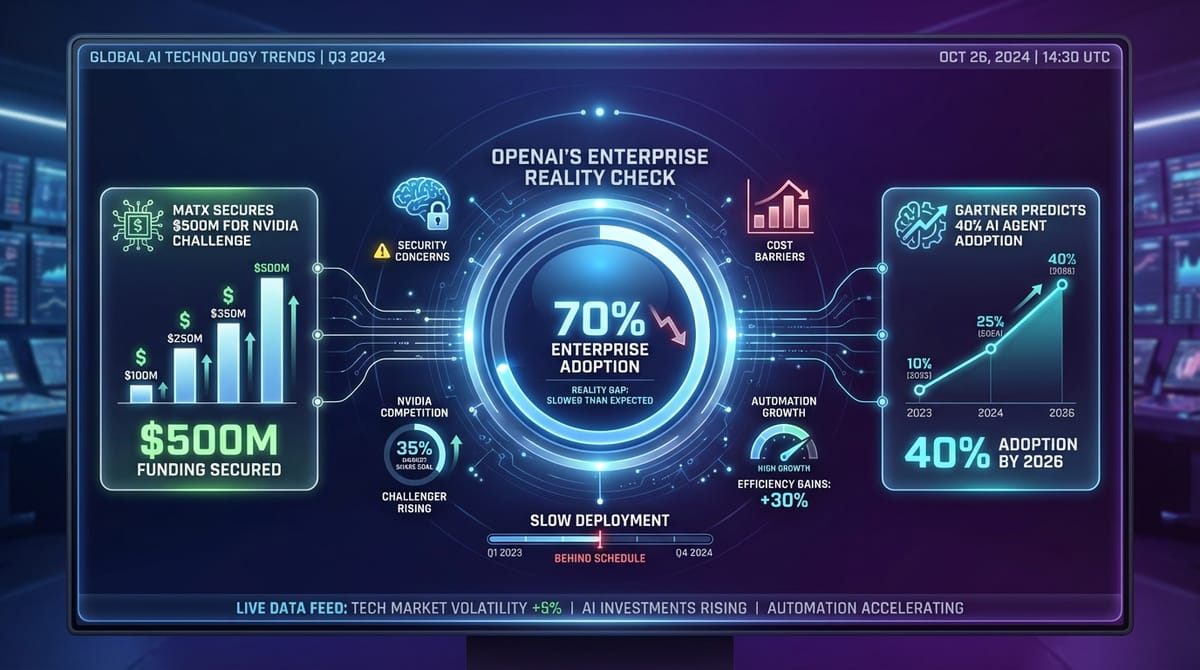
MatX, an AI chip startup founded by two alumni of Google's semiconductor business, has raised more than $500 million in a new funding round to produce hardware that competes with Nvidia Corp., with the company now valued at several billion dollars. The financing was led by Jane Street and Situational Awareness, the investment firm founded by former OpenAI researcher Leopold Aschenbrenner.
Other backers include Marvell Technology Inc., venture firms NFDG and Spark Capital, and Stripe Inc. co-founders Patrick and John Collison. MatX was founded by Reiner Pope, who worked on software for Google's chips and AI models, and Mike Gunter, a hardware engineer for the search giant's tensor processing unit chips, who left Google in 2022 with the goal of creating a chip focused solely on running large language models.
The startup aims to blend two distinct chipmaking approaches by combining high-bandwidth memory used by Nvidia and Google for training AI models with static random access memory used by other companies for faster inference processing. MatX expects to complete the final design of its chip this year and hopes to begin shipping in 2027, working with Taiwan Semiconductor Manufacturing Co. to manufacture the product.
Why it matters: With AI labs increasingly seeking alternatives to Nvidia's dominance and GPU supply constraints limiting deployment, specialized chips like MatX's could reshape the competitive landscape for AI infrastructure.
Key Developments
OpenAI COO: Enterprise AI Adoption Still in Early Stages
Earlier this month, OpenAI launched a new platform called OpenAI Frontier for enterprises to build and manage agents, but OpenAI COO Brad Lightcap said that businesses haven't yet seen AI adoption at scale. There is a lot of talk around AI agents taking over business processes and claiming that "SaaS is dead," but while these predictions have moved SaaS stocks at times, they haven't really come true.
Lightcap noted that OpenAI was a massive Slack user last year, indicating how much AI firms are still reliant on traditional enterprise software. OpenAI's revenue is on the rise, ending 2025 with over $20 billion in annualized revenue, though Lightcap acknowledged they "almost always find ourselves having to manage too much demand."
Impact: OpenAI's honest assessment signals that the "SaaS is dead" narrative may be premature, providing reassurance for traditional enterprise software vendors.
Gartner Predicts 40% of Enterprise Apps Will Embed AI Agents by 2026
Only 5% of enterprise apps integrated AI agents in 2025, according to Gartner, suggesting that most companies were wary about replacing their human workers with bots. However, Gartner expects that ratio to soar eightfold to 40% by the end of 2026 as more companies embrace the technology. In a "best-case" scenario, Gartner predicts agentic AI could drive 30% of all enterprise application software sales by 2035, up from just 2% in 2025.
Gartner also warns that C-suite executives at software organizations only have a "three- to six-month window to define their agentic AI product strategy" or "risk falling behind their peers," highlighting UiPath and ServiceNow as early movers in the agentic AI market.
Impact: This timeline suggests a massive acceleration in AI agent integration, creating urgency for enterprise software vendors to develop agentic capabilities immediately.
Capgemini Joins OpenAI Frontier Alliance for Enterprise AI
Capgemini announced a strategic partnership with OpenAI to accelerate enterprise AI transformation with Frontier, OpenAI's new platform for building, deploying, and managing AI coworkers. With 2026 identified as the "year of truth for AI," with more than half of organizations committing to sustained, multi-year investment horizons, leaders recognize that the primary barrier to scaling AI is no longer the technology itself, but the readiness of their data, operating models, technology and digital enablement.
As a founding member of the OpenAI Frontier Alliance, Capgemini will work to address the AI opportunity gap by focusing on the business, data, organizational, and systems integration challenges faced by clients, to deploy AI enterprise-wide.
Impact: The partnership signals that systems integrators are positioning themselves as critical bridges between AI platforms and enterprise deployments.
AI Security Threats Intensify with Off-the-Shelf Tools
A new incident report shows cybercriminals using off-the-shelf generative AI tools compromised more than 600 internet-exposed FortiGate firewalls across 55 countries in just over a month. The activity is attributed to a Russian-speaking cybercrime group and shows how AI can lower the barrier for exploitation, automation, and operational scale, with GenAI tools assisting with scripting, payload iteration, and campaign management.
This makes mid-tier actors more dangerous and more able to industrialize proven techniques, with the takeaway being that "basic hygiene" (patching, MFA, eliminating exposed admin ports, rotating credentials) remains the best defense against AI-amplified attacks.
(The Register via Tech Startups)
Impact: AI is democratizing cybercrime capabilities, forcing enterprises to prioritize security fundamentals as AI-powered attacks become more scalable and accessible.
Product Launches
- Google Gemini 3 Deep Think (Major Upgrade):
Google released a major upgrade to Gemini 3 Deep Think, its specialized reasoning mode, built to push the frontier of intelligence and solve modern challenges across science, research, and engineering, developed in partnership with scientists and researchers. The new Deep Think is now available in the Gemini app for Google AI Ultra subscribers and, for the first time, via the Gemini API to select researchers, engineers and enterprises.
- Wizard AI Shopping Agent:
Wizard, cofounded by serial entrepreneur Marc Lore and Melissa Bridgeford, launched its AI Shopping Agent in February 2026, bringing smarter product discovery, trusted recommendations, and native checkout together in one streamlined shopping experience. Purpose-built for ecommerce, the AI Shopping Agent delivers a streamlined shopping experience from smarter search to secure checkout in a single interface, backed by NEA and Accel.
(Wizard)
Funding & Deals
- MatX - $500M Series B:
AI chip startup founded by two former Google semiconductor engineers raised more than $500 million to develop hardware that competes with Nvidia Corp. The company is now valued at several billion dollars, with founders Reiner Pope and Mike Gunter aiming to create chips specifically for large language models.
-
Led by Jane Street and Situational Awareness (Bloomberg)
-
OpenAI - $100B+ Round (In Progress):
OpenAI is close to finalizing the first phase of a new funding round that is likely to bring in more than $100 billion, a record-breaking financing deal that would give the startup additional capital to build out its artificial intelligence tools. As the ChatGPT maker prepares to spend trillions in infrastructure investment, the overall valuation of the company could exceed $850 billion.
-
Backed by Amazon, Nvidia, SoftBank, Microsoft (Bloomberg)
-
Anthropic - $30B Series G (Recently Covered):
Anthropic raised $30 billion in Series G funding at a $380 billion valuation, marking the second-largest venture deal of all time, led by Singapore's GIC and investment firm Coatue, cementing the Claude maker as the second-most valuable generative AI startup globally.
- Led by GIC and Coatue (MLQ.ai)
Related reading: Check out this week's Deep Insights analysis for strategic context on these developments.