GenAI Daily - February 26, 2026: Meta's $60B AMD Deal, Nvidia's Vera Rubin Preview, Salesforce Q4 Revenue Beat
Top Story
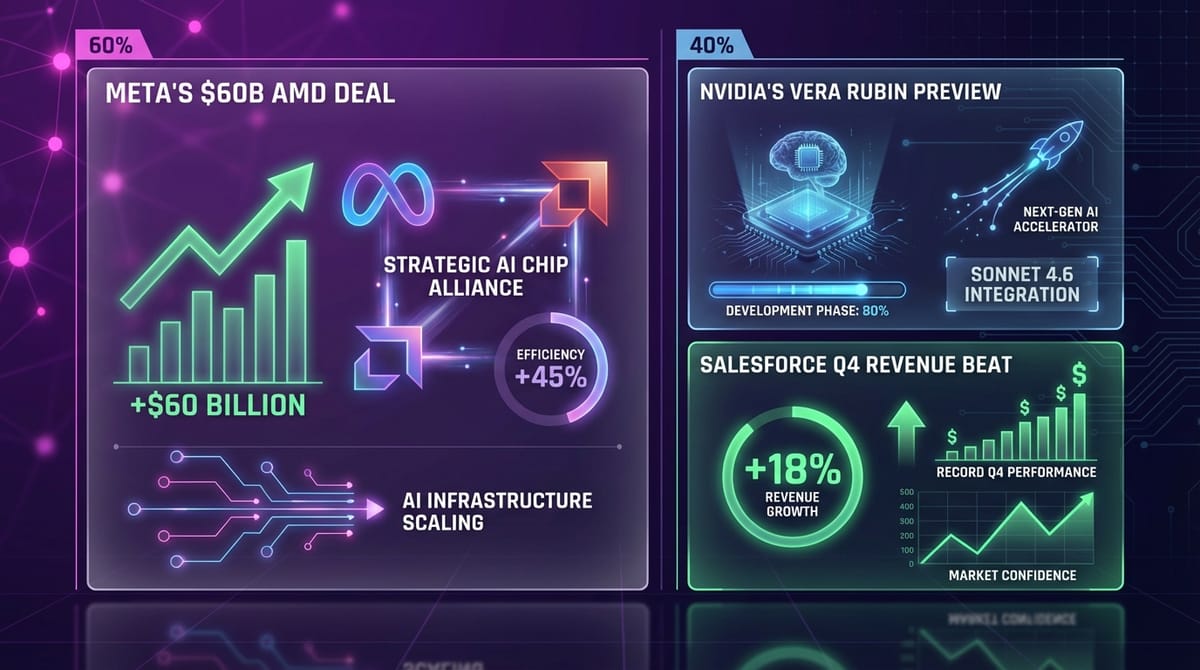
Meta Platforms announced a historic five-year agreement to buy up to $60 billion worth of AMD artificial intelligence chips, including an option for Meta to acquire up to 10% of AMD.
Under the deal, AMD will deliver six gigawatts of AI computing capacity, beginning with its MI450 platform in the second half of 2026.
Meta helped contribute to the MI450 design that is optimized for inference workloads, and the chip will compete with Nvidia's next-generation Vera Rubin processor.
According to Santosh Janardhan, head of infrastructure at Meta, the company would keep purchasing chips from various suppliers while simultaneously creating its own proprietary processors, stating "All of the chipmakers end up having sort of a seat at the table".
Why it matters: This deal signals the maturation of AI infrastructure procurement from opportunistic buying to strategic partnerships with equity stakes, diversifying Meta's supply chain while challenging Nvidia's dominance in AI accelerators.
Key Developments
NVIDIA Reveals Vera Rubin System Architecture
CNBC got an exclusive first look at Vera Rubin, Nvidia's next AI system that's due to ship in the second half of the year, which will use about twice as much power as Blackwell but will be far more efficient by delivering 10 times more performance per watt.
Vera Rubin is made up of 1.3 million components and will deliver 10 times more performance per watt than its predecessor, Grace Blackwell.
Impact: Energy efficiency improvements could significantly reduce data center operational costs, making large-scale AI deployments more economically viable for enterprises.
Salesforce Q4 2026 Earnings: Agentic AI Revenue Beat
Salesforce posted Q4 revenue of $11.18 billion, marking an 11.7% year-over-year increase and hitting the top end of its previous guidance, while non-GAAP diluted earnings per share (EPS) reached $3.04, fueled by the rapid monetization of its Agentforce platform.
Enterprise software spending is not only recovering but accelerating as corporations pivot their budgets toward autonomous systems, with the industry moving toward "Multi-Agent Systems" (MAS), where specialized agents for sales, finance, and supply chain management collaborate autonomously to solve complex business problems.
Impact: Demonstrates successful monetization of AI agents in production, validating the enterprise market's shift from generative chatbots to autonomous business systems.
SolveAI Emerges with $50M for Enterprise AI Coding
SolveAI, a London-based AI startup founded by former Palantir engineer Steve Basher, stepped out of stealth with $50 million in fresh funding including a $45 million Series A led by GV and a previously undisclosed $5 million pre-seed round led by Accel, with Northzone, Mantis VC, and NeverLift joining the round.
The platform integrates with major enterprise systems, including SAP, Salesforce, GitHub, Snowflake, and ServiceNow, covering the full software lifecycle from planning through maintenance.
Impact: Addresses the gap between AI coding tools that create demos versus production-ready enterprise software with proper governance and compliance requirements.
Product Launches
- Google Gemini 3.1 Pro:
Google's first .1 increment model that "represents a step forward in core reasoning" with ARC-AGI-2 score of 77.1%, "more than double the reasoning performance of 3 Pro" - Available across Gemini API, Vertex AI, and consumer apps (Google)
- Salesforce Spring '26 Release:
Features Agentforce Builder for building production-ready agents in a single, conversational workspace, and new Sales Workspace that brings together agents, analytics, and predictive insights in a single destination for understanding performance - Rolling out February 23 (Salesforce)
Funding & Deals
- SolveAI - $50M Series A: London-based enterprise AI coding platform that helps employees build IT-compliant software through natural language. Integrates with SAP, Salesforce, ServiceNow, and other enterprise systems. Founded by former Palantir engineer. - Led by GV (Tech Startups)
Related reading: Check out this week's [Deep Insights analysis] for strategic context on these developments.