GenAI Daily - February 27, 2026: Enterprise AI Tools Scale Up, Major Infrastructure Deals, Software Rebounds
Top Story
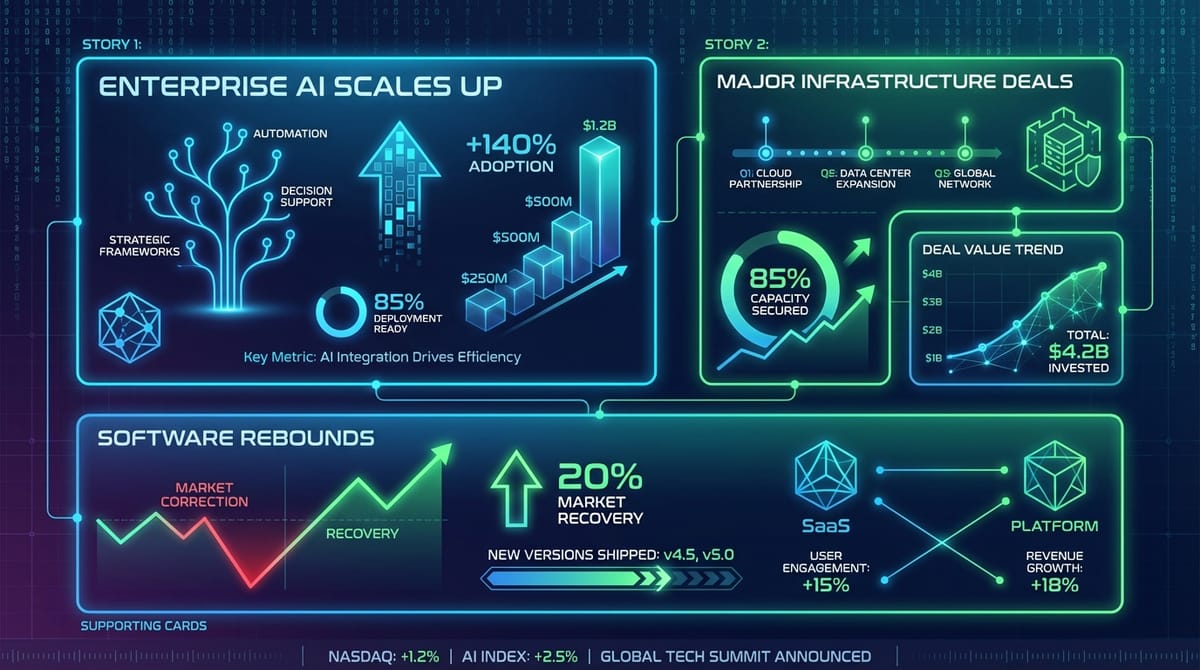
Investors are now aggressively rotating capital out of high-flying semiconductor stocks and into a battered software sector that is finally proving it can turn AI capabilities into cold, hard cash. Conversely, software companies, which spent much of 2024 and 2025 in a technical bear market, are seeing a resurgence as they debut "Agentic AI" platforms that move beyond simple chatbots and into autonomous digital labor.
Meanwhile, software incumbents like Salesforce (NYSE: CRM) and ServiceNow (NYSE: NOW) began reporting "blockbuster" growth in their new agent-based platforms. The initial market reaction was one of skepticism, but as enterprise AI spending is now projected to accelerate by 14.7% in 2026, the skepticism has turned into a frantic hunt for software value.
After falling 40% from its 2025 peak, the stock surged in February 2026 after the company demonstrated 50% quarter-over-quarter growth in "Agentic AI" deals.
Why it matters: Enterprise software companies are finally proving they can monetize AI through agent-based platforms rather than just selling seats, marking a fundamental shift from infrastructure spending to software value delivery.
Key Developments
Strategy World 2026 Declares "Enterprise Software Dead"
In a provocative opening keynote, CEO Phong Le declared the traditional era of enterprise software, business intelligence (BI), and data warehousing effectively over. Le argued that these rigid technologies are being replaced by a new paradigm built on AI and enterprise sovereignty.
Strategy is developing AI-Generated Ontologies, a capability that will allow enterprises to automatically map the relationships within their business, how customers interact with products, how sales connect to finance, how operations link to outcomes, without manual data engineering. The result is a continuously updated digital twin of the organization that AI can reason over in real time.
Impact: Traditional business intelligence and data warehouse vendors face existential pressure as AI-driven semantic layers enable direct business reasoning.
White House Targets AI Energy Costs with "Rate Payer Protection Pledge"
The White House says it will host leading data center and AI companies on March 4, 2026, to formalize a "Rate Payer Protection Pledge," a political and economic response to the rapid rise in electricity demand tied to AI infrastructure. The administration is framing the AI race as a strategic priority, but local backlash is building in regions where new data centers are colliding with utility constraints and voter anger over higher bills. The pledge's core idea is blunt: tech companies expanding compute should shoulder more of the incremental power costs, rather than passing them on to households and small businesses through utility rate structures.
Impact: AI infrastructure expansion faces new regulatory constraints as energy costs become a public policy issue affecting data center site selection.
Meta Locks in $60B AMD Chip Deal with Equity Option
Meta agreed to buy up to $60 billion in AI chips from AMD over five years, with a structure that also gives Meta the option to acquire up to 10% of AMD.
For AMD, it's a second anchor-style win after its earlier OpenAI partnership, and a direct attempt to chip away at Nvidia's dominance in AI accelerators. For Meta, it's another step toward vendor diversification and supply assurance, at a time when AI buildouts are constrained by power, networking, and the availability of high-end silicon. The equity-linked structure also raises questions investors will watch closely: when chip supply becomes the bottleneck, leverage shifts, and buyers can demand unusually favorable terms.
(Reuters)
Impact: AI compute procurement shifts toward long-term capacity contracts with equity components, signaling supply constraints driving new deal structures.
NVIDIA Reports Record $68.1B Quarter Despite Market Rotation
NVIDIA reported record quarterly revenue of $68.1B for the quarter ended January 25, 2026, underscoring that demand for AI compute remains intense even as investors debate whether the market is overheating. The company framed results around a continued shift toward accelerated computing and AI workloads in data centers, where hyperscalers and enterprises are buying both training capacity and inference capacity.
Impact: Enterprise AI infrastructure spending remains robust despite software market rotation, validating continued demand for training and inference capacity.
Product Launches
-
WalkMe Q1 2026 Release: Enhanced Action Bar makes AI contextual and proactive across enterprise applications, with precision AI authoring that lets administrators control exactly which sources AI references for learning content - Addresses the 42% enterprise AI abandonment rate (WalkMe blog)
-
Google Gemini 3.1 Pro:
Today, Google is announcing a step forward in core reasoning building on the Gemini 3 series: Gemini 3.1 Pro – a noticeably smarter, more capable baseline for complex problem-solving. On ARC-AGI-2, a benchmark that evaluates a model's ability to solve entirely new logic patterns, 3.1 Pro achieved a verified score of 77.1%. This is more than double the reasoning performance of 3 Pro. Starting today, Gemini 3.1 Pro is rolling out to millions of people globally: ... For enterprises in preview in Vertex AI and Gemini Enterprise.
Funding & Deals
- SolveAI - $50M Series A:
Eight-month-old London-based AI startup, emerged from stealth with$50 million in funding as companies look for AI coding systems that generate software closer to what internal engineering teams would actually ship. The bet is that "good enough for a demo" isn't good enough for enterprises: they need code that fits architecture standards, security controls, compliance requirements, and long-term maintainability.
-
Led by GV and Accel (Tech Startups)
-
Wayve - $1.2B Series D:
The company announced today that it raised $1.2 billion in a Series D round led by Mercedes-Benz, Stellantis, Nissan, and Uber. Including milestone payments, the round brings the total to $1.5B and Wayve's total funding to about $2.8B. The mega-round underscores renewed investor confidence in autonomous vehicles just as Wayve plans to roll out Uber robotaxis in multiple cities in 2026.
-
Led by Mercedes-Benz, Stellantis, Nissan, and Uber (Tech Startups funding news)
-
MatX - $1.2B Series B:
MatX is a U.S.-China AI hardware startup designing semiconductor accelerators for large language model training. The funding, one of the largest chip deals to date, attracted strategic backers, including chipmaker Marvell and investors such as Spark Capital and the Stripe co-founders. MatX says it will fab its first-generation chips at TSMC and begin sample shipments in 2027, positioning itself as a major competitor to Nvidia in the AI training market.
-
Led by Jane Street (Tech Startups)
-
SambaNova Systems - $350M Growth:
SambaNova Systems, a California startup developing advanced AI inference chips and cloud hardware, has closed a $350 million financing round. The round was led by Vista Equity Partners (with Cambium Capital) and included Intel Capital, among others. The investment arrives as SambaNova expands its SN50 AI chip and SambaCloud platform for data centers. Notably, SoftBank Corp. will be the first customer deploying SambaNova's SN50 chips in its AI data centers in Japan, signaling early commercial traction.
- Led by Vista Equity Partners (Tech Startups)
Tomorrow's Watch List
- White House AI Energy Summit (March 4, 2026) - Rate Payer Protection Pledge details
- OpenAI $100B+ funding round finalization expected
- Google Gemini 3.1 Pro enterprise rollout continues
Related reading: Check out this week's Deep Insights analysis for strategic context on the great AI software rotation and enterprise adoption patterns.