GenAI Daily - January 24, 2026: Major AI Infrastructure Funding, Security Breakthrough, Global Health AI
Top Story
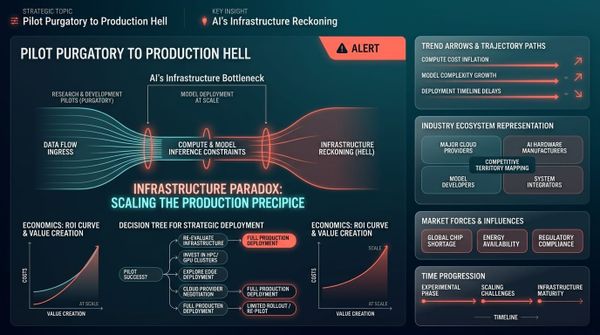
AI Infrastructure Sees Record Capital Surge as Power Crisis Intensifies
Major AI infrastructure funding reached new heights this week, with Inferact securing $150 million in seed funding on Jan. 22, 2026, co-led by Andreessen Horowitz and Lightspeed Venture Partners, valued at about $800 million.
The commercial startup behind the open-source vLLM project focuses on AI model "inference" - running large language models (LLMs) in production - by making them faster and more cost-efficient, with technologies like vLLM attracting heavy investment as companies shift focus from training to deploying AI models.
The infrastructure buildout comes as data centers face unprecedented strain, with some proposed facilities seeking more than five gigawatts of power and PJM Interconnection, the largest US grid operator serving over 65 million people across 13 states, projecting a full six gigawatts shortage of its reliability requirements in 2027.
Political opposition is mounting, with both Democratic Socialist Sen. Bernie Sanders and Republican Gov. Ron DeSantis leading skeptics of the AI industry's data center boom, signaling a potential political reckoning that could slow the industry's development plans.
Why it matters: AI infrastructure investments are colliding with grid capacity limits, creating a fundamental bottleneck that could reshape where and how quickly AI systems can scale across enterprises.
Key Developments
AI Security Gets $10M Boost for Development Vulnerabilities
Symbiotic Security has raised a $10 million seed round to secure the growing volume of AI-assisted software development, positioning its product around a practical pain point where teams can generate code faster than they can reliably validate it, with security review often becoming the bottleneck that slows releases or gets skipped under deadline pressure.
The company launched Symbiotic Code, an agent fixing AI vulnerabilities at creation that guarantees secure-by-design output, enabling high-velocity development without the risk of security debt.
Research validates the need: A Stanford University study found that developers using AI code assistants were more likely to produce insecure code while at the same time falsely having greater confidence in its security, while a Wuhan University study analyzed 452 GitHub Copilot-generated code snippets, revealing security vulnerabilities in 32.8% of Python and 24.5% of JavaScript snippets.
Impact: Enterprise development teams now have automated protection against AI-generated vulnerabilities, addressing a critical gap as code generation accelerates.
Health AI Breakthrough Targets Global TB Crisis
Qure.ai secured a major grant from the Gates Foundation to expand AI-driven diagnostics for tuberculosis and pneumonia, with funding supporting AI-powered point-of-care ultrasound algorithms designed to work in low-resource clinical settings, alongside creation of a large open-source, multi-modal lung health database.
The effort targets diseases that kill an estimated 1.23 million from tuberculosis and around 2 million from pneumonia annually, including roughly 700,000 children under five.
The grant reflects a growing shift among global health funders toward open data and interoperable AI infrastructure, rather than isolated proprietary tools, with Qure.ai positioning the project as a shared foundation for innovation across academia, startups, and public health agencies.
Qure.ai Gates Foundation Grant
Impact: Open-source medical AI datasets could accelerate diagnostic AI development across the industry while targeting diseases affecting billions globally.
NVIDIA Powers Physical AI Revolution at CES 2026
NVIDIA announced new open models, frameworks and AI infrastructure for physical AI, unveiling robots for every industry from global partners, with new technologies speeding workflows across the entire robot development lifecycle to accelerate the next wave of robotics, while global industry leaders including Boston Dynamics, Caterpillar, Franka Robotics, Humanoid, LG Electronics and NEURA Robotics are using the NVIDIA robotics stack to debut new AI-driven robots.
Jensen Huang declared "The ChatGPT moment for robotics is here," citing breakthroughs in physical AI models that understand the real world, reason and plan actions as unlocking entirely new applications.
NVIDIA IGX Thor, available later this month, extends robotics to the industrial edge, offering high-performance AI computing with enterprise software support and functional safety, with Archer using IGX Thor to bring AI to aviation, advancing critical capabilities in aircraft safety, airspace integration and autonomy-ready systems.
NVIDIA Physical AI Announcement
Impact: Physical AI infrastructure is moving from labs to production environments, with enterprise applications spanning manufacturing, aviation, and industrial automation.
Product Launches
-
January AI Enterprise Lifestyle Intelligence: AI-powered food recognition, glucose prediction, and personalized health recommendations for B2B platforms, enabling healthcare providers to deliver highly personalized nutrition experiences at scale (January AI CES 2026)
-
NVIDIA Nemotron 3 Family: Open models in Nano, Super and Ultra sizes introducing the most efficient family of open models with leading accuracy for building agentic AI applications, with Nemotron 3 Nano delivering 4x higher throughput than Nemotron 2 Nano (NVIDIA Nemotron 3)
Funding & Deals
-
Neurophos - $110 Million Series A: Austin-based AI startup developing optical processors for AI inference using proprietary metasurface modulator acting as photonic tensor core, enabling thousands of light-based computing "neurons" on a single chip for ultra-fast, energy-efficient AI accelerators - Led by Gates Frontier (Tech Startups)
-
Railway - $100 Million Series B: Austin-based cloud platform for AI infrastructure providing developer-friendly platform to manage cloud infrastructure, billing, and networking for ML workloads, addressing "data and networking bottlenecks" that hinder scaling of large AI models - Led by TQ Ventures (Tech Startups)
-
Upscale AI - $200 Million Series A: Santa Clara startup developing high-performance AI networking systems for national-scale data center buildouts and AI workloads optimization - Led by Tiger Global, Premji Invest, and Xora Innovation (Tech Startups)
Related reading: Check out this week's [Deep Insights analysis] for strategic context on these developments.