How to Build a Self-Correcting RAG System That Gets Smarter With Every Query
- Traditional RAG systems retrieve documents once and generate answers, but adding a feedback loop can dramatically improve accuracy
- Agentic RAG introduces intelligent checkpoints where an agent grades retrieved documents and rewrites queries when needed for better results
- The architecture uses LangGraph for orchestration and Redis as the vector store, creating a self-healing pipeline that adapts and improves continuously
The Opportunity Every CTO Should Know About
Here's a common scenario that reveals a major opportunity: your knowledge base contains detailed documentation about "Parameter-Efficient Training Methods for Large Language Models." A user asks "What's the best way to fine-tune LLMs?" The semantic similarity exists, but it's weak. Your retriever pulls back tangentially related chunks about model architecture instead. Without a mechanism to recognize this mismatch, the system generates an answer that misses the mark.
This is where self-correcting RAG shines. Traditional pipelines retrieve once and move forward. But by adding a feedback loop with self-correction and multiple attempts, you can transform this limitation into a strength. The system becomes resilient, adaptive, and capable of handling the natural variations in how users phrase their questions.
How Self-Correcting RAG Actually Works
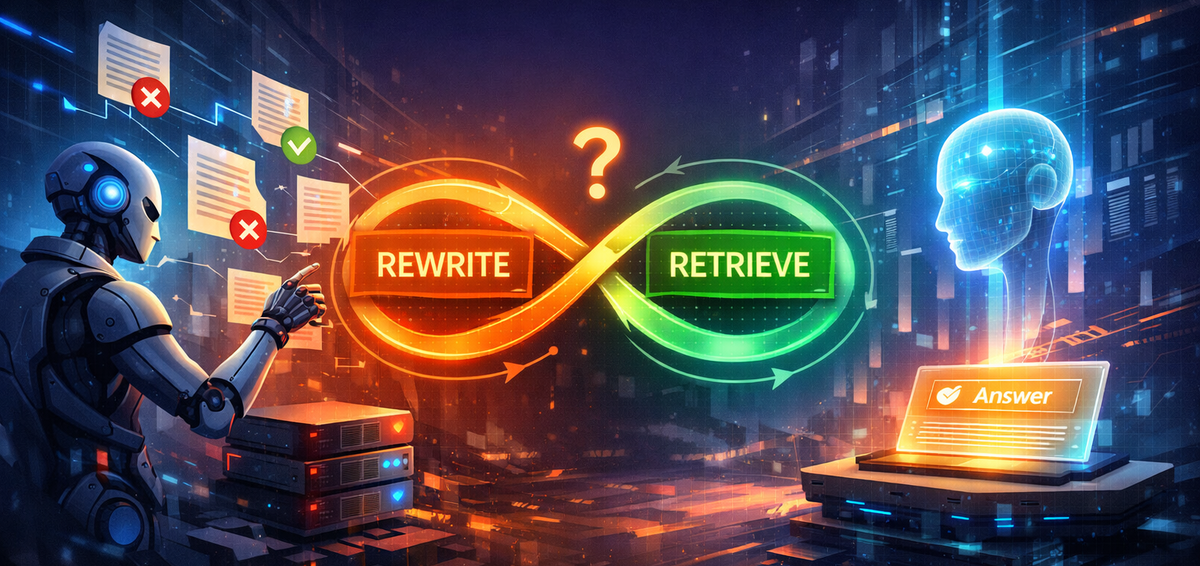
Agentic RAG solves this by introducing intelligent checkpoints throughout the retrieval process. Instead of generating answers from whatever documents come back, an agent evaluates relevance first. If the retrieved content needs improvement, the system rewrites the query and tries again. This creates a self-healing retrieval pipeline that handles edge cases gracefully and gets better results.
The architecture breaks down into six components with clear responsibilities:
Configuration Layer: Handles environment variables and API clients
Retriever Setup: Ingests source documents, splits them into chunks, embeds them, and stores everything in Redis via RedisVectorStore
Agent Node: Receives the user's question and decides whether to call the retriever or answer directly
Grade Edge: Evaluates whether retrieved documents actually match the original question - this is the critical checkpoint that enables self-improvement
Rewrite Node: Transforms queries into better search terms for improved results
Generate Node: Produces the answer after grading confirms the context is appropriate
The decision flow works like this: a user question hits the agent, which calls the retriever tool. Retrieved documents get graded for relevance. Relevant documents flow to generation. Documents needing improvement trigger a rewrite, which loops back to the agent for another retrieval attempt. The system continues until it gets excellent context or reaches its retry limit. That feedback loop from rewrite back to agent is what makes this agentic - the system learns and adapts in real-time.
Business Impact: Building Trust and Reducing Support Costs
The business case for self-correcting RAG is compelling: increased user trust and reduced support costs. Every accurate, helpful answer from your RAG system builds user confidence, and when users trust your AI assistant, they use it more frequently and effectively. This means fewer questions routed to your support team and better ROI on your AI investment.
Self-correcting architectures also simplify your development process. Traditional RAG requires you to anticipate every possible query formulation during development. Agentic RAG handles query variations at runtime by reformulating them automatically. This means less time spent on prompt engineering and query preprocessing, and more resilience when users phrase questions in creative or unexpected ways.
Performance Considerations Worth Understanding
The architecture adds some latency when a rewrite is needed - essentially an extra retrieval cycle for those queries. But here's the good news: most implementations set a retry budget of 2-3 attempts, and the rewrite step succeeds on the first retry for roughly 70-80% of cases that initially needed improvement, according to teams running similar architectures in production. The result is dramatically better answers with a modest latency trade-off.
Redis as the vector store choice works excellently for production workloads. It handles the read-heavy patterns of retrieval efficiently and supports the rapid iteration cycles you need when tuning embedding strategies. The LangGraph orchestration layer provides the state machine semantics that make the feedback loop possible without custom infrastructure.
The Bigger Picture
Self-correcting RAG represents an exciting architectural evolution. The grading step gives you fine-grained control over quality, and with proper tuning, you can achieve impressive accuracy improvements. Start with conservative retry budgets and comprehensive logging so you can see exactly where the system excels and identify opportunities for further optimization.
The broader trend here is genuinely exciting. We're moving from static AI pipelines toward adaptive systems that recognize and overcome their own limitations. Agentic RAG is a powerful early example of this pattern, and the teams that learn to build feedback loops now will have a significant advantage as these architectures mature. The opportunity is clear: integrating self-correcting approaches into your existing infrastructure can deliver meaningful improvements in accuracy, user satisfaction, and operational efficiency.
Originally reported by Towards AI