The $15 Trillion Handshake: When Your Procurement Agent Meets Their Sales Agent
TL;DR
- Google launched the Universal Commerce Protocol (UCP), an open standard for AI agent-based shopping, developed with Shopify, Etsy, Wayfair, Target, and Walmart
- This creates a unified framework for AI agents to handle everything from product discovery to post-purchase support, potentially reshaping how consumers find and buy products
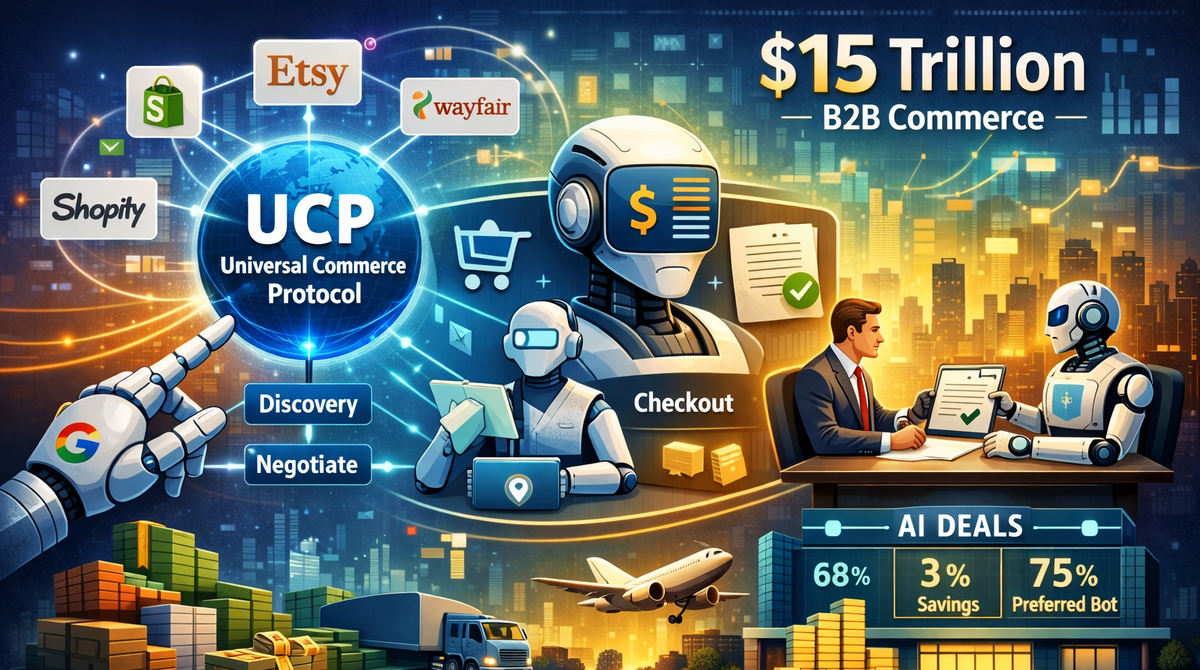
- The B2B implications are massive: Gartner projects 90% of B2B purchases will be handled by AI agents within three years, channeling over $15 trillion through automated exchanges
- Walmart already proved the model works—using Pactum's AI, they negotiate with 2,000 suppliers simultaneously, with 68% reaching agreements and 75% of suppliers preferring the bot over human negotiators
- Companies that don't adapt their commerce infrastructure for agent-to-agent communication risk becoming invisible in AI-mediated shopping experiences
What Happened
Google unveiled the Universal Commerce Protocol at the National Retail Federation conference, and it's more significant than the typical standards announcement. UCP creates a common language for AI agents to interact across the entire customer buying journey: discovery, checkout, and support, without requiring separate integrations for each step.
The protocol doesn't exist in isolation. It's designed to work with Google's existing Agent Payments Protocol (A2P), the Agent2Agent (A2A) standard, and Anthropic's Model Context Protocol (MCP). Together, these create a complete stack: an agent can discover a supplier (A2A), understand their catalog (MCP), negotiate and agree on terms (UCP), and execute payment (A2P). End to end. No human required.
Google is already rolling out UCP-powered checkout directly from AI search results, letting shoppers complete purchases from U.S. retailers without leaving the conversation. The coalition behind this includes Shopify, Walmart, Target, Etsy, and Wayfair—representing a critical mass of e-commerce infrastructure.
The Proof Point: Walmart's Already Running the Playbook
While everyone debates whether agentic commerce is hype, Walmart has been quietly proving it works since 2022.
Using Pactum's AI chatbot, Walmart negotiates with thousands of suppliers simultaneously. The results:
- 68% of suppliers reached agreements with the AI
- 3% average savings per negotiated deal
- 75% of suppliers preferred the bot over human negotiators
- Deals closed in days instead of weeks
- The system can negotiate with 2,000 suppliers at once
Read that last point again. One AI system, handling 2,000 parallel negotiations. No human buyer could do that. No team of human buyers could do that.
This started with "tail-end suppliers"—the long tail of vendors providing fleet services, shopping carts, and store equipment that procurement teams never had bandwidth to properly negotiate. Cookie-cutter terms left value on the table for both sides. The AI changed the math. Suddenly, every supplier relationship became worth optimizing.
Walmart has since expanded to transportation route negotiations, goods for resale, and mid-tier suppliers. The trajectory is clear: as the AI proves itself, it moves up the value chain.
Why Suppliers Actually Prefer the Bot
Here's the counterintuitive finding: suppliers liked negotiating with the AI. Why?
- Speed: Deals closed in days, not weeks. No waiting for callbacks or email chains dying in someone's inbox
- Consistency: The AI doesn't have a bad day. It sticks to parameters but finds creative solutions within them
- Data-driven: Every offer is grounded in historical data and market benchmarks. Less posturing, more substance
- 24/7 availability: Suppliers could engage on their schedule, from any timezone
- Clarity: The AI is explicit about constraints and what's possible. Less ambiguity than navigating human organizational politics
This points to something important: agent-to-agent commerce isn't just more efficient. In some cases, it's actually better for both parties. When both sides have clear objectives and the AI can find the Pareto frontier—the set of agreements where neither side can improve without hurting the other—you get outcomes that leave less value on the table.
The Market Projections: $15 Trillion in Play
Multiple research firms have published projections for agent-driven commerce, and the consensus is clear: this is going to be massive.
- Gartner's forecast: 90% of all B2B purchases will be handled by AI agents within three years, channeling more than $15 trillion through automated exchanges
- McKinsey's estimate: Agentic commerce could generate up to $1 trillion in U.S. retail revenue by 2030, and $3-5 trillion globally
- Merkle's B2B prediction: By 2030, one-third of all B2B e-commerce—roughly $8 trillion—will flow through machine-to-machine transactions
- Bain's outlook: The U.S. agentic commerce market could reach $300-500 billion by 2030, representing 15-25% of total online retail
These aren't projections about AI helping humans shop. They're projections about AI agents transacting with other AI agents, with humans increasingly out of the loop.
How UCP Enables This at Scale
For agent-to-agent commerce to work across organizations, you need standards. Here's how the full stack comes together:
- Your procurement agent monitors inventory levels and identifies a need
- It queries supplier agents across multiple vendors via A2A
- Each supplier agent responds with availability, pricing, and terms
- Your agent negotiates—playing suppliers against each other, optimizing for your constraints
- Agreement reached, payment executes via A2P
- Fulfillment coordinates automatically
Walmart is doing steps 3-6 today with Pactum. Google just announced the standards to make it interoperable across the ecosystem.
As Shopify's Tobi Lutke put it: "This is one of the really exciting parts about agentic. It's really good at finding people who have specific interests and finding the product that is just perfect for them."
Strategic Implications
For Consumer Commerce
The timing of UCP isn't accidental. Adobe's holiday season data showed that generative AI drove 693.4% traffic growth to seller sites. That number comes with caveats—conversion rates remain unclear—but it signals a fundamental shift in how consumers discover products. When Lutke talks about AI finding "the product that is just perfect for them" without a traditional search query, he's describing a future where SEO as we know it becomes less relevant than agent optimization.
Google is letting merchants integrate branded AI-powered Business Agents directly into Search. Lowe's, Poshmark, and Reebok are already doing this. Brands can now offer real-time discounts during AI-mediated product discovery, creating a new touchpoint in the purchase funnel.
The flip side: companies whose product catalogs aren't optimized for agent consumption may find themselves excluded from an increasingly important discovery channel. The new Merchant Center data attributes aren't optional anymore—they're table stakes.
For B2B Commerce
Supplier discovery transformation. Just as consumer brands risk invisibility without agent optimization, B2B suppliers face the same challenge. Companies selling through distributors or marketplaces will need their product data structured for agent consumption. Industrial suppliers, office equipment vendors, and raw materials providers should be watching UCP adoption closely.
Complex B2B workflows. The current UCP spec handles straightforward purchase flows, but B2B transactions often involve RFQs, custom pricing, volume discounts, and multi-stakeholder approvals. Watch for UCP extensions that address these use cases. Early movers who help shape these extensions will have an advantage.
Integration with existing infrastructure. The real question is how UCP will interact with established B2B protocols like EDI, Ariba, and Coupa. Companies with heavy investments in these systems will need a migration strategy. Expect middleware providers to emerge offering UCP bridges to legacy procurement systems.
Channel conflict considerations. B2B companies with complex channel strategies—direct sales, distributors, and marketplace presence—will need to think carefully about how AI agents navigate these options. Without clear rules, an AI procurement agent might consistently route orders away from preferred channels.
Winners and Losers
Winners:
- Large retailers with existing Google partnerships and the engineering resources to implement UCP quickly
- Shopify merchants who get UCP integration through their platform (and the parallel Microsoft Copilot integration announced the same day)
- Payment providers in the ecosystem: Google Pay is native, PayPal support is coming
- Startups building agent optimization tools—this creates a whole new category
- Organizations building decision infrastructure that captures heuristics and learns from outcomes
Losers:
- Mid-market retailers without clear AI commerce strategies who risk falling behind the integration curve
- Traditional SEO-dependent brands that haven't invested in structured product data
- Proprietary commerce platforms that don't adopt open agent protocols
- Customer service teams that will need significant retraining as AI agents handle more interactions
- Intermediaries that exist primarily to connect buyers and sellers—they'll need to evolve into trust infrastructure or face disintermediation
What to Watch
Conversion data. Adobe's 693% traffic growth number is impressive, but traffic without sales is just expensive curiosity. The first retailers to publish AI-to-purchase conversion rates will tell us whether this channel is real or hype.
OpenAI's response. They're already working on merchant discoverability in ChatGPT. Will they adopt UCP or build a competing standard? Protocol fragmentation could slow adoption across the board.
Shopify's rollout timeline. How quickly they deploy UCP to their merchant base will determine whether this becomes a big-company advantage or an ecosystem-wide shift.
Enterprise procurement pilots. Following Walmart's lead, expect announcements from other large enterprises deploying agent-based negotiation. The speed of adoption will signal whether Gartner's $15 trillion projection is conservative or optimistic.
The $15 trillion handshake is coming. The question is whether your agents will be ready to shake.
Source: TechCrunch