The $500 Billion Divergence: Why AI Just Split Into Two Industries (And You're Probably Betting on the Wrong One)
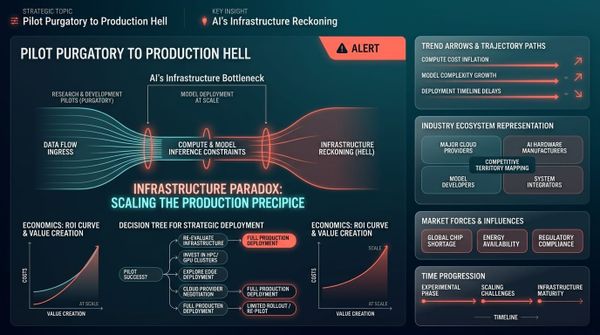
A strange contradiction is consuming Silicon Valley. While TSMC commits $56 billion to AI chip production and OpenAI signs $10 billion infrastructure deals, enterprises are demanding their first real ROI reports from AI investments. Venture capitalists deployed 65% of their dollars into AI startups, yet surveys show 91.4% of enterprises still have AI stuck in pilot purgatory.
This isn't market confusion. It's market evolution. AI just divided into two fundamentally different industries with opposite economics, timelines, and winners. Infrastructure AI - the hyperscale buildout of models, chips, and compute - is absorbing hundreds of billions in capital for 3-5 year paybacks. Application AI - the software that actually touches enterprise workflows - is being judged on quarterly returns.
Here's what nobody wants to admit: Most companies are placing billion-dollar bets on Infrastructure AI when they should be dominating Application AI. The winners of the next two years won't be the companies with the biggest models or most GPUs. They'll be the ones who figured out that AI's value isn't in the intelligence - it's in the integration.
The Story
The Setup
Until January 2026, the AI narrative was simple: bigger models, more compute, inevitable dominance. Everyone from venture capitalists to Fortune 500 CTOs bought the same story - that frontier AI capabilities would automatically translate into business value. The race was for AGI, and whoever got there first would own everything.
Enterprise buyers followed this logic. They partnered with OpenAI, Anthropic, and Google not because these models solved specific problems, but because they represented the cutting edge of AI capability. Pilot programs multiplied across organizations, testing everything from customer service chatbots to code generation tools, all built on the assumption that more capable AI meant more valuable AI.
The Shift
January 2026 shattered this unified narrative. While Infrastructure AI raised record amounts - xAI's $20 billion, Cerebras's $10 billion OpenAI deal, TSMC's $56 billion capex commitment - enterprise surveys revealed a harsh reality. Cognizant's study found that while AI could theoretically handle $4.5 trillion in US labor productivity, 93% of companies couldn't capture that value.
The divergence became undeniable. On one side, SoftBank poured $1.4 billion into Skild AI's robotics platform and Meta secured 6.6 gigawatts of nuclear power for training. On the other side, enterprise leaders complained about "AI workslop" - the 4.5 hours per week employees spend fixing AI outputs that look good but lack substance.
Meanwhile, the talent war revealed the split. Airbnb hired Meta's former AI chief not to build better models, but to create AI-powered travel experiences. The message was clear: Infrastructure AI talent was flowing toward Application AI problems.
The Pattern
This mirrors exactly what happened with cloud computing in 2008-2012. AWS, Google, and Microsoft spent tens of billions building global infrastructure while enterprises demanded immediate ROI from "cloud transformation" initiatives. The companies that thrived weren't the ones with the biggest data centers - they were the ones like Salesforce and Slack who built applications that actually changed how work got done.
Infrastructure AI and Application AI operate on completely different cycles. Infrastructure AI follows Moore's Law physics - exponential improvements requiring massive upfront capital with 3-5 year payback periods. Application AI follows software economics - iterative improvement requiring product-market fit with quarterly revenue cycles.
The $20 billion flowing into xAI and Anthropic isn't competing with the enterprise software budgets going toward AI-powered CRM or automated data engineering. They're separate markets with separate buyers, timelines, and success metrics.
The Stakes
If you're betting your company's AI strategy on Infrastructure AI advancement, you're making the same mistake as enterprises who waited for "cloud maturity" in 2010. While you're optimizing prompts and waiting for GPT-6, competitors are rebuilding core business processes around AI-native workflows.
The window for Application AI dominance is narrow - maybe 18 months before the market consolidates around clear winners. But the opportunity is massive: Cognizant's study shows $4.5 trillion in productivity gains available today, not in some theoretical AGI future.
What This Means For You
For CTOs
- Stop funding model experiments, start funding workflow rebuilds. By Q2, identify your three highest-value business processes and rebuild them AI-native. This means new data architectures, not just API integrations.
- Hedge your bets with hybrid procurement. Keep 70% of your AI budget in application-layer solutions, 30% in infrastructure partnerships. The application layer is where enterprise differentiation happens.
- Prepare for the talent war. AI product managers who understand business workflows will command 40%+ premiums by year-end. Start recruiting now.
- Build for the regulation tsunami. EU AI Act compliance becomes a competitive advantage. If your AI systems can't explain their decisions by Q3, you're out of regulated markets.
For AI Product Leaders
- Abandon horizontal platforms, embrace vertical depth. The companies winning enterprise deals aren't building "AI for everyone" - they're building AI for specific industries that understand domain nuances.
- Design for human-AI collaboration, not replacement. The productivity gains come from augmenting human judgment, not automating it away. Anthropic's tool search and Microsoft's Copilot understand this; most startups don't.
- Price for outcomes, not consumption. Agentic Enterprise License Agreements are becoming standard because CFOs can't budget unpredictable token consumption. Fixed pricing for measured outcomes wins.
- Focus on data integration over model performance. Customers don't care if you use GPT-4 or Claude - they care if your AI can access their systems seamlessly.
For Engineering Leaders
- Architect for agentic workflows now. The Model Context Protocol is becoming the standard for AI system integration. If your systems can't communicate with AI agents, you're building technical debt.
- Invest in inference optimization over training infrastructure. NVIDIA's Rubin platform promises 10x cost reductions for inference. The companies that nail efficient inference will own enterprise deployments.
- Build governance into your architecture. AI governance isn't a compliance afterthought - it's core platform infrastructure. Companies like Airia are proving this.
- Plan for the quantum transition. Equal1's silicon-based quantum computing could solve AI's energy constraints. At minimum, architecture choices should be quantum-ready.
What We're Watching
- By March 2026: Clear winners emerge in vertical AI applications. Healthcare, financial services, and manufacturing will each have 1-2 dominant platforms that become acquisition targets.
- By Q2 2026: Infrastructure AI valuations correct as enterprise buyers shift budgets to application vendors. Expect 20-30% haircuts for pure-play model companies without clear enterprise revenue.
- By July 2026: The first "AI workforce management" platform hits $1B ARR. As agentic AI scales, someone will solve the governance problem and own the market.
- If Meta's nuclear power deal succeeds: Hyperscalers will rapidly move to dedicated energy partnerships, creating new bottlenecks in power infrastructure rather than chip manufacturing.
- If enterprise ROI pressure continues: Look for major consolidation in the Application AI space as CFOs demand vendor reduction and proven outcomes over experimental capabilities.
The Bottom Line
January 2026 will be remembered as the month AI stopped being one industry and became two. Infrastructure AI will continue absorbing unprecedented capital to push the boundaries of what's possible. Application AI will focus on capturing the trillions in productivity gains available today.
The companies that win won't be the ones with the smartest AI. They'll be the ones that understand the difference between building intelligence and delivering value. Choose your battlefield carefully - because in 18 months, the territorial lines will be drawn, and switching sides will cost you everything.
The Infrastructure AI players are building the railroads. The Application AI players are building the cities. History shows us which one creates more sustainable wealth. Don't bet on the tracks when you could own the destination.