The $650 Billion Infrastructure Arms Race That Just Made Your Software Stack Obsolete
The enterprise software economy just hit an extinction event, and most CTOs are still debating pilot programs. While Alphabet doubles AI spending to $180 billion and Amazon commits $200 billion more, software stocks are cratering with 20%+ drops across the board. HubSpot down 39%, Figma down 40%, Atlassian down 35%. This isn't market volatility — it's repricing for obsolescence.
Here's what everyone missed: The $650 billion Big Tech is pouring into AI infrastructure this year isn't just about building better models. It's about replacing the entire per-seat SaaS paradigm with AI-native platforms where agents do the work instead of humans clicking through interfaces. When OpenAI's Frontier agents can execute complete sales workflows without anyone logging into Salesforce, what exactly are you paying per-seat licenses for?
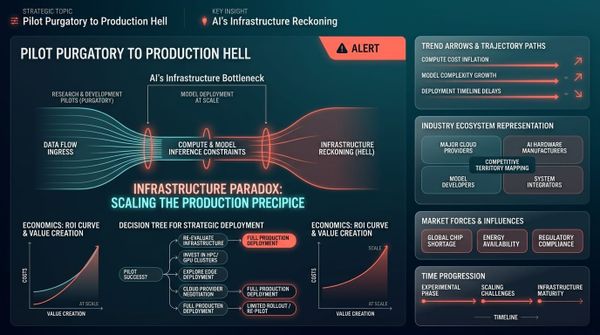
The math is brutal: 91% of enterprises use AI, but only 41% can prove ROI. That gap isn't a measurement problem — it's the sound of $2 trillion in enterprise software value evaporating as companies realize they've been paying for human interfaces to do work that AI agents can handle autonomously.
The Story
The Setup
Enterprise software thrived on a simple premise: humans need interfaces to interact with business systems. Pay per seat, scale by adding users, integrate through APIs. SaaS companies built trillion-dollar valuations on this foundation, selling software that required people to click, type, and navigate through workflows.
The conventional wisdom held that AI would augment these systems — make Salesforce smarter, help with HubSpot automation, enhance Atlassian workflows. Integration partners, not replacements.
The Shift
February 2026 shattered that narrative. OpenAI launched Frontier, an enterprise platform where AI agents access "shared business context" by connecting directly to data warehouses, CRM systems, and internal apps. No human interfaces required. Anthropic countered with Claude Opus 4.6's "agent teams" — multiple AI agents coordinating autonomously on complex projects.
The market reaction was swift and merciless. Thomson Reuters fell 16%, LegalZoom plummeted 20%, the WisdomTree Cloud Computing Fund dropped 20% for the year. Investors aren't pricing in disruption risk anymore — they're pricing in replacement.
Meanwhile, the infrastructure arms race hit warp speed. Big Tech's $650 billion 2026 capex commitment is double what they spent in 2025. Musk merged SpaceX and xAI for orbital data centers. Microsoft is pioneering superconducting cables to handle AI power demands. This isn't scaling existing infrastructure — it's building a parallel AI-native computing stack.
The Pattern
This is the exact playbook that killed previous technology paradigms. Mobile apps didn't enhance desktop software — they replaced it entirely. Cloud didn't improve on-premise deployments — it made them irrelevant. Now AI agents aren't augmenting human workflows — they're eliminating them.
The pattern is accelerating: Enterprise AI moved from chatbots (2023) to copilots (2024) to autonomous agents (2026) in just three years. Companies still piloting "AI-enhanced" versions of existing tools are missing the fundamental shift to AI-native platforms that don't need human operators.
Anthropic's legal plugins that crashed law software stocks? That's just the beginning. When AI agents can draft contracts, conduct research, manage compliance, and execute transactions without human interface layers, what's the value proposition for specialized legal software?
The Stakes
The window for adaptation is closing faster than most enterprises realize. Companies spending 2026 integrating AI features into existing SaaS tools are optimizing for a paradigm that's already obsolete. By Q4 2026, the competitive advantage will belong to organizations running AI-native operations, not those with AI-enhanced human workflows.
The $650 billion infrastructure buildout creates a forcing function. When compute is abundant and agents are capable, the cost advantage of AI-native operations becomes overwhelming. Why pay per-seat Salesforce licenses when an AI agent can manage your entire sales pipeline for the cost of API calls?
What This Means For You
For CTOs
Audit your software stack now — Map which SaaS tools could be replaced by AI agents by Q4 2026. Start with workflow-heavy tools like CRM, project management, and support ticketing. Budget for agent platforms — Allocate 30% of 2026 software budget to AI agent platforms like OpenAI Frontier, Anthropic's enterprise tools, or building custom agent orchestration. Plan the transition — Begin parallel AI-native workflows for critical processes. Don't wait for feature parity — aim for 80% automation with human oversight for exceptions. Renegotiate contracts — Add AI replacement clauses to SaaS renewals. Many vendors will offer migration credits to agent platforms rather than lose customers entirely.
For AI Product Leaders
Shift from enhancement to replacement — Stop building "AI-powered" versions of existing tools. Build AI-native platforms that eliminate human interfaces entirely. Focus on agent orchestration — The value is in coordinating multiple AI agents, not individual AI features. Target workflow automation — Sales sequences, customer support, financial processes, legal document management. These are immediate replacement opportunities. Partner with infrastructure providers — The companies building agent platforms need vertical specialists. Better to be an early partner than a late competitor.
For Engineering Leaders
Adopt agent-first architecture — Design systems for AI agents as primary users, humans as exception handlers. This inverts traditional UX priorities. Master prompt engineering and agent coordination — These become core platform skills, more important than traditional API integration. Build observability for autonomous systems — You need monitoring for what agents do, not just system performance. Plan for elastic compute — Agent workloads are spiky and unpredictable. Design for massive parallel processing.
What We're Watching
By Q2 2026: First major enterprise will announce complete replacement of CRM system with AI agents. Sales productivity jumps 300%+ while eliminating per-seat costs.
If Anthropic's $20B round closes: Expect aggressive enterprise feature releases targeting specific software categories. Legal and finance tools face direct competition from Claude-powered agents.
By Q4 2026: Software companies trading below book value become acquisition targets. Private equity will buy distressed SaaS assets to extract remaining customer value before AI replacement.
Microsoft superconductor deployment: If successful, enables 10x compute density in same footprint. This makes on-premise AI agent deployment economically viable for Fortune 500.
Watch for the "agent mesh" pattern: Multiple AI agents from different providers coordinating on single workflows. This breaks vendor lock-in and accelerates enterprise adoption.
The Bottom Line
Mark February 2026 as the month the SaaS economy began its death spiral. The $650 billion infrastructure arms race isn't about building better chatbots — it's about replacing human-operated software with autonomous AI systems. Companies still buying per-seat licenses for workflows that agents can automate are paying premium prices for legacy architecture.
The next 18 months will separate AI-native enterprises from digital dinosaurs. By 2028, explaining why humans still click through software interfaces will sound as antiquated as describing how we used to manually calculate spreadsheets. The infrastructure is being built now. The agents are production-ready. The only question is whether your organization will lead this transition or become a case study of what happens when you optimize for a paradigm that no longer exists.