The Age of Installable Expertise
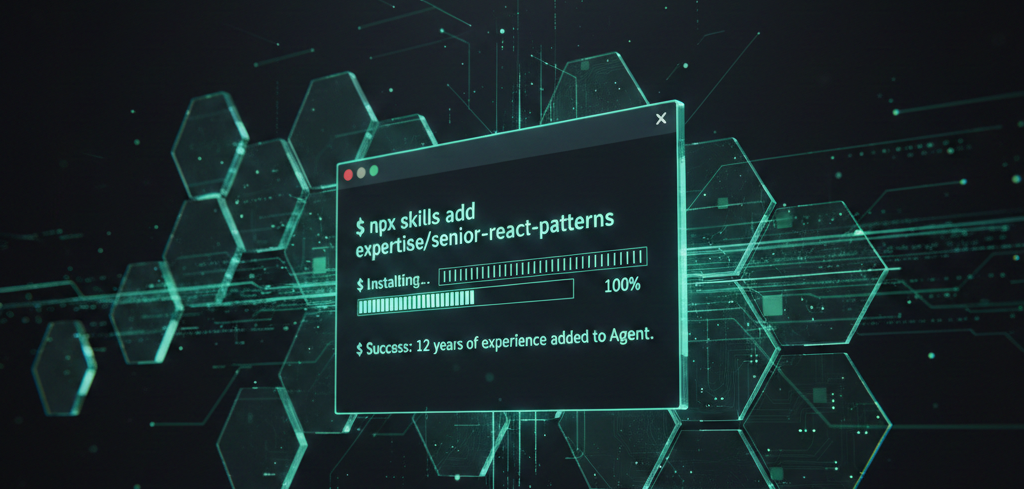
The Age of Installable Expertise
How Vercel's Skills.sh signals a fundamental shift in how we package and distribute human knowledge
Within hours of Vercel announcing Skills.sh on January 21st, their top skill had 20,000 installs. Remotion, the programmable video animation platform, shipped a video created entirely by prompting Claude Code with their new skill. Stripe published their own skills the same day. And somewhere, a three-month-old project called OpenSkills watched its head start evaporate.
This is what happens when Vercel enters a market. But more importantly, this is what happens when an idea's time has come.
What Vercel Actually Shipped
Skills.sh is deceptively simple: a package manager for AI coding agents. One command, npx skills add vercel-labs/agent-skills, and suddenly your AI assistant knows 10+ years of React and Next.js optimization patterns. 40+ rules across 8 categories. The accumulated wisdom of Vercel's engineering team, codified and installable.
The key insight isn't in the technology. It's in the framing: expertise becoming infrastructure.
A skill is just a folder containing a SKILL.md file with instructions, optional scripts, and reference materials. The AI agent reads these on-demand, gaining procedural knowledge, not documentation, not tutorials, not theory, but the actual step-by-step "how" that took engineers years to develop.
This is different from documentation. Documentation explains concepts. Skills encode procedures. The distinction matters because AI agents don't need to understand React philosophy. They need to know that waterfall requests in useEffect are a critical performance issue, and here's the exact pattern to fix it.
The Ecosystem That Existed Before Vercel Noticed
Vercel didn't invent this category. They legitimized it.
OpenSkills had been building for three months, a universal installer that works with Claude Code, Cursor, Windsurf, Aider, and Codex. Their pitch: "Think of it as the universal installer for SKILL.md." They implemented Anthropic's specification, made it agent-agnostic, and built a growing community. Then Vercel launched with distribution advantages that erased their lead overnight.
n-skills took a different angle: a curated marketplace where skills stay synced with contributor repos. "You maintain ownership. We curate the collection." The model acknowledges that the value isn't in hosting, it's in quality control and discovery.
skillcreator.ai positioned as an aggregator, scraping skills from Anthropic, OpenAI, GitHub, and Vercel into a unified catalog. When standards fragment, aggregators emerge.
And openskills.cc is positioning as the open format layer itself, adopted by Cursor, GitHub Copilot, Claude Code, and more. Their thesis: the format should be a public good, even if the marketplaces compete.
The pattern mirrors early package management. npm didn't invent JavaScript modules. It made them installable. Skills.sh is doing the same for procedural knowledge.
Skills vs. Tools: Different Layers of the Stack
There's an important distinction emerging between skills and tools that most coverage misses.
Skills are static instructions and knowledge. They tell an AI agent how to think about a problem, patterns, best practices, decision frameworks. They consume context but don't execute anything.
Tools (via MCP, Composio, etc.) are dynamic capabilities. They let AI agents do things, call APIs, authenticate with services, execute code. Model Context Protocol now has tens of thousands of servers. Microsoft Copilot Studio shipped MCP support to GA. Composio offers 500+ tool integrations with managed OAuth and API execution.
The stack is crystallizing:
┌─────────────────────────────────────────┐
│  Vertical Solutions                     │  ← Complete apps, workflows
├─────────────────────────────────────────┤
│  Skills (Vercel, OpenSkills)            │  ← Procedural knowledge
├─────────────────────────────────────────┤
│  Tools (MCP, Composio)                  │  ← API execution, auth
├─────────────────────────────────────────┤
│  Agent Frameworks (LangChain, CrewAI)   │  ← Orchestration
├─────────────────────────────────────────┤
│  LLMs                                   │  ← Reasoning
└─────────────────────────────────────────┘
Skills.sh lives in the knowledge layer. It doesn't replace MCP or Composio, it complements them. Your agent can know the right way to structure a React app (skills) and execute the deployment to Vercel (tools).
This is why the "MCP killer" framing misses the point entirely. MCP gives agents hands. Skills give agents expertise. You need both.
The Shift in Competitive Advantage
Here's the uncomfortable part: knowledge moats are eroding.
For two decades, expertise accumulated linearly. You learned React patterns by building React apps. You understood security protocols by making security mistakes. You internalized design systems by iterating through hundreds of reviews. Ten years of experience meant ten years of accumulated pattern recognition.
Skills.sh compresses that. Not completely, judgment still matters, context still matters, knowing when to apply a pattern still requires experience. But the raw procedural knowledge? That's now installable.
The gap between "senior" and "junior" becomes less about accumulated how-to and more about judgment and orchestration. A junior developer with the right skills installed can apply patterns that took seniors years to learn. They won't have the same intuition about when those patterns don't apply. But for the 80% of cases where the pattern fits, the gap just closed.
For individuals: The returns to being a generalist who can orchestrate increase. The returns to being a specialist with narrow procedural knowledge decrease. Knowing that something exists and when to use it beats knowing how to do it from memory.
For companies: Institutional knowledge becomes more portable. The senior engineer who leaves doesn't take the patterns with them, the patterns are in the skill files. Onboarding accelerates. Knowledge debt becomes manageable.
For the market: Competition shifts from "who has the expertise" to "who can best package and distribute expertise." Vercel's moat isn't just their deployment infrastructure, it's becoming their codified engineering culture.
What Comes Next: From Skills to Recipes
Skills.sh is the developer-tooling layer. But skills are just instructions. The next level up is recipes: packaged expertise that doesn't just tell an agent how to build something, but actually produces the deployable output.
The difference matters. A skill says "here's how to structure a React app." A recipe takes a prompt like "booking engine for kayak tours" and outputs a branded WordPress plugin with payment integration, calendar sync, and email confirmations. The expertise isn't guidance. It's executable.
This is where the real enterprise opportunity lives.
The Problem: System integrators, agencies, and IT departments build remarkable things, then do it all over again for the next client. The SAP consultant who mastered product configuration UIs connected to SAP backends. The ServiceNow team that perfected SLA dashboards. The web agency that nailed tourism booking flows. Each engagement starts from scratch, knowledge trapped in people's heads or buried in project folders.
Senior consultants spend 60% of their time on work they've done before. Junior staff lack access to institutional knowledge. Clients pay premium rates for reinvented wheels.
The Opportunity: Once domain expertise is formalized into a recipe, three things become possible:
First, it becomes repeatable. What took 3 months becomes 3 days. What required senior architects becomes accessible to junior teams. The recipe encodes the expertise.
Second, it becomes franchisable. A boutique SAP partner in Germany can license their product configurator recipe to an SI in Australia. Passive income from deployments in geographies you don't serve.
Third, it becomes verifiable. "47 SAP VC configurators deployed" isn't a sales claim. It's platform-tracked. Buyers searching for capability find proven providers.
What This Looks Like in Practice:
E-commerce Store Launch: The recipe knows product catalog structures, checkout optimization patterns, payment gateway edge cases, shipping rule logic, tax configuration by region. Input a prompt describing your business or upload your product spreadsheet. Output a fully configured Shopify store with optimized checkout, inventory management, and email flows ready to take orders.
Employee Onboarding Workflow: The recipe knows HR data models, approval routing patterns, system provisioning sequences, compliance documentation requirements. Input a prompt describing your onboarding process or upload your current checklist. Output a Power Platform workflow that creates accounts, assigns equipment, schedules training, and tracks completion across all your systems.
Field Service Mobile App: The recipe knows work order patterns, technician scheduling logic, parts inventory rules, customer communication templates, offline sync requirements. Input a prompt describing your service business. Output a SAP Fiori app your technicians can use on-site with real-time job updates, parts lookup, and customer signature capture.
Franchise Reporting Dashboard: The recipe knows multi-location data aggregation, KPI calculation patterns, role-based access rules, drill-down navigation. Input a prompt or upload your current Excel reports. Output a ServiceNow dashboard showing performance across all locations with alerts for outliers and scheduled distribution to stakeholders.
The pattern: domain knowledge + ecosystem expertise + best practice patterns + validation rules + integration know-how, packaged into something that produces production-ready output from flexible inputs.
The Business Model Shift:
This flips the consulting model entirely. Instead of billing hours to transfer knowledge through workshops and documentation, you package the knowledge once and license it repeatedly.
Recipe creators control distribution through platform-enforced terms: region restrictions ("Available in APAC only, I serve EMEA myself"), exclusive territories ("One licensee for DACH"), industry verticals ("Licensed for automotive only, I keep pharma"), time-limited exclusivity ("Exclusive in ANZ for 12 months, then open").
The platform takes a cut of transactions. Creators get passive income. Buyers get verified providers with proven deployments. Everyone benefits except the status quo of bespoke project work.
Why This Is Different from Generic AI App Builders:
Generic platforms (Lovable, Bolt, Replit) produce generic output. Same prompt, different ecosystem = completely different quality. They rely on the user to provide complete specifications.
Recipe platforms invert this by embedding domain expertise. The recipe knows that ServiceNow dashboards need specific ACL patterns. The recipe knows that SAP Fiori apps require transport management. The recipe knows that tourism booking engines need availability calendars and payment gateway edge cases.
Same prompt into a generic builder produces a React app with mock data and no deployment path. Same prompt into a vertical recipe produces ecosystem-native output deployed to the target environment.
The domain knowledge is the moat. And that knowledge comes from the SIs, agencies, and consultants who've accumulated it through years of project work.
The Recipe-Based Economy
Skills.sh launched as open source. The leaderboard shows install counts. But there's no marketplace transaction yet.
For the skills layer specifically, the models will likely stratify:
Free/Open: Generic best practices, framework patterns, widely-applicable knowledge. Vercel's React skills. Security fundamentals. Design system basics. These drive ecosystem adoption and funnel users to platforms.
Marketplace: Creator-economy model. Domain experts publish skills, take a revenue share. A senior architect codifies enterprise integration patterns. A security consultant packages penetration testing methodologies.
Enterprise/Private: Company-specific skills that never leave the organization. The institutional knowledge layer that's too valuable to share but too important not to codify.
But here's the thing: skills are just the first layer. The real economic shift happens when packaged expertise moves from "instructions agents follow" to "recipes that produce deployable output." That's where the franchise-style licensing, regional exclusivity, and verified deployment metrics create genuine marketplace economics.
The Risks and Limitations
This isn't utopia. Several hard problems remain:
Knowledge rot: Skills encode patterns at a point in time. React best practices from 2024 might be anti-patterns by 2026. Who maintains these? How do deprecated patterns get sunset? The maintenance problem that plagues documentation gets worse when the documentation is executable.
Context collapse: Procedural knowledge without contextual judgment is dangerous. The skill knows how to optimize React performance. It doesn't know whether this particular project needs performance optimization versus faster iteration. Juniors with access to senior patterns but not senior judgment could optimize the wrong things confidently.
Quality variance: When anyone can publish skills, quality becomes inconsistent. The difference between "React patterns from Vercel Engineering" and "React patterns from random GitHub user" matters enormously. Curation, reputation, and trust become critical infrastructure.
Liability ambiguity: If an AI agent follows a skill's instructions and causes harm, deploys insecure code, gives bad medical advice, misconfigures financial systems, who's responsible? The skill author? The agent developer? The user? The regulatory frameworks don't exist yet.
Moat erosion anxiety: If expertise becomes installable, what happens to the experts? The optimistic view: they move up the value chain to judgment, strategy, novel problem-solving. The pessimistic view: commoditization pressure drives down compensation for knowledge work broadly.
The Tribal Knowledge Opportunity
Here's where this connects to enterprise transformation more broadly.
Today, configuration knowledge lives in someone's head. "Oh, you need to do X before Y, and make sure you check that box or it won't work." That knowledge walks out the door when people leave. It can't be searched, can't be versioned, can't be transferred efficiently.
With skills, the knowledge is captured in prompts. "Here's how we configure new sales regions." The skill encodes the tribal knowledge. Anyone can run it.
This isn't just about AI coding agents. It's about every system that currently requires human expertise to configure. The ServiceNow admin who knows the approval routing logic. The Salesforce architect who understands the custom object relationships. The SAP consultant who's memorized the IMG paths.
Their knowledge is currently trapped in their heads and their muscle memory. Skills provide a format to extract it, version it, and distribute it, either within their organization or to the market.
Where This Is Going
We're watching human knowledge transform from something you acquire over years into something you compose in seconds. But the transformation has layers.
Layer 1 (now): Skills. Instructions that tell agents how to approach problems. Vercel's React patterns. Security protocols. Design guidelines. The agent still does the work; the skill provides the playbook.
Layer 2 (12-24 months): Recipes. Packaged expertise that produces deployable output. The SAP configurator recipe. The ServiceNow dashboard recipe. The CPQ-from-Excel recipe. The domain knowledge isn't guidance; it's executable.
Layer 3 (2-5 years): Verified marketplaces. Franchise-style licensing with regional exclusivity. Deployment metrics that prove capability. SIs competing on recipe portfolios, not headcount. The consulting model inverted.
The platforms that win will solve discovery (finding the right skill or recipe), trust (knowing it's high quality and ecosystem-native), composition (combining expertise effectively), and verification (proving deployments, not just claims).
Skills.sh is the starting gun for Layer 1. The race for Layer 2 is already underway. And the economics of Layer 3 will reshape how expertise flows through the enterprise software ecosystem.
The question isn't whether expertise becomes installable. The question is: what do you build when it does?