The Great AI Infrastructure Repricing: Why Your $2 Million AI Budget Just Became $200K
The Great AI Infrastructure Repricing: Why Your $2 Million AI Budget Just Became $200K
The enterprise AI market is about to experience the most dramatic cost collapse in computing history. While everyone obsesses over who builds the biggest models, the real story is infrastructure commoditization happening right under our noses. NVIDIA just promised 10x cheaper AI inference. DeepSeek is delivering frontier model performance at 15-50% of OpenAI's pricing. Chinese open models are matching proprietary capabilities while undercutting costs by 85%.
This isn't gradual improvement—it's structural disruption. The $2 trillion infrastructure buildout everyone thinks is about reaching AGI is actually creating the conditions for AI to become as cheap and ubiquitous as email by 2027. The companies betting their future on premium AI pricing are about to learn what newspaper publishers discovered about digital: when your core product becomes free, your business model dies.
Here's what nobody wants to admit: we're witnessing the iPhone moment for enterprise AI infrastructure. Just like mobile apps couldn't exist until smartphones made computing power cheap and portable, an entire category of "AI-native" businesses is about to emerge that simply couldn't survive at 2025 AI pricing levels.
The Story
The Setup
The narrative has been simple: AI is expensive, complex, and requires massive capital investment. Enterprises pilot cautiously, budget carefully, and expect to pay premium prices for premium capabilities. The infrastructure arms race validates this—xAI raising $20 billion, Anthropic at $350 billion valuation, massive data center buildouts consuming entire power grids.
Conventional wisdom says this proves AI's strategic value. Vendors price accordingly. CTOs budget for six-figure AI deployments. The assumption: frontier AI capabilities come with frontier prices.
The Shift
But look at what actually happened this week. NVIDIA's Rubin platform promises 10x reduction in inference token costs—not 10% improvement, but an order of magnitude shift. DeepSeek's R1 reasoning model matches OpenAI's o1 performance while costing 50-85% less. Meta is signing 6.6 GW nuclear contracts not because AI is expensive, but because they're building infrastructure for trillion-token daily usage at commodity pricing.
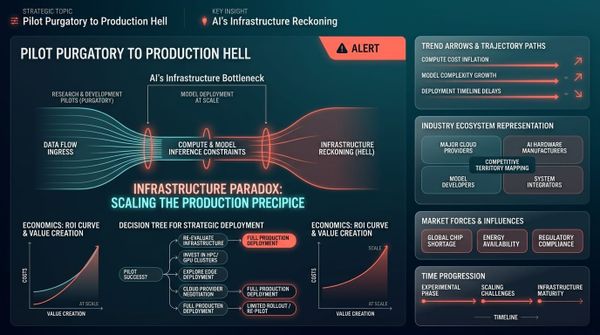
The enterprise data is even more telling. Survey of 120,000+ companies shows only 8.6% have AI agents in production, with 76% now buying AI solutions rather than building custom models. Translation: the market has already moved from bespoke AI development to commodity AI consumption. Companies aren't pilot-trapped because AI is too complex—they're waiting for the infrastructure cost collapse to make large-scale deployment economically rational.
The Pattern
This is the exact playbook that killed enterprise software margins in the cloud transition. Remember when Oracle database licenses cost $100K+, then AWS RDS made databases a $50/month commodity? Or when enterprise email meant Exchange Server deployments, until Google Apps made it free?
The pattern is identical: massive infrastructure investment by platforms → dramatic cost reductions → commoditization → new business models that couldn't exist at previous price points → incumbents with high-cost structures get disrupted.
We saw it with Amazon Web Services (2006-2012), with mobile app ecosystems (2008-2014), with SaaS platforms (2010-2018). Now it's happening with AI infrastructure, except faster.
The Stakes
Companies making AI strategy decisions based on 2025 pricing are planning for a world that won't exist in 18 months. If you're budgeting $2 million for AI capabilities that will cost $200K by 2027, you're not being conservative—you're being obsolete.
The window for competitive advantage is closing rapidly. Early movers who architect for commodity AI will dominate markets. Late adopters who wait for "AI ROI clarity" will face competitors who rebuilt their entire business models around 10x cheaper intelligence.
By Q4 2026, the companies still treating AI as a premium service will be competing against AI-native businesses that embed intelligence into every workflow, customer interaction, and operational decision—because they can afford to.
What This Means For You
For CTOs
Stop optimizing for expensive AI. Your current vendor strategy assumes AI remains premium-priced. Wrong bet. By Q3 2026, AI inference costs will drop 70%+ industry-wide. Start architectural planning for AI-everywhere, not AI-as-special-service.
Renegotiate AI contracts now. Lock in consumption-based pricing with downward price adjustments. Avoid fixed-fee premium AI services—they'll be uncompetitive within 12 months.
Budget for commodity AI by 2027. Plan your 2027 infrastructure assuming AI costs drop to database-level pricing. This means 10x more AI usage in your budget, not 10x bigger AI budgets.
Build for AI-native workflows. Don't bolt AI onto existing processes. Redesign core systems assuming intelligence is cheap and abundant. The companies that win will be architecturally ready for commodity AI.
For AI Product Leaders
Price for the commodity future, not the premium present. If your product economics depend on AI remaining expensive, you have 18 months to find a new model. Build businesses that get better as AI gets cheaper, not worse.
Target markets that unlock at commodity pricing. Small/mid-market customers who can't afford $50K AI deployments will be your growth engine when those same capabilities cost $5K.
Differentiate on integration, not model performance. Model capabilities are commoditizing rapidly. Competitive advantage shifts to data integration, workflow optimization, and user experience.
For Engineering Leaders
Design for AI abundance. Your current systems assume AI is scarce and expensive. Rewrite that assumption. Plan infrastructure for 100x more AI calls, not 2x better AI models.
Hire for commodity AI skills. Stop competing for frontier model researchers. Start hiring engineers who can build reliable systems around cheap, abundant AI capabilities.
Optimize for integration speed, not AI costs. Your bottleneck is shifting from "can we afford this AI capability?" to "how fast can we integrate intelligence everywhere?"
What We're Watching
By Q2 2026: First wave of AI startups face margin compression as infrastructure costs drop faster than they can reprrice their services.
By Q3 2026: Mid-market AI adoption accelerates 300%+ as commodity pricing makes enterprise AI accessible to companies with <$100M revenue.
If DeepSeek V4 matches GPT-4 performance at 20% of OpenAI pricing: Expect OpenAI to slash enterprise pricing 50%+ to maintain market position.
By Q4 2026: First "AI-native" unicorn emerges—a company whose business model only works because AI is cheap enough to embed in every user interaction.
By Q1 2027: Traditional software companies start acquiring AI-native competitors rather than building AI capabilities, because the cost structure advantage is insurmountable.
The Bottom Line
Mark this prediction: January 2027 will be remembered as the moment AI became infrastructure instead of innovation. The companies building for premium AI pricing will spend 2027 explaining why their expensive solutions are better than free alternatives. Meanwhile, AI-native businesses that couldn't exist at 2025 price points will be capturing markets nobody knew were possible.
The infrastructure arms race isn't creating AI scarcity—it's creating AI abundance. The $20 billion rounds and nuclear power contracts aren't about making AI more expensive. They're about making it so cheap and reliable that embedding intelligence everywhere becomes the default, not the exception. Your competitors are already planning for that world. Are you?