The Great Hardware Decoupling: Why Meta's $60B AMD Bet Signals the End of GPU Hegemony
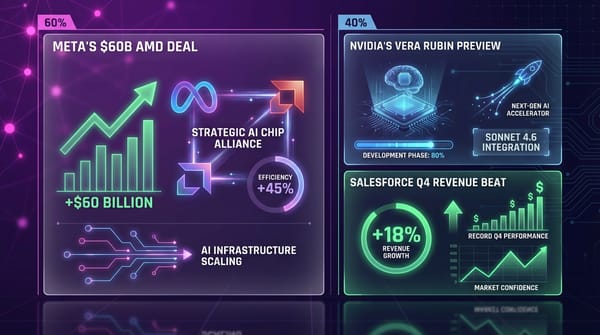
Meta just signed a $60 billion check that will reshape the AI industry. Not for more ChatGPT features. Not for better customer service bots. For chips.
The five-year AMD deal, announced February 26, includes an option for Meta to acquire 10% of AMD. That's not procurement—that's strategic alliance warfare. While everyone debates whether AI agents will kill SaaS, the real battle is happening one layer deeper: who controls the silicon that powers the AI revolution.
This isn't about diversification anymore. It's about survival. When Nvidia controls 90% of AI training chips and can dictate terms, pricing, and roadmaps, every AI-dependent company faces an existential risk. Meta's move signals the beginning of what I'm calling the "Great Hardware Decoupling"—a systematic effort by AI leaders to break free from single-vendor dependence.
The stakes couldn't be higher. By 2027, companies that successfully diversify their AI infrastructure will run circles around those still locked into GPU hegemony. The window to act is closing fast.
The Story
The Setup
For three years, the AI industry operated under one simple rule: buy Nvidia or fall behind. H100s became the de facto currency of AI capability. OpenAI, Anthropic, Google, and Meta all competed for the same scarce resource, driving prices up and delivery timelines out. The assumption was straightforward: Nvidia makes the best chips, so Nvidia gets the biggest checks.
The Shift
Meta's $60 billion AMD commitment changes everything. This isn't diversification—it's a declaration of independence. The deal includes co-engineering AMD's MI450 platform specifically for inference workloads and an equity stake that aligns long-term interests. MatX raised $500 million the same week to build inference-specific chips. Nvidia responded by unveiling Vera Rubin, promising 10x better performance per watt.
Meanwhile, OpenAI's COO admitted something remarkable: "We have not yet really seen AI penetrate enterprise business processes." Despite $130+ billion in recent funding rounds between OpenAI and Anthropic, actual enterprise deployment remains limited. Gartner predicts only 40% of enterprise apps will embed AI agents by year-end—aggressive growth, but far from the "SaaS apocalypse" narrative driving private valuations.
The Pattern
This follows the exact playbook from cloud infrastructure's early days. In 2008, every startup ran on AWS because there were no alternatives. By 2015, smart companies had multi-cloud strategies because vendor lock-in became too risky. Today's AI leaders are applying the same logic one layer deeper.
The pattern is accelerating because AI infrastructure costs are orders of magnitude higher than traditional cloud workloads. When your monthly compute bill hits eight figures, diversification isn't nice to have—it's existential. Meta's deal essentially guarantees AMD 20% market share by volume, creating the competitive dynamic Nvidia's customers desperately need.
But here's the twist: while private AI companies raise billions on "agents will replace everything" narratives, public enterprise software stocks are getting hammered based on the same story. ServiceNow dropped 20% year-to-date despite beating revenue expectations. The market is pricing in disruption that enterprise buyers aren't actually implementing yet.
The Stakes
Companies have roughly 18 months to lock in diversified AI infrastructure before supply constraints and pricing power shift permanently. Meta's AMD partnership doesn't just secure their compute—it potentially gives them cost advantages over competitors still paying Nvidia premiums.
The first movers in hardware diversification will set the competitive dynamics for the next decade. If AMD delivers on the MI450 performance promises, Nvidia's pricing power evaporates. If specialized inference chips from MatX and others prove superior for production workloads, training-focused architectures become oversized and overpriced.
Meanwhile, enterprises caught between AI capability promises and deployment reality face their own timing pressure. The companies successfully piloting AI agents today will scale to autonomous business processes by 2027. Those still evaluating use cases will find themselves competing against organizations with fundamentally different cost structures and capabilities.
What This Means For You
For CTOs
Diversify your AI infrastructure stack now. Don't wait for AMD's MI450 to ship—start evaluating alternatives to pure Nvidia deployments. Negotiate multi-vendor contracts for 2027-2028 capacity, even if current volumes don't justify it. The supply chain dynamics are shifting faster than most procurement cycles can adapt.
Build inference-first architectures. Meta co-engineered the MI450 for production workloads, not training. If you're still running inference on training-optimized hardware, you're burning money. Start testing inference-specific solutions and quantify the cost differences.
Question the agent hype timeline. OpenAI's honest assessment about enterprise penetration should inform your AI roadmap. Plan for gradual AI integration over 24-36 months, not revolutionary transformation in 6-12 months.
For AI Product Leaders
Focus on production-ready deployments over demos. The funding environment rewards capability showcases, but enterprise customers are buying reliability and ROI. The UCSF research showing AI accelerating medical analysis by 10x matters because it moved from pilot to production.
Choose specialized models over general-purpose giants. The February model releases fragmented the leaderboard—no single "best" AI exists anymore. Build your product strategy around models optimized for your specific use cases rather than chasing the latest general-purpose benchmark leader.
Price for consumption, not seats. Salesforce's new "Agentic Enterprise License Agreement" represents the future—flat-fee, all-you-can-use models that align vendor success with customer value creation.
For Engineering Leaders
Architecture for multi-vendor reality. Design your AI systems to work across different chip architectures and model providers. The companies that can seamlessly switch between AMD, Nvidia, and specialized chips will have massive cost and performance advantages.
Prioritize inference optimization over training scale. Most engineering teams are over-optimizing for training workflows when 90% of their compute will be inference. Start with production workload requirements and work backward to infrastructure decisions.
Implement agent workflows gradually. Despite the enterprise software stock selloff, traditional SaaS isn't disappearing overnight. Build AI agents that augment existing workflows before replacing them entirely.
What We're Watching
By Q3 2026: AMD's MI450 platform ships and early benchmarks reveal whether it can truly compete with Nvidia's inference performance. If yes, expect a flood of enterprise partnerships similar to Meta's.
By Q4 2026: The first wave of inference-specific chips from MatX, Groq, and others reaches production scale. Watch for enterprises testing these specialized platforms for cost-sensitive AI workloads.
By Q1 2027: OpenAI's IPO filing will reveal the gap between private AI valuations and public market reality. If the gap is massive, expect a correction in private AI funding.
If enterprise software stocks continue falling: Traditional SaaS vendors will start acquiring AI-native startups at distressed valuations rather than building competitive capabilities internally.
If Nvidia's Vera Rubin delivers 10x performance per watt: The hardware decoupling accelerates as energy efficiency becomes the primary differentiator for large-scale AI deployments.
The Bottom Line
Mark this moment: February 26, 2026. Meta's $60 billion AMD bet just ended Nvidia's monopoly on AI infrastructure strategy. Not through technology competition, but through supply chain warfare.
The companies that recognize this shift and diversify their AI infrastructure now will have sustainable cost advantages over those that don't. By 2028, running AI workloads exclusively on Nvidia hardware will be like running enterprise applications exclusively on Oracle databases in 2015—expensive, limiting, and ultimately unnecessary.
The Great Hardware Decoupling has begun. Your infrastructure strategy for the next five years gets decided in the next five months. Choose wisely.