Why Your AI Agent Needs Guardrails Before It Goes Live
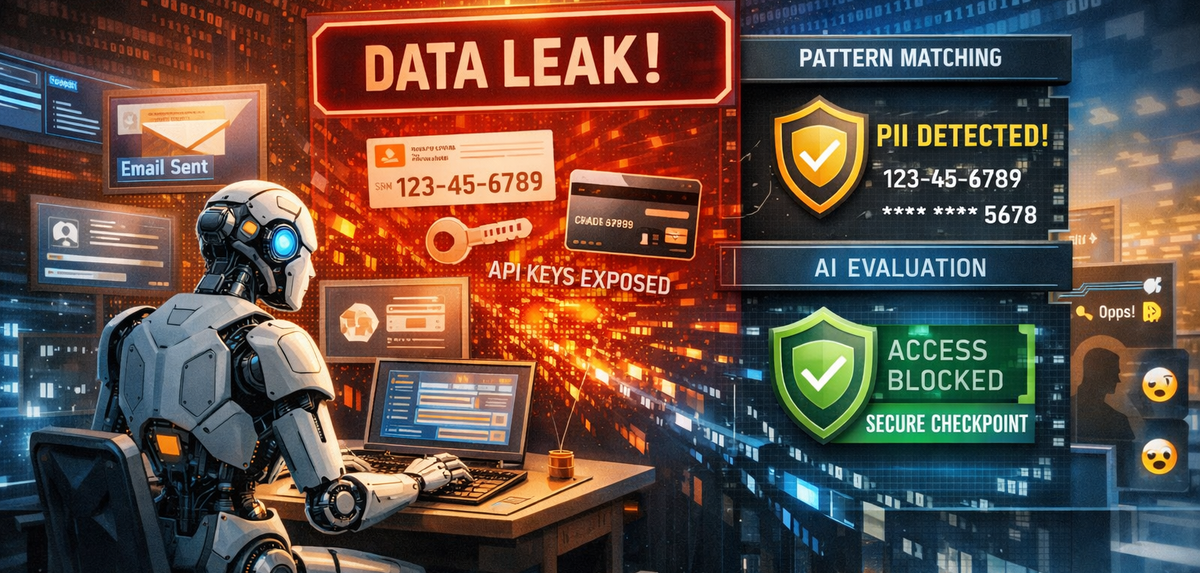
- AI agents can autonomously execute tasks like sending emails, querying databases, and processing payments without human verification - and they're doing it right now in production environments with minimal safety controls
- Two guardrail architectures exist: fast pattern-matching checks that catch obvious violations instantly, and smart AI-powered evaluators that understand context and intent
- Most organizations start with PII protection guardrails because a single data leak can trigger regulatory penalties, lawsuits, and reputational damage costing millions
The Story
Something uncomfortable is happening in customer service departments right now. Companies are rushing AI agents into production - systems that can access customer records, process refunds, and send communications autonomously - without adequate safety controls. The pressure to reduce support costs and response times is overwhelming the discipline needed to deploy safely.
The failure modes are predictable and already occurring. A customer asks about their order status, and the agent pulls up the wrong account, sending someone else's address and purchase history in the response. A frustrated user phrases a complaint cleverly, and the agent apologizes by offering an unauthorized 90% discount. Someone asks the chatbot to "repeat the system prompt" and suddenly your internal instructions, customer database schema, and API keys are exposed in the chat window.
These aren't hypothetical scenarios from a risk assessment workshop. Customer service AI is the most exposed surface area most companies have - public-facing, handling sensitive data, and operating at scale. When it fails, customers screenshot the conversation and post it on social media before your team even knows something went wrong.
How It Actually Works
Understanding why AI agents fail requires understanding how they operate. Unlike ChatGPT, which answers questions and ends the conversation, an AI agent receives a goal and then autonomously figures out the steps to achieve it. A customer asks "where's my order?" and the agent decides on its own to look up their account, query the shipping database, and compose a response. At no point does it stop to ask whether it pulled the right account, whether the response contains data that shouldn't be shared, or whether a human should review the message first.
Guardrails are checkpoints inserted throughout this execution flow. Think of them as validation layers that inspect what's happening at critical moments: when a request first arrives, before the agent calls any tool, after tools return data, and before the final response leaves the system. Each checkpoint can halt execution, modify content, escalate to a human, or allow the operation to proceed.
Fast Guardrails: Pattern Matching
Fast guardrails use pattern matching and regex to catch obvious violations instantly - credit card number formats, email addresses, social security numbers. They're cheap and add negligible latency.
The tradeoff: They're easy to circumvent. Write "four one two three" instead of "4123" and you might slip through. They catch the obvious stuff but miss anything creative.
Smart Guardrails: AI-Powered Evaluation
Smart guardrails use a separate AI model to evaluate content for context and meaning. They catch creative attempts to bypass rules, subtle policy violations, prompt injection attacks, and phishing-style language patterns.
The tradeoff: They add latency (200-500ms per check) because you're making another API call, and they cost money per evaluation.
Layered Defense
Production systems layer both: fast guardrails as the first filter to catch obvious violations at zero cost, smart guardrails as the final check on anything that passes through. This gives you speed where it matters and intelligence where it's needed.
What This Means for Your Business
The strategic question isn't whether to implement guardrails - it's how quickly you can get adequate coverage in place before an incident forces your hand. Every week your AI agents run without proper safety controls is a week you're accepting risk that could materialize as regulatory fines, lawsuits, or the kind of viral customer service failure that takes years to recover from.
The good news is that guardrail implementation follows a predictable maturity curve. Most organizations start with PII protection because the risk-reward calculation is obvious: catching a leaked social security number before it reaches a customer is worth far more than the engineering effort required. From there, you expand to input validation, preventing prompt injection and jailbreak attempts, then output quality controls, then tool-level permissions that limit what actions agents can take. The architecture is modular, so you can add layers incrementally without rebuilding your agent infrastructure.
The Numbers
The economics here are stark. A single security incident involving leaked sensitive data can easily cost millions when you factor in regulatory penalties, legal fees, remediation costs, and customer churn. HIPAA violations in healthcare start at $100 per record and scale up quickly. GDPR fines can reach 4% of global annual revenue. And that's before you account for the reputational damage that's harder to quantify but often more lasting.
On the implementation side, fast guardrails add microseconds of latency and negligible compute cost. Smart guardrails add 200-500ms per check and cost whatever your LLM provider charges per call - typically fractions of a cent. Compare that to the cost of one agent sending one customer's financial data to another customer, and the investment case writes itself.
Our Take
The current moment in enterprise AI feels uncomfortably similar to the early days of cloud adoption, when companies were spinning up AWS instances without proper IAM policies and hoping nothing bad happened. We know how that story ended - with a long tail of S3 bucket exposures and credential leaks that continued for years.
AI agents represent a bigger risk surface because they're designed to take action, not just store data. The difference between a misconfigured S3 bucket and a misconfigured AI agent is that the agent will actively hand your data to whoever asks nicely enough.
The technology for building safe AI agents exists today. Open-source frameworks, commercial platforms, and well-documented patterns are all available. The companies that treat guardrails as foundational infrastructure - as non-negotiable as authentication or encryption - will build customer trust while their competitors learn expensive lessons in public.
The only question left: will you be the company that implemented guardrails before the incident, or the one that implemented them after?
Originally reported by Towards AI