GenAI Daily - April 12, 2026: Tether's Local AI Push, LM Studio Mobile Expansion, Enterprise Security Race
Top Stories
Tether Launches QVAC SDK for Decentralized AI Infrastructure
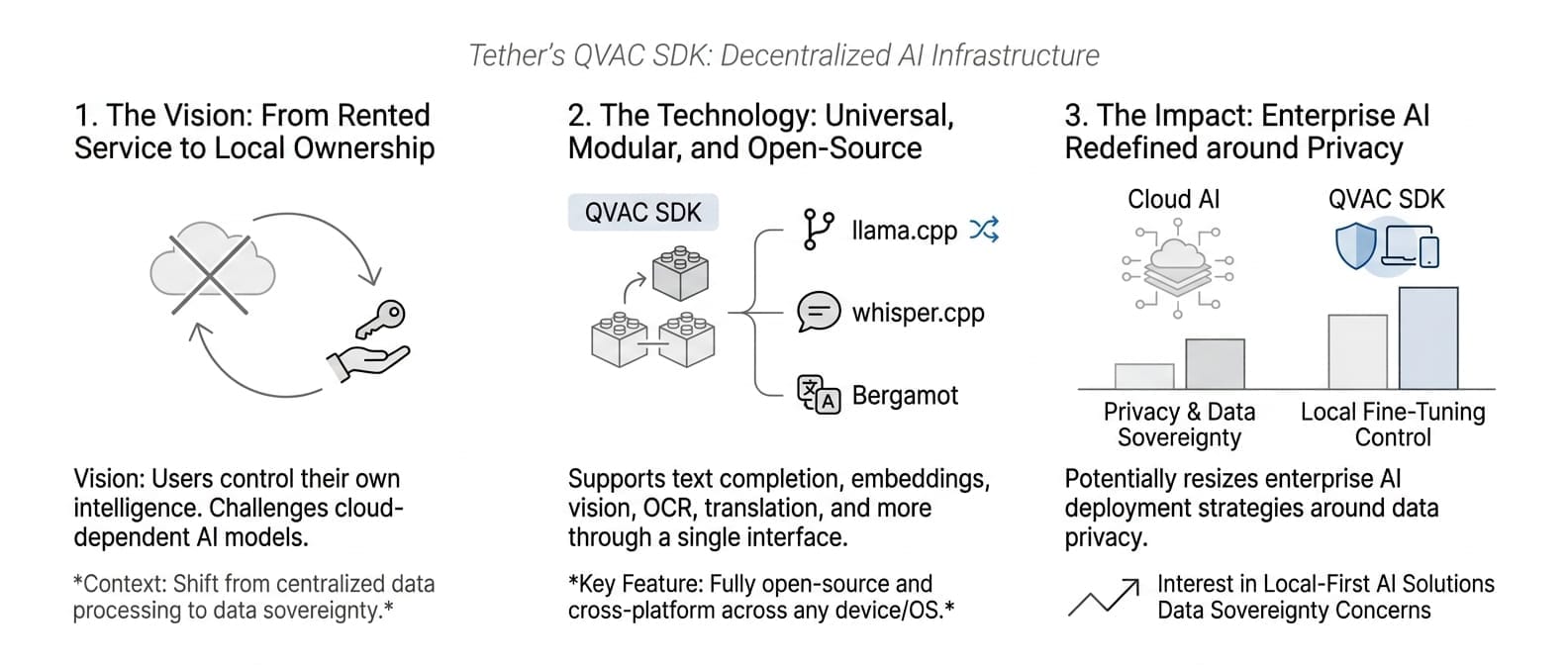
Tether's QVAC team announced the launch of QVAC SDK, a fully open-source cross-platform Software Development Kit designed to become a universal Artificial Intelligence building block. The company sees AI as "a new element of the periodic table - a raw material that can be embedded into the very fabric of the universe." QVAC is positioned as "the atomic unit of this new world," functioning as a modular, highly efficient, local-first AI platform designed to run on any device, platform, and operating system.
The SDK enables developers to build, run, and fine-tune AI directly on any device, consistently across environments. Tether's vision is that "intelligence should not be a service one rents" but should belong to users who control it.
Built on QVAC Fabric (a fork of llama.cpp), the SDK integrates engines like whisper.cpp for speech-to-text and Bergamot for on-device translation, supporting text completion, embeddings, vision, OCR, text-to-speech, speech-to-text, translation, and more through a single interface.
Why it matters: Tether's move beyond stablecoins into local-first AI infrastructure challenges the cloud-dependent model, potentially reshaping enterprise AI deployment strategies around privacy and data sovereignty.
LM Studio Acquires Locally AI for Mobile Local AI
LM Studio acquired Locally AI on April 8, 2026, bringing the popular iPhone/iPad local AI app into its ecosystem. Adrien Grondin, creator of Locally AI, joins LM Studio to lead native mobile AI development.
The combined platform targets seamless local AI across macOS, Windows, Linux, iPhone, and iPad - all without cloud dependency.
This acquisition represents the most concrete signal that the local AI movement is expanding beyond desktop roots. As on-device hardware from Apple, Qualcomm, and MediaTek improves, the ceiling for mobile local AI rises every year, with LM Studio positioning itself to own this category before cloud providers can respond.
Locally AI demonstrated that models could run natively on Apple Silicon iPhones and iPads. With Apple Silicon M4 chips appearing in iPads and delivering improved neural engine throughput, lightweight models in the 1B-3B range (like SmolLM2, Qwen2.5-0.5B) already run comfortably on modern iPhones.
Why it matters: The acquisition signals serious enterprise demand for local AI solutions that work across all devices without cloud dependencies, potentially disrupting enterprise AI procurement strategies.
Anthropic Expands Mythos Preview Access Through Project Glasswing
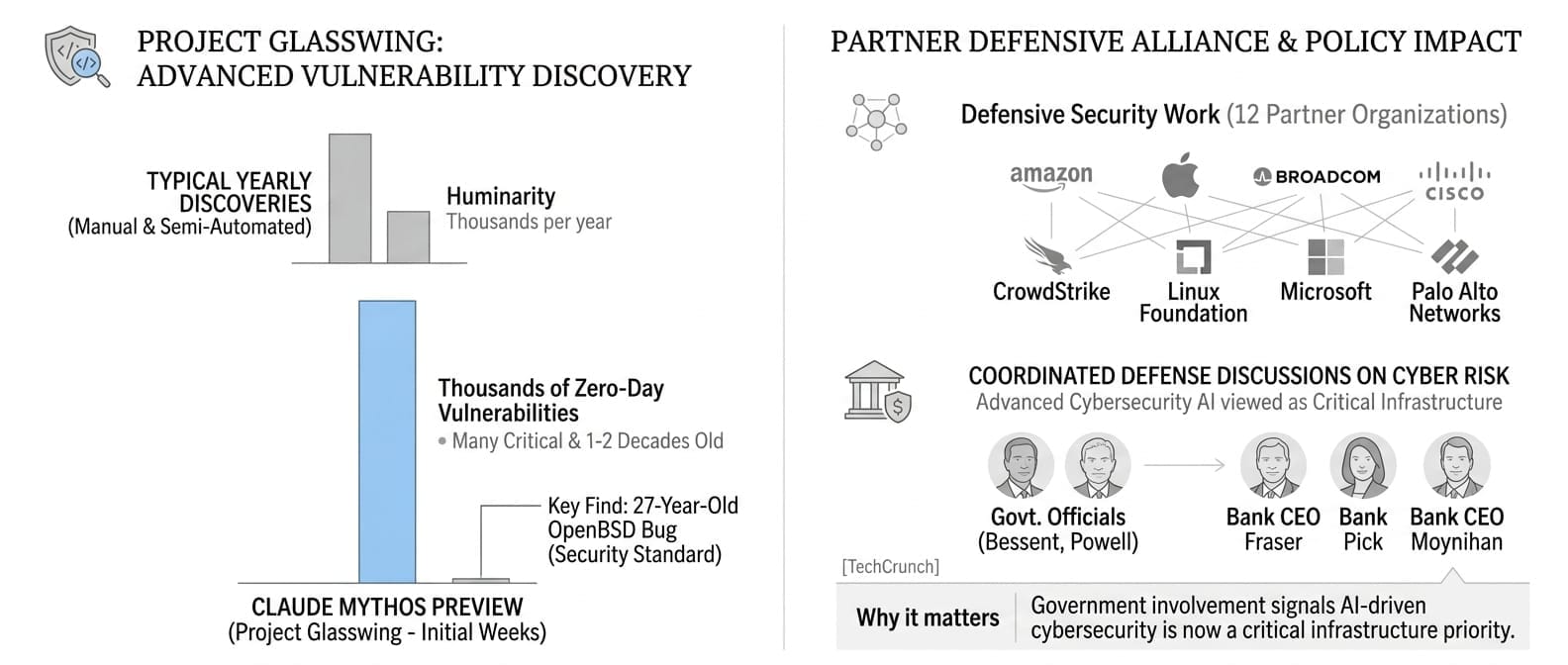
Anthropic's Claude Mythos Preview is now available to 12 partner organizations for "defensive security work" through Project Glasswing. Over the past few weeks, Mythos identified "thousands of zero-day vulnerabilities, many of them critical," with many vulnerabilities being one to two decades old.
Several vulnerabilities discovered using the model had existed undetected for years, including a 27-year-old bug in OpenBSD - an operating system known for strong security.
Partner organizations include Amazon, Apple, Broadcom, Cisco, CrowdStrike, the Linux Foundation, Microsoft, and Palo Alto Networks.
Anthropic does not plan to make Claude Mythos Preview generally available, with their eventual goal being to enable users to safely deploy Mythos-class models at scale once new safeguards are developed.
Treasury Secretary Bessent and Fed Chair Powell assembled major bank CEOs including Citigroup's Jane Fraser, Morgan Stanley's Ted Pick, and Bank of America's Brian Moynihan to discuss cyber risks presented by the new model.
Why it matters: The government's direct involvement in managing AI model releases signals that advanced cybersecurity AI is now considered critical infrastructure requiring coordinated defense strategies.
Key Developments
Enterprise AI Labor Market Shows Sharp Divisions
SHRM's State of AI in HR 2026 report found that AI is 5.7 times more likely to shift job responsibilities than to eliminate jobs outright. Workers face being required to do jobs differently, faster, and with AI tools they may not know how to use, while employers adjust expectations upward without adjusting pay to match.
Challenger, Gray & Christmas reported that AI was cited as the leading reason for tech layoffs in March 2026, accounting for 25% of stated reasons, up from 10% just one month earlier.
The Dallas Fed found that AI tends to automate codifiable tasks that entry-level workers depend on while making experienced workers more valuable. The IMF found entry-level hiring is declining in AI-exposed fields even as wages rise for current workers. PwC's Global AI Jobs Barometer found that workers with advanced AI skills earn 56% more than peers in identical roles without those skills.
Impact: The AI skills divide is creating a bifurcated job market where experienced, AI-fluent workers capture most gains while entry-level positions face automation pressure.
NeuBird AI Raises $19.3M for Production Operations Automation
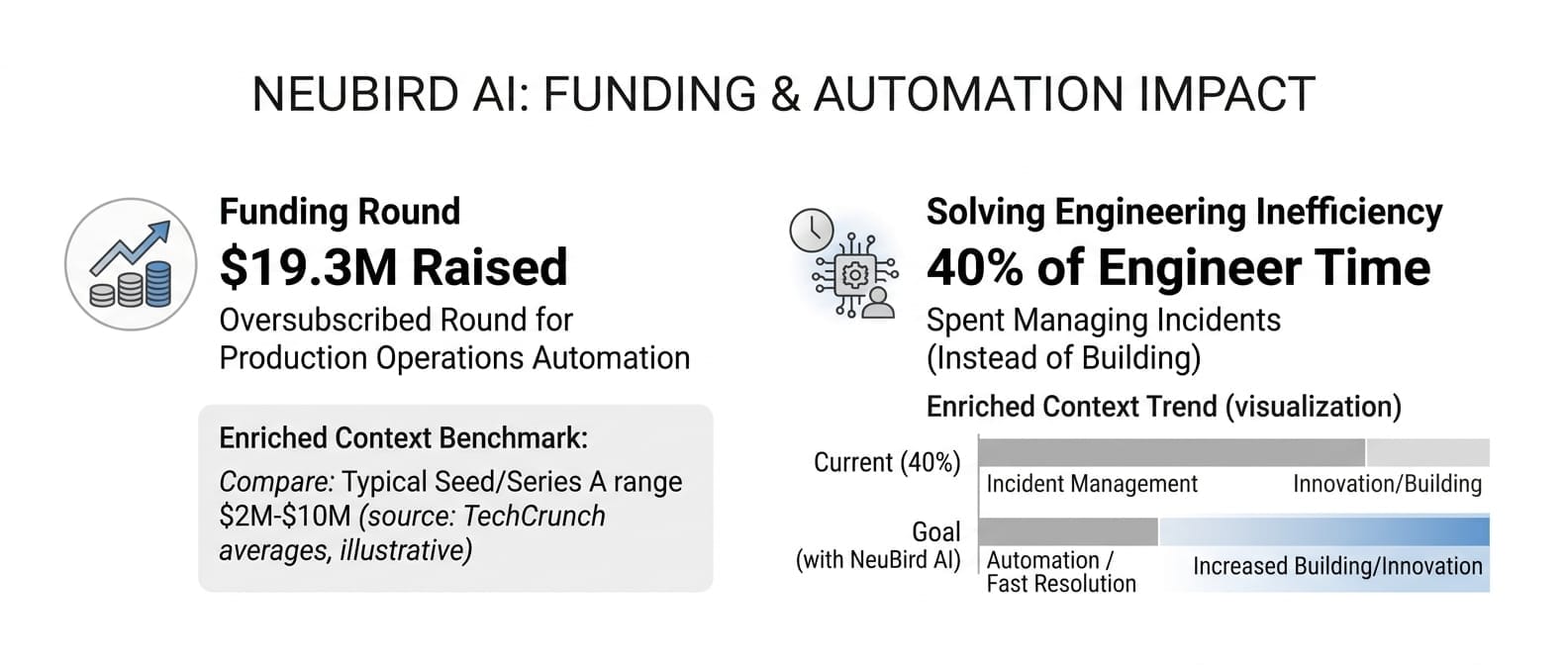
NeuBird AI raised $19.3M in an oversubscribed round to expand its AI-powered production operations platform for enterprise IT, DevOps, and SRE teams. Its autonomous AI agent analyzes infrastructure data in real time to detect issues, perform root cause analysis, and automate remediation, reducing incident response times and engineering workload.
The round was led by new investor Xora Innovation with participation from Mayfield, StepStone Group, Prosperity7 Ventures and M12, Microsoft's venture fund.
According to the 2026 State of Production Reliability and AI Adoption Report, engineers spend an average of 40% of their time managing incidents rather than building.
NeuBird AI earned the AWS Generative AI Competency and joined the Microsoft for Startups Pegasus Program, providing preferred access to Azure and AWS enterprise customer networks as it scales globally.
Impact: Production operations represents a massive addressable market for AI automation, with companies willing to pay premium prices to reduce the 40% time burden on engineering teams.
NVIDIA Agent Toolkit Gains 17 Enterprise Partners
Leading software platforms including Adobe, Atlassian, Amdocs, Box, Cadence, Cisco, Cohesity, CrowdStrike, Dassault Systèmes, IQVIA, Red Hat, SAP, Salesforce, Siemens, ServiceNow and Synopsys are advancing enterprise and physical AI agents with NVIDIA Agent Toolkit software.
NVIDIA CEO Jensen Huang told the crowd that "the enterprise software industry will evolve into specialized agentic platforms," positioning NVIDIA as "the tollbooth at the entrance to that expansion - open to all, owned by one."
NVIDIA Agent Toolkit provides open source models and software for enterprises building tools that scale productivity by autonomously determining how to complete assigned tasks. It includes NVIDIA OpenShell™, an open source runtime that enforces policy-based security, network and privacy guardrails for safer autonomous agent deployment.
For Salesforce, this means Agentforce agents that can draw from both cloud and on-premises data through a single Slack interface.
Impact: NVIDIA's platform strategy for AI agents mirrors its success in AI training hardware, creating ecosystem dependency that could generate long-term revenue beyond chip sales.
Product Launches
Meta Launches Muse Spark from Superintelligence Labs
Meta debuted its first major large language model, Muse Spark, spearheaded by chief AI officer Alexandr Wang, who leads Meta Superintelligence Labs.
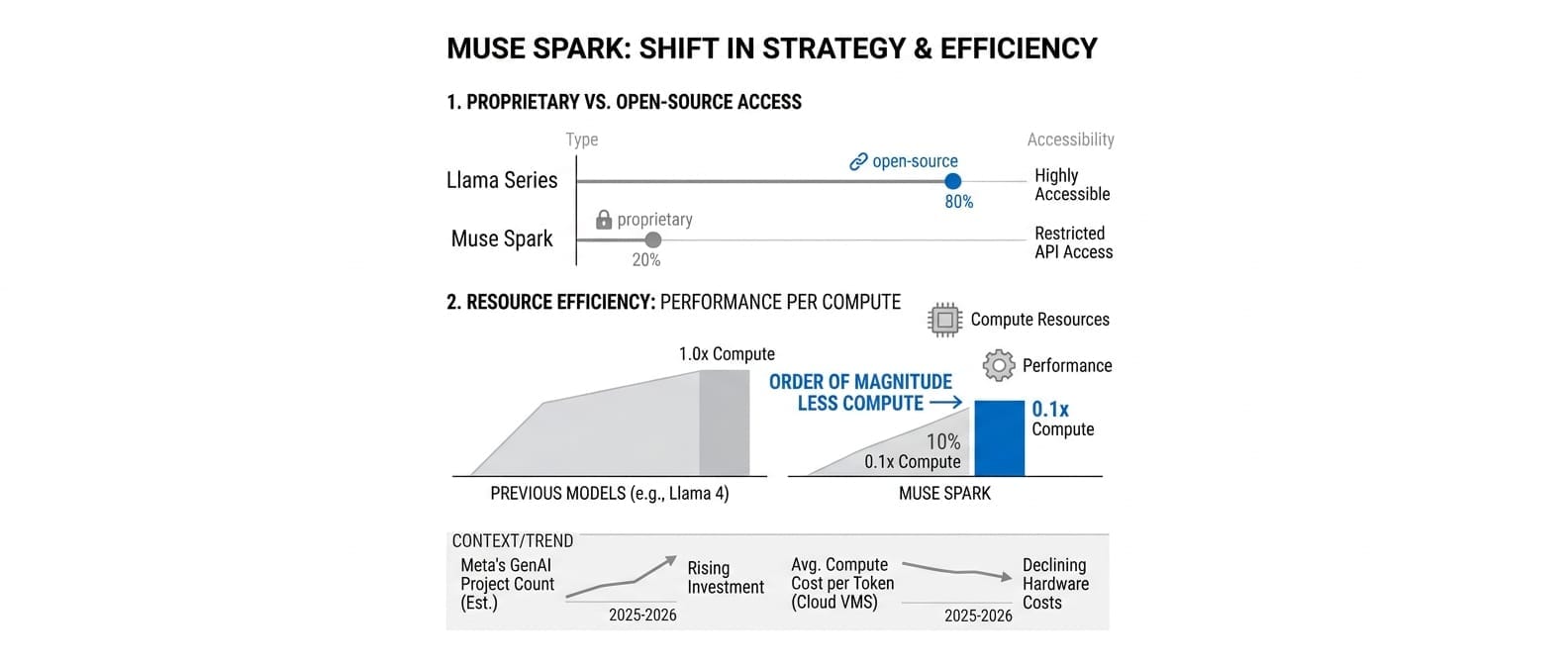
The new Muse Spark will be proprietary, with the company saying there is "hope to open-source future versions of the model." Meta said improved AI training techniques along with rebuilt technology infrastructure enabled the company to create smaller AI models that are as capable as its older midsize Llama 4 variant for "an order of magnitude less compute." Muse Spark offers competitive performance in multimodal perception, reasoning, health, and agentic tasks.
The model will be rolled out to WhatsApp, Instagram, Facebook, Messenger, and AI glasses in the coming weeks. It will also be up for private preview via API to select partners, with "hope to open-source future versions of the model."
Why it matters: Meta's proprietary approach with Muse Spark represents a strategic shift from its open-source Llama strategy, signaling intensified competition in the enterprise AI market.
OpenAI Frontier Platform for Enterprise Agents
Enterprise now makes up more than 40% of OpenAI's revenue and is on track to reach parity with consumer by the end of 2026. Companies want AI to be a unified operating layer for their business, with AI coworkers grounded in their company's context, connected to internal systems, external data sources, and governed by the right permissions and controls. OpenAI Frontier is helping customers like Oracle, State Farm, and Uber build, deploy, and manage agents company-wide, enabling agents to move across a company's systems and data, working across tools, and continuing to improve over time.
Impact: OpenAI's enterprise focus demonstrates the maturation of AI from experimental tools to core business infrastructure, with enterprise revenue approaching consumer levels.
Funding & Deals
Nexus Secures $4.3M Seed for Enterprise AI Agent Deployment
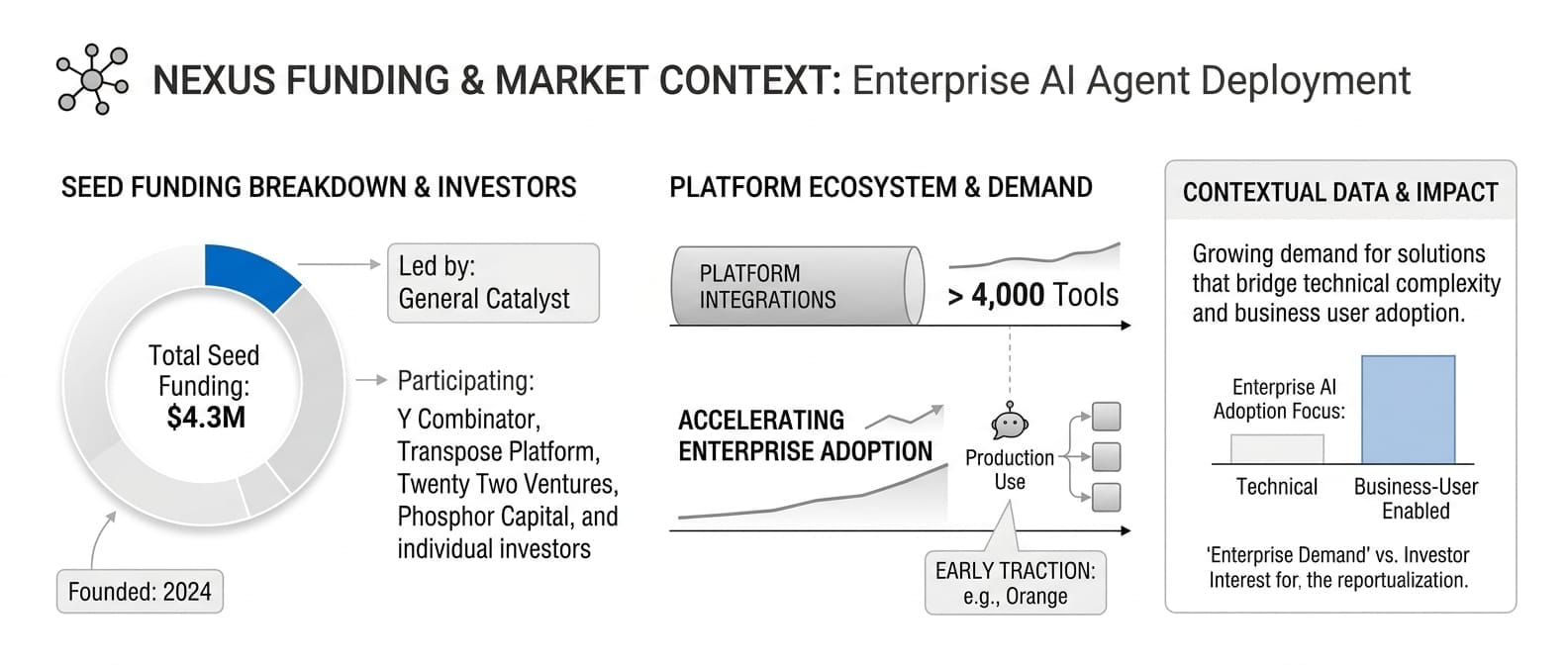
Nexus, a startup building enterprise AI agents, has raised $4.3 million in seed funding to accelerate adoption of agent-based AI in business operations. The round was led by General Catalyst with participation from Y Combinator, Transpose Platform, Twenty Two Ventures, Phosphor Capital, and individual investors. Founded in 2024 by CEO Assem Chammah and AI engineer Shady Al Shoha, Nexus focuses on enabling non-technical teams to deploy autonomous agents across enterprise systems. Its platform integrates with more than 4,000 tools and combines AI software with implementation support to drive production use, with early traction including enterprise clients such as Orange.
Impact: The strong investor interest in enterprise AI agent deployment reflects growing demand for solutions that bridge technical complexity and business user adoption.
Tomorrow's Watch List
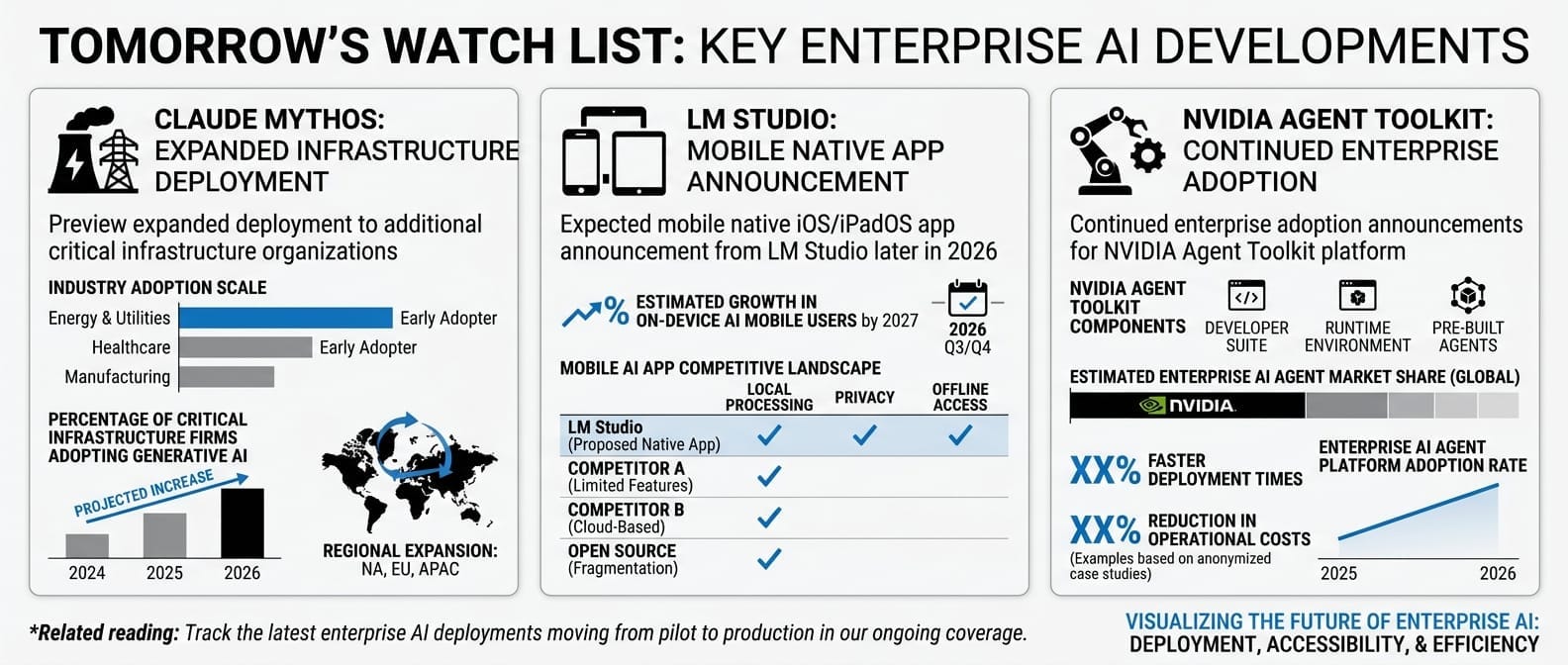
- Claude Mythos Preview expanded deployment to additional critical infrastructure organizations
- Expected mobile native iOS/iPadOS app announcement from LM Studio later in 2026
- Continued enterprise adoption announcements for NVIDIA Agent Toolkit platform
*Related reading: Track the latest enterprise AI deployments moving from pilot to production in our ongoing coverage.