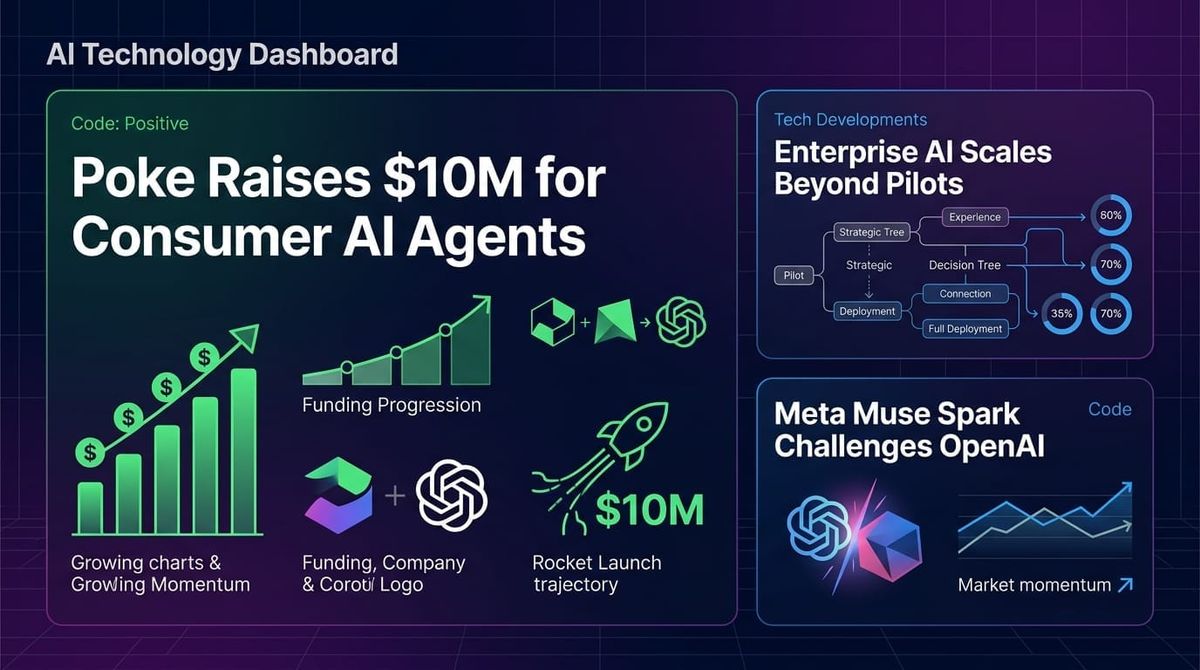
GenAI Daily - April 13, 2026: Poke Raises $10M for Consumer AI Agents, Enterprise AI Scales Beyond Pilots, Meta Muse Spark Challenges OpenAI
Top Stories
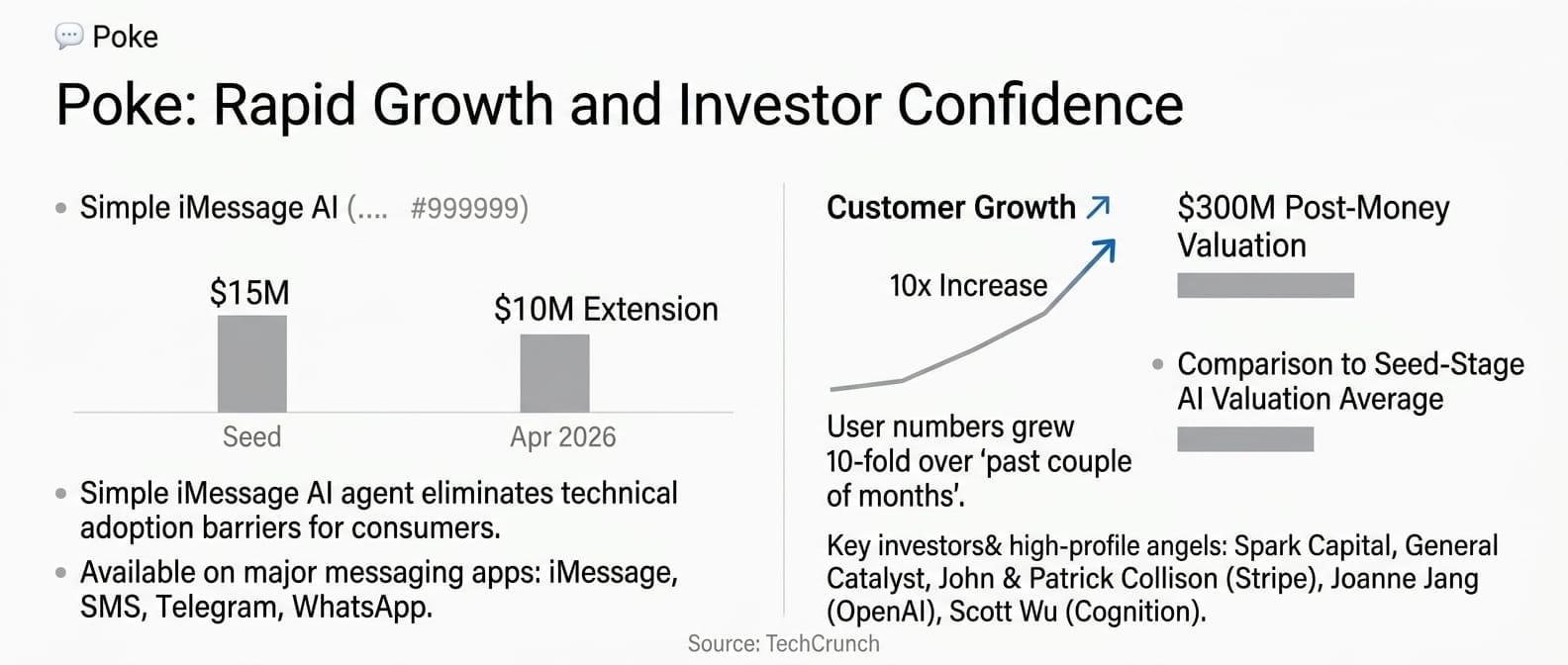
Poke Raises $10M Extension for Text-Based AI Agents at $300M Valuation
Poke, the consumer AI startup, has raised an additional $10 million on top of its $15 million seed round, bringing its valuation to $300 million post-money. The Palo Alto company offers an AI agent accessible via iMessage, SMS, Telegram, and WhatsApp that can handle everyday needs like daily planning, managing calendars, tracking health and fitness, controlling smart homes, and editing photos through text messaging.
Backed by Spark Capital and General Catalyst, the startup has attracted high-profile angels including Stripe founders John and Patrick Collison, OpenAI's Joanne Jang, and Cognition founders Scott Wu and Walden Yan. The company reports that customer numbers have increased 10x over the past couple of months.
Why it matters: Poke represents the consumer democratization of AI agents, removing technical barriers that have limited adoption to developers and enterprises.
Enterprise AI Matures: Organizations Deploy 28 Autonomous Systems on Average
IT leaders report an average of 28 autonomous or semi-autonomous systems currently in operation, with plans to expand to 40 within the next year. Over a third of companies now prioritize speed-to-market as the primary driver for AI adoption, with AI functioning as a competitive lever rather than just a back-office tool.
Between 10-20% of leading firms are building internal "agent platforms" to handle planning, tool selection, long-running workflows, and human-in-the-loop controls because off-the-shelf copilots don't provide the reliability, auditability, and policy control they need. However, 84% of companies still haven't redesigned jobs or workflows around AI capabilities.
Why it matters: Enterprise AI is transitioning from experimental pilots to production-scale orchestration, but organizational readiness remains the primary bottleneck.
Meta Launches Muse Spark AI Model from Superintelligence Labs
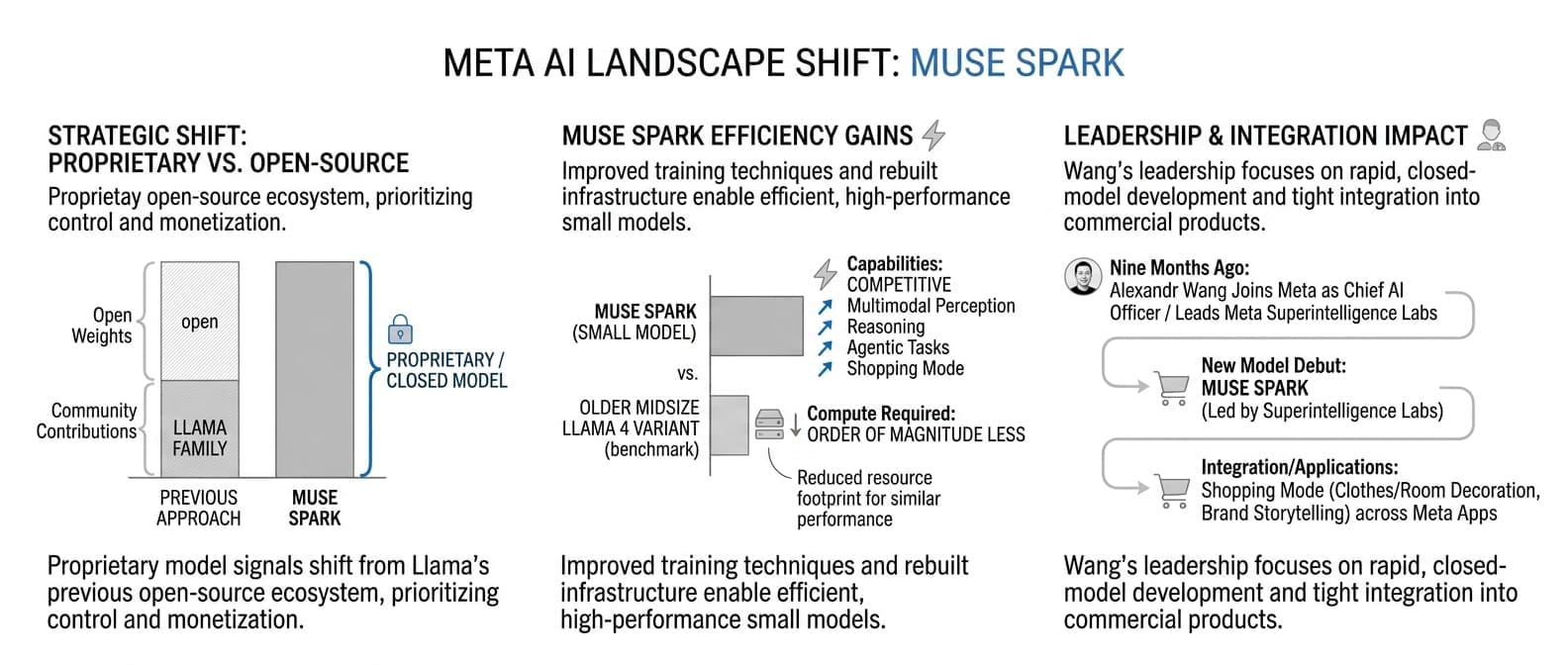
Meta debuted its first major AI model, Muse Spark, spearheaded by chief AI officer Alexandr Wang, who joined nine months ago and leads Meta Superintelligence Labs. The company claims improved AI training techniques and rebuilt infrastructure enable smaller models with capabilities matching older midsize Llama 4 variants for "an order of magnitude less compute," with competitive performance in multimodal perception, reasoning, health, and agentic tasks.
The new Muse Spark will be proprietary initially, with Meta saying there is "hope to open-source future versions," marking a shift from the company's previous open-source approach with its Llama family of models. Meta AI with Muse Spark will include a Shopping mode designed to help people buy clothes or decorate rooms, drawing from styling inspiration and brand storytelling across Meta's apps.
Why it matters: Meta's first proprietary model since hiring Alexandr Wang signals a strategic shift toward closed models and marks intensified competition with OpenAI and Google.
Key Developments
Cyberhill Partners Secures $11M for Enterprise AI Factory Platform
Cyberhill Partners, a professional services firm specializing in enterprise AI solutions for Fortune 500 organizations and US government agencies, has secured a strategic investment of up to $11 million from Baleon Capital. The company's AI Factory platform is designed to deploy enterprise-grade AI solutions within weeks at significantly lower cost than traditional implementation approaches.
Enterprise AI spending is projected to surpass $3 trillion by 2027, yet MIT research suggests 95% of AI projects fail to reach production. Cyberhill's approach draws on US government deployment experience, with enterprise-grade security, data governance, and traceability built from the outset, targeting enterprises that need "AI that actually works in their environment, with their data, under their security requirements".
Impact: Addresses the critical gap between AI pilot programs and production deployment in regulated industries.
Microsoft Launches Three In-House AI Models to Challenge OpenAI
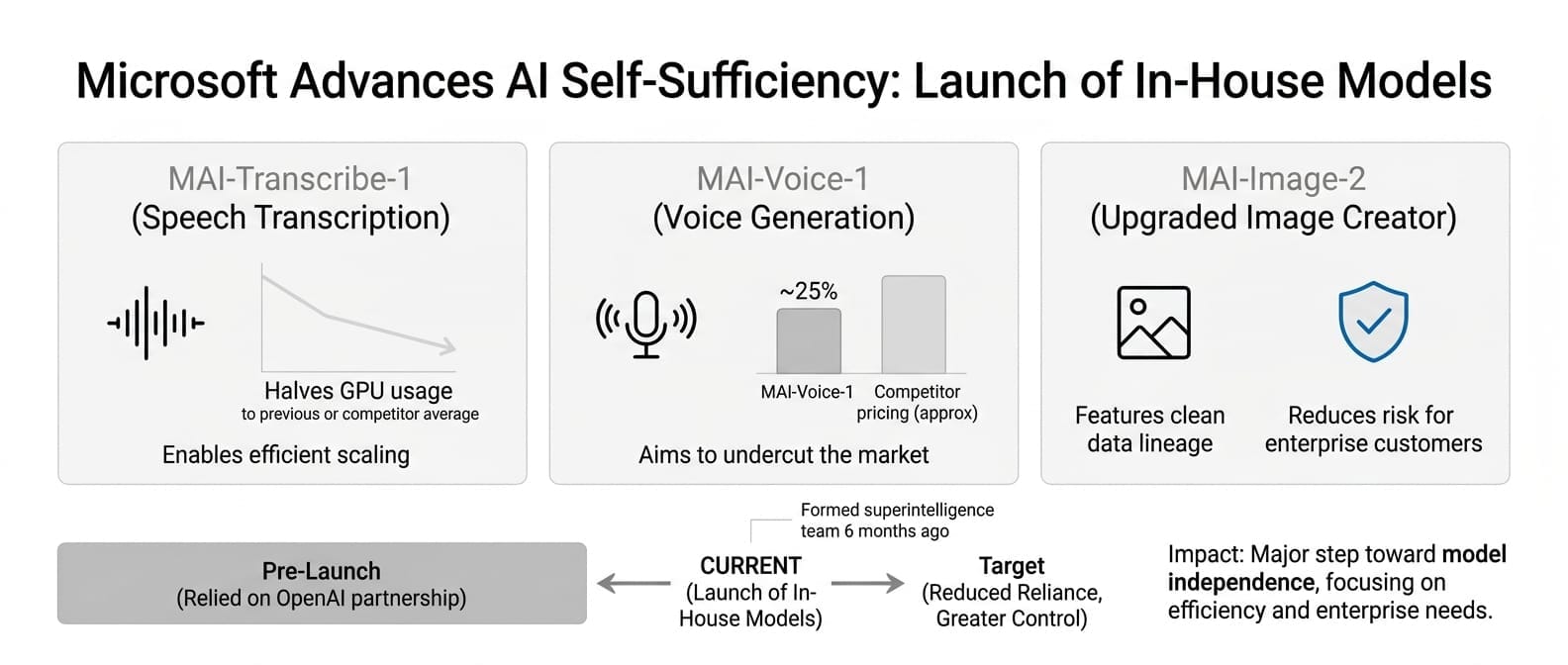
Microsoft launched three foundational AI models built entirely in-house: MAI-Transcribe-1 (speech transcription), MAI-Voice-1 (voice generation), and MAI-Image-2 (upgraded image creator), available immediately through Microsoft Foundry and a new MAI Playground. The trio represents the opening salvo from Microsoft's superintelligence team formed six months ago to pursue "AI self-sufficiency".
Microsoft claims the models run on half the GPUs of competitors while offering developers pricing designed to undercut the market, with the goal of delivering "COGS efficiencies necessary to serve AI workloads at immense scale". The company emphasizes clean data lineage as a competitive advantage, reducing legal and reputational risk for enterprise customers amid copyright lawsuits across the industry.
Impact: Microsoft's first major move toward AI model independence reduces reliance on OpenAI while targeting cost-conscious enterprise customers.
Anthropic Revenue Run Rate Hits $30B as Enterprise Demand Surges
Anthropic's revenue run rate has skyrocketed to $30 billion, marking a dramatic jump from $9 billion at the end of 2025, with the company now serving more than 1,000 business customers spending over $1 million annually after closing a $30 billion Series G funding round valuing the company at $380 billion. The company has significantly expanded its compute agreement with Google and Broadcom amid exploding demand for Claude models, particularly from enterprise customers.
Claude is experiencing unprecedented momentum, with App Store downloads briefly surpassing ChatGPT for the first time, built on enterprise applications while OpenAI dominated the consumer market. Claude differentiates through constitutional AI training based on documents like the UN's Universal Declaration of Human Rights.
Impact: Demonstrates enterprise AI's shift toward safety-focused models and validates Anthropic's enterprise-first strategy against OpenAI's consumer focus.
Product Launches
Alibaba Launches Qwen3.6-Plus for Enterprise AI Applications
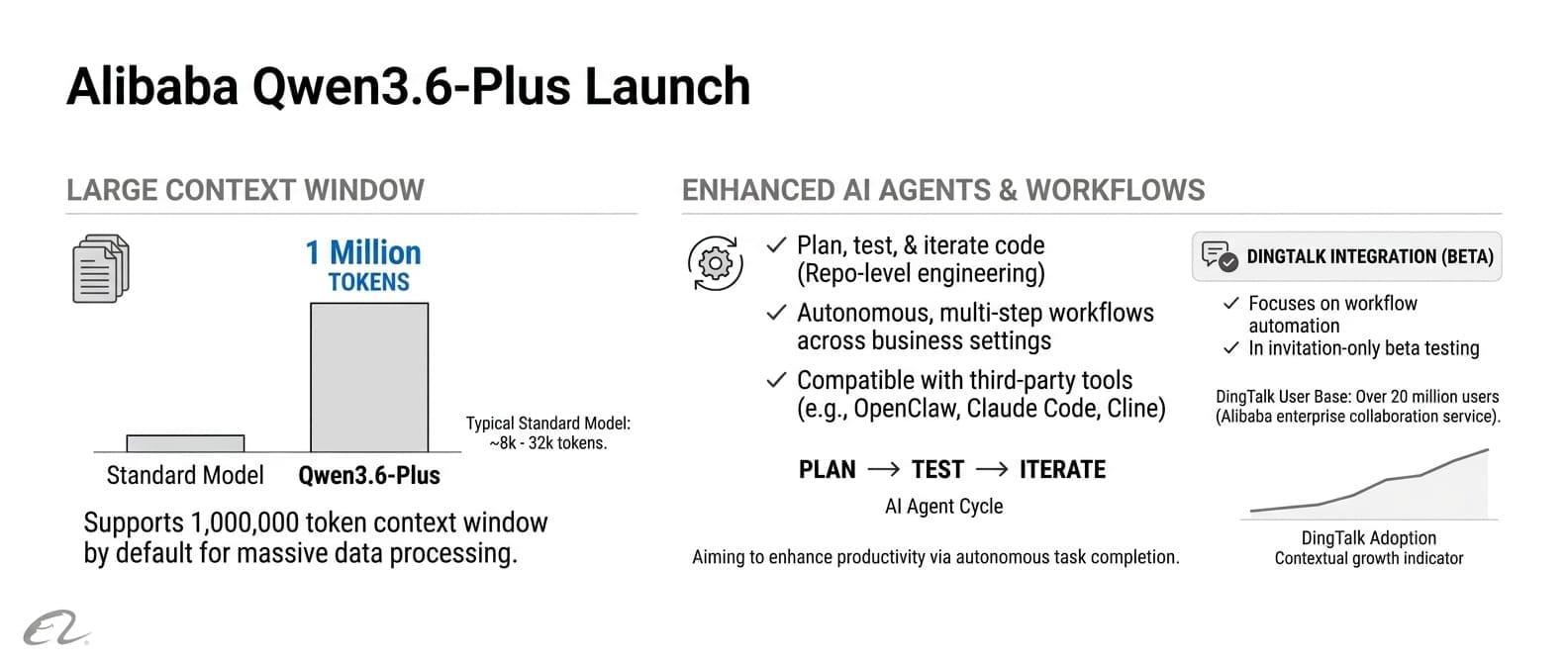
Alibaba has launched Qwen3.6-Plus, a new model intended for enterprise AI applications including coding and multimodal reasoning, aiming to enhance productivity by enabling autonomous, multi-step workflows across various business settings. The model supports a 1 million-token context window by default, can plan, test, and iterate on code for repository-level engineering, and is compatible with third-party coding tools including OpenClaw, Claude Code, and Cline.
Wukong supports agentic workflows and is currently in invitation-only beta testing, connecting with DingTalk, Alibaba's enterprise collaboration service used by over 20 million users, focusing on workflow automation.
Infosys and Harness Strategic Collaboration for Agentic AI-Led Software Delivery
Infosys and Harness announced a strategic collaboration to accelerate agentic AI-led software delivery transformation for enterprises globally, aligning Infosys Topaz Fabric and Infosys Cobalt with the Harness Software Delivery Platform to drive improvements in productivity, software engineering, AI governance, and time-to-market at scale. Infosys Topaz Fabric is a purpose-built agentic services suite that unifies infrastructure, models, data, applications, and workflows into a composable, agent-ready ecosystem.
Funding & Deals
NeuBird AI Closes $19.3M for Production Operations AI Platform
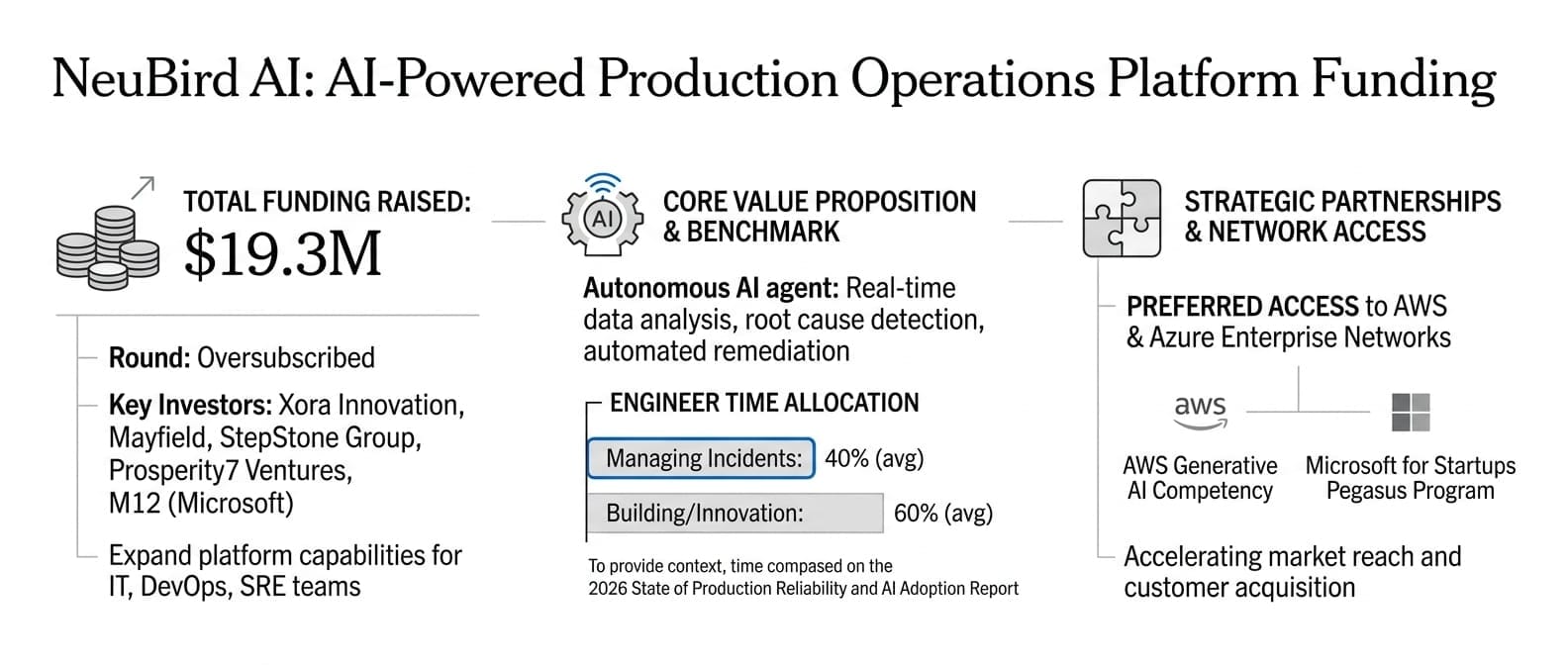
NeuBird AI raised $19.3 million in an oversubscribed round to expand its AI-powered production operations platform for enterprise IT, DevOps, and SRE teams, with its autonomous AI agent analyzing infrastructure data in real time to detect issues, perform root cause analysis, and automate remediation. The round was led by new investor Xora Innovation with participation from existing investors Mayfield, StepStone Group, Prosperity7 Ventures and M12, Microsoft's venture fund.
According to the 2026 State of Production Reliability and AI Adoption Report, engineers spend an average of 40% of their time managing incidents rather than building. NeuBird AI has earned the AWS Generative AI Competency and joined the Microsoft for Startups Pegasus Program, providing preferred access to Azure and AWS enterprise customer networks.
Nexus Secures $4.3M Seed for Enterprise AI Agent Deployment
Nexus, a startup building enterprise AI agents, raised $4.3 million in seed funding led by General Catalyst with participation from Y Combinator, Transpose Platform, Twenty Two Ventures, Phosphor Capital, and individual investors including Gokul Rajaram, Raphael Schaad, and Jake Mintz. Founded by CEO Assem Chammah and AI engineer Shady Al Shoha, Nexus focuses on enabling non-technical teams to deploy autonomous agents across enterprise systems, integrating with more than 4,000 tools and reporting early traction with enterprise clients such as Orange.
Related reading: Check out this week's Deep Insights analysis for strategic context on these developments.