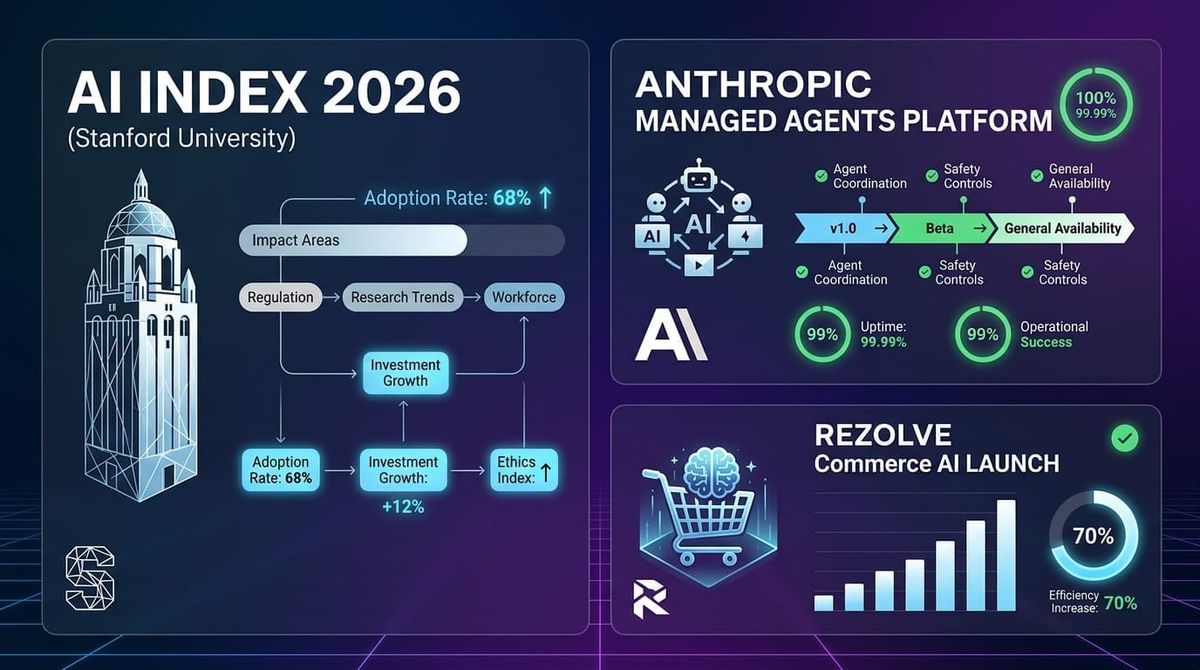
GenAI Daily - April 15, 2026: Stanford's AI Index 2026, Anthropic's Managed Agents Platform, Rezolve's Commerce AI Launch
Top Stories
Stanford AI Index 2026 Reveals Accelerating Progress Despite Energy Concerns
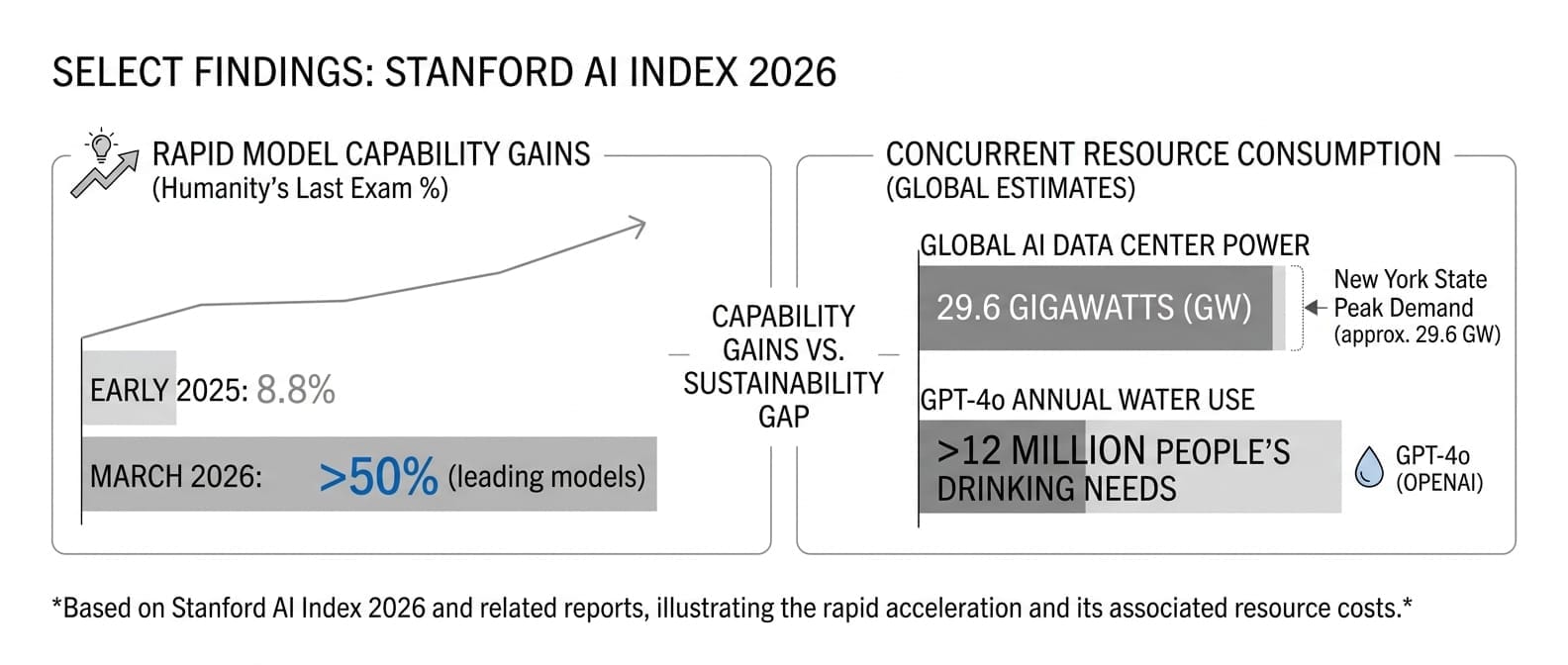
Stanford's 2026 AI Index shows leading models like Anthropic's Claude Opus 4.6 and Google's Gemini 3.1 Pro now top 50% accuracy on Humanity's Last Exam benchmark, up from just 8.8% in early 2025. The report confirms the top models keep getting better despite predictions of hitting development walls, with Anthropic leading in March 2026, followed closely by xAI, Google, and OpenAI.
However, this progress comes at enormous cost: AI data centers worldwide now draw 29.6 gigawatts of power-enough to run New York state at peak demand-while OpenAI's GPT-4o alone may consume more water annually than 12 million people need for drinking.
The data reveals "a technology evolving faster than we can manage."
Why it matters: The gap between AI capability gains and infrastructure sustainability is widening, forcing enterprises to balance performance needs with resource constraints in deployment decisions.
Anthropic Launches Claude Managed Agents in Public Beta
Anthropic launched Claude Managed Agents in public beta, offering a fully managed agent harness for running Claude as an autonomous agent with secure sandboxing, built-in tools, and server-sent event streaming.
Teams can create agents, configure containers, and run sessions through the API, with all endpoints requiring the managed-agents-2026-04-01 beta header.
The platform includes three deployment options: Claude Console for intuitive building, Claude Code for scripting, and a CLI for command-line deployment. The managed agents offering centralizes agent lifecycle management, including configuration, evaluation, and deployment, reducing integration overhead for production use cases.
Why it matters: Enterprise teams can now deploy autonomous AI agents without building infrastructure, accelerating the shift from AI tools to AI coworkers in production workflows.
Rezolve AI Launches brainpowa Commerce Models in Microsoft Foundry
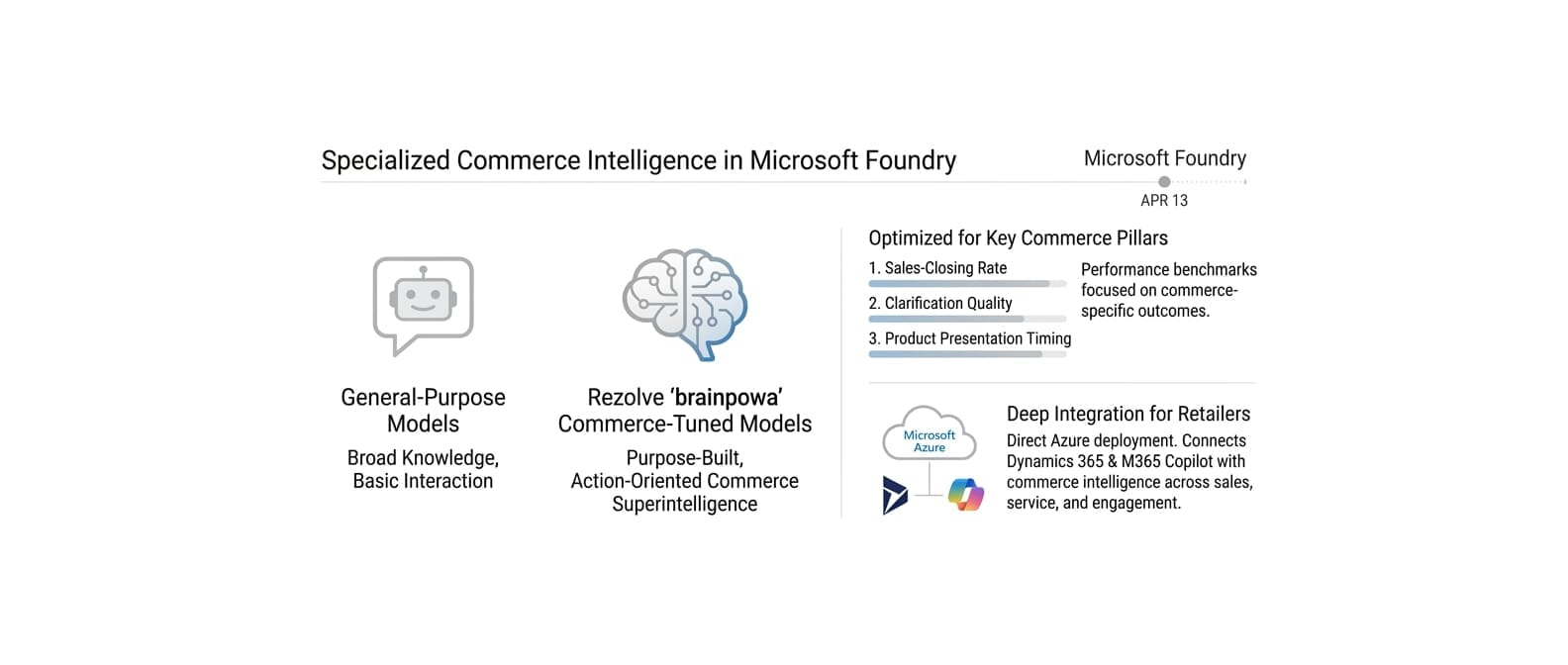
Rezolve AI launched its proprietary brainpowa commerce-tuned model suite in Microsoft Foundry on April 13, enabling brands to build commerce copilots on Azure. By joining foundational leaders like OpenAI and Anthropic within the Foundry ecosystem, Rezolve provides specialized "Commerce Superintelligence" for enterprise growth.
Unlike general-purpose models, brainpowa is purpose-built for commerce to identify buying intent, orchestrate real-time tool calls, and present products in a brand-aligned voice. The models are benchmarked against three core commerce pillars: sales-closing rate, clarification quality, and product presentation timing.
The models deploy directly on Microsoft Azure with full integration to Dynamics 365 and Microsoft 365 Copilot experiences, allowing retailers to extend commerce intelligence across customer engagement, sales, and service operations.
Why it matters: Commerce-specific AI models signal the shift from generic ChatGPT implementations to purpose-built solutions that understand buying behaviors and drive measurable conversion rates.
Key Developments
PwC Study: 20% of Companies Capture 75% of AI Economic Value
A small group of companies is pulling sharply ahead in generating real financial returns from AI, according to PwC's new AI Performance study. Without a shift in approach, the performance gap between AI leaders and laggards is likely to widen further as leading companies continue to learn faster and scale proven use cases.
Organizations with the strongest AI performance treat technology as a reinvention engine, using it to reshape business models and expand beyond traditional industry boundaries. Leading companies are 2.6 times as likely as peers to report AI improves their ability to reinvent their business model.
Impact: The 80/20 rule applies to AI ROI-enterprises must move beyond pilots to fundamental business model changes or risk falling permanently behind competitors.
Q1 2026 Venture Funding Shatters All Records at $300B
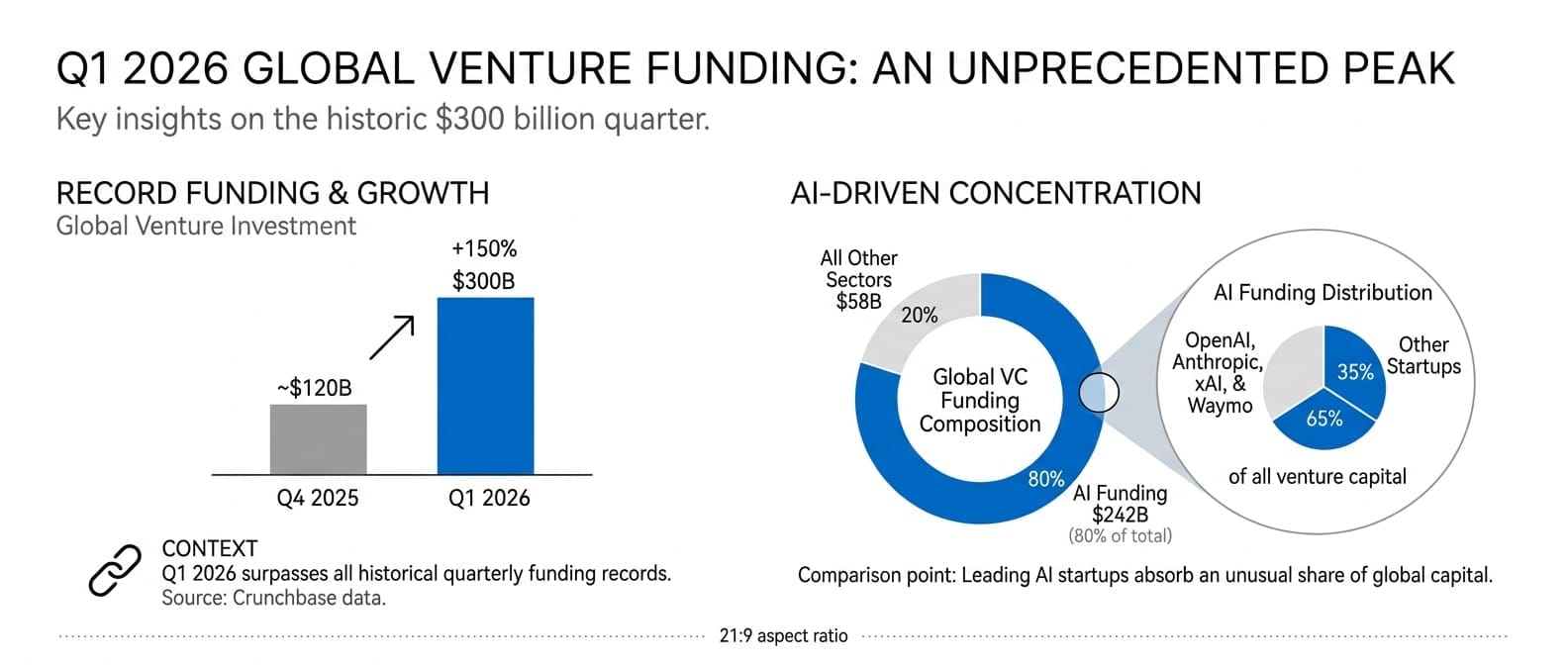
Crunchbase data shows investors poured $300 billion into 6,000 startups globally in Q1 2026, up over 150% quarter over quarter and year over year, marking an all-time high for global venture investment not approached by any other quarter on record.
AI accounted for $242 billion or 80% of total global venture funding, though concentration was extreme with OpenAI, Anthropic, xAI, and Waymo absorbing 65% of all global venture capital.
Major IPOs are coming: SpaceX/xAI targets June 2026 IPO at $1.75 trillion while OpenAI targets Q4 2026 near $1 trillion. The market must absorb $2.9T+ in combined float-an unprecedented test of public market appetite for AI companies.
Impact: Historic funding levels create both opportunity and risk as markets prepare for the largest tech IPO wave in history, potentially reshaping public market AI valuations.
OpenAI Expands Enterprise with Pay-As-You-Go Codex Seats
OpenAI introduced a new seat type for ChatGPT Enterprise: Codex-only seats with flexible pricing. These seats provide access to Codex only without ChatGPT workspace access and have no fixed cost per user per month.
More than 9 million paying business users rely on ChatGPT for work and over 2 million builders now use Codex weekly. Within ChatGPT Business and Enterprise, Codex users have grown 6x since January.
Enterprise now makes up more than 40% of OpenAI's revenue and is on track to reach parity with consumer by end of 2026. Codex hit 3 million weekly active users while APIs process more than 15 billion tokens per minute.
Impact: The shift to usage-based pricing for AI development tools signals the market's maturation from fixed seats to consumption models that scale with actual business value.
Product Launches
Claude Code Ships Broad Update with Vertex AI Integration
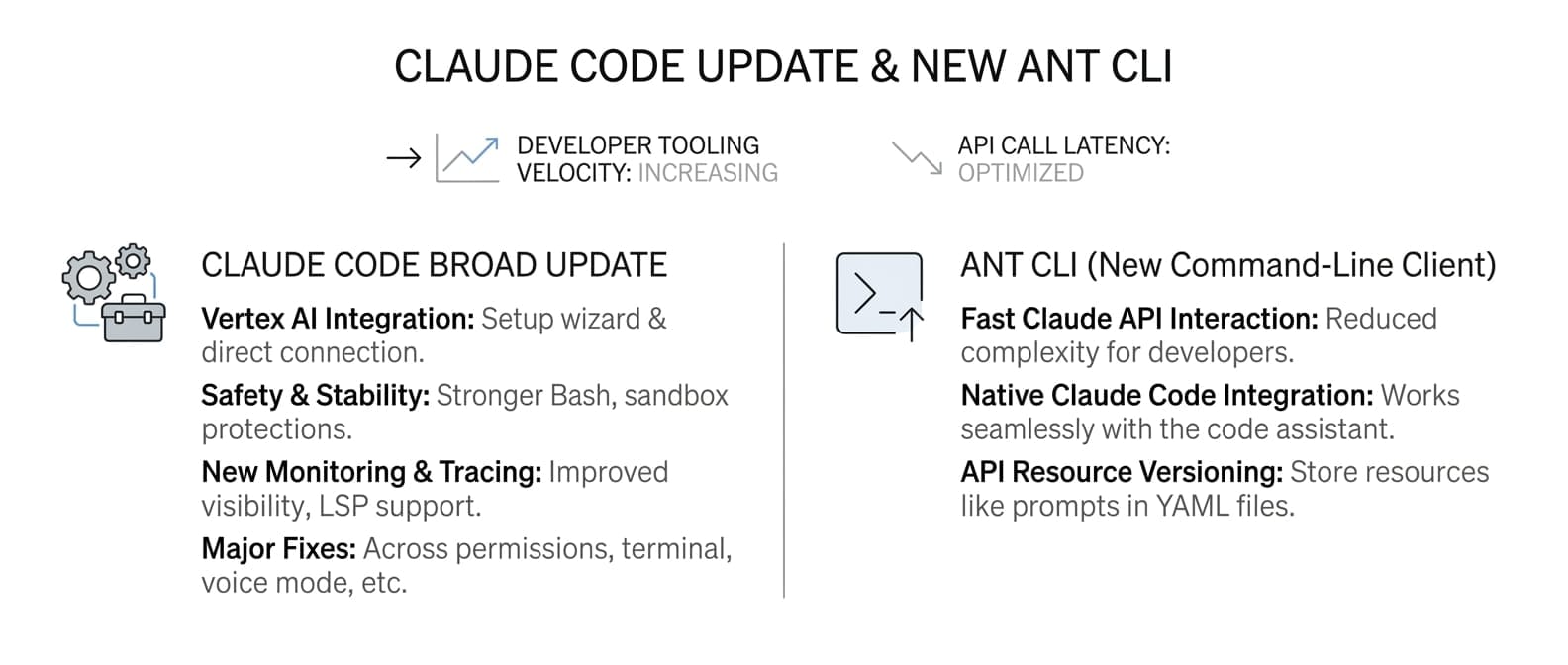
Claude Code shipped a broad release with a Vertex AI setup wizard, stronger Bash and sandbox safety, new Monitor tooling, improved tracing and LSP support, and major fixes across resume, permissions, terminal behavior, voice mode, plugins, and managed settings.
Anthropic also launched the ant CLI, a command-line client for the Claude API that enables faster interaction with the Claude API, native integration with Claude Code, and versioning of API resources in YAML files.
Tredence Expands Google Cloud Strategic AI Partnership
Tredence announced expansion of its global strategic partnership with Google Cloud to help enterprises operationalize AI at scale, moving beyond experimentation to deliver last-mile, enterprise-grade AI adoption that drives agility, scalability, and sustainable growth.
The partnership combines Google Cloud's AI infrastructure including Gemini Enterprise and Vertex AI with Tredence's portfolio of 100+ industry-first AI/ML accelerators and deep domain expertise.
Funding & Deals
Cyberhill Partners Raises $11M Strategic Investment
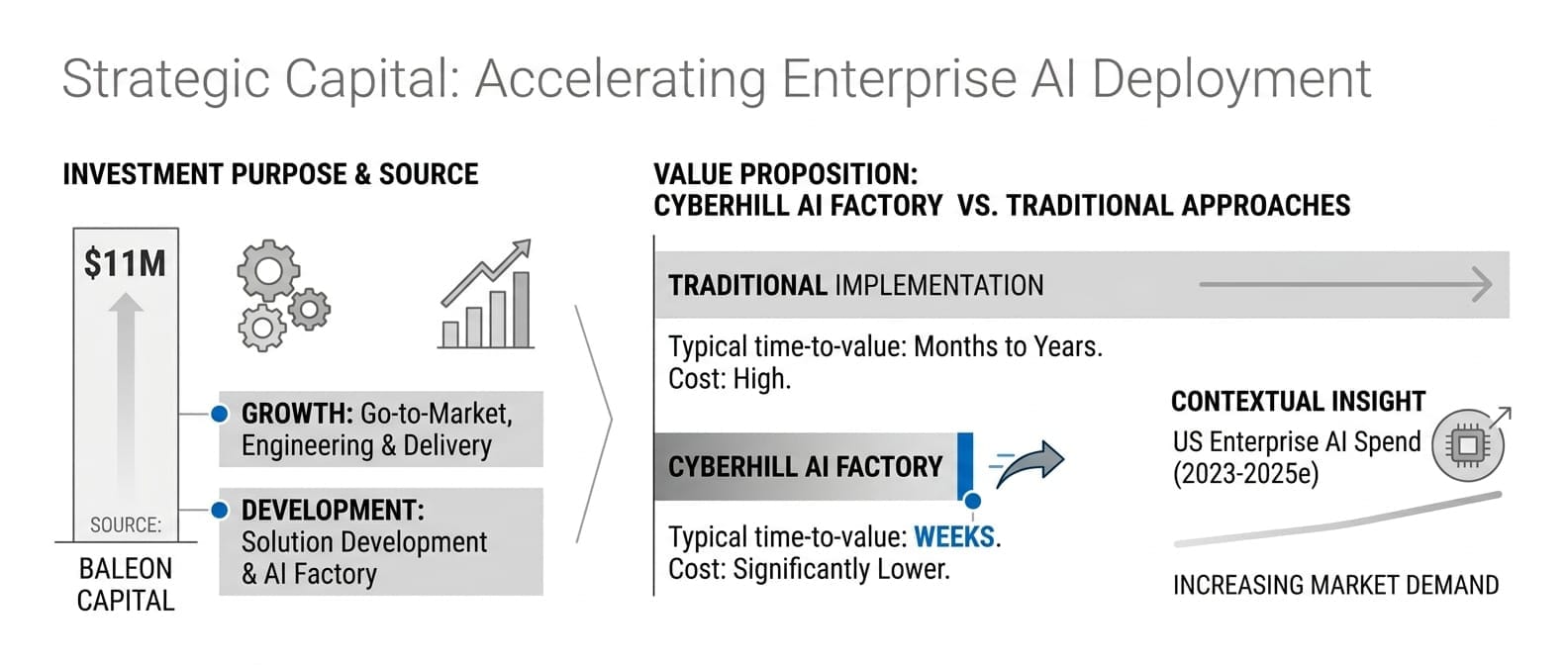
Cyberhill Partners, a professional services firm specializing in enterprise AI solutions for Fortune 500 organizations and US government agencies, secured a strategic investment of up to $11 million from Baleon Capital. The funding will accelerate growth across go-to-market organization, engineering and delivery teams, and solution development.
At the heart of Cyberhill's proposition is its AI Factory platform designed to deploy enterprise-grade AI solutions within weeks at significantly lower cost than traditional implementation approaches. The company argues organizations are caught between consumer AI tools that fall short of enterprise requirements and large-scale platform deployments that can take years.
*Related reading: Check out this week's Deep Insights analysis for strategic context on these developments.