GenAI Daily - October 7, 2026: Mistral and Reflection Push Western Open Weights, SAP Joule Goes Agentic, Agent Protocols Arrive
Top Stories
Mistral Large 4 and Reflection Beam Open a Western Open-Weight Front - UPDATE
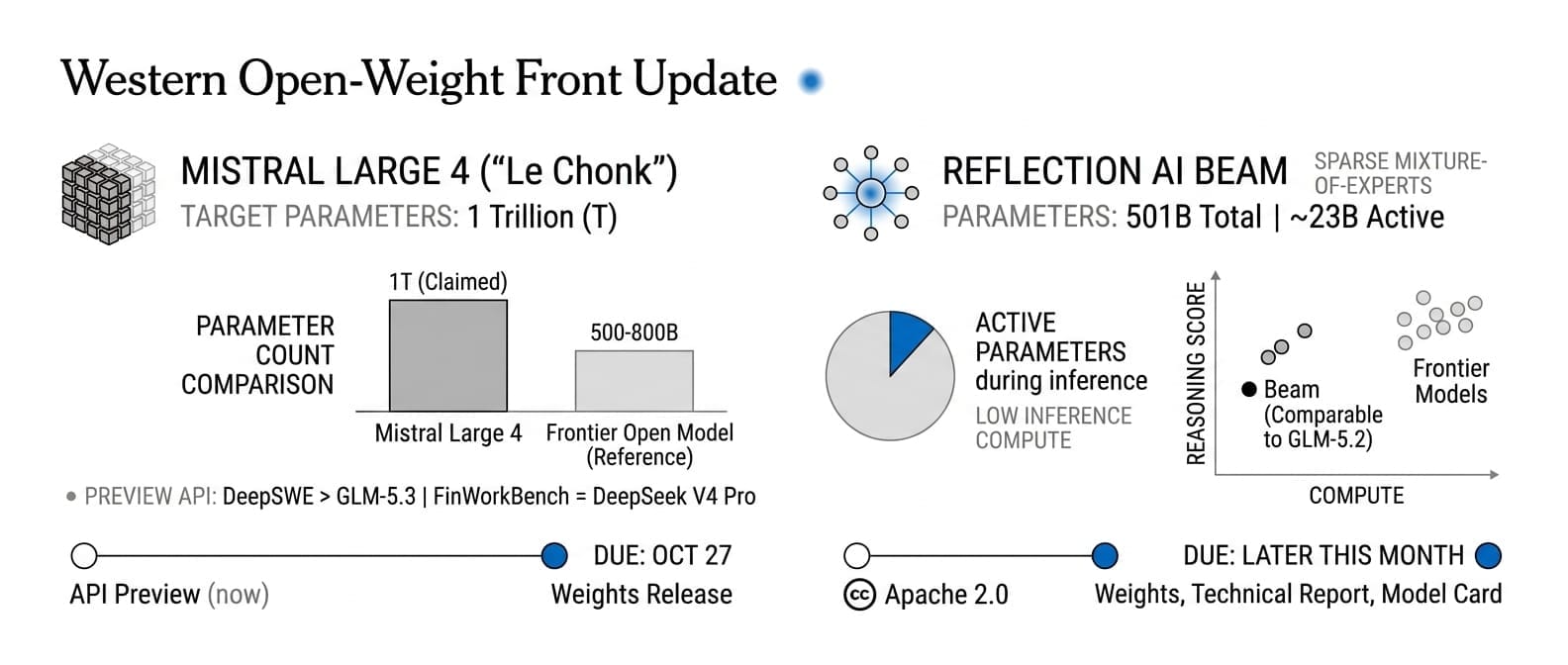
Mistral released a preview of Mistral Large 4 on Tuesday.
ML4, nicknamed "le Chonk," is a 1-trillion-parameter model aimed at cyber, coding, manufacturing, finance and multimodal tasks.
It is a preview, and the download is not available yet.
The model opens in API preview with weights due October 27.
Developers, cybersecurity firms and government agencies will get a version with fewer restrictions and more cyber features than the public API.
Mistral's claims are narrow.
On DeepSWE, Large 4 edges out GLM-5.3, and on FinWorkBench it ties with DeepSeek V4 Pro.
It still lags the frontier in areas such as coding.
Reflection AI's Beam is the follow-through on the open-weight model we flagged as in preparation.
Beam is a sparse Mixture-of-Experts model with 501 billion total parameters and 23 billion active, built for coding, reasoning, and agentic workloads.
On advanced reasoning benchmarks it scores comparably to GLM-5.2 while using 3-4x less inference compute.
Frontier open models like Kimi K3 remain ahead on raw capability.
Weights, technical report and model card are due later this month.
The weights will ship under Apache 2.0.
TechCrunch on Mistral | CNBC | Reflection
Why it matters: Teams that need self-hosted models without Chinese-origin weights get two candidates this month, but neither can be downloaded yet, so plan evaluations around the October release dates.
SAP Connect Makes Autonomous Enterprise Generally Available, With Joule as a Work Layer
SAP used SAP Connect to move from roadmap to shipping product.
The company is making the Autonomous Enterprise architecture, introduced at Sapphire in May, generally available this month alongside Joule Work and Desktop, with an expanded suite of autonomous assistants and agents.
Joule Work provides the framework to bring AI assistants to customer workflows, with autonomy across both SAP and non-SAP applications.
Through the Agent2Agent protocol, Joule can connect with third-party AI and agents.
Customers control the level of autonomy.
One early adopter gave a concrete number.
Maschinenfabrik Reinhausen says work that once took up to an hour across its S/4HANA environment is now available in seconds through natural language.
SAP's own executive framed the rollout as gradual.
Manoj Swaminathan said the autonomous enterprise is a journey for the customer, not a line drawn on one date.
SAP also announced the TechWolf acquisition (see Funding & Deals), which adds a skills and work data layer for HR agents.
SiliconANGLE | SAP press release
Why it matters: SAP shops can start piloting cross-app agents this month, and the A2A hook means they can wire Joule into non-SAP agent stacks instead of waiting for a closed ecosystem.
Sierra, Meta and Decagon Publish Competing Standards for Personal Agents Calling Businesses
Two protocols landed within a day.
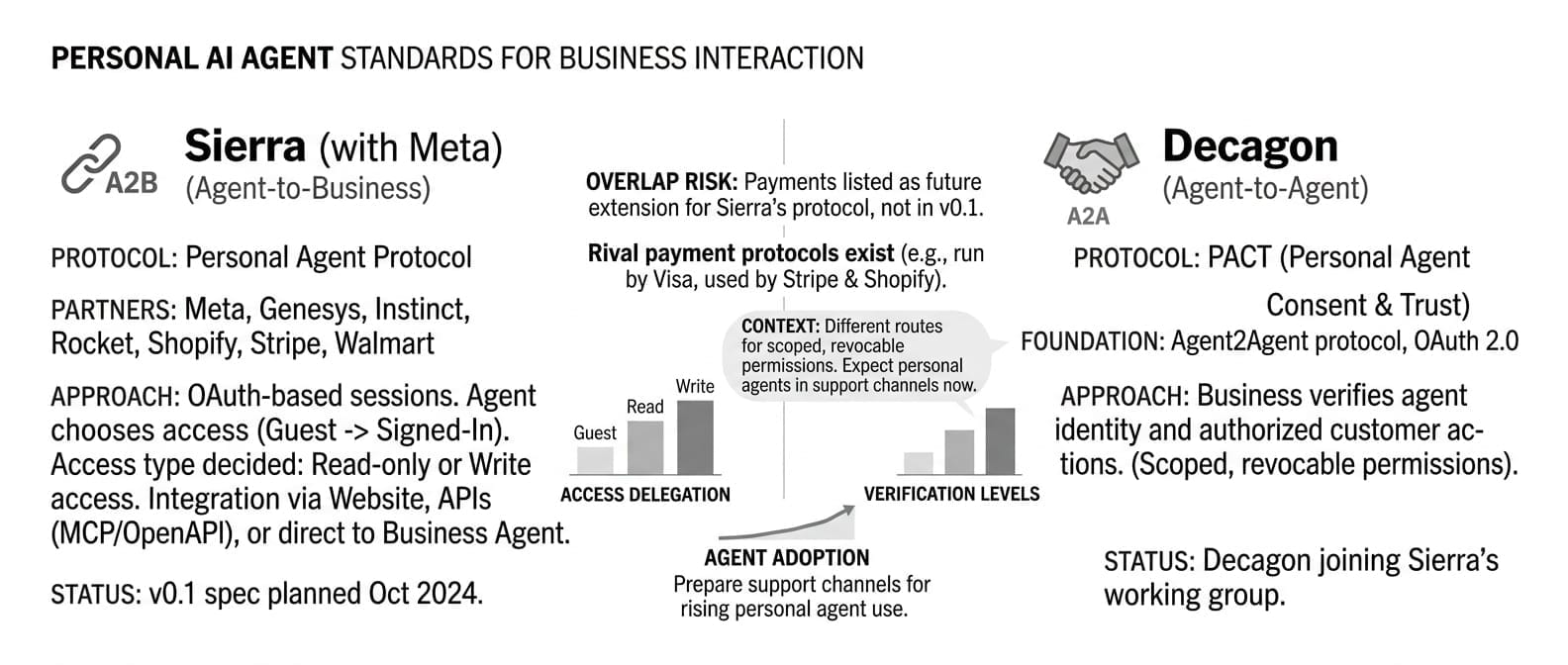
Sierra announced the Personal Agent Protocol on October 6, an open standard for how personal AI agents interact with businesses.
It is being developed with Meta and partners at Genesys, Instinct, Rocket, Shopify, Stripe, and Walmart, with a v0.1 spec planned for later in October.
Sessions are built on OAuth. An agent can start as a guest to check stock or a returns policy, and once a customer signs in they decide whether it gets read-only or write access.
Companies choose whether the agent works through their website, through APIs using standards such as MCP and OpenAPI, or through an agent of their own.
Decagon took a different route with PACT.
It is built on the Agent2Agent protocol and OAuth 2.0, and lets businesses verify whom a personal agent represents and what that customer has authorized it to do.
Decagon also said it is joining the Personal Agent Protocol working group.
Overlap with existing standards is a risk.
Stripe and Shopify are already on a rival protocol run by Visa.
Payments are listed as a future extension of Personal Agent Protocol rather than part of v0.1.
Unite.AI | The Next Web | Decagon PACT
Why it matters: Customer-facing teams should expect personal agents (Muse, dots, Instinct) to start hitting their support channels, and should design for scoped, revocable permissions now rather than waiting for one standard to win.
Key Developments
Meta and Microsoft Cut Internal Claude Use, Per The Information
Claude Code use inside Meta has dropped to roughly 30,000 employees, down from about 60,000 earlier this year, The Information reported.
Meta's internal MetaCode tool has passed 30,000 users, and Muse Code, its external Claude Code competitor, has over 6,000 internal users.
Microsoft projected at least $1 billion of Anthropic spend this year, and that estimate has been cut by more than a third.
Meta still spent about $105 million in a recent 28-day period on Claude Code.
The pullback is narrower than the headline.
Microsoft's investment in Anthropic and Anthropic's $30 billion Azure compute commitment are untouched, and customer spending on Claude via Azure and Bedrock continues to grow.
Neither company has confirmed the reports.
Impact: Large buyers are treating coding-agent spend as something to cap with token budgets and in-house tools, which gives mid-size teams leverage when negotiating per-seat or per-token pricing.
Anthropic Folds Project Glasswing Into a Three-Tier Cyber Verification Program
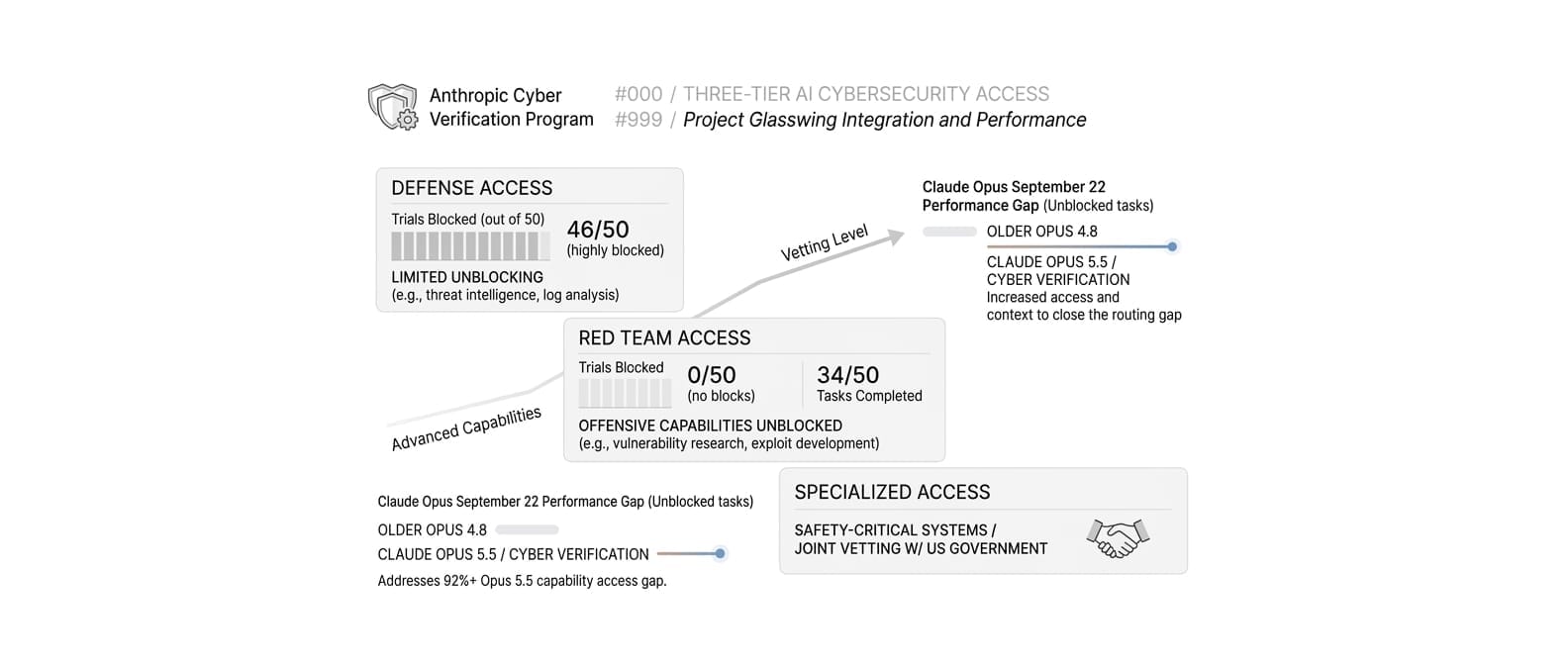
Anthropic on October 6 expanded its Cyber Verification Program, making advanced cyber capabilities and reduced blocking classifiers available to qualifying security professionals across three access tiers.
Each tier includes Claude Opus 5.5, Claude Sonnet 5.5, Claude Mythos 5.1, and new models going forward.
When Opus 5.5 launched September 22, most security tasks sent to it were routed to the older Opus 4.8, which is the gap this program addresses.
The tiers differ in what they unblock.
In Anthropic's CyScenarioBench test, 46 of 50 trials were still blocked at Defense Access, while Red Team Access saw no blocks and completed 34 of 50 tasks.
Specialized Access, the tier with the fewest restrictions, covers safety-critical systems and involves vetting conducted jointly with the U.S. government.
Organizations already enrolled in Glasswing or the earlier CVP do not need to reapply.
SiliconANGLE | Claude help center
Impact: SOC and pen-test teams using Claude should apply to the tier that matches their work, because Defense Access will not run attack-chain tasks.
OpenAI Adds textGrain Watermarking for ChatGPT and Codex in the EU
OpenAI said it will add an invisible watermark to eligible ChatGPT and Codex text output in the EU over the coming weeks.
The technology, called textGrain, slightly changes the model's word choices to create a statistical pattern that can later be detected.
API developers worldwide can opt in for supported models, but it stays off by default.
Detector access is limited at first to approved researchers and expert organizations.
Detection is fragile.
In one OpenAI test, swapping 25% of words in 400-token passages for synonyms dropped detection from about 92% to 17%.
The EU-only rollout is to comply with the EU AI Act.
Search Engine Journal | BleepingComputer
Impact: Teams with EU users should treat watermarking as a compliance feature, not an AI-text detector, and decide whether to opt in on API traffic before the AI Act deadline.
Product Launches
Cohere North 2
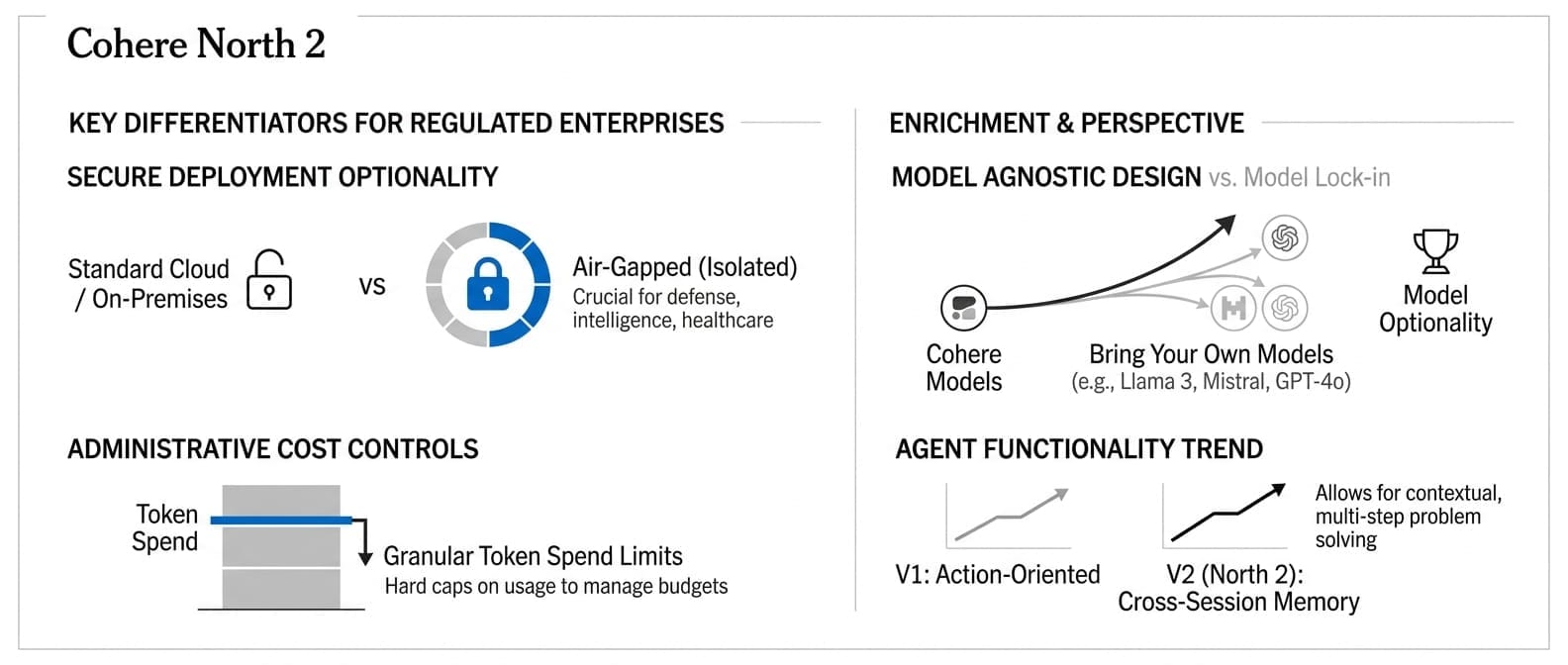
Cohere launched North 2 on October 5, adding cross-session agent memory, a redesigned orchestration harness, and granular administrative cost controls across cloud, on-premises, and air-gapped deployments.
Connectors cover Slack, SharePoint, OneDrive, Outlook, Jira, Linear, Notion, and GitHub, and the design is model agnostic so enterprises can bring their own models.
Air-gapped support and token spend limits are the differentiators for regulated buyers.
Why it matters: Regulated enterprises that need air-gapped deployment and hard token spend limits now have an agent platform built around those requirements, without being locked into a single model provider.
Decagon Personal Agent Gateway
Introduced at Decagon Dialogues, the gateway flags likely personal agents across chat and voice, and adds a dedicated personal-agent channel with separate Agent Operating Procedures, so the same request can follow a different workflow depending on whether a person or an agent is asking.
Support teams get a way to apply different policies to agent traffic without rebuilding their stack.
Why it matters: As personal agents begin contacting businesses, support teams need a way to distinguish agent traffic from human traffic and apply different rules to each.
Microsoft Copilot Studio Hooks (Preview)
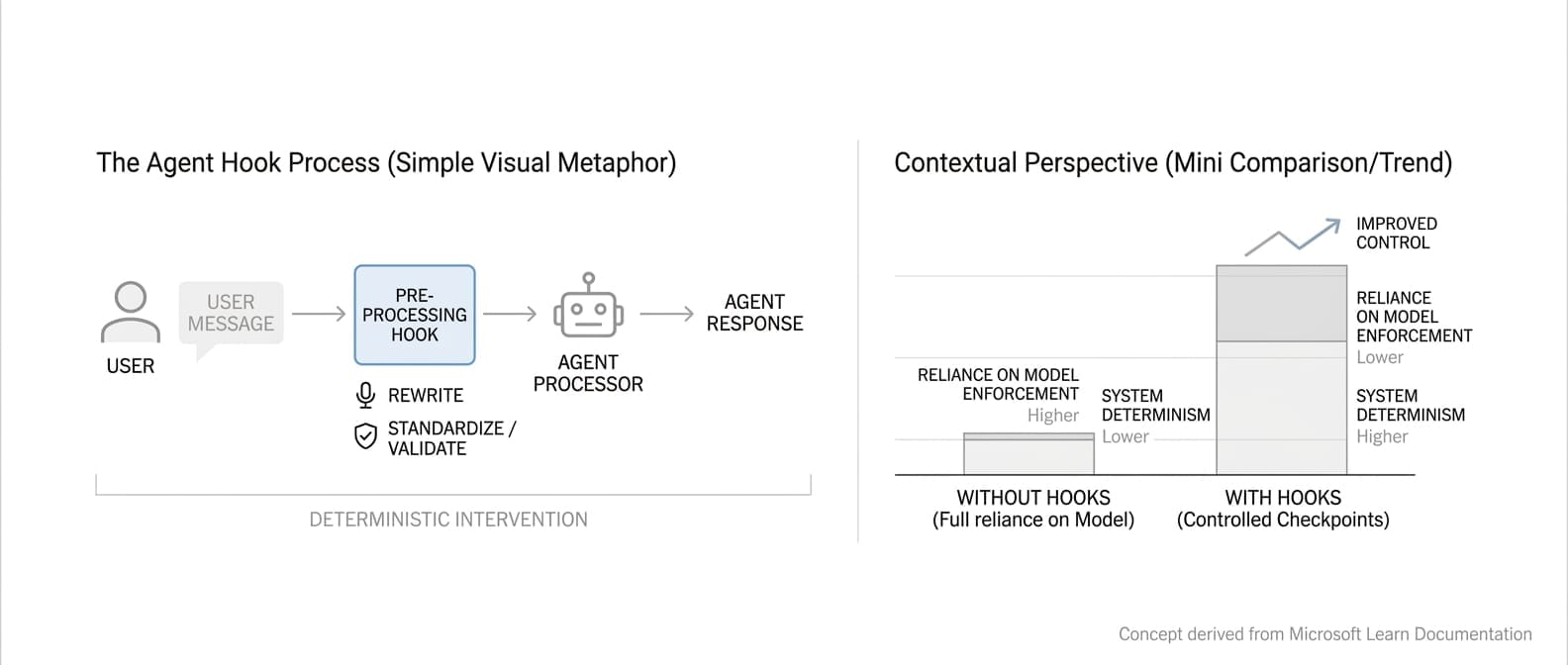
Hooks let builders run workflows at set points in an agent's loop.
One hook runs each time the user sends a message, before the agent processes it, and can be used to rewrite or standardize what the agent receives.
Microsoft's docs say to treat that prompt as untrusted user input.
That gives teams deterministic checkpoints around non-deterministic agents.
Why it matters: Deterministic checkpoints let teams add validation, standardization and security controls around agent behavior without relying on the model itself to enforce them.
Funding & Deals
DeepSeek Nears $12B-$15B Round Ahead of 2027 IPO
The Hangzhou-based Chinese lab behind the DeepSeek open-weight models is close to raising far more than planned.
The round is at least 80 billion yuan (about $12 billion), backed by Tencent and CATL.
It had initially targeted 50 billion yuan, but demand rose after its latest model launch.
Sources said signed term sheets indicate the round could approach $15 billion.
The financing would value DeepSeek at a minimum of about $75 billion.
The company plans to restructure after the round as it prepares for an IPO in early 2027, per Bloomberg.
Reports differ on whether this is a new round or an expansion of the roughly $7.4 billion raised earlier this year.
Nairametrics (citing Bloomberg) | Proactive Investors
Why it matters: A round of this size, with strategic backers and an IPO planned, signals strong investor demand for Chinese open-weight labs even as Western alternatives emerge.
SAP to Acquire TechWolf
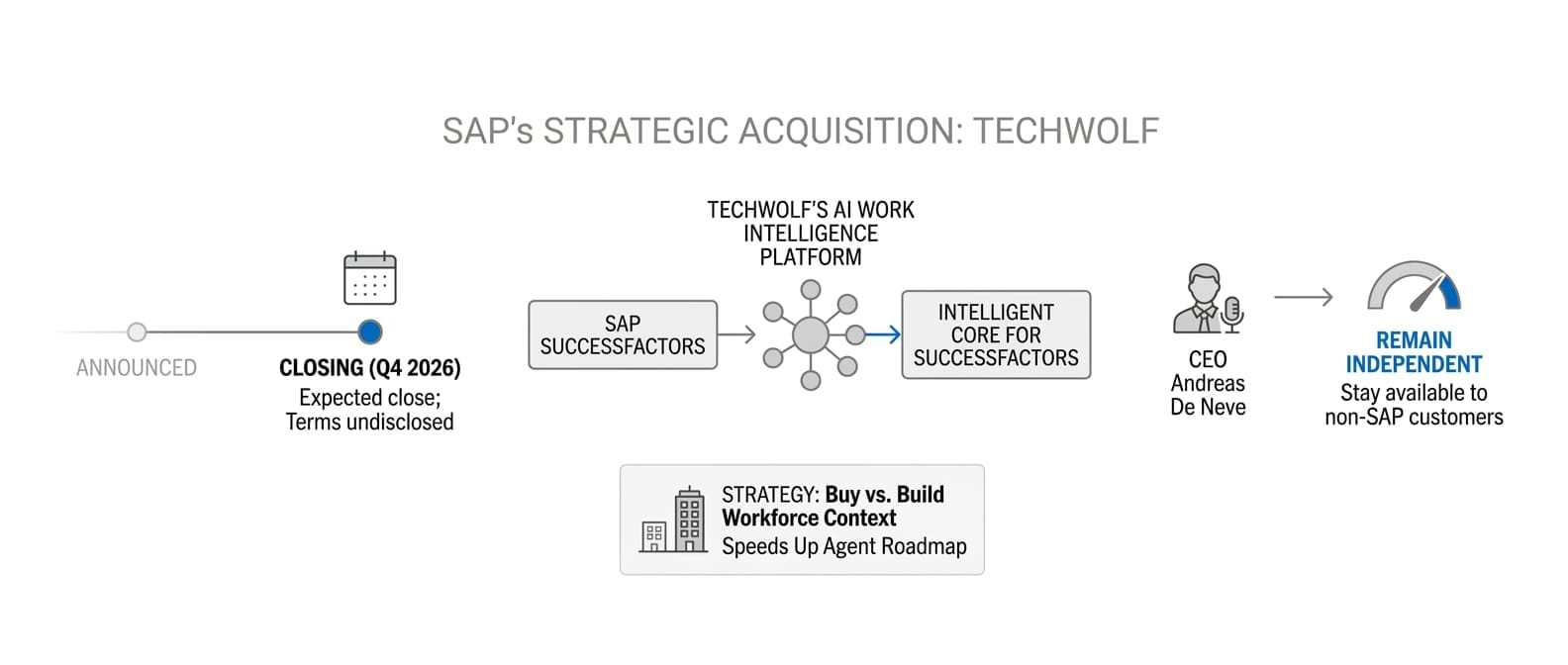
SAP agreed to buy Ghent, Belgium-based TechWolf, an AI work intelligence platform that gives enterprises a continuously updated view of the work their people do and the skills they have, using a proprietary data model called a context graph for work.
TechWolf is expected to become an intelligent core of SAP SuccessFactors.
SAP expects it to remain independent under CEO Andreas De Neve and stay available to non-SAP customers.
The deal is expected to close in Q4 2026, and terms were not disclosed.
Rather than build workforce context in-house, SAP is buying a grounding layer for HR agents.
SAP's Manoj Swaminathan called TechWolf's graph an excellent grounding layer for agent queries on work and skills planning.
Why it matters: HR agents are only as useful as the workforce context they can draw on, and SAP is buying that data layer rather than building it, which speeds up its SuccessFactors agent roadmap.
Tomorrow's Watch List
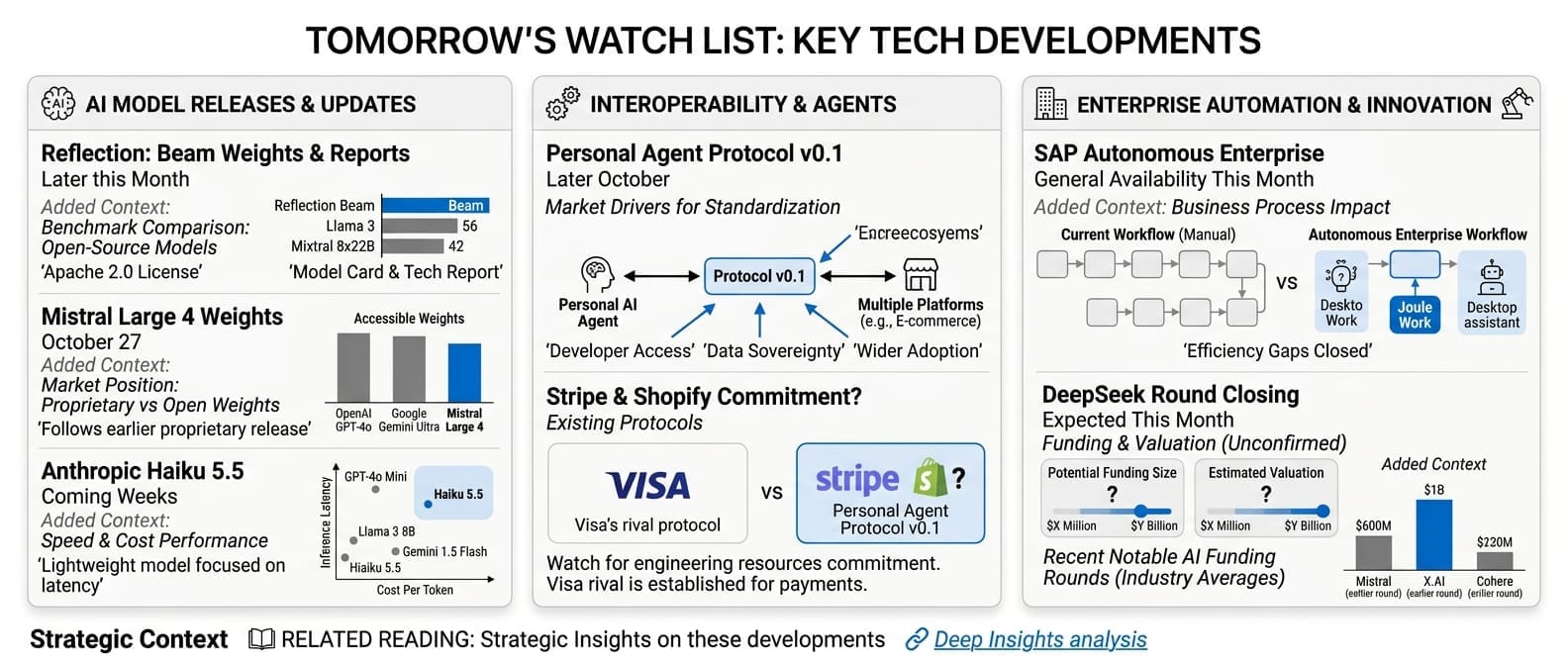
- Reflection says Beam's weights, technical report and model card arrive later this month under Apache 2.0, and Mistral Large 4's weights are due October 27.
- The Personal Agent Protocol v0.1 specification is due later in October. Watch whether Stripe and Shopify, already on Visa's rival protocol, commit engineering resources to both.
- SAP's Autonomous Enterprise architecture and Joule Work and Desktop are due to reach general availability this month.
- Anthropic's Haiku 5.5 is expected "in the coming weeks."
- DeepSeek's round is expected to close this month, and the final size and valuation are still unconfirmed.
*Related reading: Check out this week's [Deep Insights analysis] for strategic context on these developments.