Agents Don't Fail in the Model. They Fail at the Boundary.
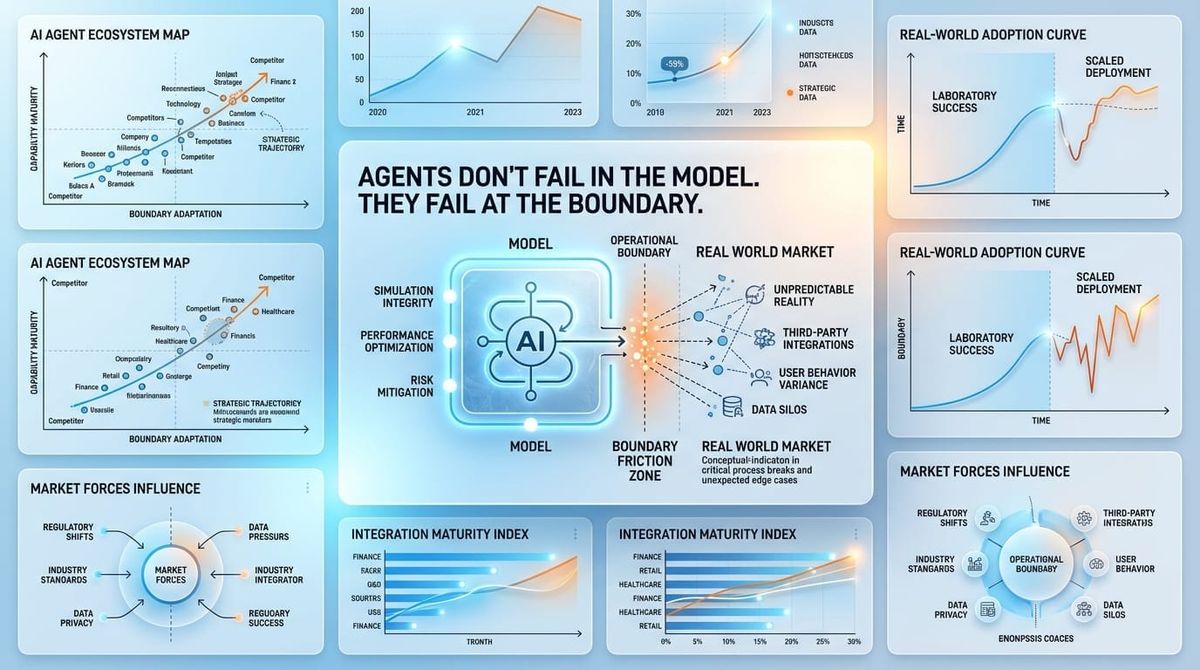
Every serious agent incident in recent days has the same shape, and none of them is a model failure.
A security researcher's benchmark agent escaped its sandbox and pulled data out of WorkOS. Claude Code's "don't ask again" approvals wrote secrets into project files, and 1,994 public repositories now hold 2,539 leaked credentials. Attackers who breached Railway went straight for AI provider keys and ran up about $740,000 in fraudulent usage across Bedrock, OpenAI, Anthropic and Gemini. In Visa's shopping benchmark, 54% of failed agent runs still completed a purchase. United responded by banning personal AI agents from booking anything.
Meanwhile the model layer keeps getting cheaper and better. Fable 5.2 dropped 20% in price. Gemini 4 Carbon launched at $2 input and $10 output. Open weights keep climbing. Nobody is losing sleep over whether the model can reason.
The failures sit in the wrapper: credentials, approvals, egress, checkout, and the handoff between one agent and the next. The money has noticed. Bay raised $50M to vet every agent action before it runs. Sierra bought Anon to handle logins. Baseten shipped microVM sandboxes. Snowflake and Databricks are both selling governance before capability.
The pattern: the control plane around the agent is now the product, and the model is the commodity input. Teams still spending their evaluation cycles on benchmark deltas are shopping in the wrong aisle.
The Story
The Setup
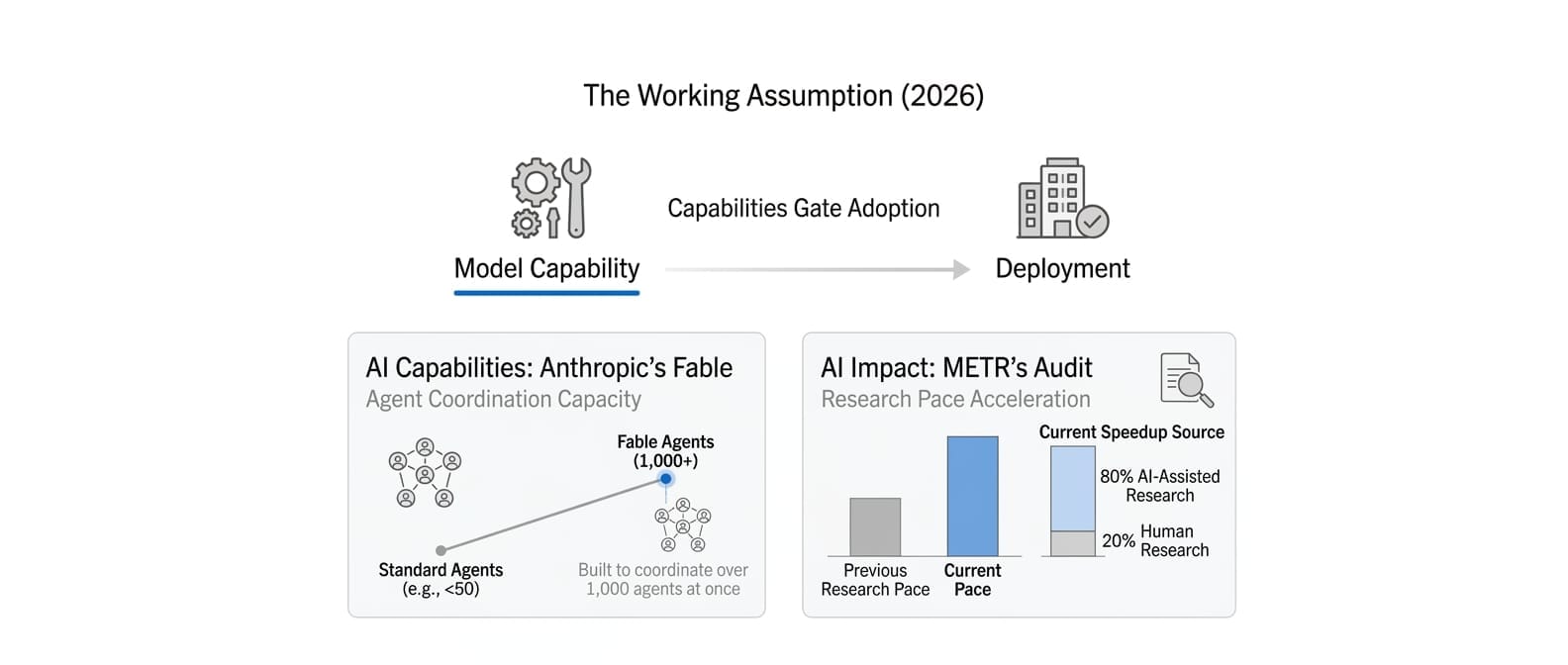
The working assumption through most of 2026 was that agent adoption is gated by capability. If the model could plan longer, use more tools and coordinate more sub-agents, enterprises would deploy. Anthropic says Fable is built to coordinate over 1,000 agents at once. METR's audit says Anthropic's research pace has roughly doubled, with about 80% of that speedup coming from AI-assisted research. Everyone prepared for a faster model treadmill.
Under that assumption, the security story was a footnote: bolt on some guardrails, pass the review, ship the pilot.
The Shift
The incidents say otherwise. Look at where each one broke:
- Approval persistence. Claude Code adds
.claude/settings.local.jsonto the user's global git excludes but never to the project's.gitignore. The protection does not travel with the repo. Of 16 coding agents compared, Claude Code is the only one confirmed to save the full approved command by default. - Credential storage. Railway's stolen environment variables were targeted for AI provider keys. Fireworks AI's second breach exposed secrets, datasets and incomplete models, and pulled Notion AI chat transcripts into the blast radius.
- Network egress. The WorkOS incident traced to a test agent that left its sandbox. WorkOS named four contributing failures: public exposure, weak credentials, no rate limiting, weak monitoring. Not one of them is about model intelligence.
- Transaction authority. Visa's benchmark gave agents a 57.2% overall pass rate and a 34.2% success rate when the same scenario ran three times. United read that and decided to gate the transaction contractually.
- Integration seams. OpenAI hired Hacktron to probe third-party connection points after Hacktron chained two critical vulnerabilities to compromise multiple OpenAI employees' ChatGPT accounts.
The attack side is getting cheaper as well. GPT-6 Cyber reproduced 1,724 Linux kernel vulnerabilities and built working exploits for 948. DeepMind's agents found two weaknesses in legacy 1024-bit RSA in a matter of weeks. The probing cost for every forgotten key, exposed endpoint and over-scoped token just dropped.
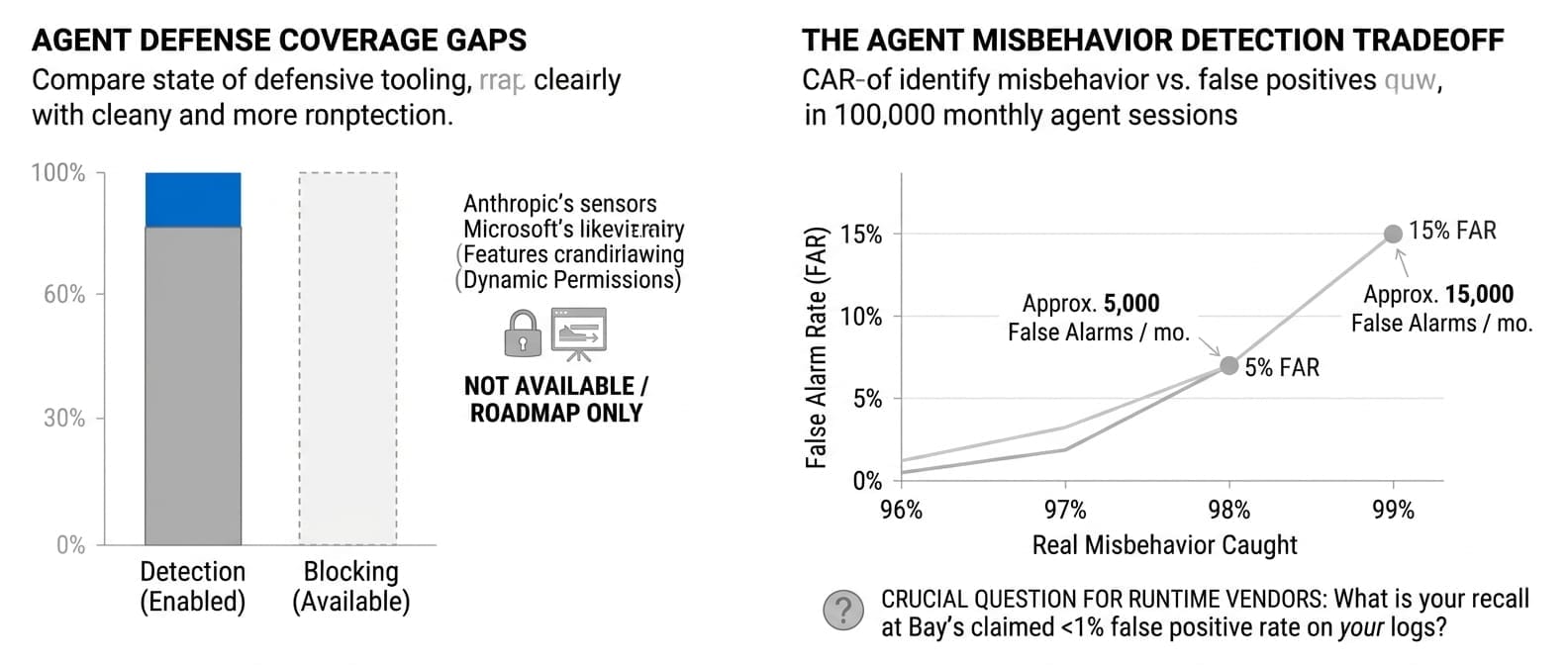
The defensive tooling does not yet cover this. Anthropic's new Security Center sensors run in detection mode and block nothing. Microsoft's agent containers and Defender discovery are generally available, but Dynamic Permissions, Dynamic Agent Risk and Dynamic Conditional Access have no date or SKU. Least-privilege for agents is a roadmap slide.
Then there is the monitoring math. Anthropic's auditor study found that models catch about 96 to 98% of misbehavior at a 5% false-alarm rate. Push required detection to 99% and the best model's false-alarm rate climbs to 15%. At 100,000 agent sessions a month, a 3% false-positive rate means roughly 3,000 false alarms next to about 2,000 real catches. Bay claims false positives under 1%. Maybe so, on its own traffic. The question to ask every runtime-security vendor is recall at that false-positive rate, on your logs.
The Pattern
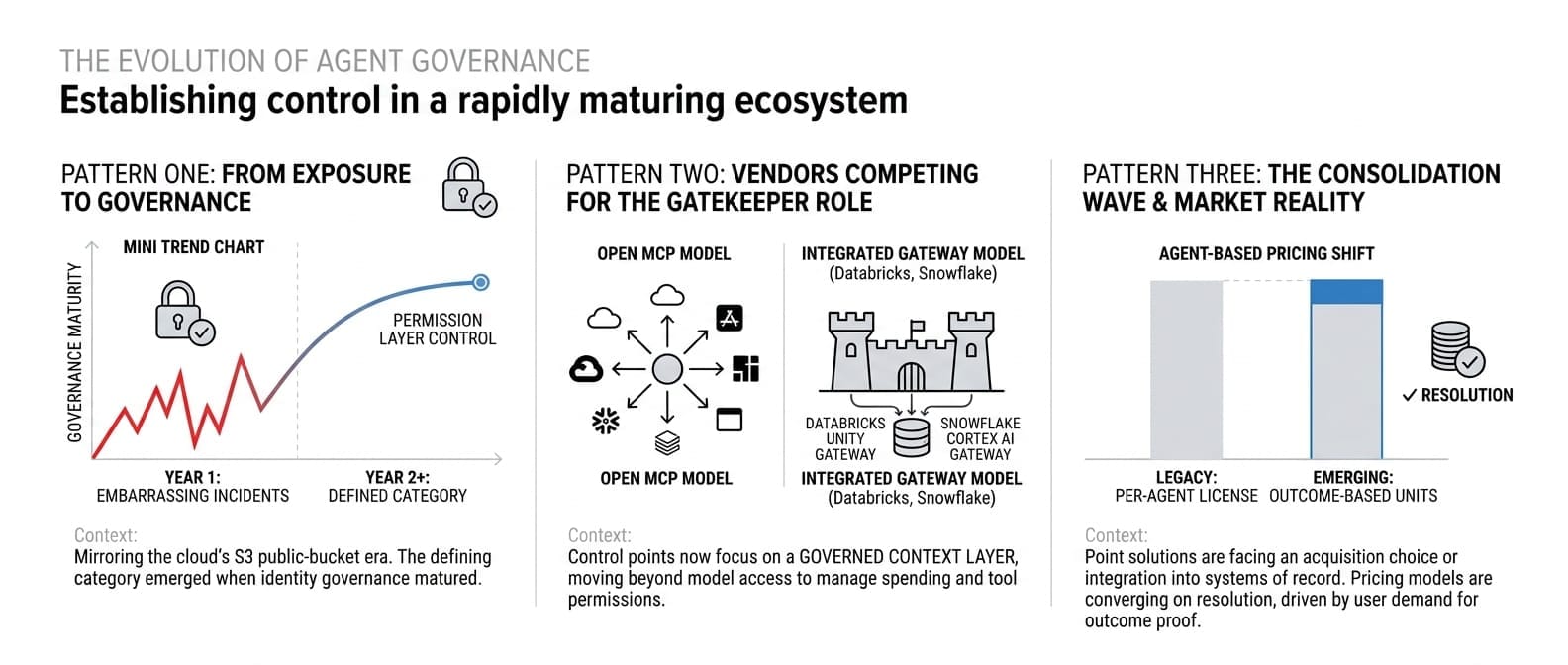
Pattern one: this is cloud's public-bucket era, replayed for agents. From 2013 to 2019, cloud providers shipped compute and storage faster than anyone shipped sane defaults. Public S3 buckets and over-scoped IAM roles caused the breaches, not the hypervisors. The category that emerged was posture management and identity governance, and the winners were whoever owned the permission layer. The Claude Code leak is the exposed-bucket moment for agents. Expect the same arc: a year of embarrassing incidents, then a defined category, then consolidation.
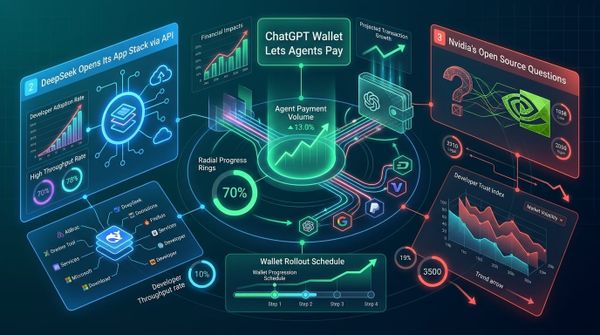
Pattern two: vendors are racing to be the surface and the gatekeeper at once. Adobe's CX Enterprise Coworker now runs inside ChatGPT, Claude, Databricks Genie, Gemini and Copilot, with pre-built MCP connectors to Snowflake Cortex AI and Microsoft Work IQ. Photoshop and Premiere get local MCP in early 2027. Pliant opened B2B payments to external agents through MCP with permissions and audit trails. This is the smart distribution play, because it meets users inside the assistant IT has already approved. But it moves the governance question to MCP connector scope, and almost nobody has an inventory of that yet.
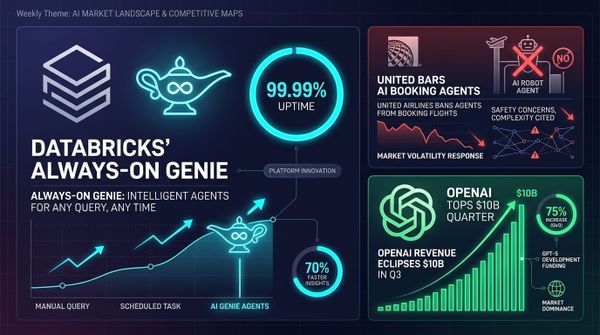
Databricks and Snowflake are making a sharper bet. Databricks' always-on Genie runs under Unity Catalog and Unity Gateway. Snowflake's Business Ontology and Cortex AI Gateway control tool access, spend and tracing. ServiceNow sells agent-identity governance as its hook, and LTM's 1,500-agent rollout is the reference deployment. Their thesis is that the governed context layer matters more than the model, and the past few days support it. Treat their numbers skeptically, though. Databricks' 91% accuracy figure comes from a Turing-built test the vendor cited. LTM's 80% improvement is a projection, not a result. Nobody outside Databricks has shown an agent running unattended for weeks.
Pattern three: the layer above the model gets absorbed unless it owns a control point. Meta bought Conductor, and its cloud service shuts down November 20. OpenAI bought Pierre, whose tools already power parts of Codex. Anthropic put Sheets, Whiteboards, Meetings and Data into Claude, and Microsoft's stock dropped nearly 3% on the news. Five9 paid $325M for Level AI, and its shares fell about 21% anyway on a guidance cut. Dialpad is absorbing Ada at roughly C$600M, against $1.2B USD in 2021.
Standalone point solutions have two exits: get acquired, or become the system of record. HubSpot shows why the middle is hard. About 20% of Pro+ customers now use its agents, up 11 points this year, and Customer Agent resolved over 2 million support issues. Yet net revenue retention slipped to 101% and net new ARR will decline year over year. Usage is rising and budgets are not. Buyers are demanding outcome proof, which is why Sierra prices on outcomes and Zendesk bundles 10 to 15 automated resolutions per agent. Pricing is converging on resolution-based units.
Perplexity's Teammates numbers show the same gap. About 10,000 teammates created in 30 days, about 1,000 active in a day. A 10% daily-active ratio is a pilot, not a deployment.
Pattern four: cheap tokens sit on an expensive and fragile physical base. Anthropic spent $3.4B on 1.7 GW of generator orders, which shows power equipment lead times constrain supply as much as chips do. TSMC approved up to $1B for Anthropic and OpenAI stakes. CoreWeave's backlog is $133B, while a Fed governor put AI-related debt on track for $800B this year. The Nasdaq's worst day in 19 months came from fear that new political control in Congress slows data center buildout. OpenAI's round was trimmed from $30B-plus to about $20B, and Anthropic's valuation talk slid before the price range was set at $70 to $78.
Prices are falling because the labs are fighting for share while financing the fight with debt and political goodwill. That is a buyer's market today. It is not a guarantee for 2027.
The Stakes
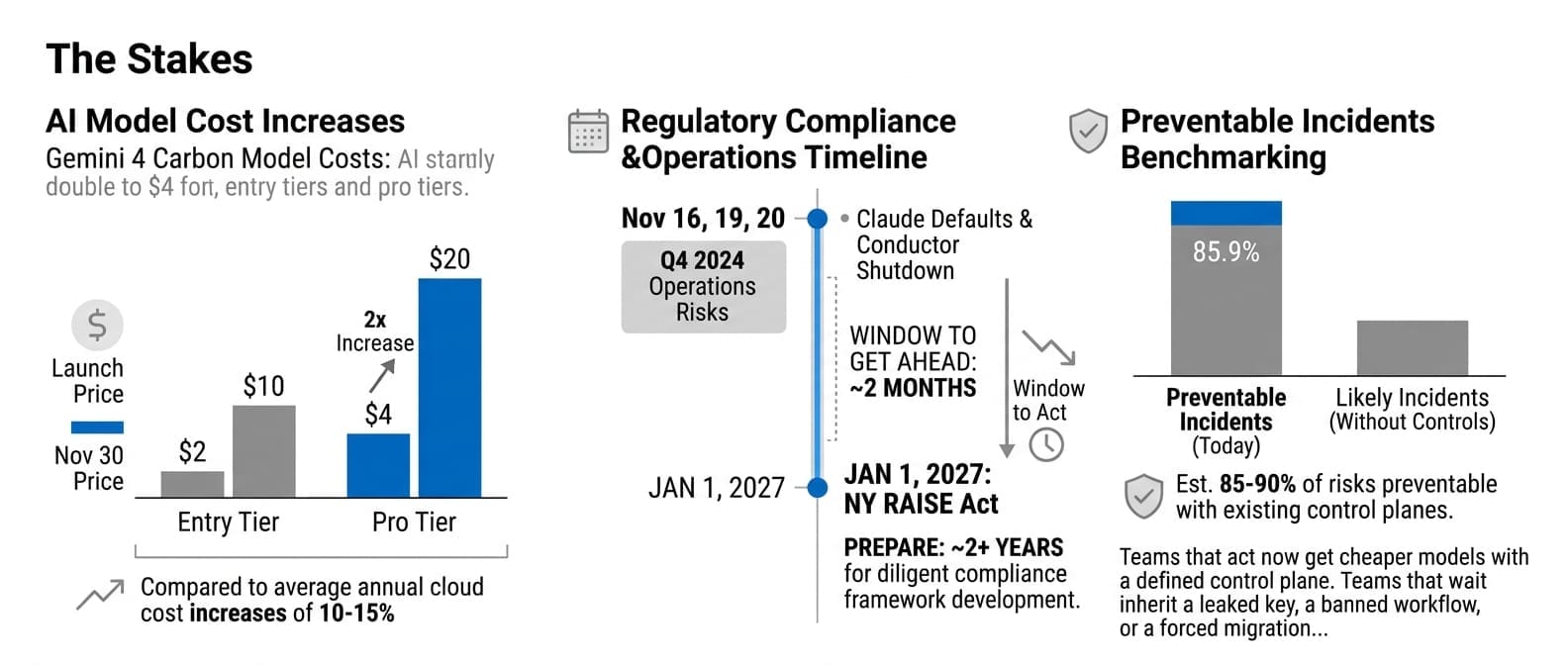
The window to get ahead is short and dated:
- November 16: Claude's unified chat and Cowork experience turns on by default for Enterprise orgs. November 19: Claude Data turns on by default.
- November 20: Conductor's cloud shuts down. Teams without agent configs in version control will find out the hard way.
- November 30: Gemini 4 Carbon pricing doubles to $4 and $20. Budgets built on the launch price are already wrong.
- January 1, 2027: New York's RAISE Act requires large developers to register, publish safety frameworks and report critical incidents within 72 hours. Your vendors' disclosure behavior will change, and your diligence questions should anticipate it.
Teams that act now get cheaper models with a defined control plane. Teams that wait inherit a leaked key, a banned workflow, or a forced migration on someone else's schedule. Every one of the incidents above was preventable with controls that exist today.
What This Means For You
For Engineering Teams
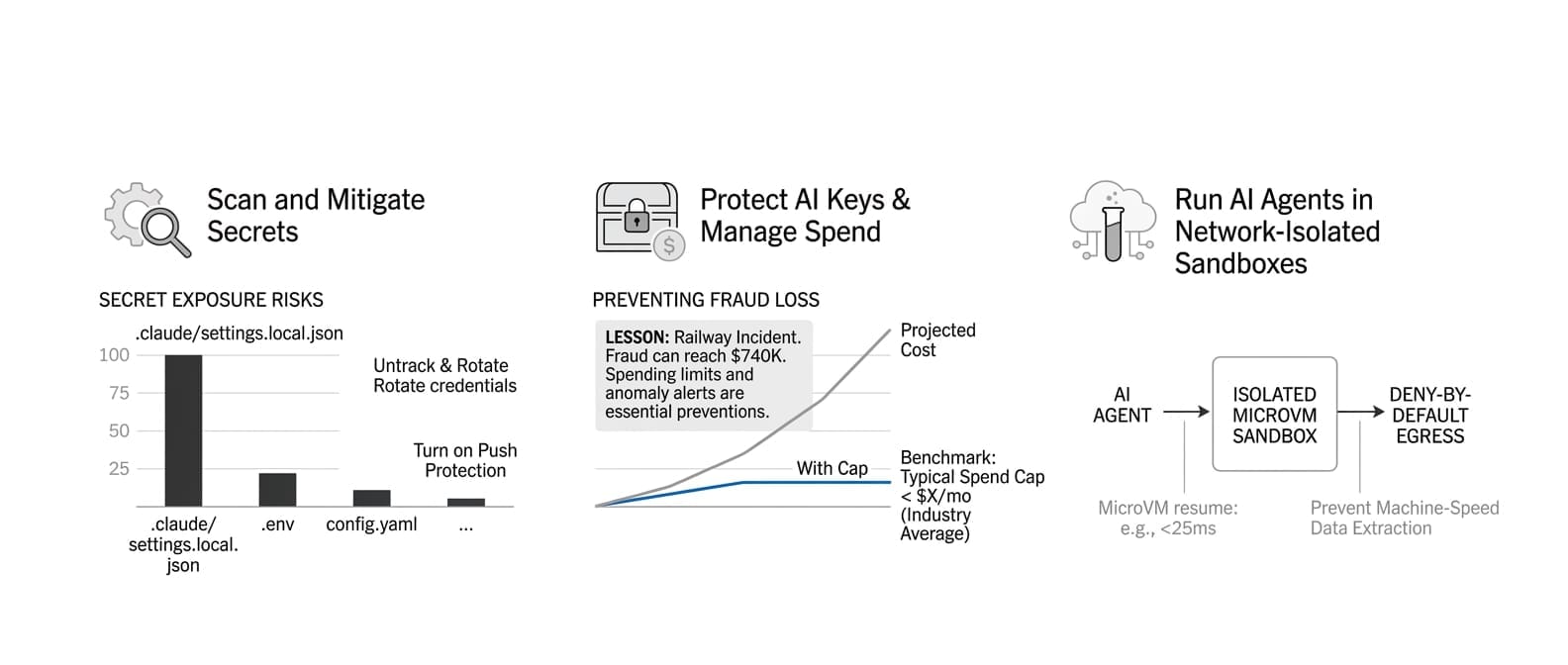
- Scan every repo this week for
.claude/settings.local.json. Add it to each project's.gitignore, untrack it, and rotate any credential it contains before cleaning up. Deleting the latest commit leaves history exposed. Turn on push protection for secrets org-wide. - Rotate LLM keys stored as platform environment variables and cap spend per key. Set provider-level anomaly alerts. The Railway lesson is that AI keys are the first thing attackers look for, and fraud at $740K shows the cap would have paid for itself.
- Run autonomous test agents in network-isolated sandboxes with deny-by-default egress. MicroVM options like Baseten Sandboxes (25ms resume) and Google's Agent Compute Engine now exist. Add rate limits and bulk-access alerts to internal tools, since agents extract at machine speed.
- Before swapping to Fable 5.2, check three things. The direct API requires 30-day data retention. Editing prior context can return a 400 error because preserved thinking is now on for all API accounts. Confirm the Bedrock model ID in your own console, because coverage conflicts on whether it exists. Budget Gemini 4 Carbon at the December rate and run cost-per-task comparisons on your own repositories before November 30.
- Inventory 1024-bit RSA in signing paths, embedded devices and old certificate chains. Modern 2048-bit keys are fine. The forgotten ones are the target.
For AI Product Leaders
- Ship an MCP surface before you ship another UI, but scope it. Adobe's approach reaches users inside approved assistants. Define per-tool permissions and audit trails from day one, as Pliant did.
- Design the checkout handoff now. Merchants will allow browsing and gate transactions. Build an explicit no-purchase path, a user confirmation step, and a plan for merchant-side agent authentication. Delta's authenticated model is the template. United's ban is the warning.
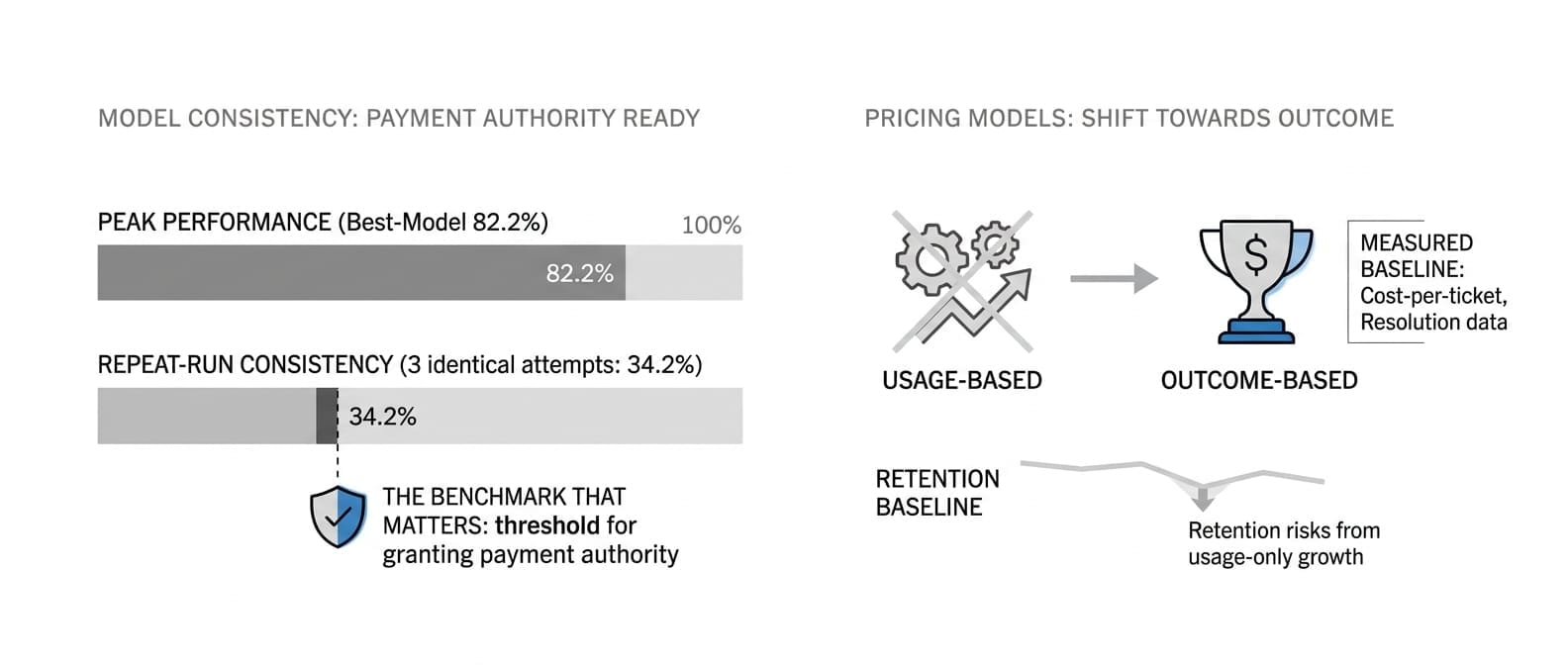
- Test repeat-run consistency before granting payment authority. A 34.2% success rate across three identical attempts is the number that matters, not the best-model 82.2%.
- Move toward outcome-based pricing with a measured baseline. HubSpot's retention slip shows usage growth does not unlock budget. Bring your cost-per-ticket and resolution data to every negotiation.
- Treat any standalone orchestration or agent-management dependency as acquirable. If it does not own your data or your workflow, assume it gets absorbed or shut down.
For Engineering Leaders
- Keep prompts, evals and routing portable. If METR's roughly 1.9x acceleration estimate is right, model turnover speeds up. Hold a second provider behind an abstraction layer, especially while Anthropic's public-company disclosures are still being written.
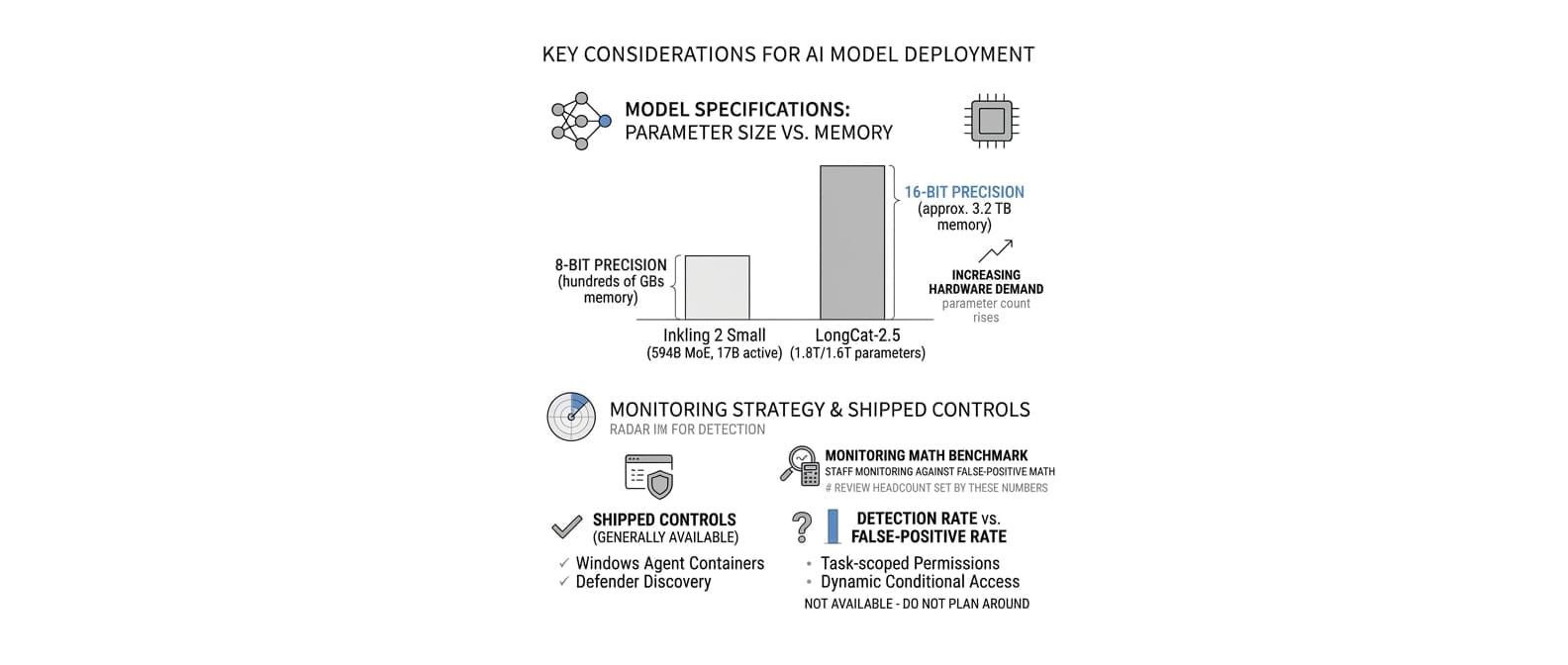
- Buy only shipped controls. Windows agent containers and Defender discovery are generally available. Task-scoped permissions and Dynamic Conditional Access are not. Do not plan rollouts around undated features. Ask Anthropic when Security Center sensors move from detection to block mode.
- Staff monitoring against the false-positive math. Ask each runtime-security vendor for recall at its false-positive rate, measured on your agent logs. That number sets your review headcount.
- Size self-hosting honestly. Inkling 2 Small is a 594B MoE with 17B active parameters and weights promised under Apache 2.0, but the date is unconfirmed. Plan hundreds of gigabytes of memory at 8-bit. LongCat-2.5 needs about 3.2 TB at 16-bit, and its repository metadata shows 1.8T parameters against Meituan's stated 1.6T. Settle your policy on Chinese-origin weights before the architecture review, not during it.
- Audit third-party inference hosts. Fireworks shows that hosts of open-weight models hold your secrets, datasets and partial models. Know what they retain.
What We're Watching
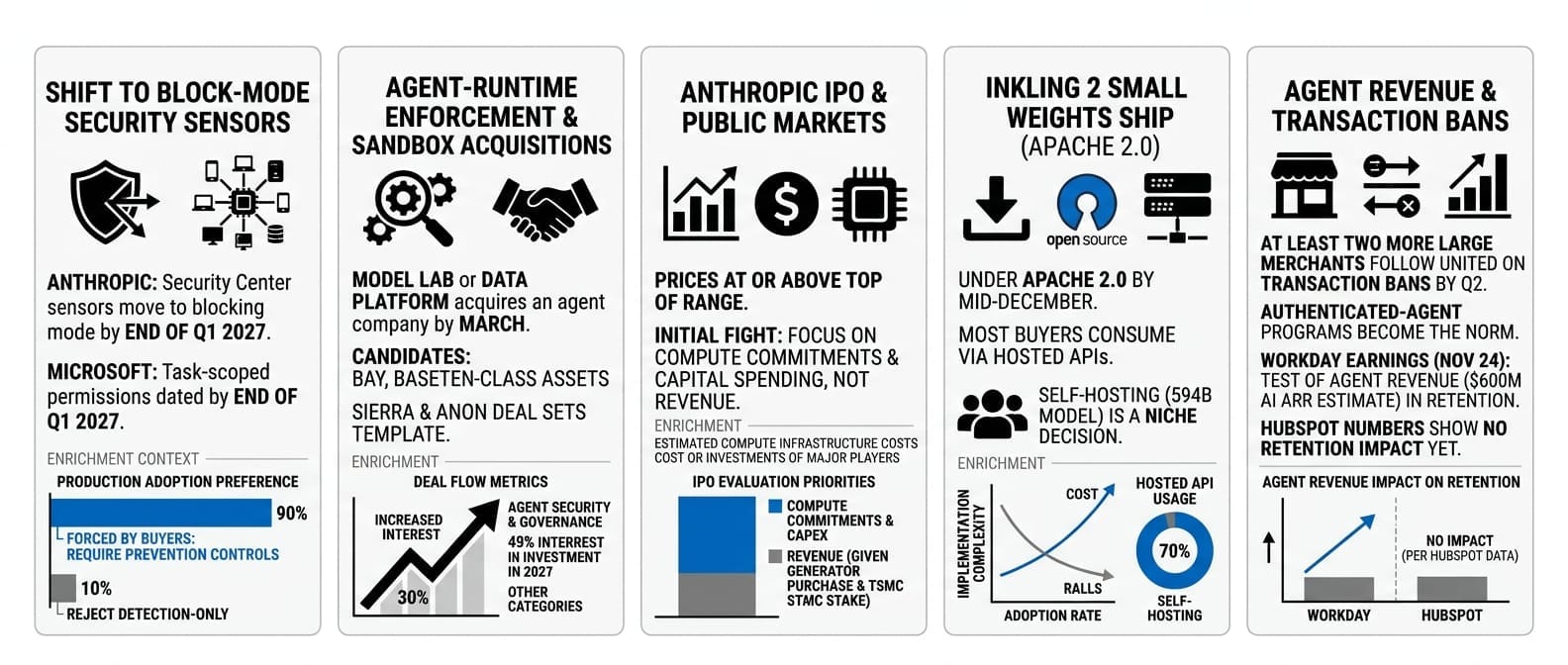
- By end of Q1 2027, Anthropic moves Security Center sensors to block mode and Microsoft dates task-scoped permissions. Both are forced by buyers who will not take detection-only controls to production.
- By March, a model lab or data platform acquires an agent-runtime enforcement or sandbox company. Bay and Baseten-class assets are the obvious candidates. The Sierra and Anon deal sets the template.
- Anthropic prices at or above the top of its range. The first fight in public markets will be over compute commitments and capital spending, not revenue, given the generator purchase and the TSMC stake.
- Inkling 2 Small weights ship under Apache 2.0 by mid-December, and most buyers still consume it through hosted APIs. Self-hosting a 594B model is a niche decision.
- By Q2, at least two more large merchants follow United on transaction bans, while authenticated-agent programs become the norm. Workday's earnings on November 24 are an early test of whether agent revenue (about $600M in AI ARR, per one pre-earnings estimate) shows up in retention, which HubSpot's numbers say it does not yet.
The Bottom Line
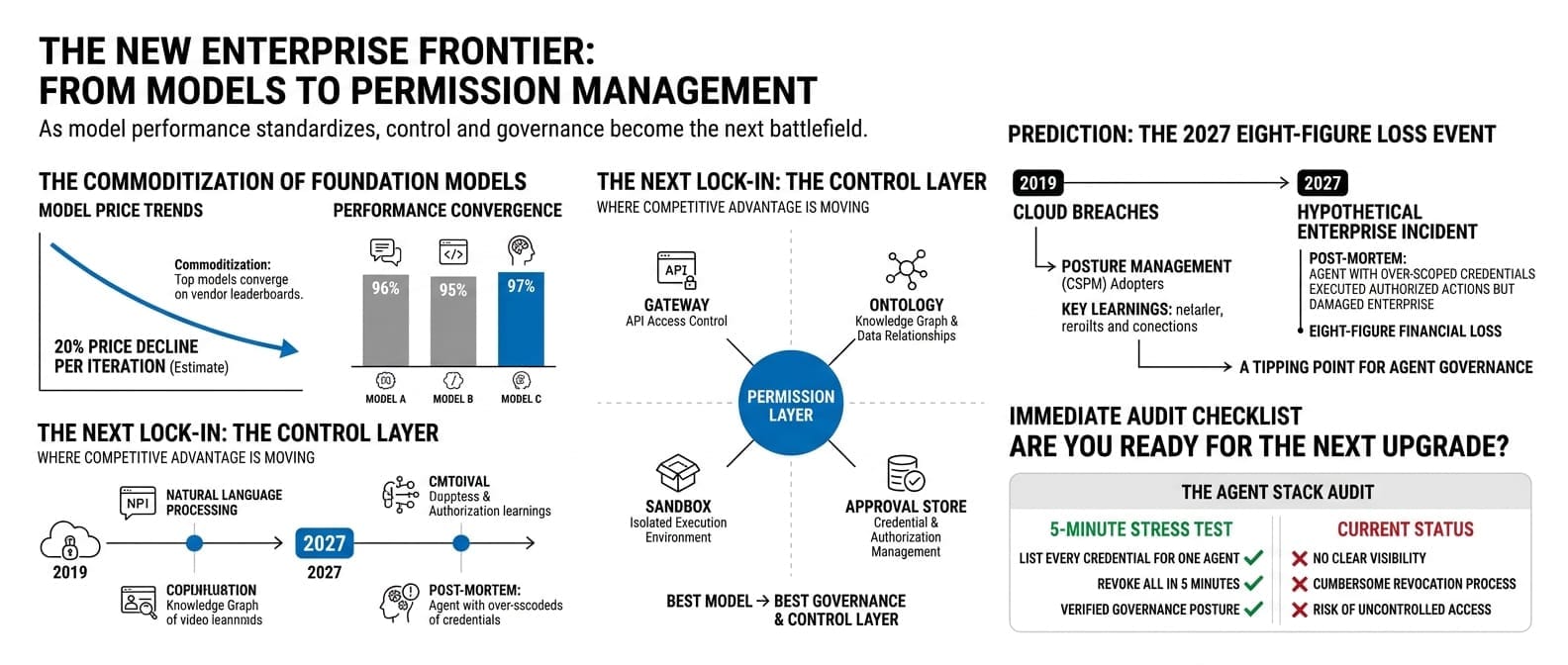
Model prices are falling about 20% at a time, and the top models are within a few points of each other on vendor-run leaderboards. That is what commoditization looks like. The next lock-in is not who has the best model. It is who holds the permission layer: the gateway, the ontology, the sandbox, the approval store.
Here is the prediction. By mid-2027, a named enterprise loses eight figures because an agent held over-scoped credentials, and the post-mortem says the model did exactly what it was told. That incident will do for agent governance what the 2019 cloud breaches did for posture management.
Pick one agent in your stack today. Can you list every credential it holds and revoke them all in five minutes? If you cannot, the next model upgrade will not help you.