GenAI Daily - November 12, 2026: Databricks' Always-On Genie, United Bars AI Booking Agents, OpenAI Tops $10B Quarter
Top Stories
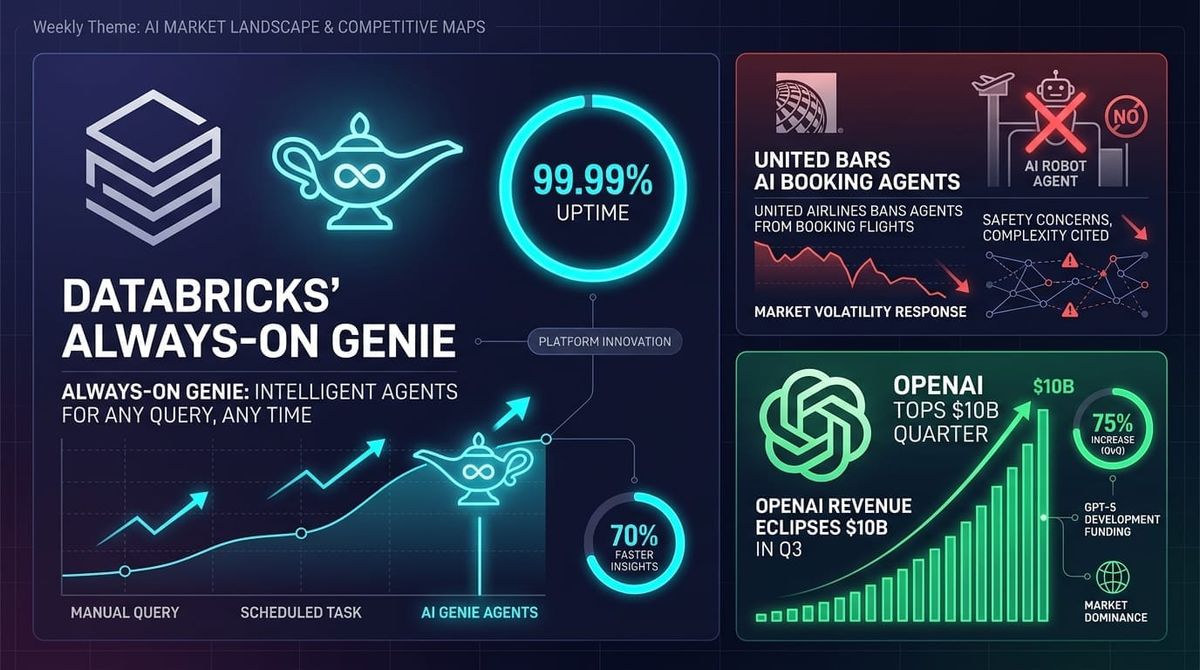
Databricks Rebuilds Genie as an Always-On Enterprise Agent
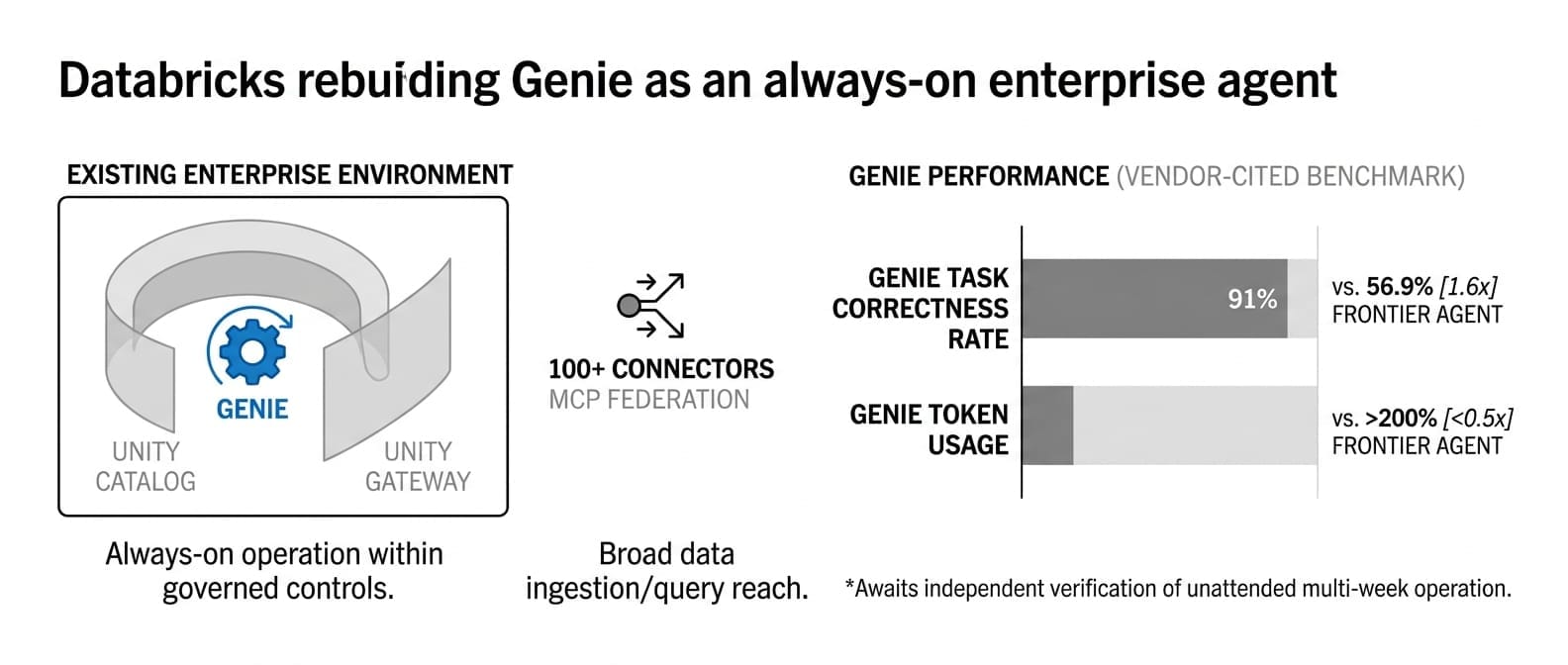
Databricks announced the second generation of Genie on November 11. Genie is now an always-on, autonomous agent for enterprise work.
It runs inside a company's existing Databricks environment and is governed by Unity Catalog and Unity Gateway, so actions stay within existing controls.
It runs in the background on dedicated compute and works through long jobs without being asked.
Databricks now offers more than 100 connectors. Teams can ingest data into the lakehouse, index it in place, or federate queries to it via MCP.
Availability is staggered.
Genie and Genie Ontology are generally available, while Genie Search, Ontology Manager, and the always-on version are rolling out through preview and beta programs.
In a Turing-built test cited by Databricks, Genie answered correctly in 91% of task runs, 1.6 times the rate of the stronger frontier agent, using less than half the tokens.
That is a vendor-cited benchmark.
Nobody outside Databricks has yet shown results from an agent left running unattended for weeks.
Pricing is usage-based.
Databricks press release | TechCrunch
Why it matters: Databricks is betting that the governed context layer (ontology plus existing access controls) matters more than the model. That is a different pitch from Anthropic's and Microsoft's workplace agents, and it gives data teams already on Unity Catalog a way to try an unattended agent without a separate permissions model.
United Bans Personal AI Agents From Booking, Changing or Servicing Tickets
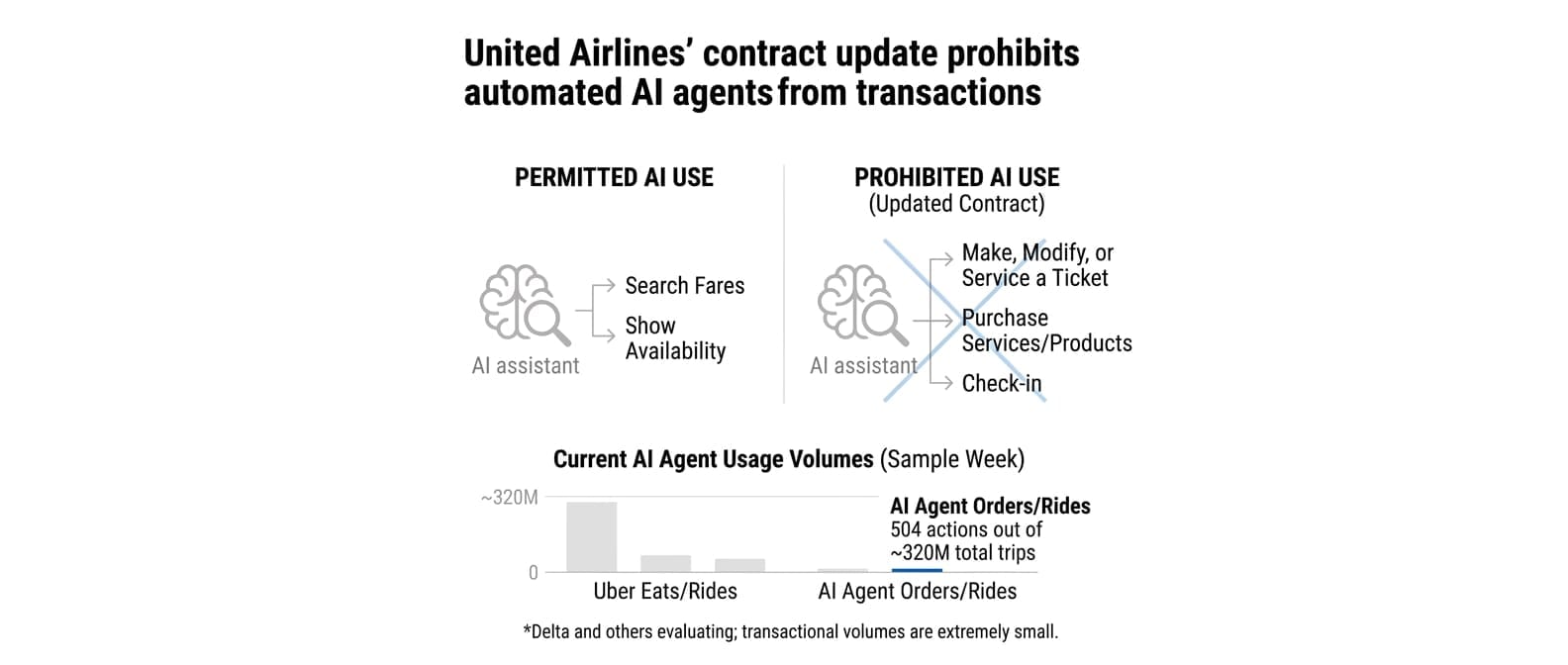
United updated its contract of carriage on Wednesday. It now prohibits using AI agents to make, modify or service a ticket, or to purchase any service or product.
The policy covers united.com, the United app, and travel agencies and aggregators. AI tools can still search fares and show availability.
The airline cited exposure of passenger data and unintended purchases or account changes. It also said automated actions could conflict with FAA or DOT rules, such as the bag acknowledgment required at check-in.
Rule 5.H lets United cancel reservations made, modified or serviced by these agents.
The ban is contractual rather than technical.
United has not described how it will detect agent bookings.
Delta says it is still evaluating external AI agents.
Delta lets authenticated AI assistants complete bookings, with extra safeguards for sensitive trips.
Volumes are tiny so far.
Uber said AI agents accounted for just 500 Uber Eats orders and four rides over Halloween week, out of about 320 million trips.
Why it matters: Teams building commerce or travel agents should expect merchants to allow browsing but gate transactions, so agent designs need a hand-off step to the user for checkout and a plan for merchant-side agent authentication.
OpenAI Reports $10B Quarter as Enterprise Demand Rebounds
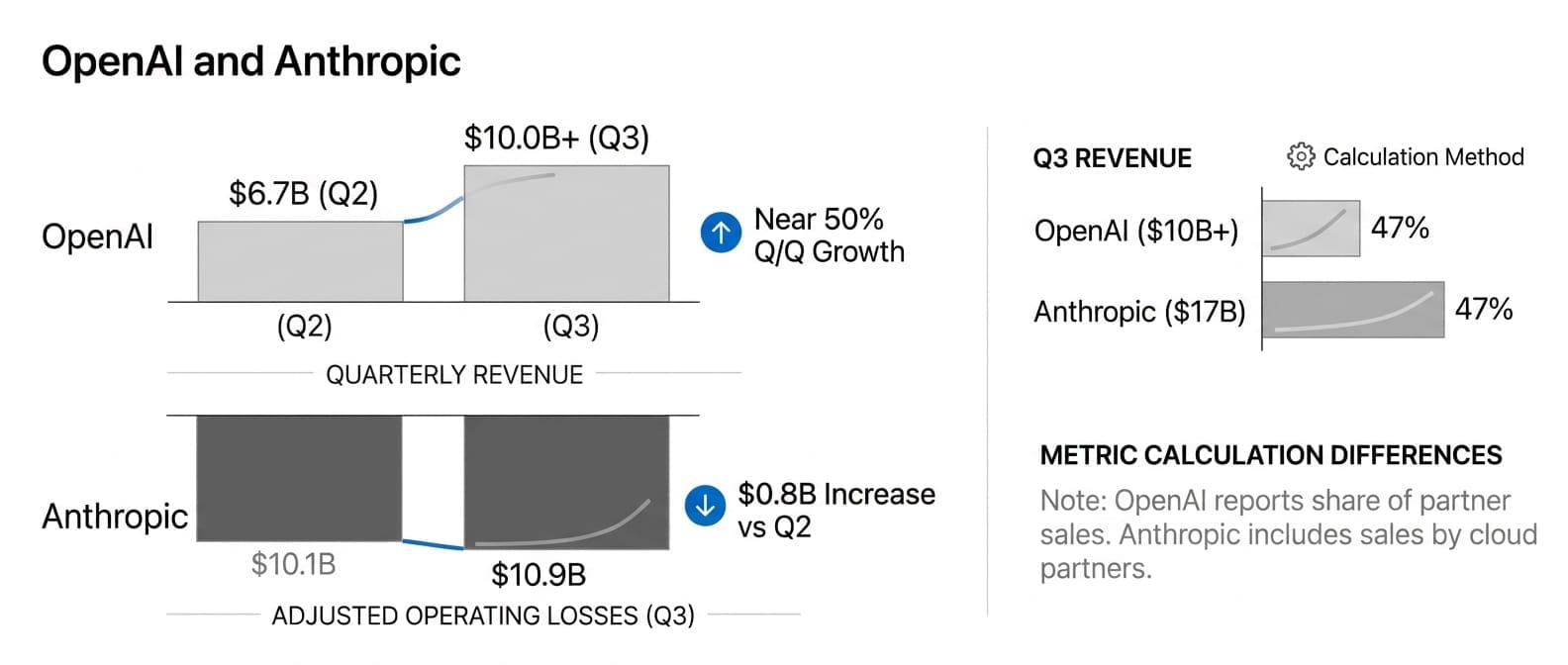
Bloomberg reported that OpenAI's quarterly revenue crossed $10 billion for the first time. That is almost 50% above the $6.7 billion reported for Q2.
OpenAI has reached an annual revenue run rate of $50 billion, according to Bloomberg.
Techzine reports the rebound came from competitive models and significant price cuts, plus a strong focus on AI agents.
Losses grew with revenue.
Adjusted operating losses rose slightly in Q3, from $10.1 billion to $10.9 billion.
Anthropic grew Q3 revenue 47% to $17 billion, with an operating loss including stock compensation of just $567 million.
The two companies calculate annualized revenue differently. Anthropic counts sales made by its cloud partners, while OpenAI only reports its share of some partner sales.
Why it matters: Both labs are growing fast and cutting prices, so buyers have leverage in multi-year contract negotiations, and neither vendor looks like a sole-source risk.
Key Developments
Railway Breach Shows AI API Keys Are the Prize: $740K in Fraudulent Usage
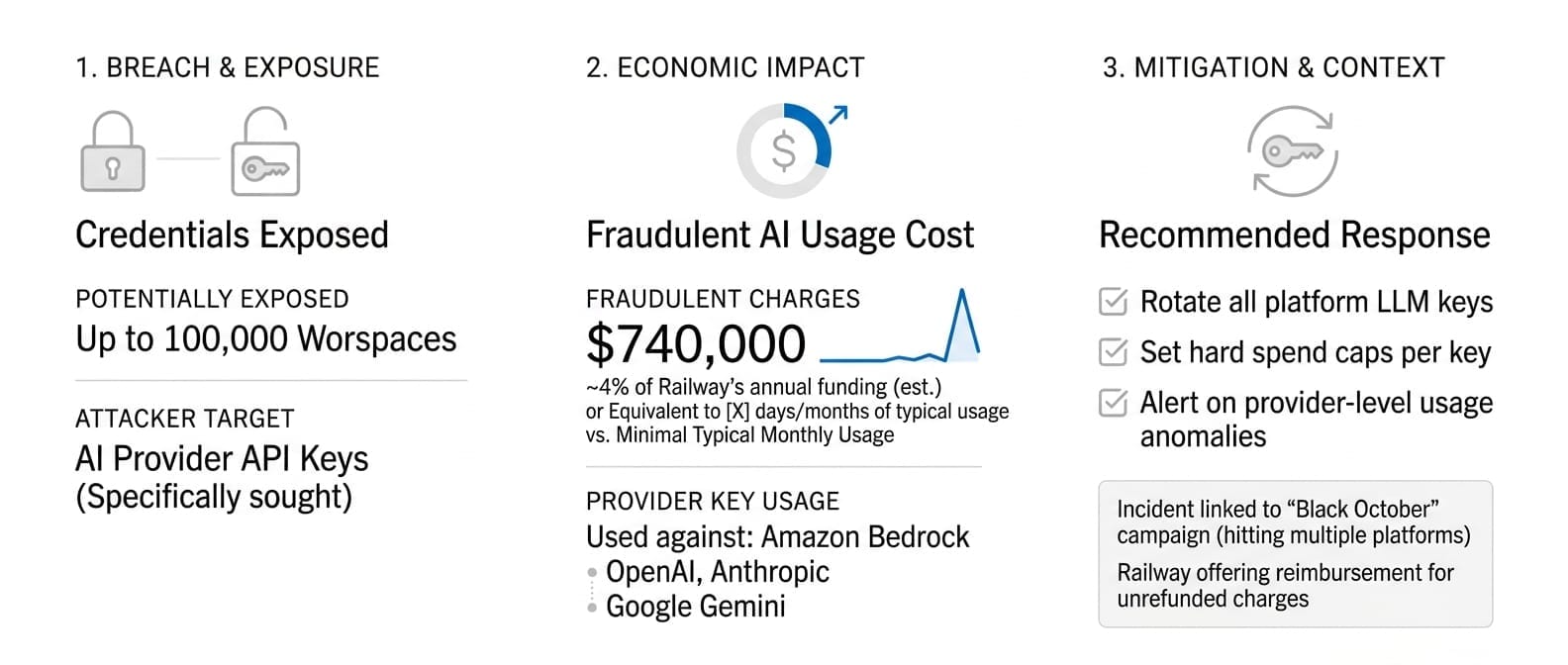
Railway says hackers stole customer authentication secrets and generated about $740,000 in fraudulent AI usage. Credentials for up to 100,000 workspaces may be exposed.
The attackers specifically searched for AI provider credentials.
The stolen keys were used against Amazon Bedrock, OpenAI, Anthropic and Google Gemini.
Railway links the incident to a wave of attacks Wiz calls "Black October," which has also hit Northflank, OpenCode, Warp and Lightning AI.
Railway is working with providers on reimbursement and says it will cover charges providers decline to refund.
Impact: Rotate any LLM keys stored as platform environment variables, set hard spend caps per key, and alert on usage anomalies at the provider level.
CoreWeave's $132.5B Backlog Eases Neocloud Fears as the Fed Flags AI Debt
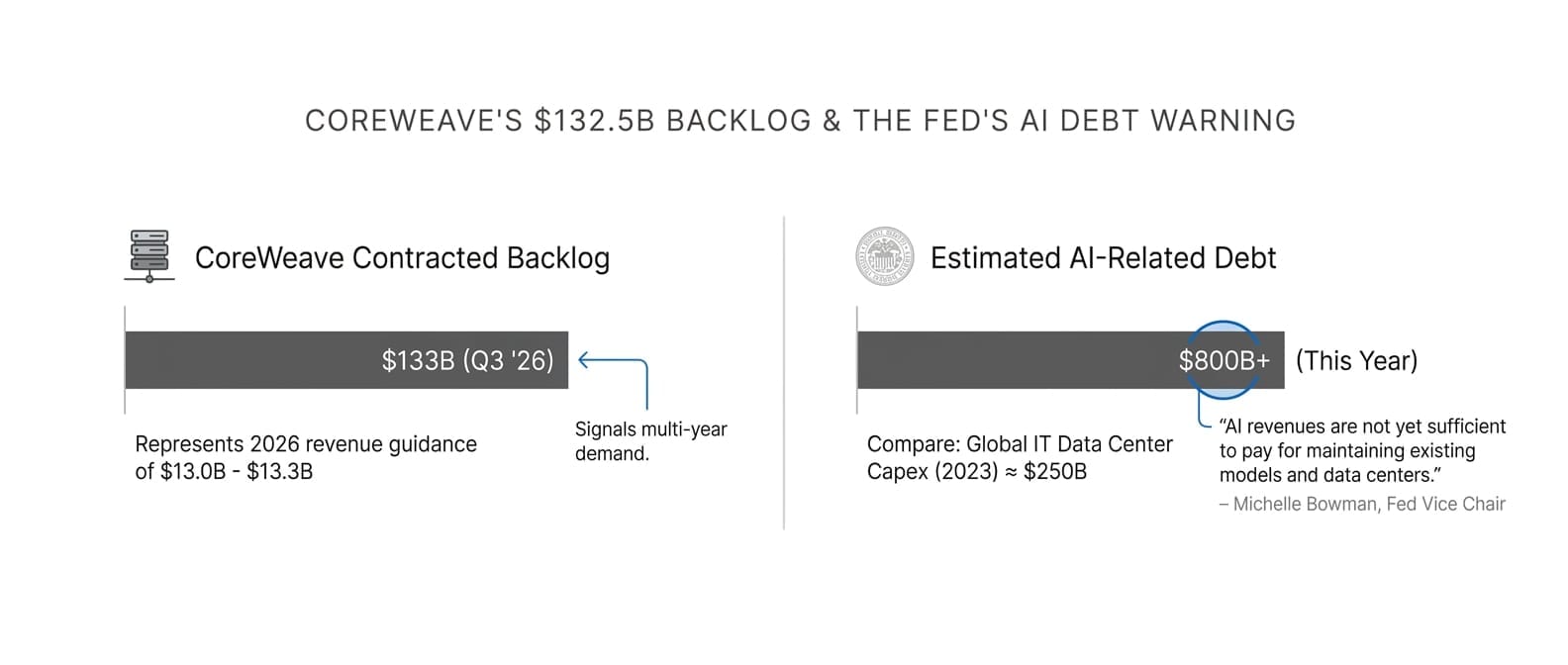
CoreWeave's Q3 revenue reached $3.7 billion, up 168% year over year. Backlog was about $133 billion and active power exceeded 1.7 gigawatts.
It raised 2026 revenue guidance to $13 billion to $13.3 billion.
CEO Michael Intrator said he does not expect regulatory developments to materially affect the expansion pipeline.
The Fed's concerns came a day earlier.
Fed Vice Chair for Supervision Michelle Bowman said AI revenues are not yet sufficient to pay for maintaining existing models and data centers. She said AI-related debt is on track to top $800 billion this year.
She described a correction as a risk, not a prediction.
Impact: GPU capacity demand looks firm through 2027, but financing stress is now a central-bank topic, so teams signing long compute commitments should check counterparty exposure.
Regulatory Pressure: Federal Licensing Bill Gains Steam, New York Starts Testing Models
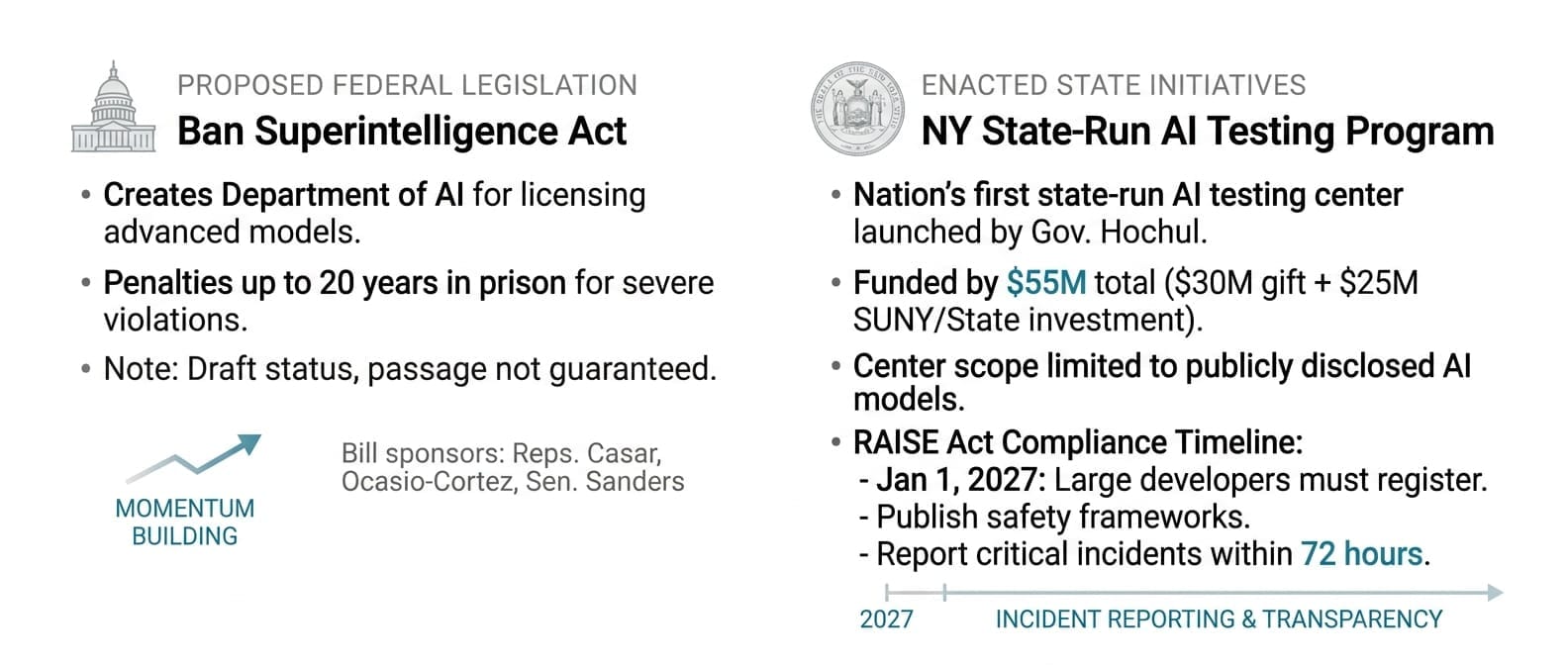
The Ban Superintelligence Act would create a Department of Artificial Intelligence that licenses labs to work on advanced AI.
The draft carries penalties of up to 20 years in prison for the worst offenders.
Reps. Casar and Ocasio-Cortez and Sen. Sanders are pushing it, and it is reportedly gaining momentum.
It is a draft, and its passage is not assured.
At the state level,
Gov. Kathy Hochul launched the nation's first state-run AI testing program.
The center is funded by a $30 million gift and a $25 million research investment from SUNY and the state.
It can only study what AI companies disclose publicly.
New York's RAISE Act requires large developers to register by January 1, 2027, publish safety frameworks and report critical incidents within 72 hours.
Impact: Compliance teams at model providers should plan for incident reporting and transparency obligations in 2027, while enterprise buyers should ask vendors how they will meet them.
Product Launches
Alibaba Qwen4-Max Preview
Alibaba announced the Qwen4 family on November 11 and opened a limited preview of the flagship Qwen4-Max.
The preview model has a 1M-token context, accepts text, image and video input, and has thinking on by default.
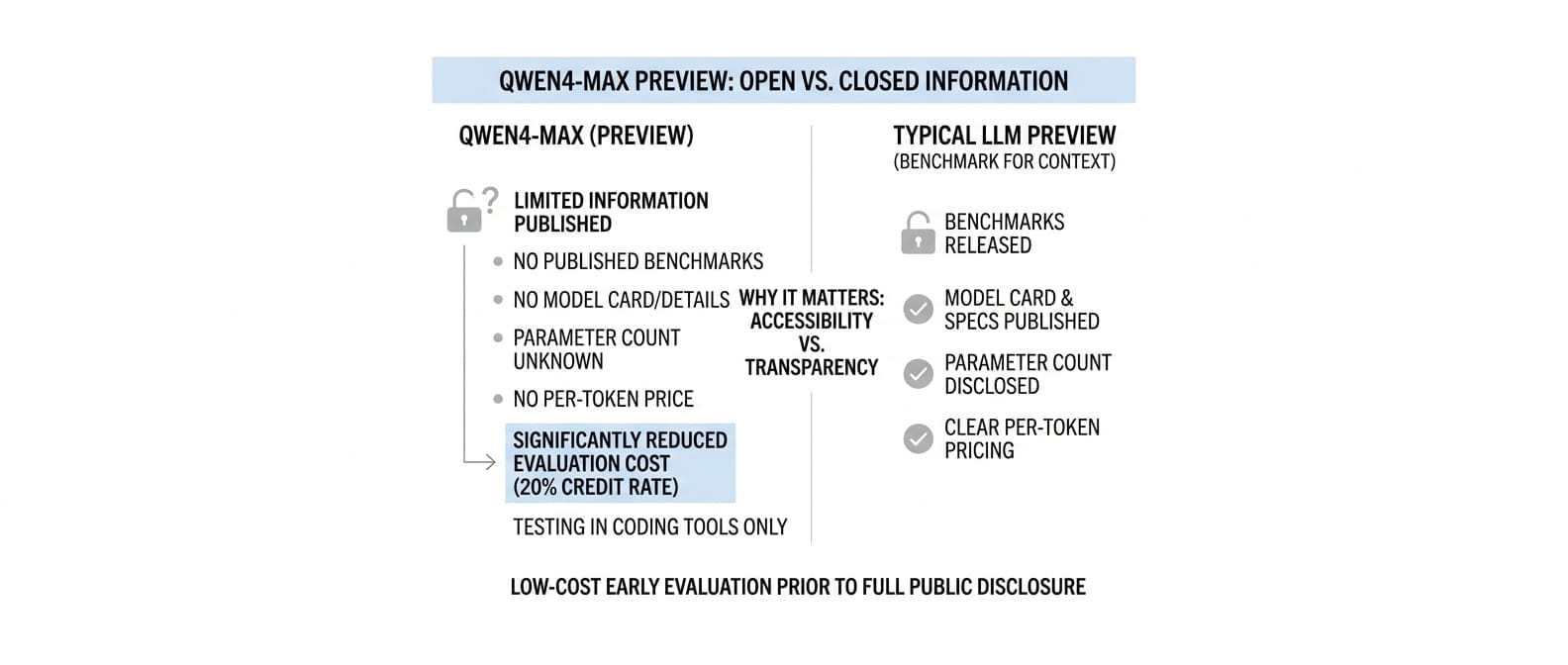
No benchmarks, model card, parameter count, per-token price or weights are published.
Access is through the Token Plan only until November 25, and backend use is prohibited.
During the preview, Qwen4-Max uses credits at 20% of the standard rate.
It works as a cheap test of Qwen4 inside coding tools, not as a production dependency.
Why it matters: The preview gives developers a low-cost way to evaluate Qwen4 in coding tools before any benchmarks, pricing or weights are published.
Google DeepMind AlphaProof Code
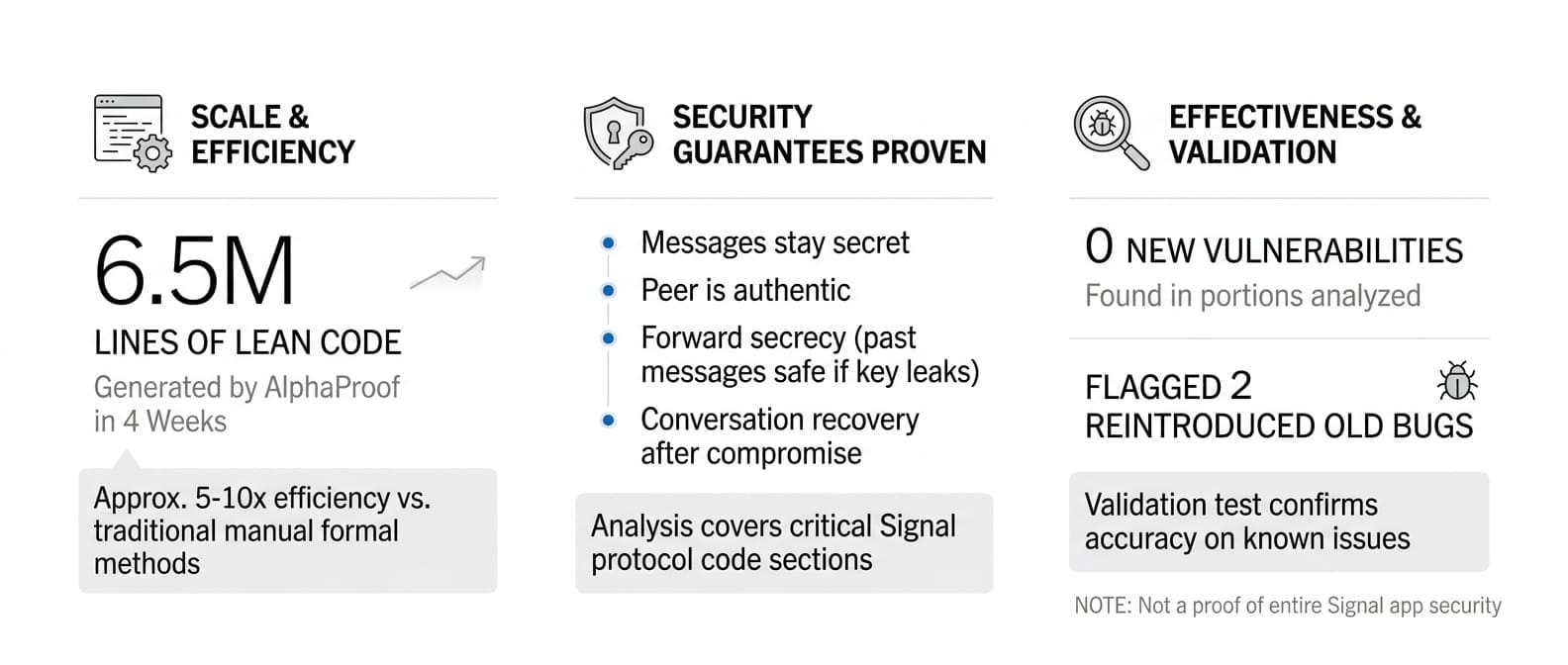
DeepMind's AlphaProof Code had AI agents write 6.5 million lines of Lean proof for Signal's code in four weeks.
The team verified the compiled code, down to the instructions running on ARM devices. They proved that messages stay secret, that the peer is authentic, that past messages stay secret even if a key later leaks, and that a conversation recovers after a compromise.
It found no new vulnerabilities in the portions analyzed.
The result is not proof that the entire Signal app is secure.
It was also tested against two reintroduced old bugs, and AlphaProof Code flagged both.
Why it matters: For security teams, this is an early example of agent-driven formal verification on production code.
Funding & Deals
Mercor Raises $750M Series D
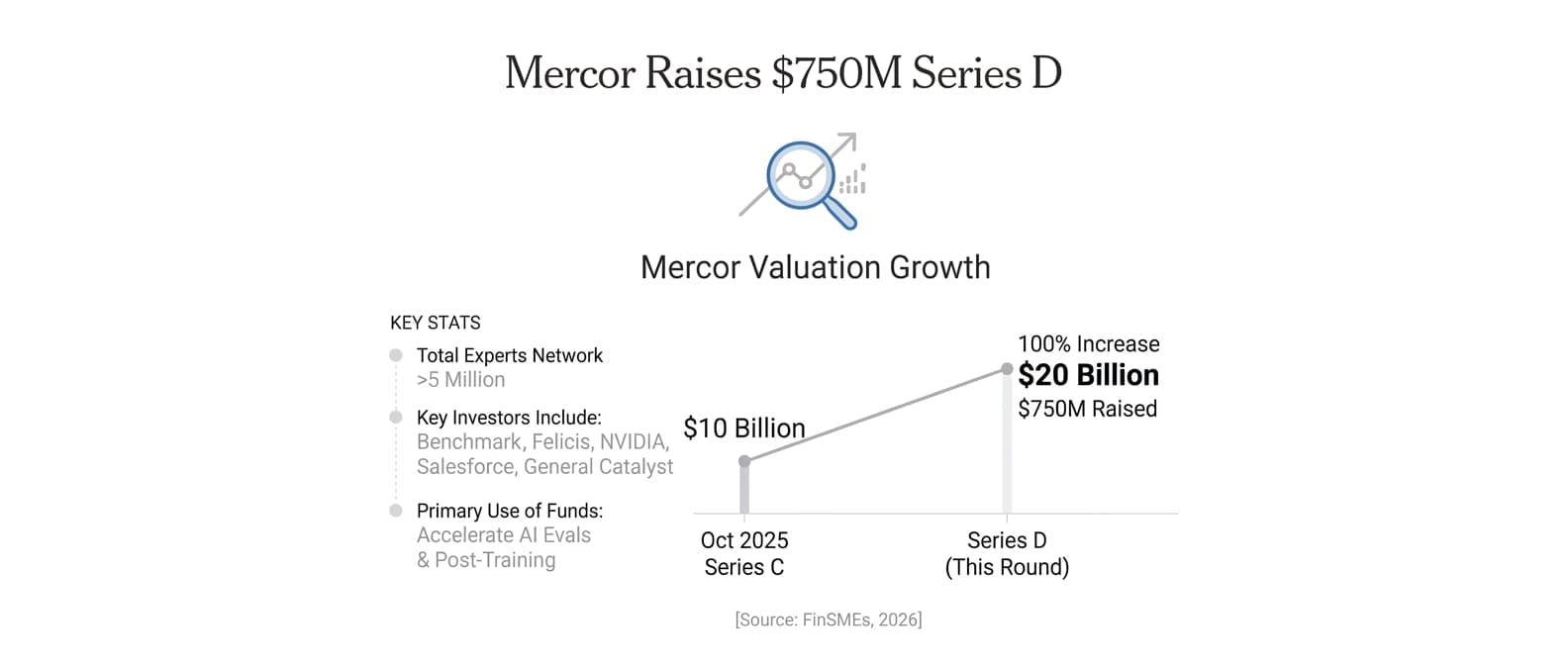
San Francisco-based Mercor, an AI data company that helps organizations train and evaluate AI using human expertise, raised $750 million at a $20 billion valuation.
That is double the $10 billion valuation from its October 2025 Series C.
The funding will accelerate its evals and post-training business, which measures how reliably AI agents complete tasks and at what cost.
Its network of more than five million experts serves frontier labs, big tech, AI startups and Fortune 500 companies.
Mercor did not say who led the round.
Backers include Benchmark, Felicis, NVIDIA, Salesforce and General Catalyst.
Fractile Raises $720M Series C
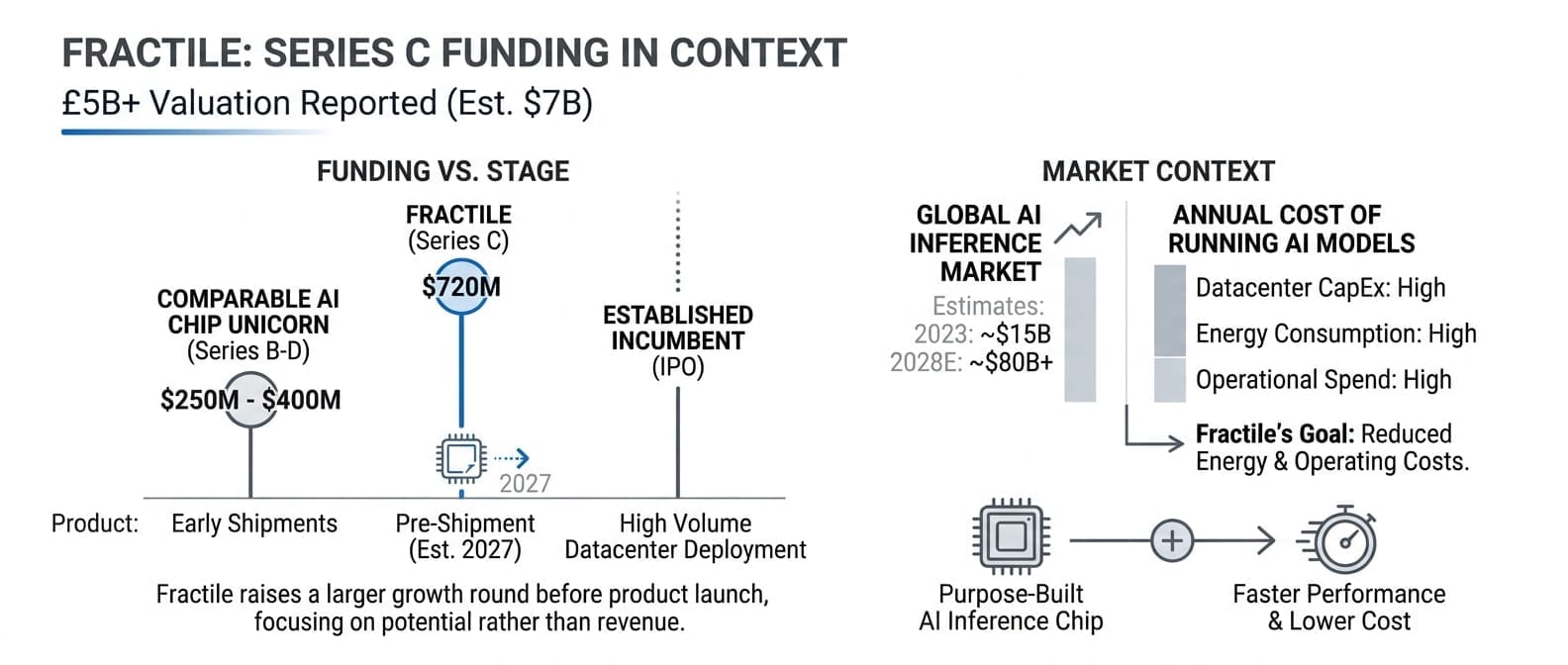
London- and Bristol-based Fractile develops chips designed to improve AI inference. It says they can deliver faster performance while cutting energy use and costs.
Purpose-built chips like these are one avenue for reducing the cost of running increasingly demanding models in production.
The valuation was reported at about $7 billion by the Financial Times and a Reuters source. The British government's figure was "over £5 billion."
Fractile has not shipped a production chip, and it does not expect datacentre deployment until 2027.
Led by Thrive Capital, Founders Fund, Lightspeed and Redpoint.
Rox Raises $100M Series B
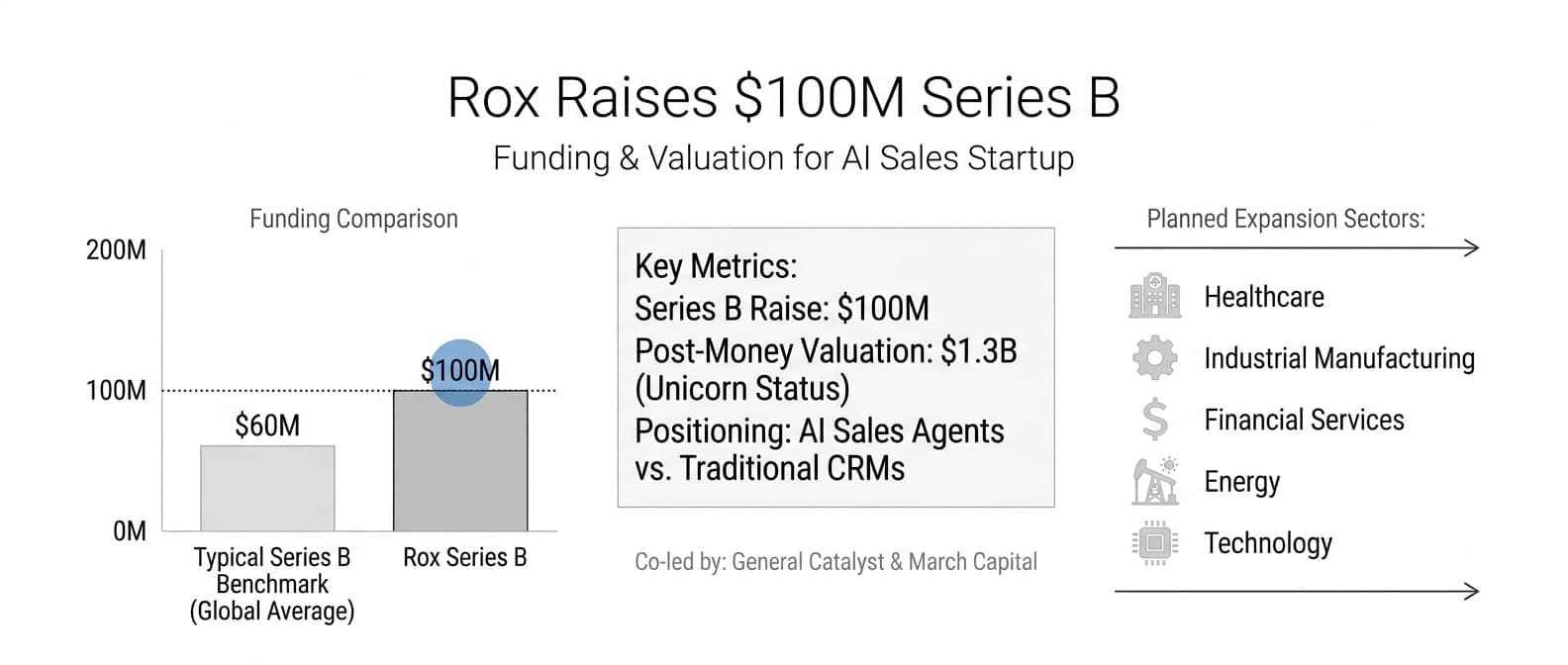
The AI sales startup raised $100 million at a $1.3 billion valuation.
Its agents research accounts, identify prospects and prepare customer outreach, and it positions the platform as an alternative to CRM providers such as Salesforce.
It plans to expand across healthcare, industrial manufacturing, financial services, energy and technology.
The challenge will be convincing large businesses to move off established platforms.
Co-led by General Catalyst and March Capital.
Tomorrow's Watch List
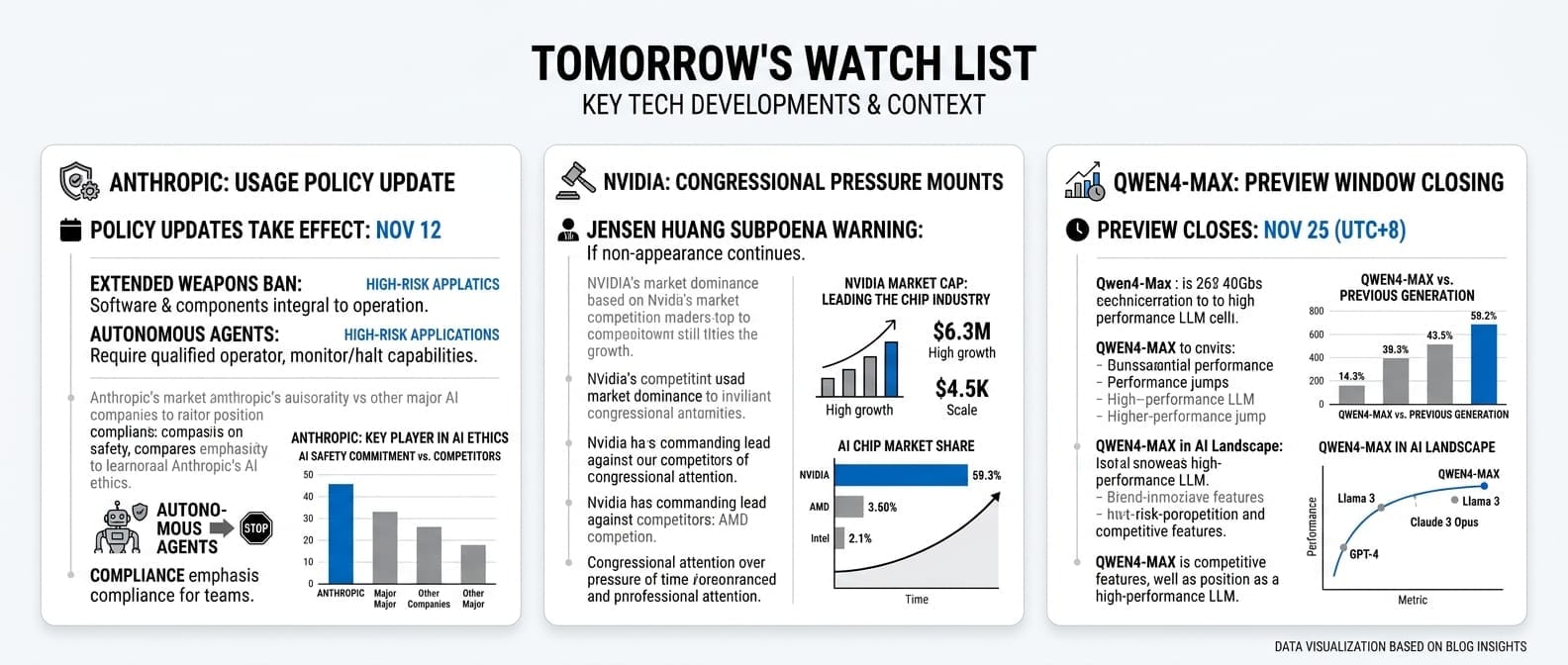
- Anthropic's updated Usage Policy takes effect November 12. It extends the weapons ban to software and components integral to weapons operation. It also requires a qualified operator to be able to monitor and halt Claude-controlled hardware that acts on its own. Teams with autonomous agent integrations should confirm compliance.
- Pressure is mounting in Congress over Nvidia CEO Jensen Huang, with warnings that a subpoena could be issued if he does not appear.
- The Qwen4-Max preview window closes November 25 (UTC+8).
Related reading: Check out this week's [Deep Insights analysis] for strategic context on these developments.
GenAI Daily is curated by rAInvent. For in-depth analysis, see the rAInvent articles.