GenAI Daily - April 27, 2026: xAI's Voice Lead, Google's TurboQuant Breakthrough, Anthropic IPO Signals
Top Stories
xAI Launches Grok Voice Think Fast 1.0, Tops Industry Benchmarks
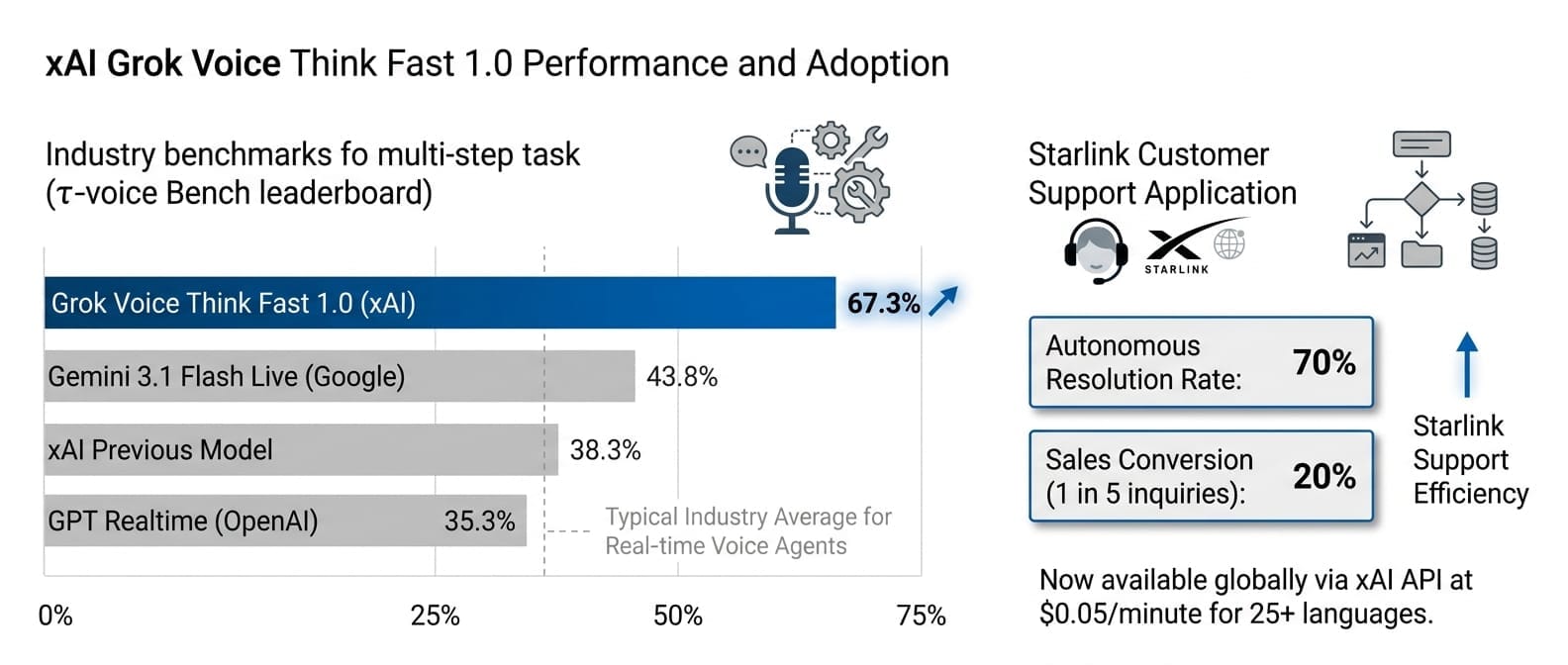
xAI released its flagship voice model Grok Voice Think Fast 1.0 on April 23, 2026, establishing dominance in enterprise voice AI with a 67.3% score on the τ-voice Bench leaderboard - significantly outperforming Gemini 3.1 Flash Live (43.8%), OpenAI's GPT Realtime (35.3%), and xAI's own previous model (38.3%). The new model excels at complex, ambiguous, multi-step workflows across customer support, sales, and enterprise applications.
The model is particularly well-suited for high-stakes scenarios demanding precise data entry and high-volume tool calling. Grok Voice already powers Starlink's customer support at +1 (888) GO STARLINK, achieving a 20% conversion rate (1 in 5 sales inquiries result in purchases) and 70% autonomous resolution rate.
Available immediately via the xAI API at $0.05 per minute, the model supports 25+ languages with custom voice activity detection and tokenizer systems.
Why it matters: xAI's breakthrough in real-time voice reasoning without latency overhead positions it as the first practical enterprise voice agent capable of handling multi-tool workflows, directly challenging traditional call center operations.
Google's TurboQuant Delivers 6x Memory Compression Breakthrough
Google Research unveiled TurboQuant on March 24, 2026, a compression algorithm that quantizes AI key-value caches to just 3 bits without requiring training or fine-tuning while causing zero accuracy loss. The breakthrough enables 6x memory reduction and up to 8x speedup in attention computation on H100 GPUs.
TurboQuant combines PolarQuant (high-quality compression through vector rotation) with Quantized Johnson-Lindenstrauss (QJL) to eliminate bias in attention scores. This allows a 70-billion-parameter model that previously required 80GB of VRAM to run on just 12GB.
The announcement triggered immediate market reaction, with memory stocks falling sharply - SK Hynix dropped 6.23%, Samsung 4.8%, and SanDisk fell 8% as investors feared reduced demand for high-bandwidth memory.
Why it matters: TurboQuant fundamentally shifts AI economics from "bigger hardware" to "smarter memory," potentially reducing inference costs by 50%+ and enabling massive models to run on consumer hardware.
Anthropic Revenue Surge Positions October IPO at $400B+ Valuation
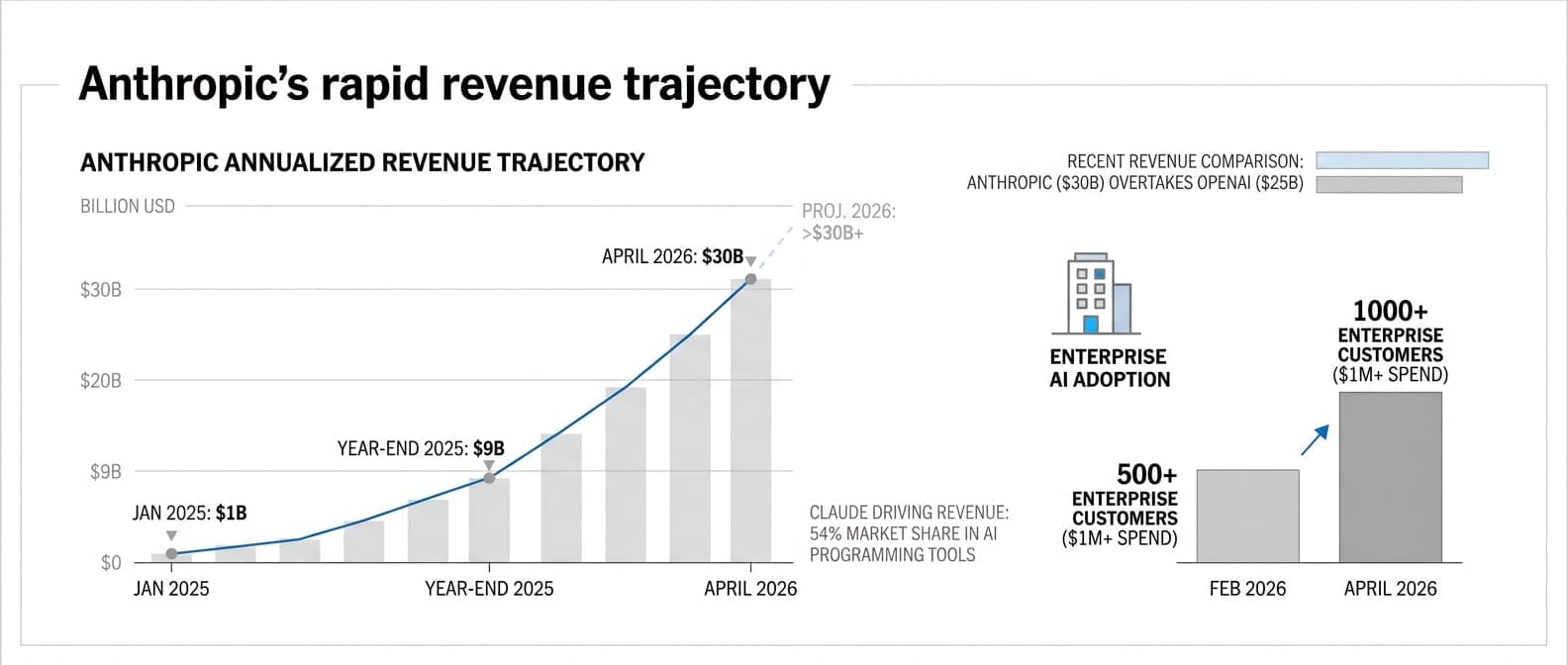
Anthropic announced on April 7, 2026 that its annualized revenue surpassed $30 billion, overtaking OpenAI's $25 billion for the first time. This represents explosive growth from $9 billion at year-end 2025 and $1 billion in January 2025.
The company is in active discussions with Goldman Sachs and JPMorgan about a potential October 2026 IPO targeting a $60+ billion raise at $400-500 billion valuation.
Claude Code drives significant revenue growth with $2.5+ billion in annualized revenue and 54% market share in AI programming tools. Over 1,000 enterprise customers now spend $1+ million annually, doubling from 500 in February. Eight of the Fortune 10 are Claude customers.
Anthropic secured 3.5 gigawatts of Google TPU capacity through 2027, with compute demand expected to reach 3GW by 2027 versus 1GW in 2026.
Why it matters: Anthropic's enterprise-first strategy is generating higher-quality revenue than consumer-focused rivals, potentially making it the first profitable frontier AI company and validating enterprise AI as the path to sustainable AI business models.
Key Developments
ServiceNow CEO Defends AI Strategy Amid Record Q1 Results
ServiceNow CEO Bill McDermott rejected concerns that AI could weaken the business, stating "There has never been a tailwind for ServiceNow like AI" during Q1 2026 earnings. The enterprise software company reported that customers are moving from AI experiments to broader deployments, with AI boosting demand and productivity rather than cutting jobs.
Subscription revenue rose 19% in constant currency, with current remaining performance obligations growing 21%. Operating margin reached 32% while free cash flow margin hit 44%.
McDermott raised AI commitments guidance to $1.5 billion for 2026, up from a previous target of $1 billion.
Impact: ServiceNow's strong AI monetization validates the platform approach to enterprise AI, positioning workflow orchestration as a defensive moat against pure-play AI companies.
Enterprise Talent Exodus Accelerates to AI Companies
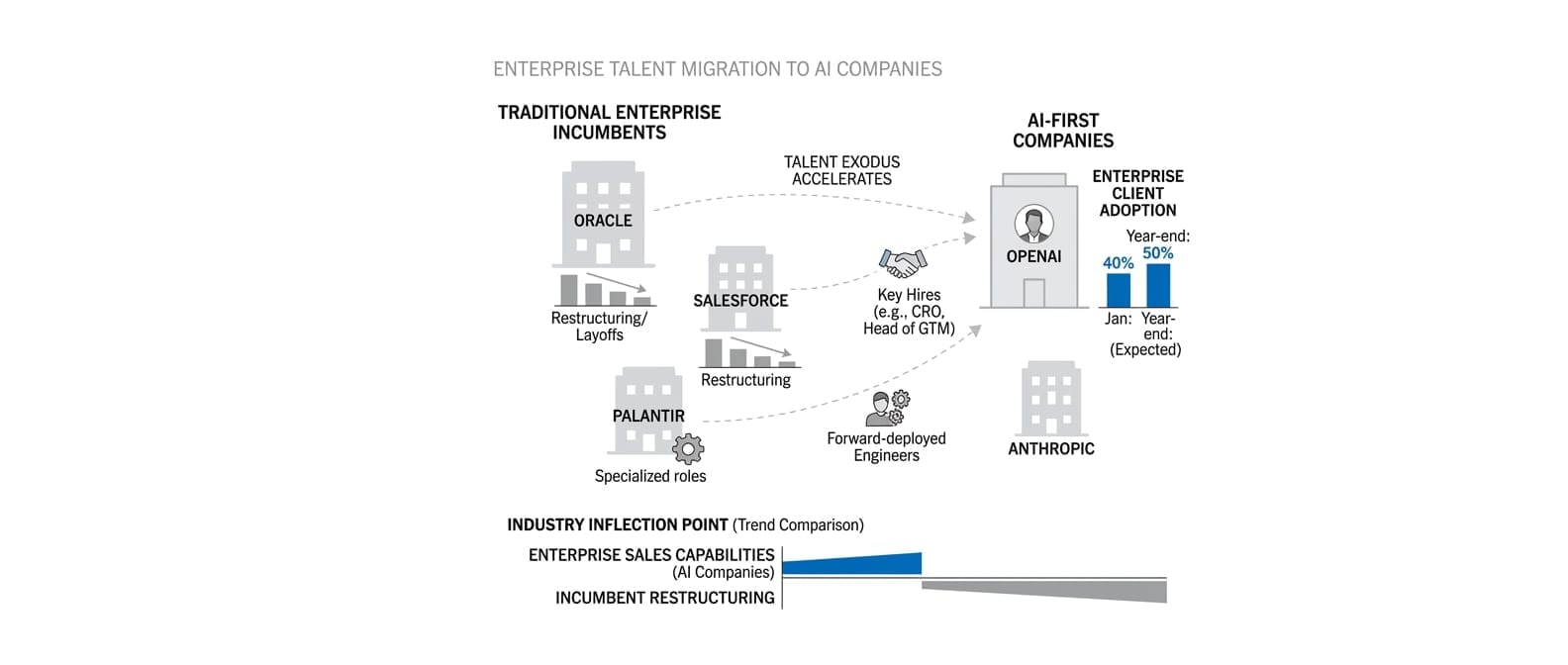
OpenAI and Anthropic have recruited top enterprise software executives from Salesforce, Snowflake, and Datadog with large pay packages. Notable hires include former Slack CEO Denise Dresser as OpenAI's chief revenue officer and Jennifer Majlessi from Salesforce as head of go-to-market at OpenAI.
OpenAI has also been quietly recruiting forward-deployed engineers from Palantir, a highly specialized role. As of January, 40% of OpenAI's business comes from enterprise clients, expected to reach 50% by year's end.
Oracle began laying off thousands of workers while shifting resources toward AI cloud computing, with Meta and Microsoft also cutting headcount in recent weeks.
Impact: The talent migration from traditional enterprise software to AI companies signals an industry inflection point where AI-first companies are building enterprise sales capabilities while incumbents restructure.
Stanford AI Index Shows Human Scientists Still Outperform AI Agents
The Stanford AI Index 2026, released this month, found that 6-9% of natural science publications now mention AI, with over 80,000 papers in 2025 representing 26% growth from 2024. Computer scientist Yolanda Gil notes "Scientists have really embraced this AI era."
However, the report remains skeptical about AI agents' performance in autonomous scientific workflows. While AI use is exploding, Princeton's Arvind Narayanan warns "it is happening too fast, without giving scientific norms time to adjust, and so the quality of research has taken a nosedive."
Impact: The disconnect between AI adoption and research quality suggests enterprise teams should focus on human-AI collaboration rather than full automation for complex knowledge work.
Product Launches
Microsoft Agent Governance Toolkit
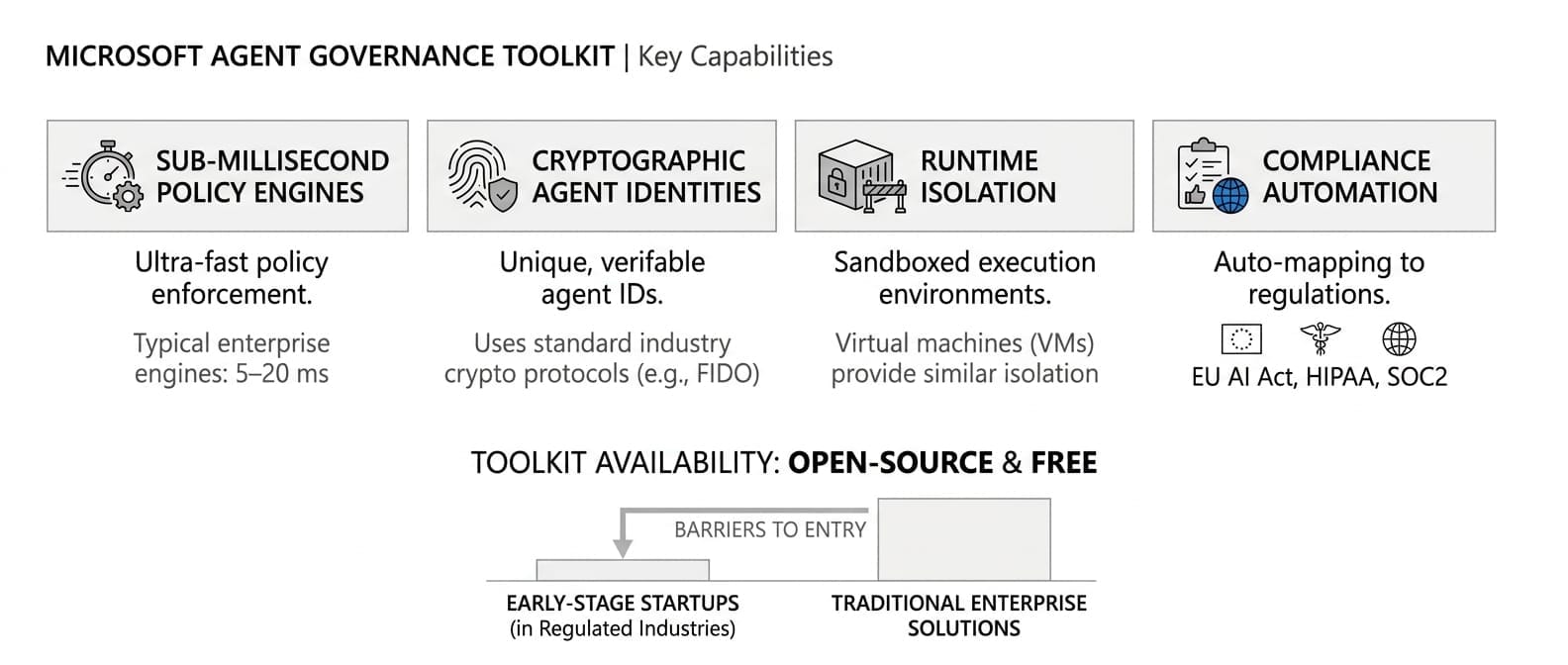
Microsoft released its Agent Governance Toolkit on April 3, 2026, providing sub-millisecond policy engines, cryptographic agent identities, runtime isolation, and compliance automation mapped to EU AI Act, HIPAA, and SOC2. The toolkit is open-source and free, lowering barriers for early-stage startups building in regulated industries.
Cursor 3 AI Coding Interface
Cursor 3 launched with an interface allowing users to start AI coding agents to complete tasks autonomously. Wired reported the new system transforms how developers interact with agentic tools like Claude Code, as millions of developers adopt these systems.
Funding & Deals
OpenAI Acquires Hiro Finance
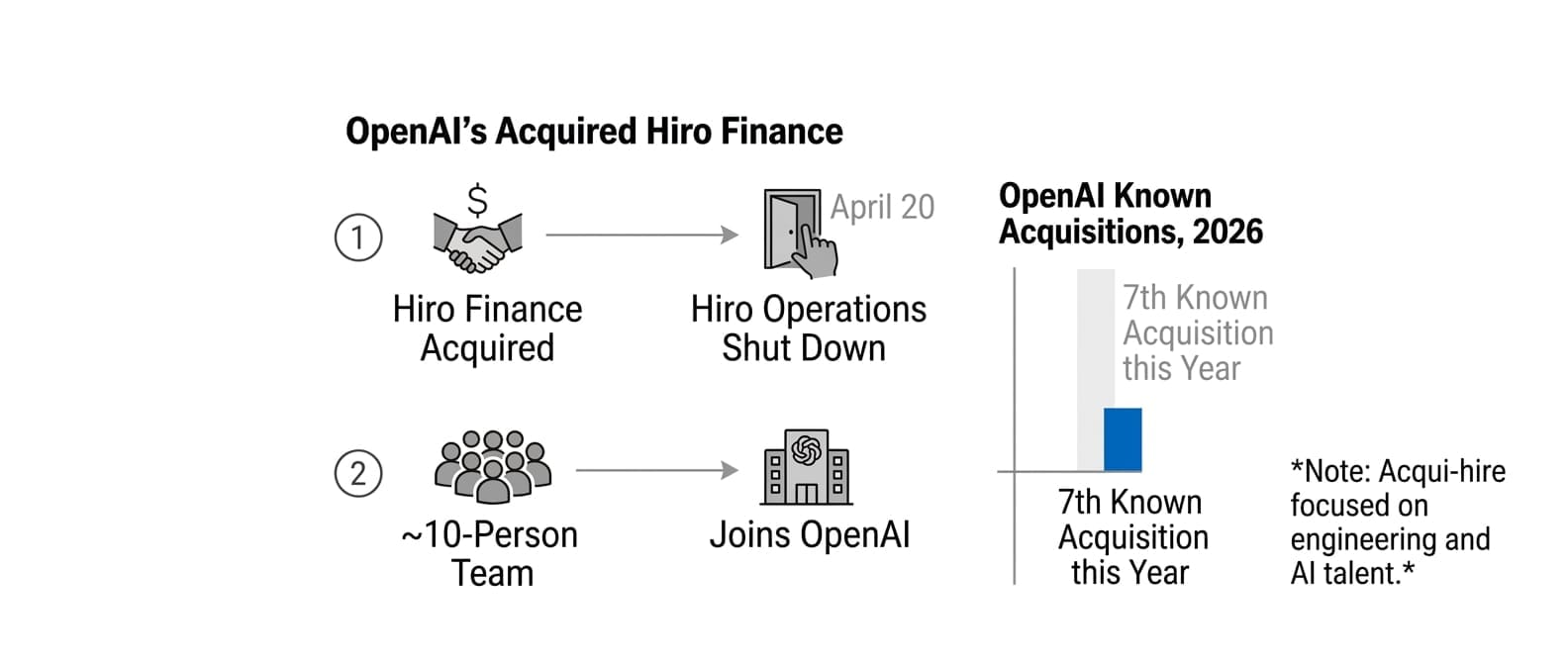
OpenAI acquired personal finance AI startup Hiro Finance in an apparent acqui-hire, founded by serial entrepreneur Ethan Bloch. Hiro will shut down operations on April 20 with its ~10-person team joining OpenAI. This marks OpenAI's seventh known acquisition of 2026.
Bluefish $43M Series B for AI Visibility
Bluefish raised $43M Series B (co-led by Threshold Ventures and NEA) for AI visibility control, marking a shift where AI visibility has moved from experimental spend to budgeted infrastructure for Fortune 500 brands. Salesforce Ventures and Amex Ventures participated, signaling enterprise buyer commitment.
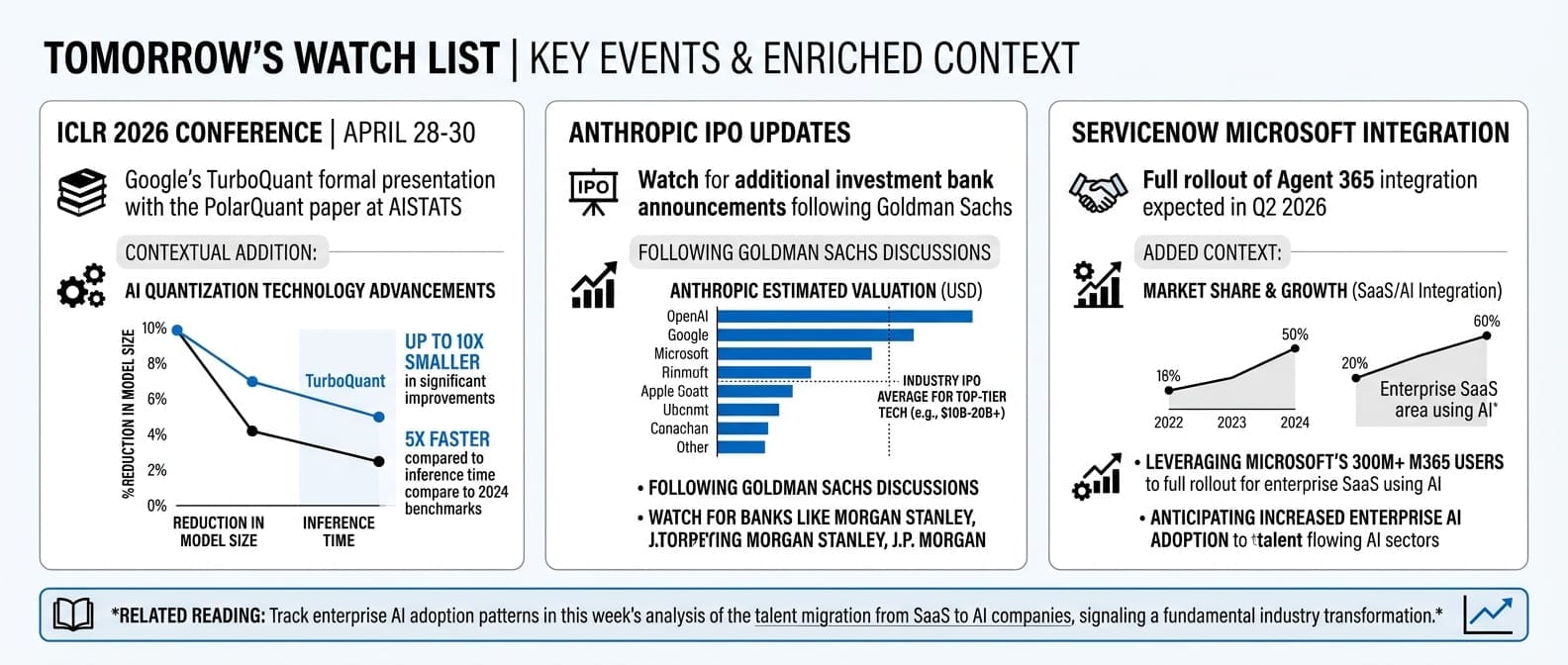
Tomorrow's Watch List
- ICLR 2026 Conference (April 28-30): Google's TurboQuant formal presentation with PolarQuant paper at AISTATS
- Anthropic IPO Updates: Watch for additional investment bank announcements following Goldman Sachs discussions
- ServiceNow Microsoft Integration: Full rollout of Agent 365 integration expected in Q2 2026
*Related reading: Track enterprise AI adoption patterns in this week's analysis of the talent migration from SaaS to AI companies, signaling a fundamental industry transformation.