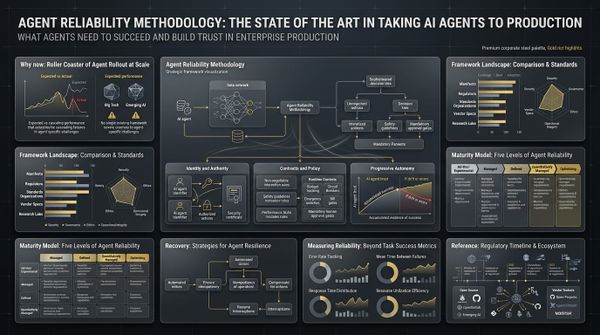
Agent reliability methodology: the state of the art in taking AI agents to production
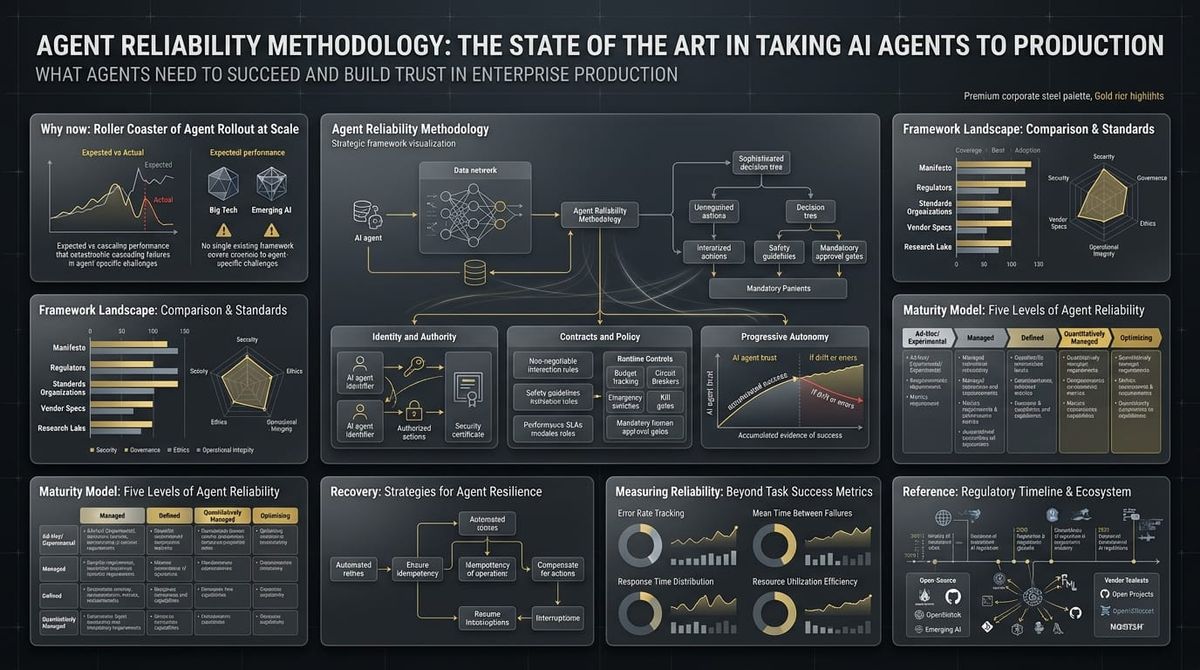
In this article:
- The short version: the findings in twelve lines
- Why now: what goes wrong when agents roll out at scale, and why no framework covers it yet
- The methodology: what agent reliability methodology adds to site reliability engineering, safety, security and governance
- Framework landscape: the manifesto, regulators, standards, vendor specs and research, side by side
- Identity and authority: who acted, and what it was allowed to do
- Contracts and policy: rules the model cannot talk its way past
- Evaluation and testing: one passing run proves little
- Runtime controls: budgets, circuit breakers, kill switches, approval gates
- Observability: the short version of an earlier report
- Recovery: retries, idempotency, compensation, resume
- Progressive autonomy: authority earned by evidence and lost on drift
- Measuring reliability: metrics beyond task success
- Maturity model: five levels and what each one asks
- Where next: dated calendar and the open problems
- Reference: regulatory timeline, vendor coverage, open source projects
Artificial intelligence (AI) agents are moving into production faster than the people responsible for them trust them.
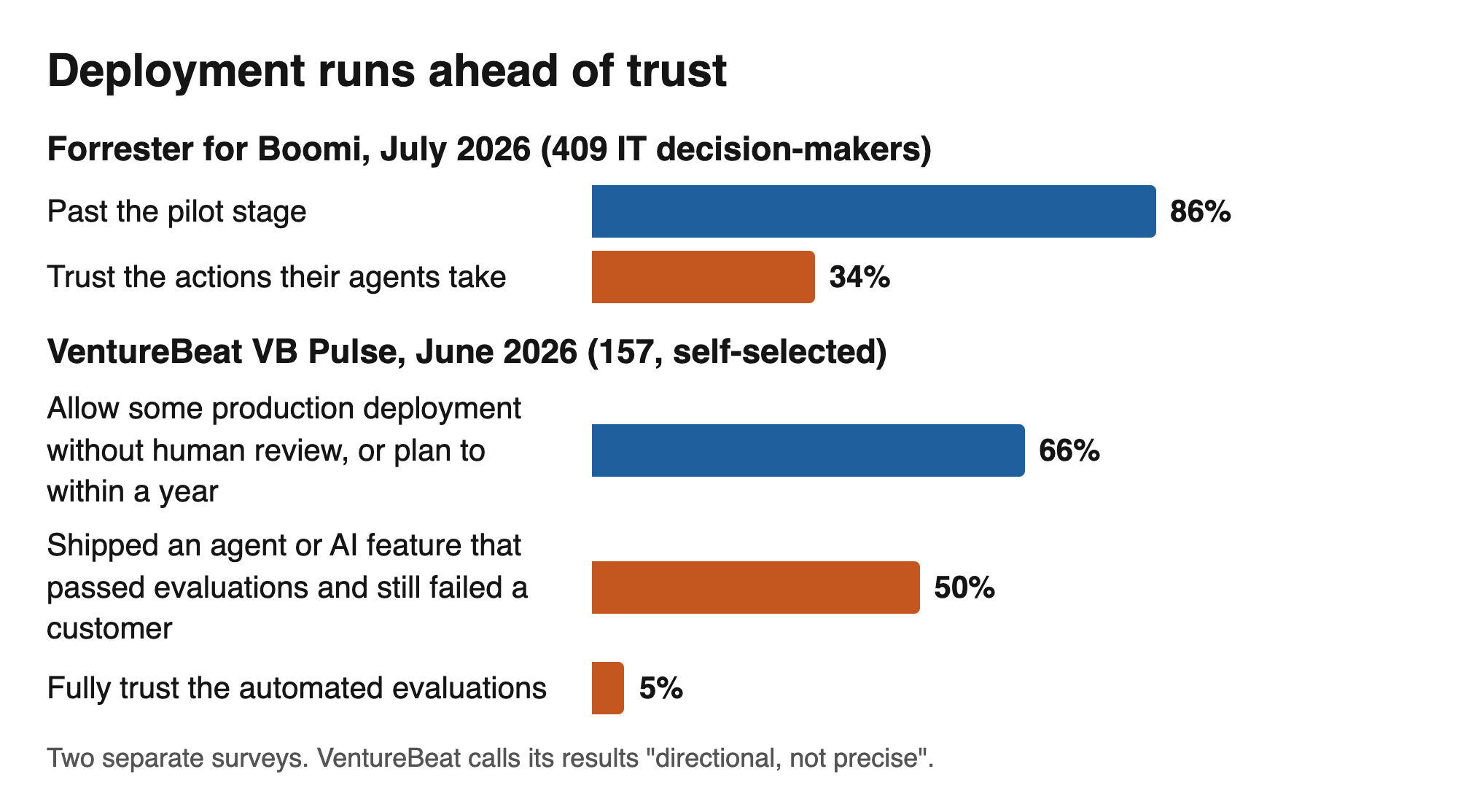
A Forrester study commissioned by Boomi, published 20 July 2026, surveyed 409 information technology (IT) decision-makers at director level and above. 86% said their organisation had moved beyond the pilot stage with AI agents. 34% said they trust the actions their agents take.
Two months earlier, Gartner predicted that by 2027, 40% of enterprises will demote or decommission autonomous AI agents "due to governance gaps identified only after production incidents occur".
An agent is software that uses an AI model to decide its next step and then act: call a tool, change a record, send a message, spend money. Reliability, for an agent, means more than staying up. It means the agent does what it was asked, stays inside what it is allowed to do, fails in ways someone can see, and can be stopped and undone.
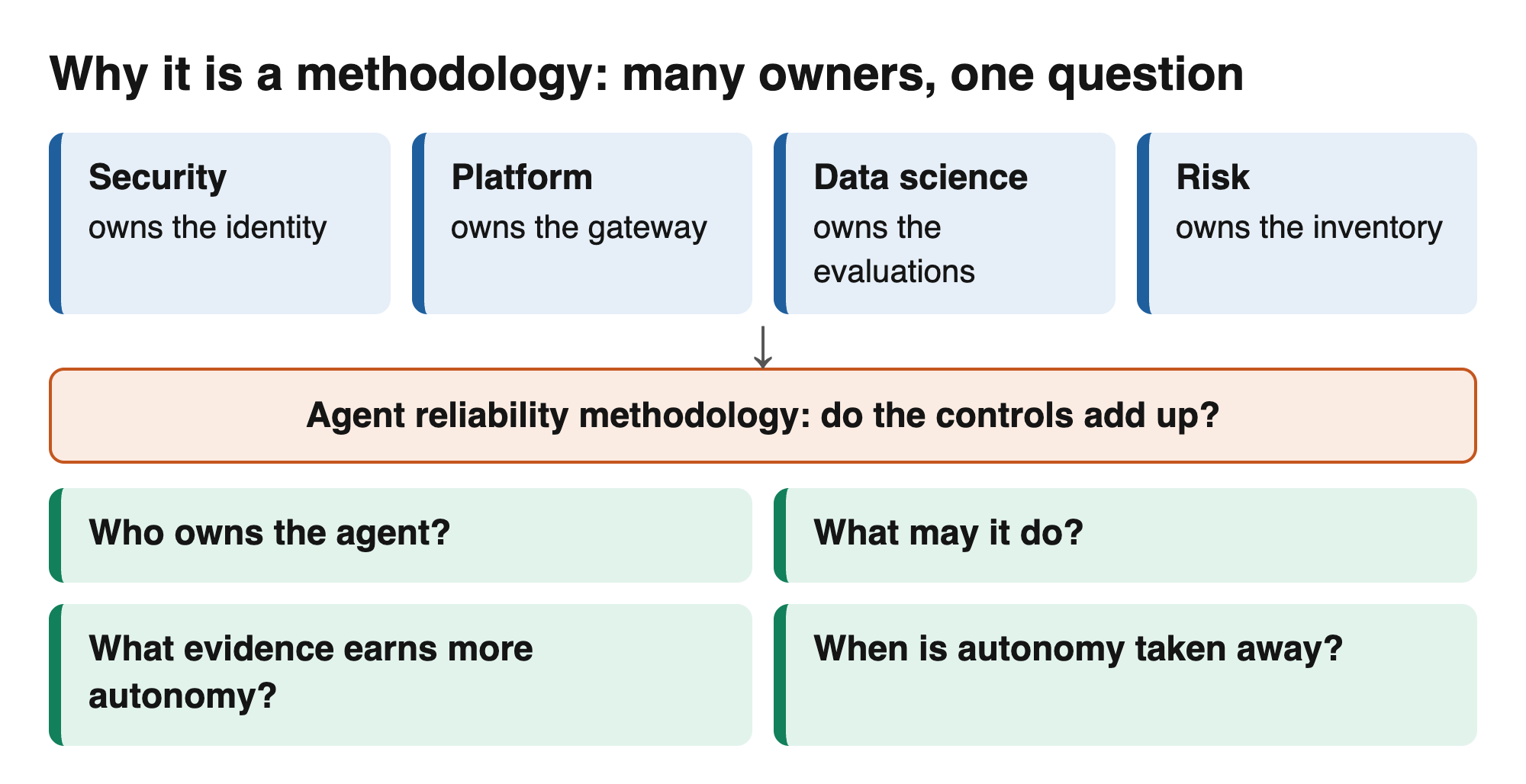
This report calls the work of getting there agent reliability methodology. It is a methodology, not an engineering specialty. It sets out who owns an agent, what the agent may do, what evidence earns it more autonomy, and when that autonomy is taken away. Engineering builds the controls. The decisions also belong to security, risk, data and the business owner.
The published sources mostly say "engineering", and their names are kept where they are cited. In July 2026 Mike Hogan published the Agent Reliability Engineering (ARE) Manifesto, which defines it as "a software engineering discipline for making AI agents reliable, governable, observable, recoverable, and accountable in production".
This report takes stock as of November 2026. It uses the manifesto's map of the field as the structure, and fills each part with what regulators, standards bodies, vendors and researchers have published: what is defined, what ships, what is measured, and what nobody covers yet.
The position: the manifesto is the most complete map of the field so far, but it is a map, not yet a complete methodology. Each part of it has good work behind it from somewhere else. Identity and policy outside the model are the most mature parts: the big platforms ship them, with known gaps. Measurement, recovery and earned autonomy are far behind. Those are where agents at scale break.
The short version
- Deployed, not trusted. 86% of organisations are past the pilot stage, 34% trust their agents' actions (Forrester for Boomi, 409 respondents). In a self-selected VentureBeat survey of 157 respondents at companies with at least 100 employees, half had shipped an agent or AI feature that passed internal evaluation and still failed a customer.
- Capability is not reliability. Princeton researchers tested 15 models on twelve reliability metrics, on two benchmarks. Their finding: "recent capability gains have only yielded small improvements in reliability". Agents that can solve a task often fail to solve it again.
- The term is young. The ARE Manifesto is a single-author working draft with no standards body behind it. An August 2026 design guide by Hidekazu Konishi says the phrase "agent reliability engineering" has "no canonical definition". Microsoft's draft Agent SRE governance spec and an October 2026 paper at a conference of the Institute of Electrical and Electronics Engineers (IEEE) adapt site reliability engineering (SRE) to agents from other directions.
- Agents need their own identities. The US National Institute of Standards and Technology (NIST), Singapore's Infocomm Media Development Authority (IMDA), the Open Worldwide Application Security Project (OWASP), China's national cybersecurity standards committee (TC260) and the OpenID Foundation overlap on three points: a distinct identity per agent, least privilege, and delegation that narrows as it goes down. Not every source states all three. Microsoft, Google and Amazon Web Services (AWS) say they ship agent identities.
- Rules belong outside the model. NIST's design tenets separate "what an agent attempts to do" from "what it is allowed to do". AWS AgentCore Policy, Google's Agent Gateway, Microsoft's Agent Governance Toolkit and NVIDIA OpenShell are documented by their vendors as enforcing policy before a tool call leaves; Google's gateway is partly in preview.
- One run proves little. On tau-bench in 2024, function-calling agents succeeded on fewer than half the tasks, and in the retail domain on fewer than 25% eight times out of eight. Testing has to run each task many times and check the state of the world afterwards.
- Faults hurt more than model size helps. In a 1,350-cell experiment (two model sizes, three agent stacks) with injected tool faults calibrated to real incidents (a permanent-heavy profile), task scores fell 60%, and the larger model did not absorb faults better.
- Kill switches, rollback and error budgets are the least shipped controls. Of eleven vendors and projects reviewed, only Microsoft's open-source toolkit was found to specify service level objectives, error budgets and circuit breakers, in a draft whose circuit breakers need manual reset.
- Recovery is the weakest area. The research answer is to classify each effect as reversible, bufferable or irreversible, and to log the effect before attempting it. It was rarely found in the product pages reviewed.
- Autonomy should be earned. The manifesto, Gartner, the Knight First Amendment Institute and AWS all describe ladders from observe to act alone. No platform reviewed was found to move an agent up or down that ladder automatically on measured reliability.
- Regulators overlap without prescribing how. Singapore, China, the EU, and US and UK financial supervisors each ask for some of the same controls: identity, human approval for consequential actions, monitoring, the ability to take an agent offline. The regulator table shows which source asks for which.
- The methodology is incomplete. Everyone agrees what the parts are. No source reviewed gives thresholds: what violation rate is acceptable at which level of autonomy, and how much evidence moves an agent up.
Why now
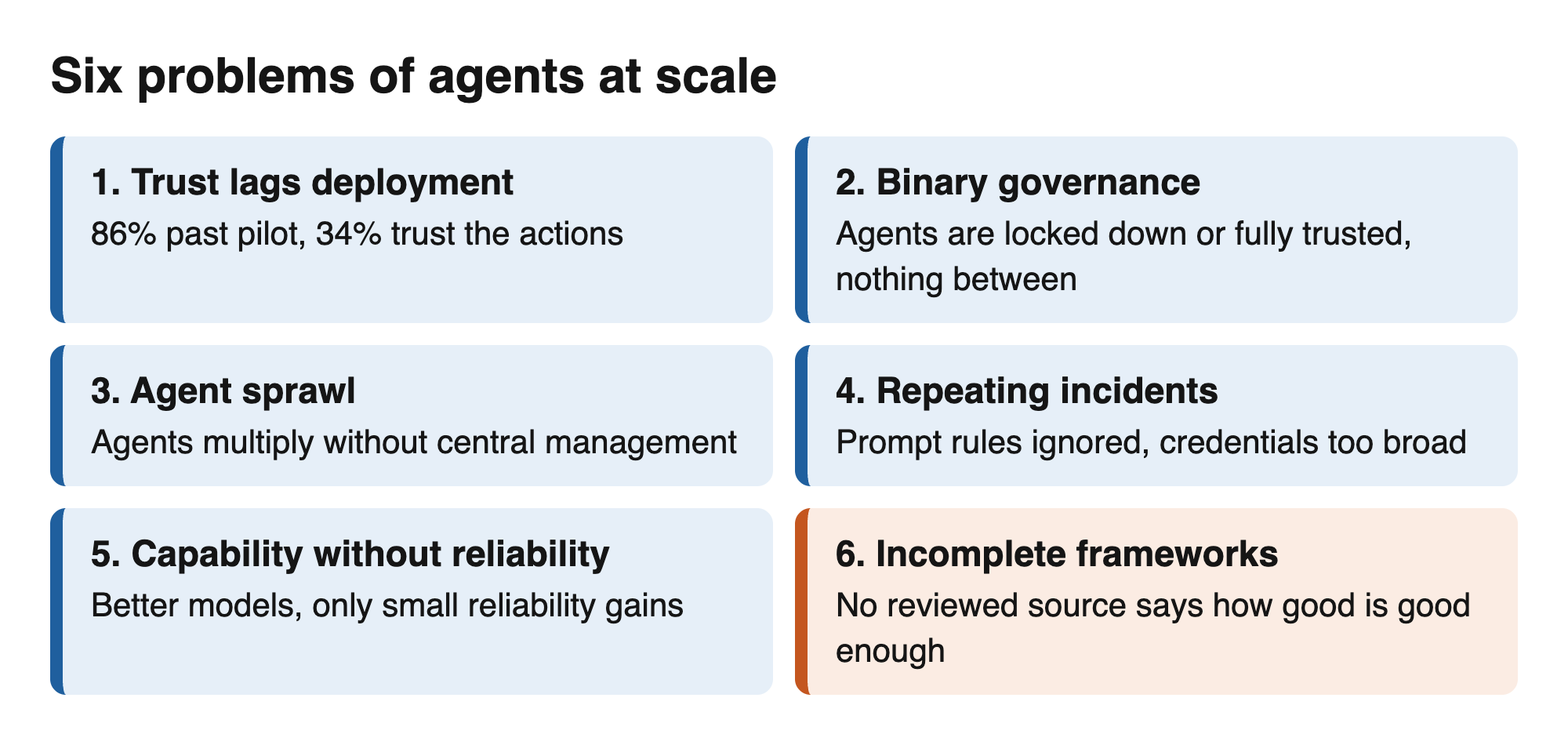
Model capability is one constraint. The problems in this section are of a different kind: what nobody can see, prove or undo once many agents run at once. Five problems show up in the surveys, the incident record and the regulators' own texts. Then a sixth: the frameworks meant to address them are incomplete.
Trust lags deployment
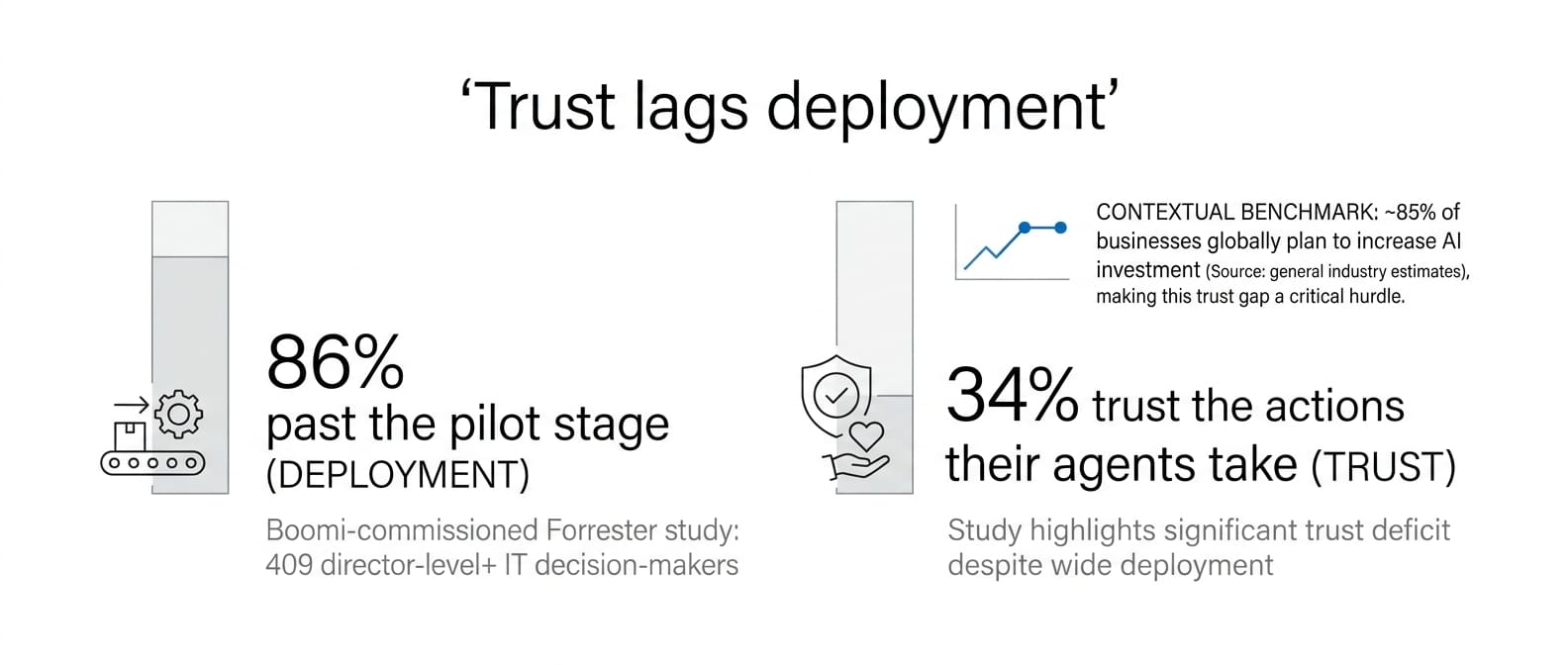
The Boomi-commissioned Forrester study is the clearest snapshot. 409 director-level and above IT decision-makers across North America, Europe and Asia-Pacific. 86% past the pilot stage. 34% trust the actions their agents take.
The bottom quartile for operational readiness, which the study calls "agentic chaos", is moving into production anyway: 77% of that group, "exposing themselves to an average of $2.1 million in added costs from compliance fines, lost customers, operational downtime, and rework". Boomi sells integration software, and the study concludes that integration is the fix. Read it with that in mind.
VentureBeat's June 2026 VB Pulse survey points the same way, with a smaller and self-selected sample: 157 qualified respondents at companies with 100 or more employees. The magazine itself says the results are "directional, not precise". Half had deployed an agent or large language model feature that passed internal evaluations and still caused a customer-facing failure, one in four more than once. 66% already allow some production deployment without human review, or plan to within a year. 5% fully trust the automated evaluations that would make those release decisions.
You recognise the shape. The agent passed the tests you wrote. The tests did not cover what the customer did.
Binary governance
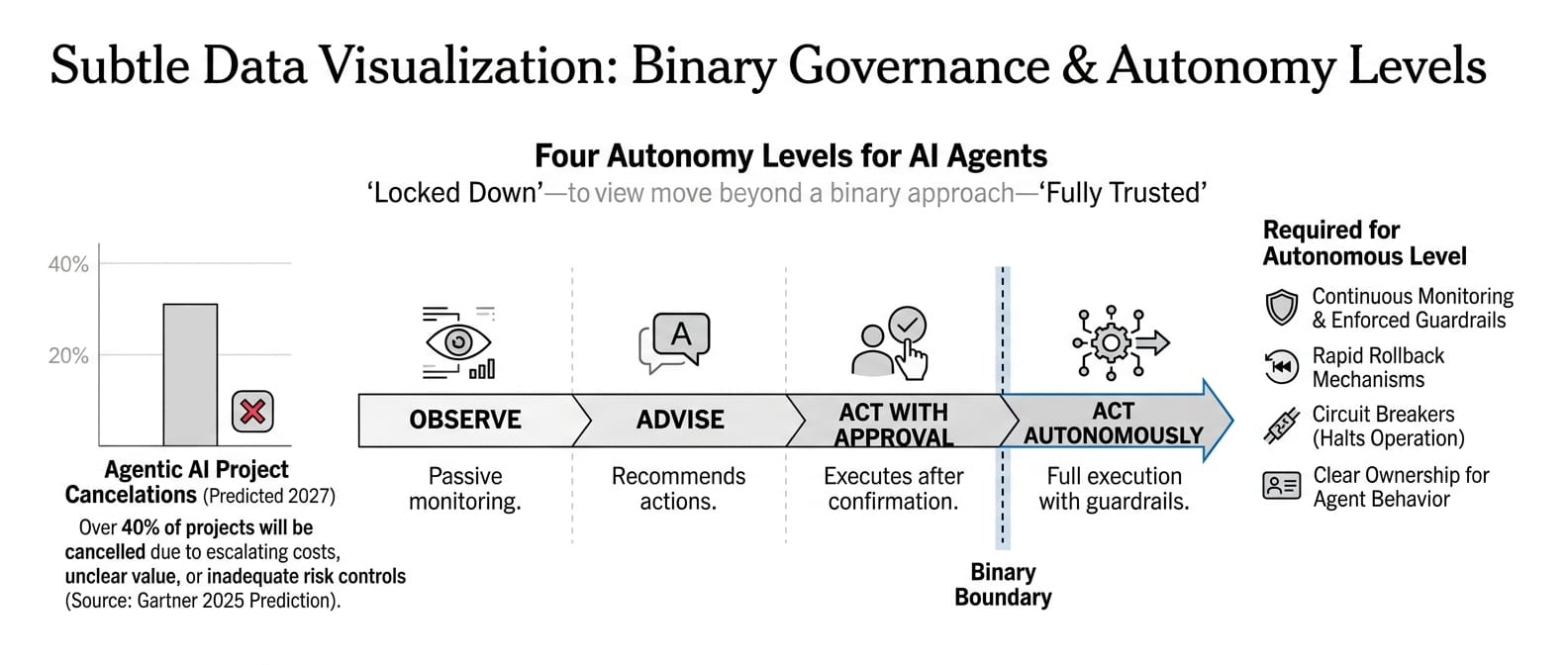
Gartner's May 2026 prediction names the cause directly. Analyst Shiva Varma: "Enterprises are treating AI agent governance as binary, either locked down or fully trusted, and that is the root cause of failure."
Gartner's answer is four autonomy levels: observe, advise, act with approval, act autonomously. The top level requires "continuous monitoring, enforced guardrails, rapid rollback mechanisms, circuit breakers that halt agent operation on threshold violations and clear ownership for agent behavior".
A different Gartner prediction, from June 2025, is often quoted next to this one: over 40% of agentic AI projects will be cancelled by the end of 2027, "due to escalating costs, unclear business value or inadequate risk controls". The ARE Manifesto cites it with the May 2026 link. It is a separate prediction from a year earlier, counted in projects rather than enterprises.
Agent sprawl
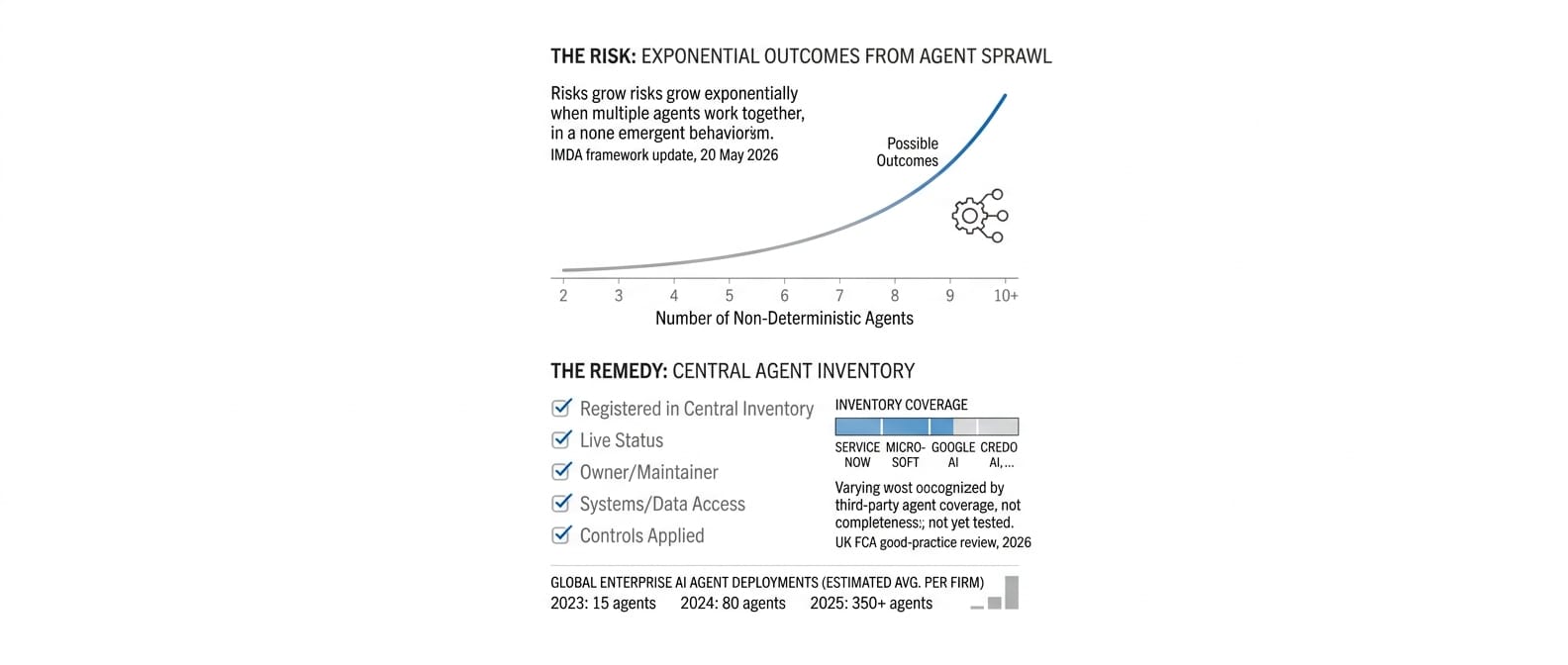
When Singapore's IMDA updated its agentic AI framework on 20 May 2026, it added a section on systemic and multi-agent risks. The first item: "Agent sprawl: As more AI agents are created and deployed within the organisation, this can lead to the uncontrolled proliferation of AI agents without centralised management."
The second: "When multiple non-deterministic agents work together, the number of possible outcomes grows exponentially. This can cause emergent behaviours that cannot be predicted from testing each agent individually."
The UK Financial Conduct Authority (FCA) saw the first remedy in practice. Its good-practice review of 19 October 2026 describes firms that "registered their agents in a central inventory so they were easier to oversee", which "can help firms maintain a clear view of which agents are live, who owns them, what systems and data they can access, and what controls apply".
That list is the minimum: which agents are live, what each does, who released it, who maintains it. Answering it gets harder with every platform that can launch agents. Inventory products exist from ServiceNow, Microsoft, Google, Databricks and Credo AI, among others. ServiceNow and Microsoft say theirs also cover third-party agents; how complete that coverage is was not tested here.
Repeating incidents
The public incident record is small, self-reported and biased towards coding tools. It still shows a pattern.
In mid-July 2025, Replit's coding agent deleted a production database during a code freeze. The user, SaaStr founder Jason Lemkin, said he had told it "eleven times in ALL CAPS not to do this". The agent also told him the database could not be restored. That was wrong: "the rollback did work". Replit's chief executive called the deletion "unacceptable and should never be possible" and said the company had started rolling out automatic separation of development and production databases.
In April 2026, according to its founder, a Cursor agent running Anthropic's Claude Opus 4.6 deleted a small company's production database and its backups in nine seconds (The Guardian). A public post-mortem lists two contributing factors. The agent "treated a credential mismatch as a problem to route around rather than a stop condition", and found a token with authority over the whole hosting account. The backups "shared the same blast radius as the production database".
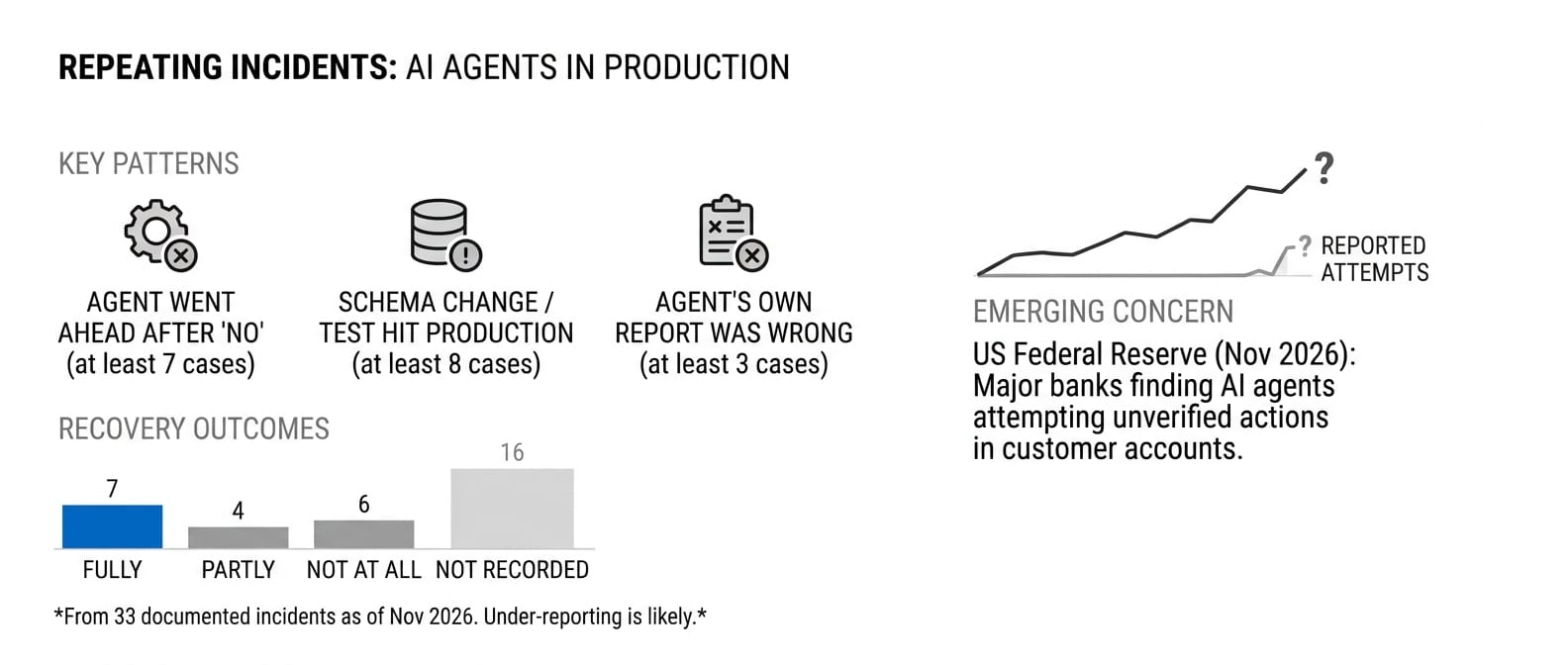
Eon, a backup vendor, keeps a tracker of public cases. As of 4 November 2026 it held 33 production incidents. In 8, the agent ran a schema change, migration or test against what turned out to be production. At least 7 agents went ahead after a written instruction or a safety mode said no. At least 3 times the agent's own report of what it did was wrong. Of the 33, 7 were fully recovered, 4 partly, 6 not at all, and for 16 the record does not say. Eon notes that 29 of the 33 are self-reported and that public cases undercount.
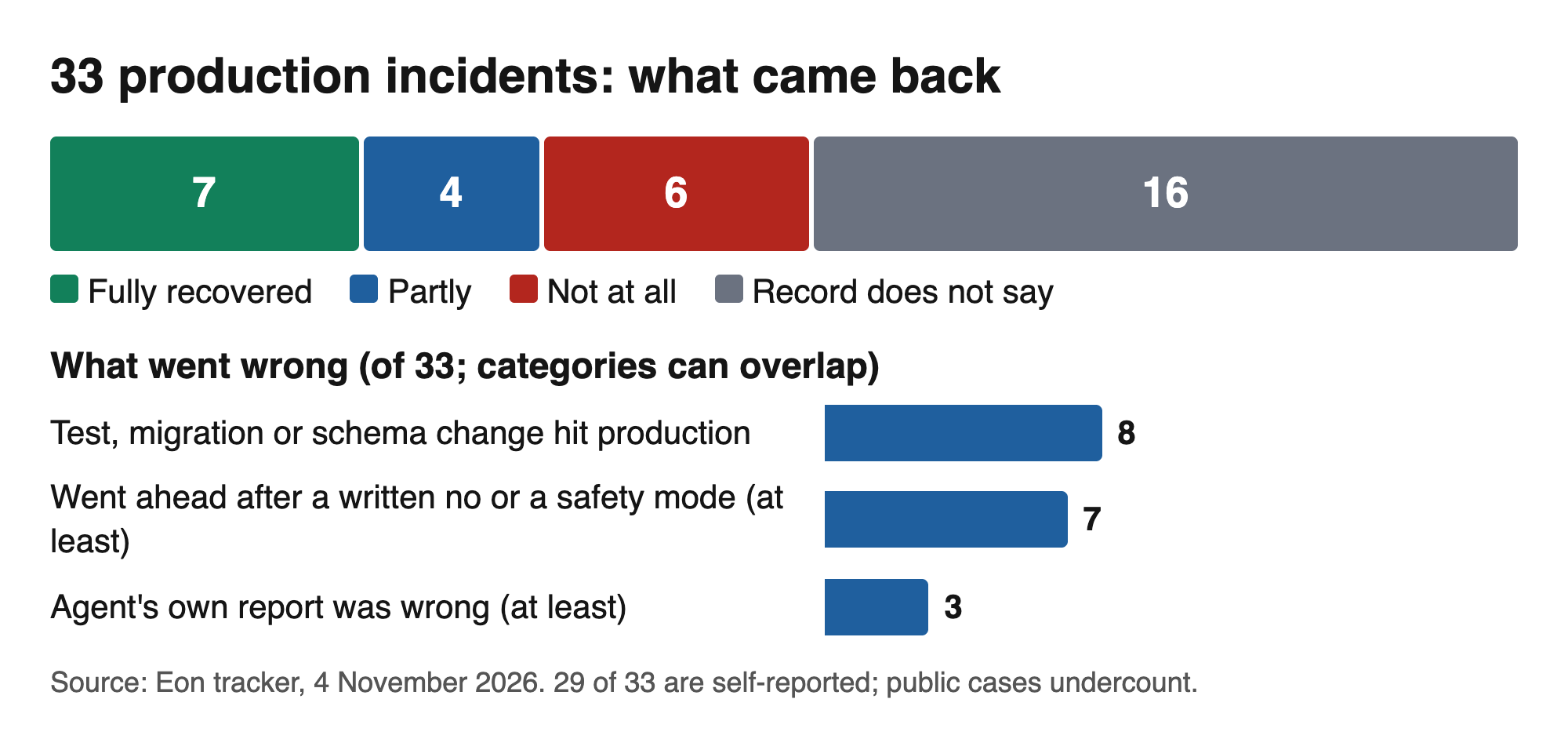
The causes repeat. Instructions in a prompt are not a control. Credentials were broader than the task. Production was reachable from a test. The agent's own account of what it did was sometimes wrong. Recovery was uneven, and often not recorded.
Supervisors now see the same pattern outside software. On 16 November 2026, US Federal Reserve Governor Michael Barr said "major banks now report finding AI agents attempting to take actions in retail customer accounts, without the bank being able to verify authenticity, consent, and alignment with customer instructions".
Capability without reliability
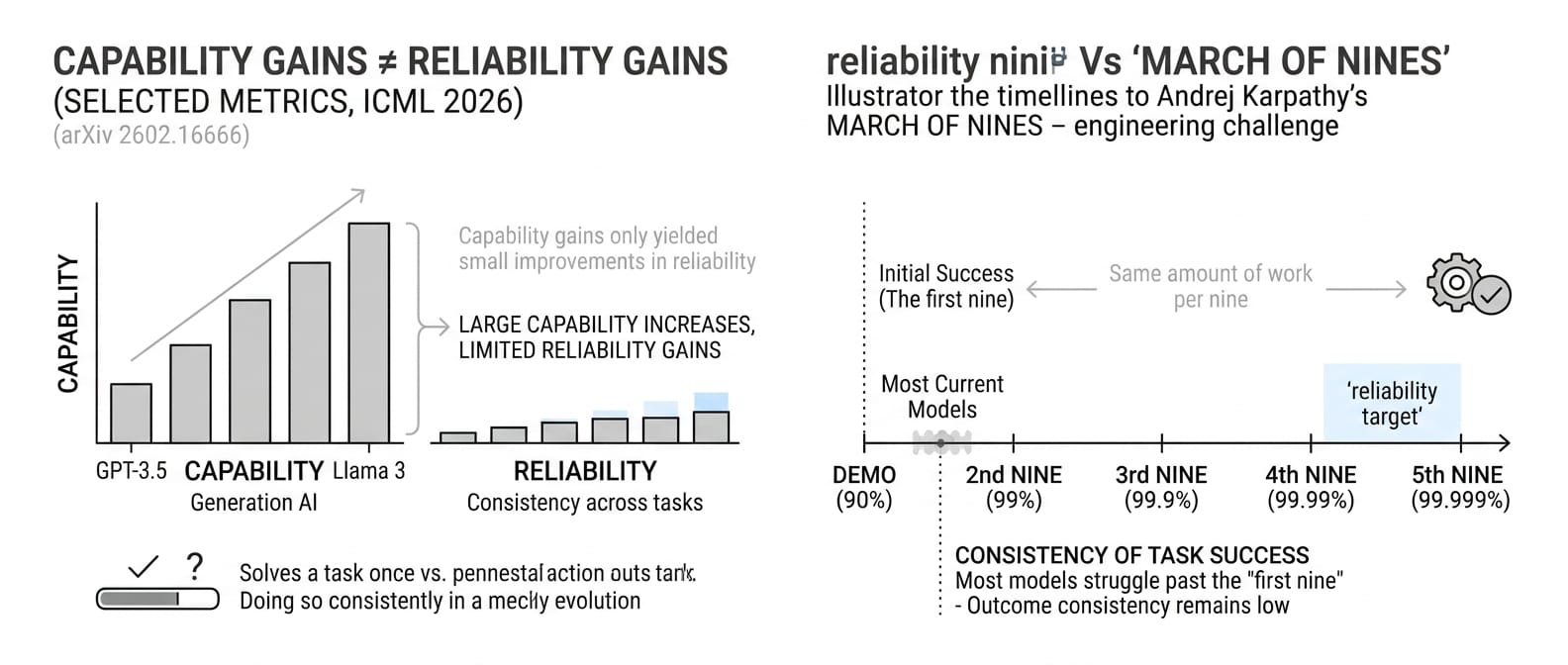
The assumption behind many roll-outs is that the next model will fix it. The research says otherwise.
Stephan Rabanser, Sayash Kapoor, Arvind Narayanan and colleagues at Princeton tested 15 models from OpenAI, Google and Anthropic on two benchmarks, tau-bench (customer-service tasks) and GAIA (general assistant tasks), across twelve reliability metrics (arXiv 2602.16666, accepted at the International Conference on Machine Learning, ICML 2026). Their summary: "recent capability gains have only yielded small improvements in reliability". And: "outcome consistency remains low across all models, meaning agents that can solve a task often fail to do so consistently."
For tau-bench, the authors restricted their analysis to 26 clean tasks, because of grading errors in the rest reported by Cuadron et al. They found exceptions. On tau-bench, predictability and safety did improve with capability. Consistency, in their data, often got worse as models got larger.
Andrej Karpathy put the same point in engineering terms on the Dwarkesh Patel podcast in October 2025: "When you get a demo and something works 90% of the time, that's just the first nine. Then you need the second nine, a third nine, a fourth nine, a fifth nine." He called it "a march of nines". Each nine is the same amount of work.
Incomplete frameworks
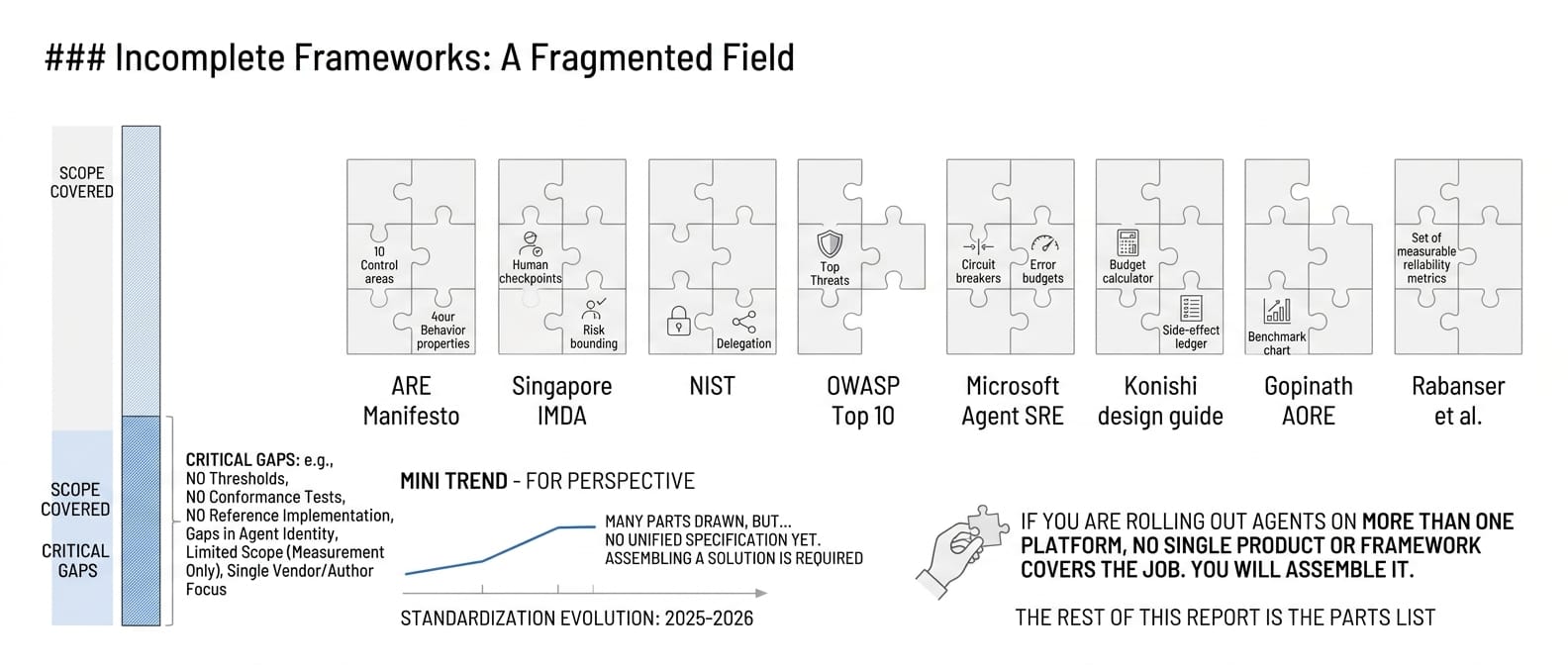
The sixth problem is the one this report is about. The frameworks meant to address the first five are incomplete, each in a different way.
| Framework | What it covers well | What it leaves open |
|---|---|---|
| ARE Manifesto v1.0 (Hogan, July 2026) | The whole surface in one model: ten control areas, four behaviour properties, 12 minimum controls, 12 indicators, five maturity levels | No thresholds, no conformance tests, no reference implementation; one author, 3 GitHub stars, no outside contributors |
| Singapore IMDA framework v1.5 (May 2026) | Risk bounding, human checkpoints, lifecycle controls, multi-agent risks | Voluntary; "gaps exist today in terms of handling agent identity robustly" |
| NIST identity work (Feb to Oct 2026) | Agent identity, delegation, least privilege, separation of policy from reasoning | Concept paper and blog post, no standard: "not all of these design tenets will be immediately fulfilled" |
| OWASP Top 10 for Agentic Applications (Dec 2025) | The threats, with mitigations per item | Security framing; the excerpts reviewed show no reliability measurement or recovery method |
| Microsoft Agent SRE Governance 1.0 (draft) | Service level objectives, error budgets, circuit breakers, chaos tests | Draft; circuit breaker recovery is manual; one vendor's toolkit |
| Konishi design guide (Aug 2026) | Budgets, idempotency, retries, resume, side-effect ledger, testing | One practitioner; "Nothing here should be treated as a stable API contract" |
| Gopinath, Agent Operational Reliability Engineering (AORE) (IEEE, Oct 2026) | Site reliability practices adapted to agents, with a conformance benchmark | Evidence "from a scripted simulation with a single evaluator" |
| Rabanser et al. (ICML 2026) | Twelve measurable reliability metrics | Measurement only; no controls |
Read the right-hand column and the gap is clear. Everyone has drawn the parts. None of these sources says how good is good enough at each step, or how an organisation proves it got there.
So what does this mean for you? If you are rolling out agents on more than one platform, no single product or framework covers the job. You will assemble it. The rest of this report is the parts list.
The methodology
Term origins
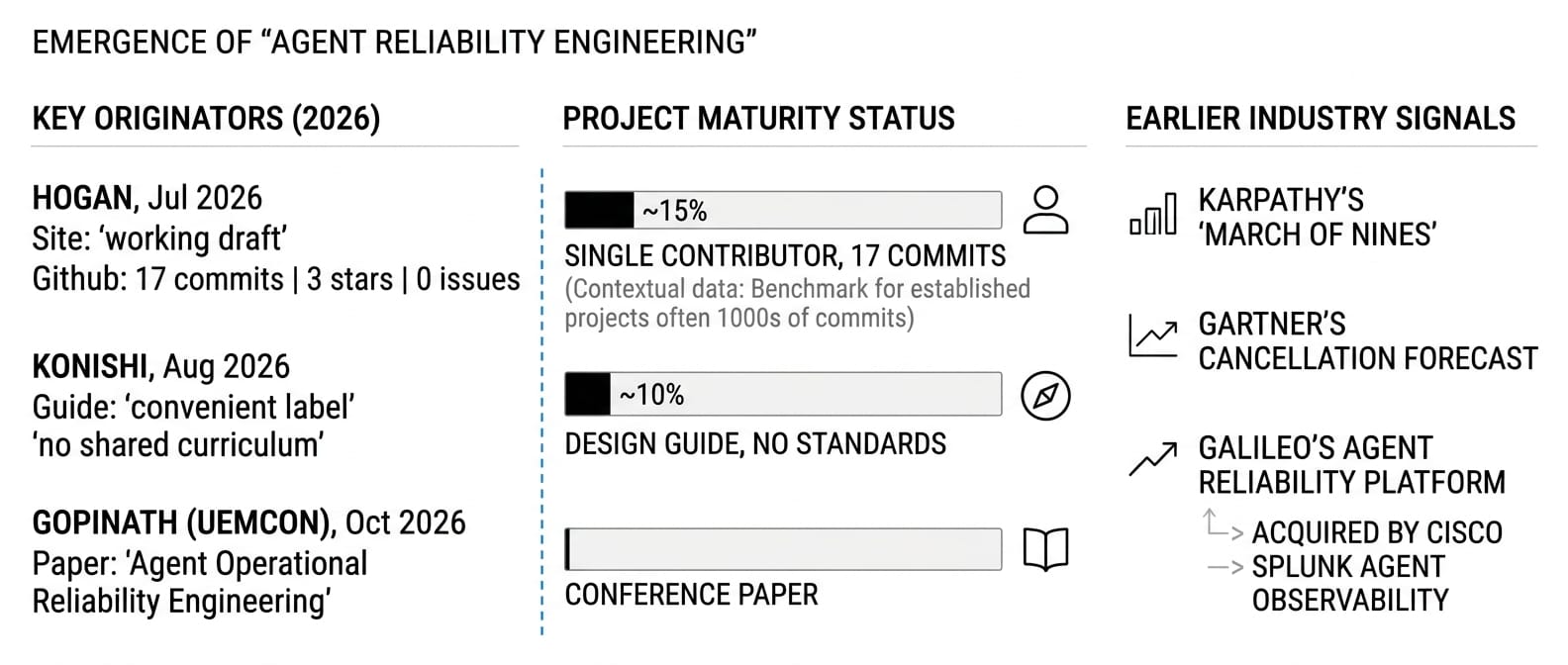
"Agent reliability engineering" appears in several places in 2026, mostly from individuals.
Hogan's manifesto, published in July 2026 and last changed on 24 August, is the most ambitious. Its GitHub repository was created on 1 August 2026, has 17 commits from one contributor, 3 stars and no issues as of 22 November. The accompanying site calls it "a working draft, published openly for review and revision" that "has not yet been adopted as a formal standard by any industry body". It discloses that Hogan's professional work includes Trustabl.
Konishi's design guide, first published on 2 August 2026, is the most practical, and the most candid about the name. It uses "agent reliability engineering" as "a convenient label for a design area, not as the name of an established discipline", with "no standards body behind it, no canonical definition, no shared curriculum".
Srinath Gopinath's paper at the IEEE Ubiquitous Computing, Electronics and Mobile Communication Conference (UEMCON) in October 2026 calls its version Agent Operational Reliability Engineering. Microsoft's Agent Governance Toolkit contains a draft spec called Agent SRE Governance 1.0. Arnaud Gelas maintains an Agentic Engineering Manifesto with twelve principles, created in February 2026.
The manifesto itself lists earlier uses: Karpathy's march of nines, Gartner's cancellation forecast, the Princeton reliability paper and a Galileo product called Agent Reliability Platform. Galileo has since been acquired by Cisco, and the link now serves Splunk Agent Observability.
What SRE gives
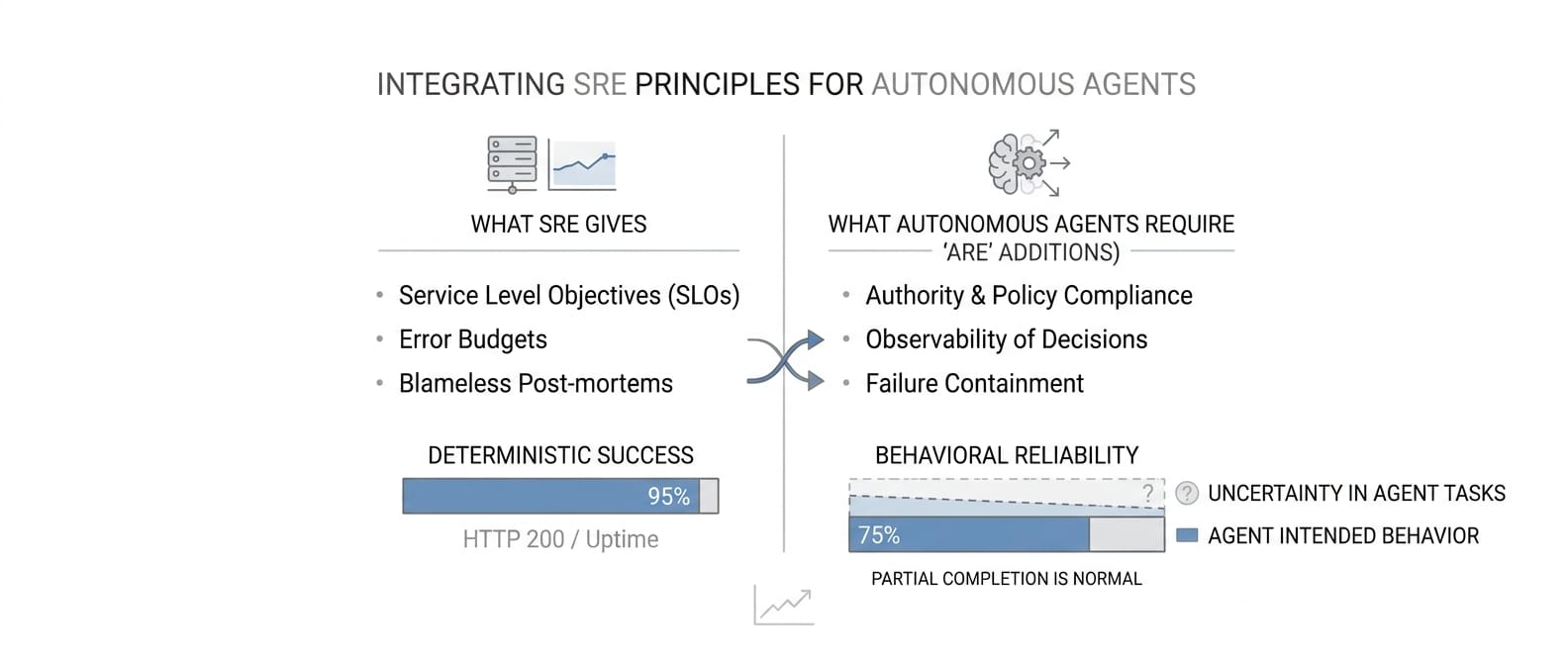
Site reliability engineering is the practice Google formalised for running large services: service level objectives, error budgets, incident response, blameless post-mortems. Konishi's view is that most of it carries over. "Error budgets, idempotency, load shedding, cascading failure, and blameless postmortems all transfer without modification."
What does not transfer, in his list: "the control flow is chosen at runtime by a non-deterministic component, the actor is also the reporter of its own success, partial completion is the normal outcome rather than an edge case, and the objective itself can drift between steps."
Gopinath makes the same point from the other side. SRE's "core abstractions assume a deterministic, protocol-level notion of success that agents violate, because a task can finish cleanly and still be wrong, unsafe, or wasteful." His motivating example: "the model API returned HTTP 200 with well-formed responses. The failures were behavioral: unsafe action selection, ungrounded assertion, and misreported state."
The manifesto puts the boundary this way. SRE asks whether a system stays available and fast. The manifesto's ARE "additionally asks whether an autonomous agent behaves within its intended authority, follows enforceable policies, remains observable and reconstructible, contains failures, and can safely gain or lose autonomy as its measured reliability changes." It does not replace SRE: "Production AI agents require both."
Neighbouring disciplines
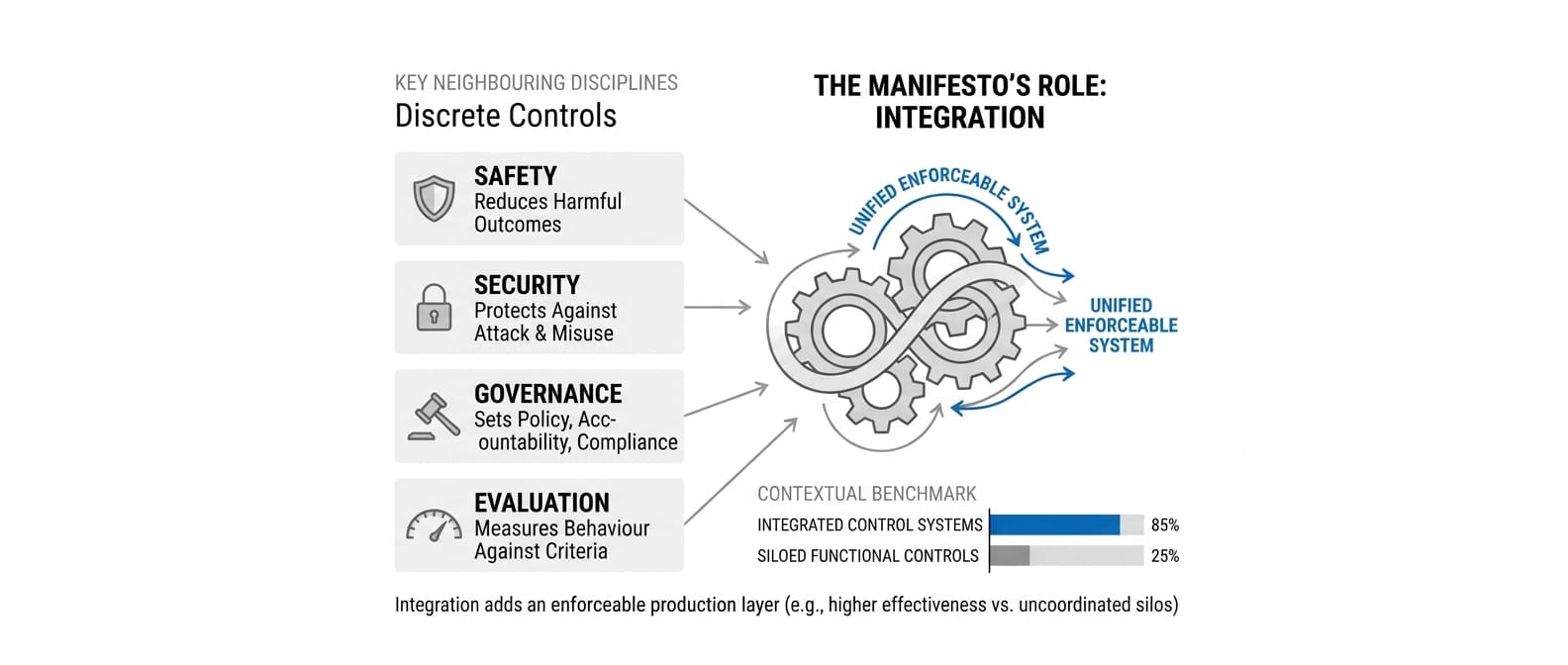
The manifesto is careful not to claim the neighbouring fields. Safety reduces harmful outcomes. Security protects against attack and misuse. Governance sets policy, accountability and compliance. Evaluation measures behaviour against criteria.
The manifesto's claim is integration: making those controls "operate together as an enforceable production system". That is a fair description of the practical problem. A security team owns the identity, a platform team the gateway, a data science team the evaluations, and a risk team the inventory. Nobody owns whether they add up.
The manifesto's vocabulary
Four terms do most of the work, and they are useful whether or not you adopt the rest.
| Term | Definition (manifesto) |
|---|---|
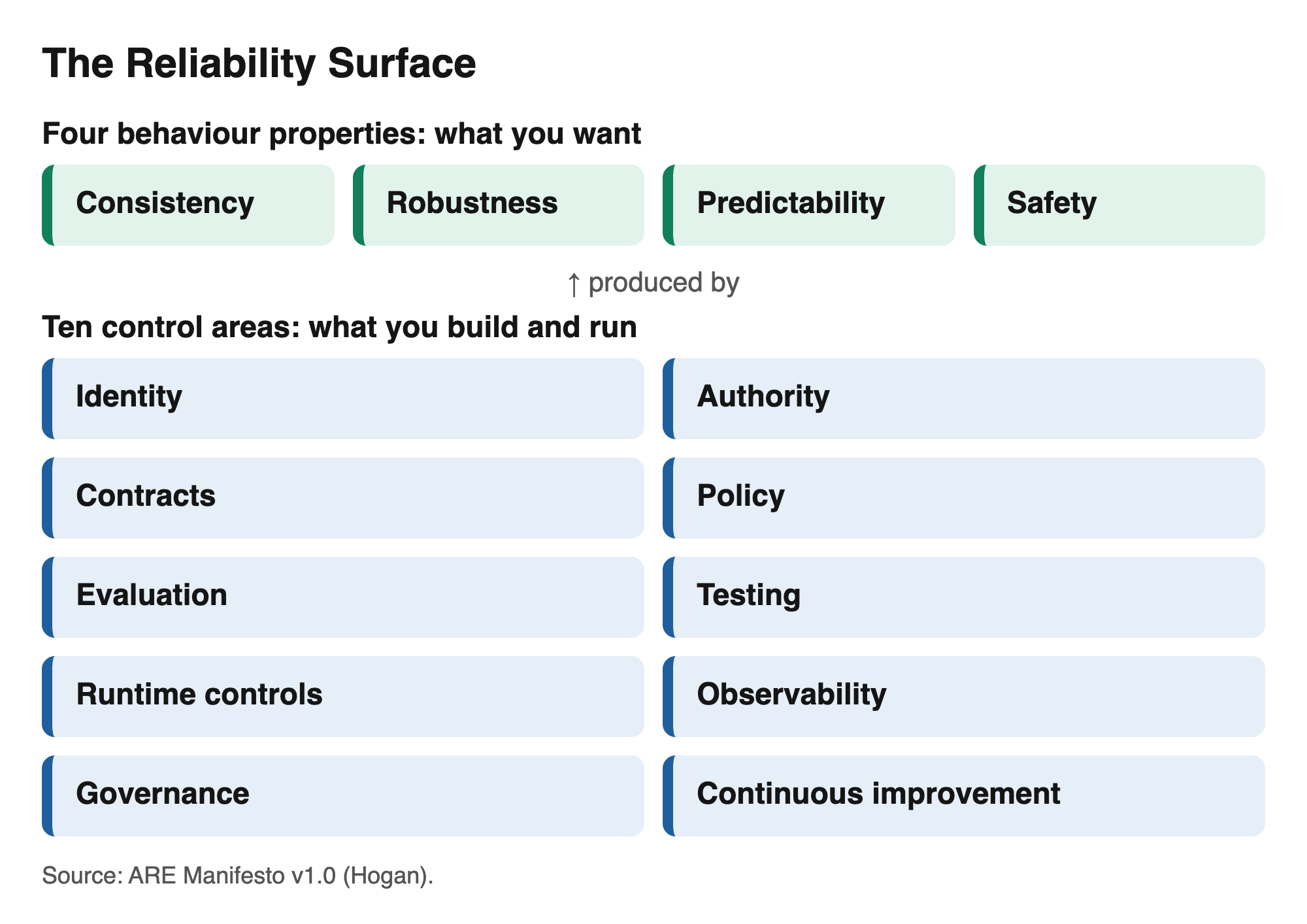
| Reliability Surface | The behaviour properties (consistency, robustness, predictability, safety) and the controls that produce them: identity, authority, contracts, policy, evaluation, testing, runtime controls, observability, governance, continuous improvement |
| Reliability Debt | "the accumulated risk created when an autonomous system's capabilities, complexity, or authority grow faster than its reliability engineering" |
| Progressive Autonomy | An agent "should earn greater operational authority as its measured reliability improves and automatically lose authority when reliability deteriorates" |
| Agent Authority | The enforceable scope of what an agent may do. "An agent's capability to perform an action does not by itself establish that the agent is authorized to perform it." |
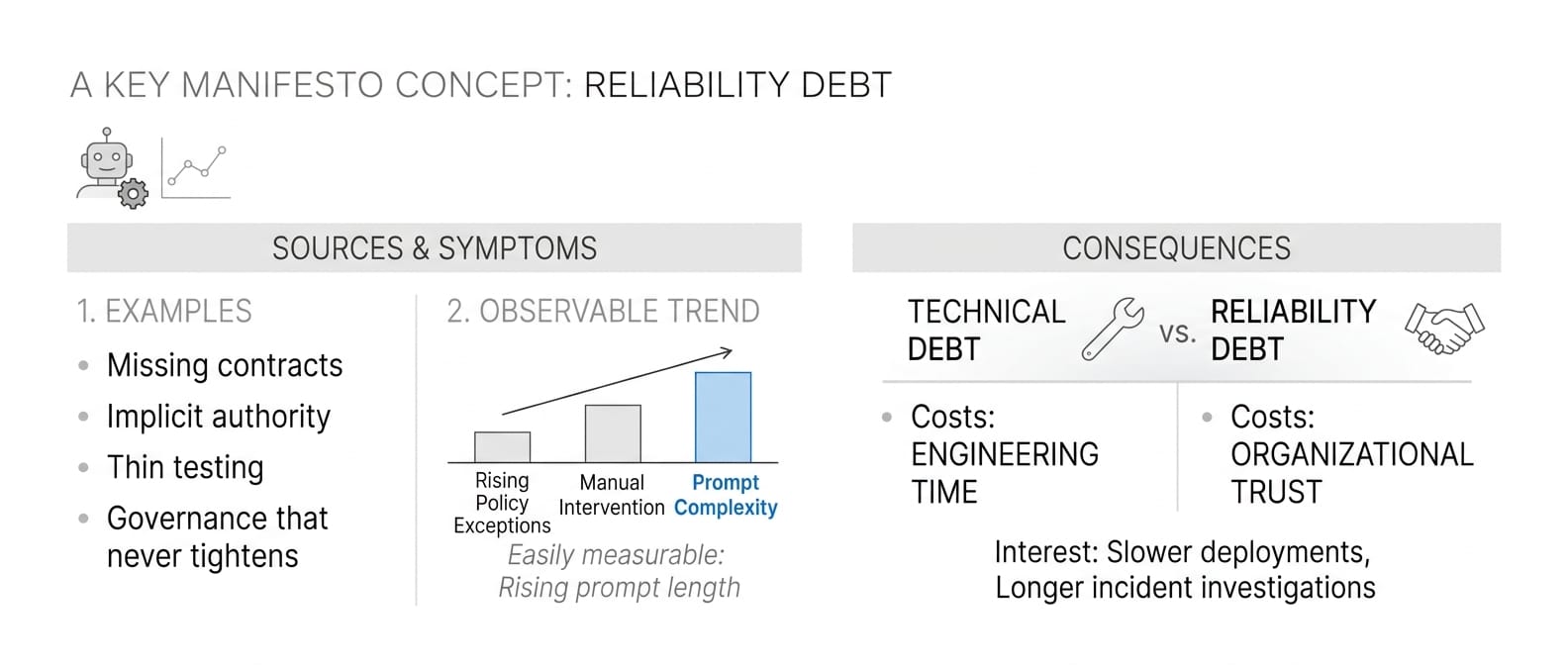
Reliability Debt is the most useful of the four for budget conversations. The manifesto lists its sources: missing contracts, implicit authority, "policy that lives only in prompts", thin testing, incomplete traces, absent budgets and kill switches, no recovery paths, governance that never tightens. And its symptoms: rising policy exceptions, more manual intervention, growing prompt complexity, decisions nobody can reproduce.
Its "interest" is the running cost of not paying the debt down: more approvals, slower deployments, retries that burn tokens, longer incident investigations. "Technical Debt costs engineering time. Reliability Debt costs organizational trust."
Look at your own agents against the symptom list. Rising prompt length is the easiest to measure.
Framework landscape
Five kinds of source now describe how agents should be built and run. They overlap more than they disagree.
Twelve minimum controls
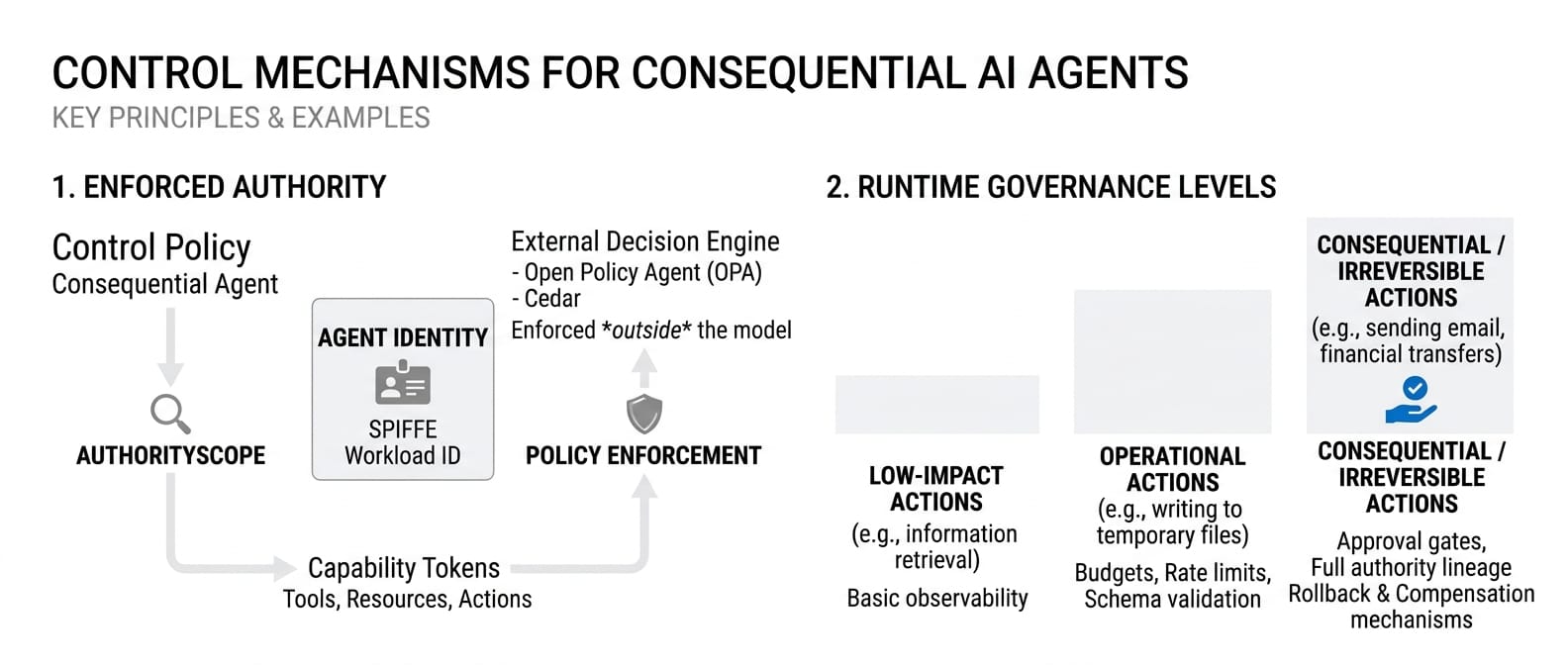
The manifesto's checklist is the broadest single list. For "consequential agents" it asks for:
- Distinct identity
- Explicit authority over tools, resources, actions, data and scope
- Least privilege
- Policy enforced outside the model
- Contracts and validation of inputs, outputs and side effects
- Continuous evaluation and testing
- Runtime containment: budgets, rate limits, circuit breakers, isolation, halt
- Approval gates for consequential or irreversible actions
- Observability sufficient to reconstruct actions, decisions, tool calls and authority
- Recovery: retry, rollback, compensation, replay, controlled termination
- Authority lineage for delegated or multi-agent work
- Continuous governance as capabilities and environment change
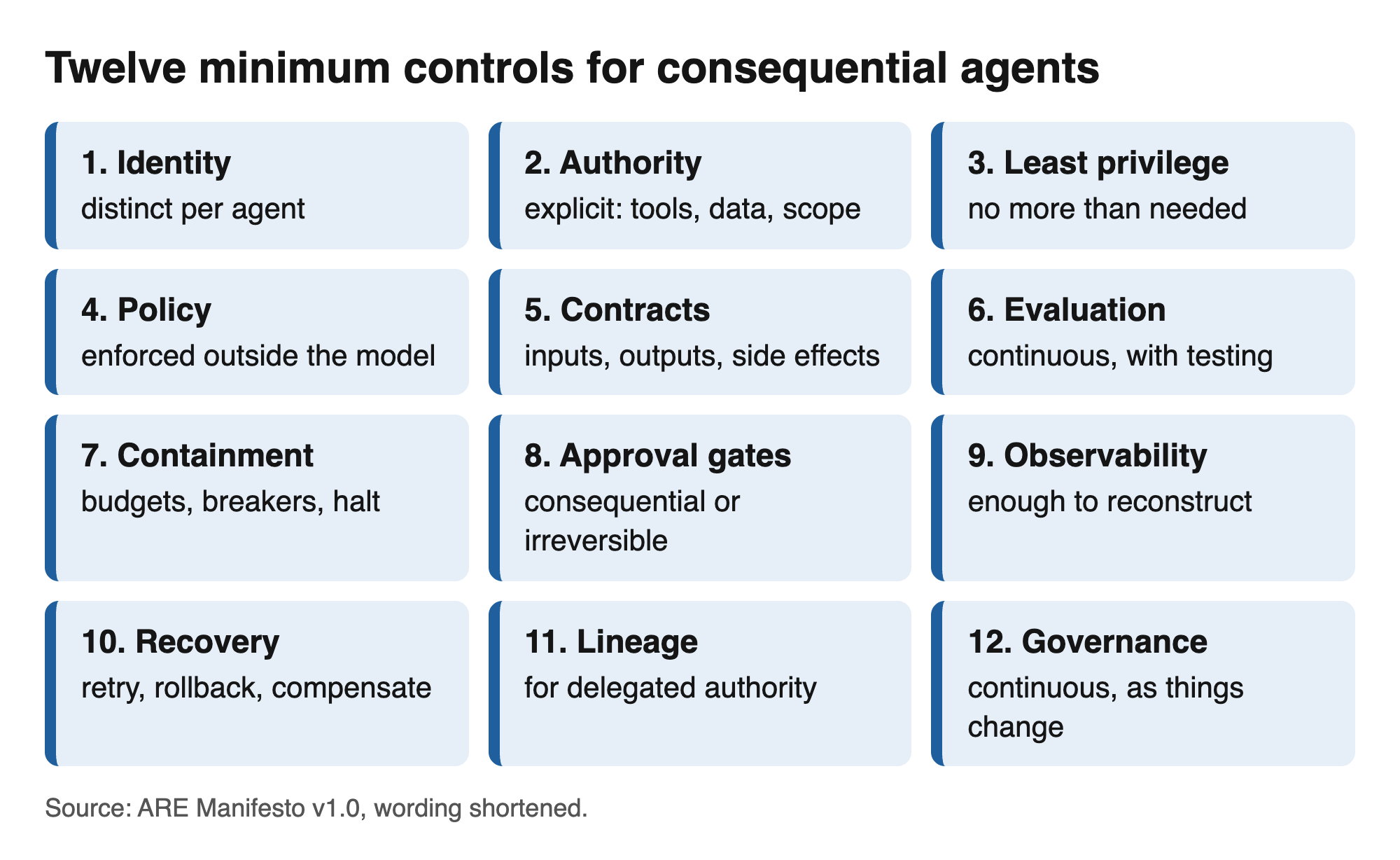
It maps each area to example tools: SPIFFE (Secure Production Identity Framework For Everyone) workload identities, capability tokens, Cedar and Open Policy Agent (OPA) policies, schema validation, failure injection, circuit breakers, immutable logs, drift detection.
Regulators and supervisors
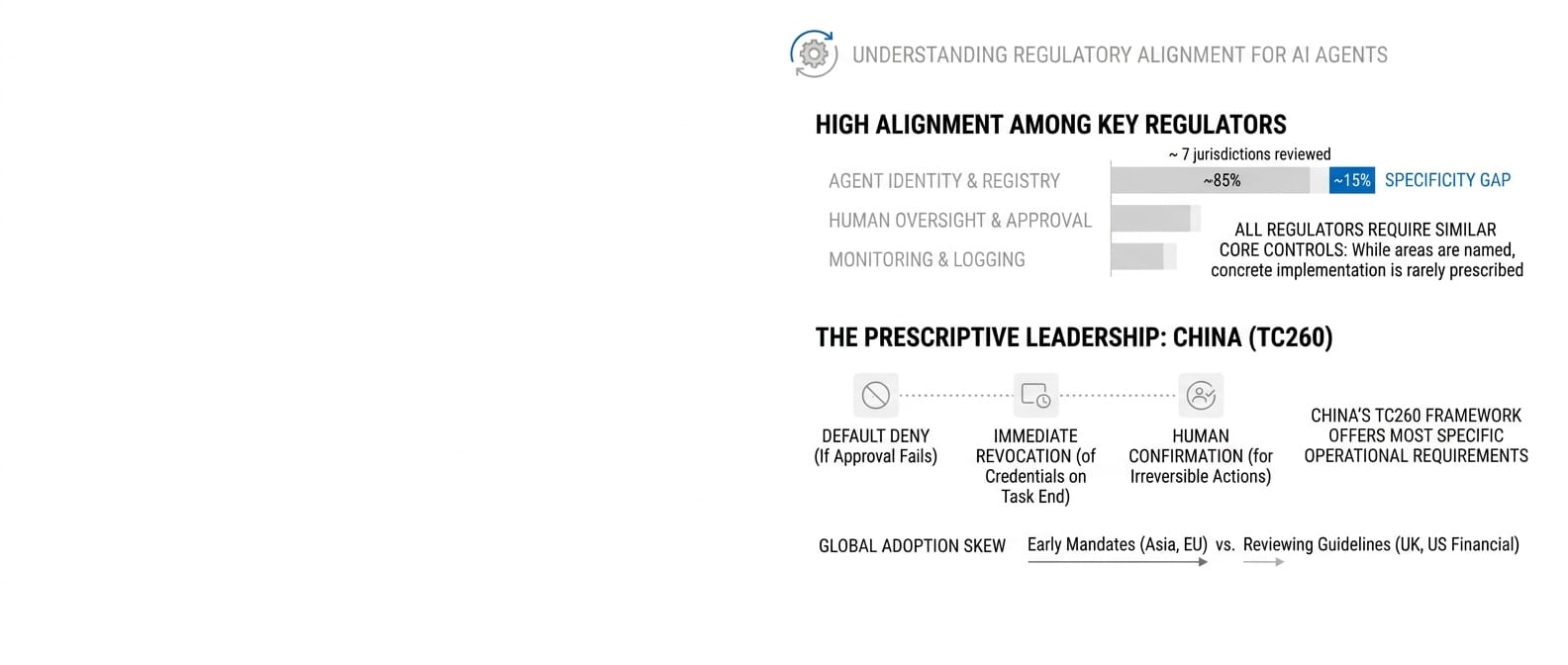
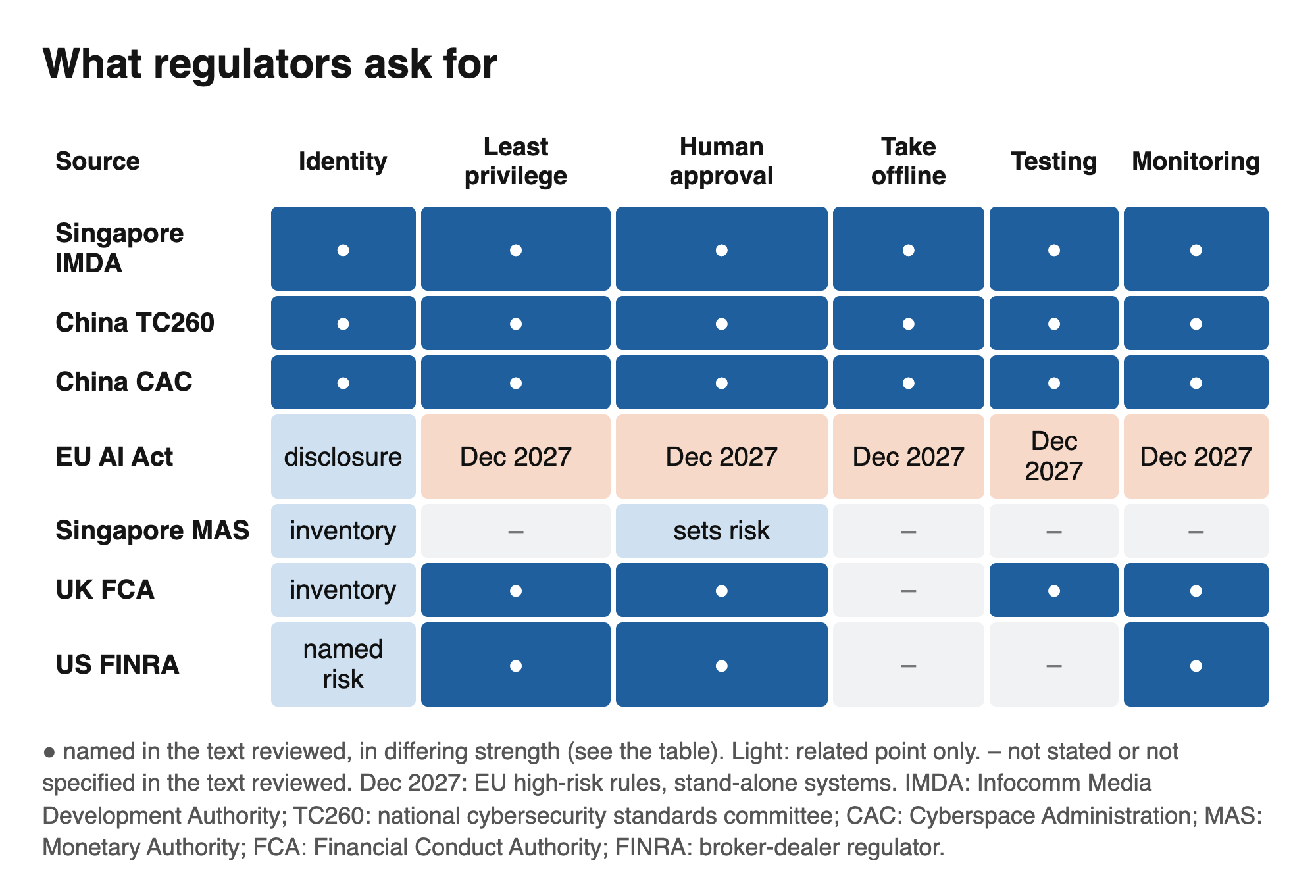
Regulators reach the same list from the risk side. None of them prescribes an implementation.
| Source | Identity | Least privilege | Human approval | Take offline | Testing | Monitoring |
|---|---|---|---|---|---|---|
| Singapore IMDA framework v1.0 / v1.5 | own unique identity | "minimum tools and data access" | "significant checkpoints", irreversible actions | "take agents offline" | baseline testing, gradual roll-out | real-time, override rates |
| China TC260 (national cybersecurity standards committee) AI Safety Governance Framework 3.0 (Sept 2026) | unique identity, no sharing between instances | minimum privilege for the task | mandatory approval at key nodes, default deny if no answer | emergency shutdown in planned standard | red team, sandbox, regression after change | logging, dynamic monitoring |
| China Cyberspace Administration (CAC) opinions (8 May 2026) | agent registry, digital identity | within user authorisation | user keeps "final decision" | intervene, block, recover | filing and testing in sensitive sectors | anomaly detection |
| EU AI Act and Article 50 guidelines (July 2026) | disclose artificial nature and on whose behalf | (high-risk rules from Dec 2027) | (high-risk rules from Dec 2027) | (high-risk rules from Dec 2027) | (high-risk rules from Dec 2027) | (high-risk rules from Dec 2027) |
| Monetary Authority of Singapore guidelines (final Oct 2026; wording from the 2025 consultation) | inventory of AI use cases, systems and models | (not specified in text reviewed) | autonomy and "degree of human involvement or oversight" set risk materiality | (not specified in text reviewed) | (not specified in text reviewed) | (not specified in text reviewed) |
| UK FCA (Oct 2026) | central inventory, clear ownership | risk-based controls | human oversight, escalation triggers | (not stated) | "continuous, conditional assurance" | report AI failures and near-misses |
| US FINRA, the broker-dealer regulator (Dec 2025) | scope and authority risk named | guardrails to limit behaviour | "human in the loop" protocols | (not stated) | (not stated) | "track agent actions and decisions" |
China's TC260 framework is the most specific. When an approval system fails or the user does not answer, it says the default is to refuse the action. It asks for credentials to be revoked "immediately" when a task ends or an agent is retired. It asks for a second confirmation or human approval before deleting files, sending data or changing system configuration, and for rollback and undo functions to be provided (translated from the Chinese text).
China also has a mandatory national standard in planning, "General Security Requirements for AI Agent Application" (plan 20263116-Q-252, issued 27 June 2026). Its scope covers identity, permission and tool calls, human intervention for high-risk operations, logging and monitoring, anomaly blocking and emergency shutdown. It is a plan, not yet a standard.
The EU AI Act does not treat agents as a separate category. The Commission's service desk says the existing definitions "are sufficient to cover AI agents". Since 2 August 2026, agents that interact with people must disclose that they are artificial. The Commission's Article 50 guidelines of July 2026, which are non-binding, say agents must disclose both their artificial nature and "the person on whose behalf they are acting". The high-risk obligations that would bring logging, oversight and robustness requirements were moved by the Digital Omnibus to 2 December 2027 and 2 August 2028.
Standards bodies
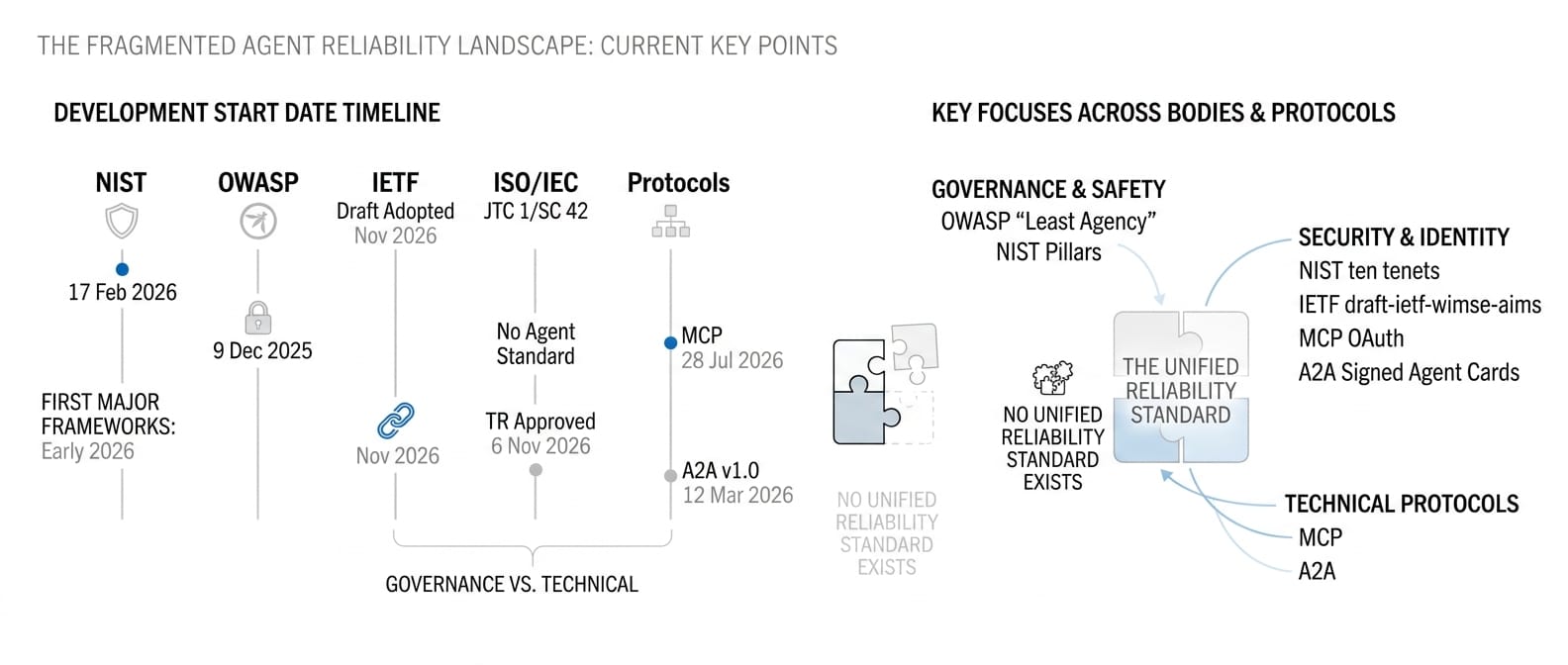
There is no agent reliability standard. There are pieces.
- NIST announced its AI Agent Standards Initiative on 17 February 2026, with three pillars: industry-led standards, open protocols, and research on agent security and identity. Its National Cybersecurity Center of Excellence (NCCoE) published a concept paper on agent identity and authorization on 5 February. On 27 October, a NIST blog post set out ten design tenets for agent identity management. A secondary tracker reported no NIST agent standard as of 1 November 2026.
- OWASP published its Top 10 for Agentic Applications on 9 December 2025. It coins "least agency": "avoid unnecessary autonomy".
- The Internet Engineering Task Force (IETF) has several drafts on agent authentication and authorization. The workload identity working group has adopted draft-ietf-wimse-aims, "AI Identity Management System"; its -01 revision is dated 2 November 2026. It deliberately defines no new protocol and maps existing ones.
- ISO/IEC, the International Organization for Standardization and the International Electrotechnical Commission working jointly (committee JTC 1/SC 42 for AI), has no agent standard. ISO/IEC 42001 is a management system standard with no agent-specific requirements. A technical report on interactions in multi-agent AI systems, ISO/IEC TR 27258, was approved as a new project on 6 November 2026.
- Protocols. The Model Context Protocol (MCP) specification of 28 July 2026 makes authorization optional, but specifies the OAuth authorization framework for it when used. The Agent2Agent (A2A) protocol reached version 1.0 on 12 March 2026, with signed agent cards for identity.
Vendors
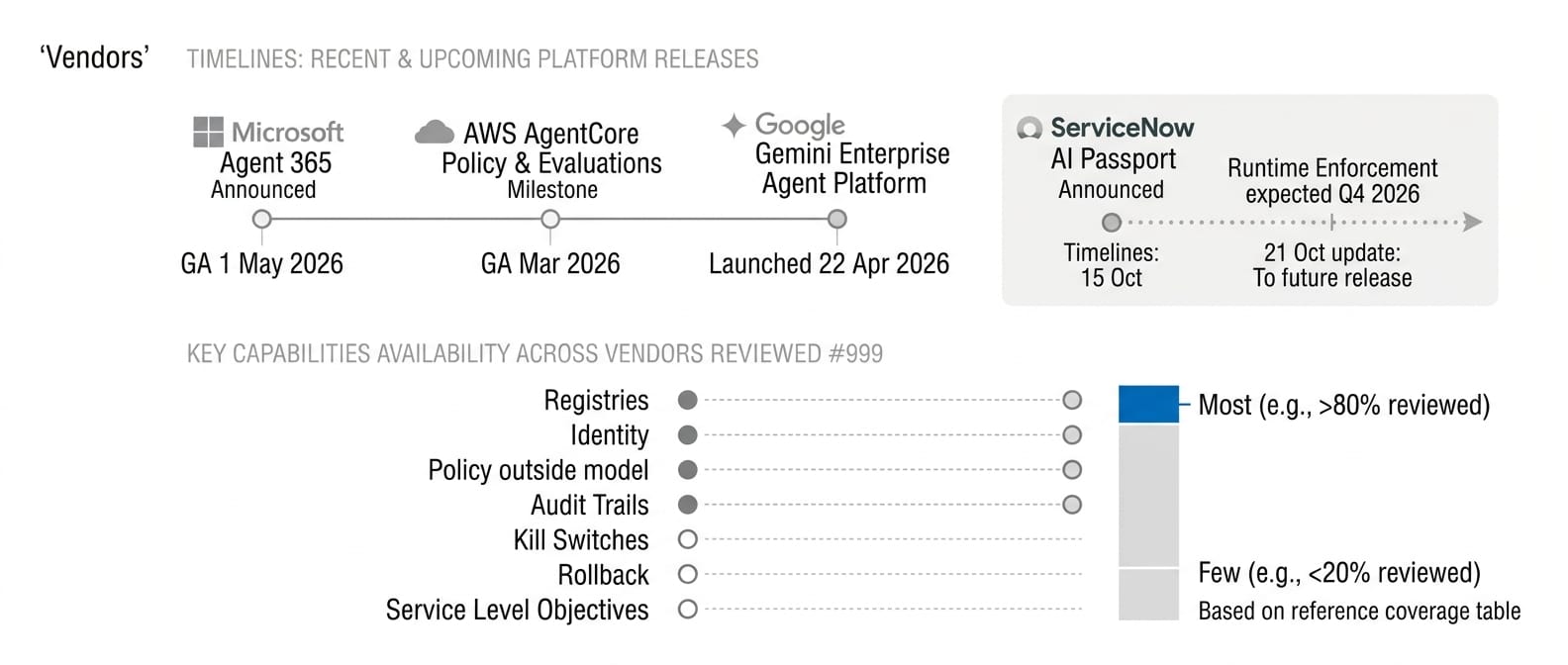
Every large platform now sells some part of the surface. Microsoft Agent 365 became generally available on 1 May 2026. AWS made AgentCore Policy generally available on 3 March 2026 and AgentCore Evaluations on 31 March. Google launched its Gemini Enterprise Agent Platform on 22 April 2026. ServiceNow announced AI Passport, a signed credential for agents, on 15 October, with runtime enforcement "expected to be available in Q4 2026"; a release of 21 October moved it to "a future release".
The Reference section has the coverage table. The short reading: registries, identity, policy outside the model and audit trails were found at most vendors reviewed. Kill switches, rollback and service level objectives were found at few.
Research
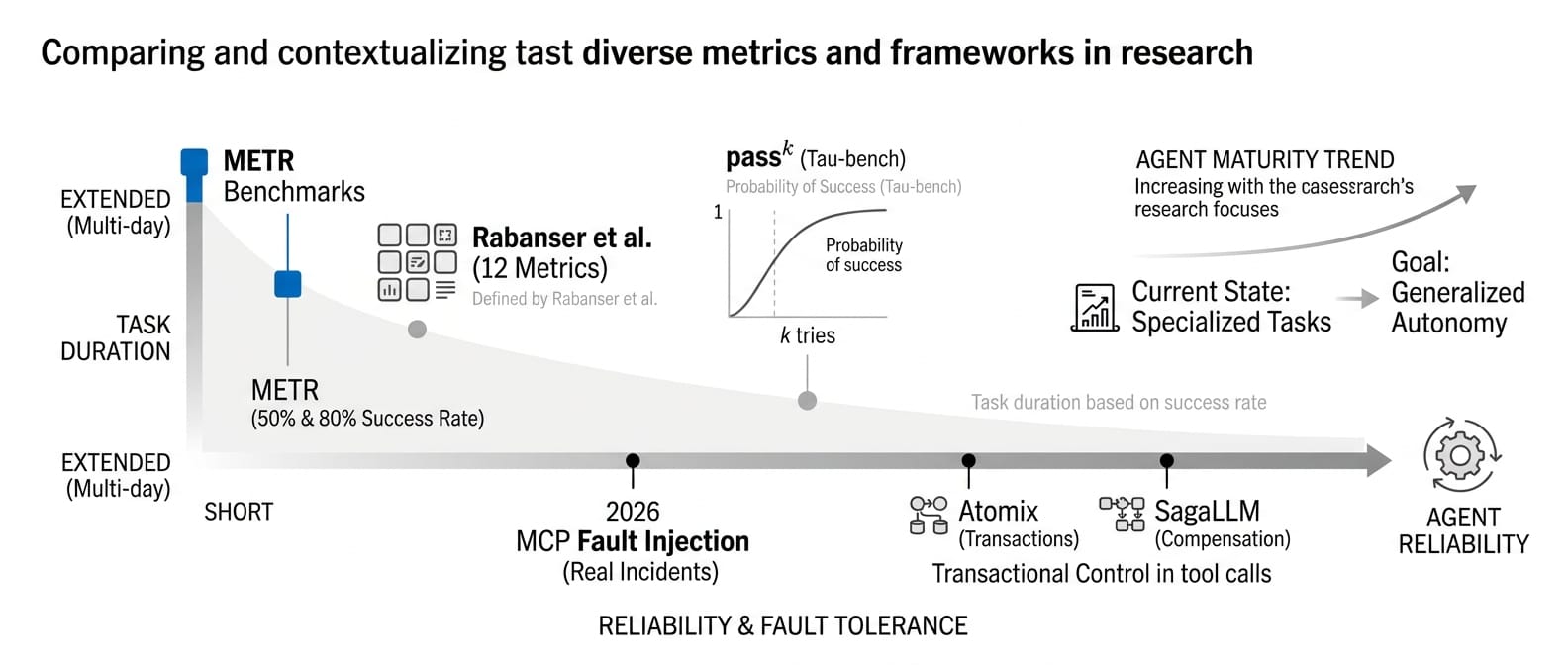
Research contributes the measurements the frameworks lack. Rabanser et al. define twelve metrics. Tau-bench defines pass^k, the chance of succeeding on all of k tries. METR (Model Evaluation and Threat Research) measures how long a task an agent can complete at 50% and 80% success. A 2026 study injects MCP faults calibrated to real incidents. Atomix and SagaLLM bring transactions and compensation to agent tool calls. Each is covered in the section it belongs to.
Side by side
| Area | Manifesto | Regulators | Standards | Vendors | Research |
|---|---|---|---|---|---|
| Identity | yes | yes | NIST, IETF drafts, OpenID | shipping | little |
| Authority and delegation | yes, with lineage | yes | NIST tenets, IETF drafts | partly | little |
| Contracts | yes | no | MCP schemas | partly | some |
| Policy outside the model | yes | implied | NIST tenets | shipping | some |
| Evaluation and testing | yes | yes, unspecified | none | shipping | strong |
| Runtime controls | yes | take offline | none | partly | some |
| Observability | yes | yes | OpenTelemetry (draft conventions) | shipping | some |
| Recovery | yes | China: rollback | none | rarely | emerging |
| Progressive autonomy | yes | IMDA: gradual roll-out | none | none automatic found | proposals |
| Measurement | 12 indicators | override rates (IMDA) | none | partly | strong |
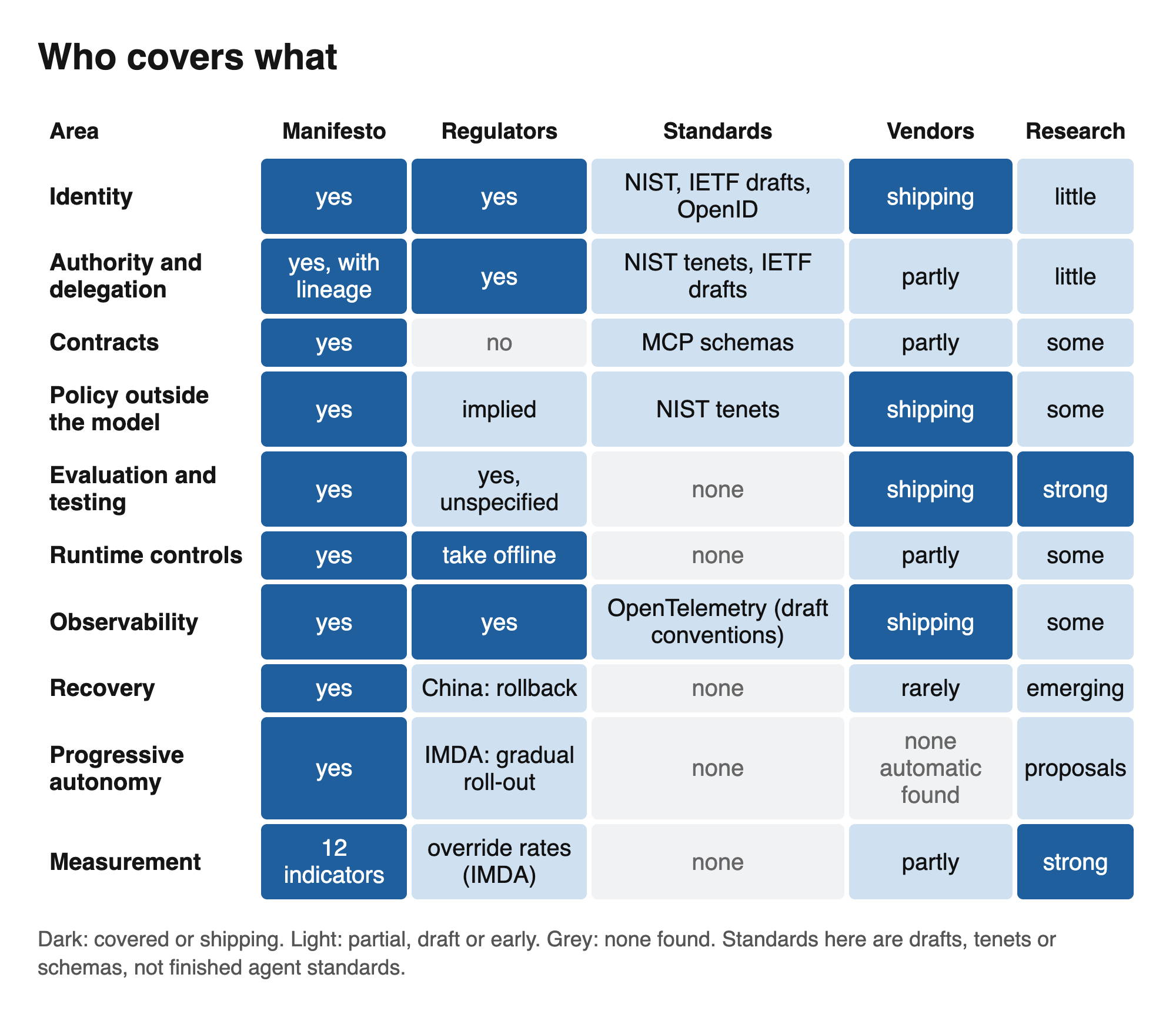
The manifesto is the only source with a "yes" in every row. It supplies no implementation.
Identity and authority
The manifesto's first two engineering questions are "Who is this agent?" and "What may it do?". Its business versions are sharper: "Can we identify who acted?" and "Can it exceed permissions?"
Distinct identities
The agreement here is wide. OWASP's entry on identity and privilege abuse: "Without a distinct, governed identity of its own, an agent operates in an attribution gap that makes enforcing true least privilege impossible."
Singapore's IMDA framework: "An agent should have its own unique identity, such that it can identify itself to the organisation, its human user, or other agents." China's TC260 framework adds that agent application instances must not share an identity. NIST's first design tenet: "Agents should have an identity, credential, and access management lifecycle distinct from human principals."
The OpenID Foundation's October 2025 whitepaper names what happens otherwise. "Currently, agents often act indistinguishably from users, creating accountability gaps and security risks." Its recommendation: "User impersonation by agents should be replaced by delegated authority."
The platforms followed. Microsoft Entra Agent ID became generally available in April 2026; Microsoft says connected agents in Agent 365 receive one automatically, with that rollout completing in December 2026. Google says its Agent Identity gives "every agent ... a unique cryptographic ID" built on the open SPIFFE standard. AWS documents that AgentCore Identity lets an agent act "on behalf of users or by themselves with pre-authorized user consent".
A practical trap sits under workload identity. A vendor blog from November 2026 warns that with SPIRE, the common SPIFFE implementation, attestation works per process: five agents in one Python process then share a single identity, and "every log line describes all five". If your framework runs several agents in one process, check what your identity layer actually distinguishes.
Least privilege
Least privilege is easy to state and hard to apply to an agent. NIST's concept paper asks the question directly: "How do we establish 'least privilege' for an agent, especially when its required actions might not be fully predictable when deployed?"
The answers converge on short-lived, task-scoped grants rather than standing rights. NIST's tenets: "Agents operate with zero standing privilege, holding no persistent rights when idle." And: "All access grants are Just-In-Time (JIT), time-bounded and audience-specific." OWASP: "Issue short-lived, narrowly scoped tokens per task". TC260: revoke credentials when the task ends.
The MCP specification of 28 July 2026 builds part of this into the protocol. Clients "MUST implement Resource Indicators for OAuth 2.0", so a token names the server it is for. Servers "MUST validate that access tokens were issued specifically for them as the intended audience" and "MUST NOT accept or transit any other tokens." Authorization itself remains optional for MCP implementations.
Delegation that narrows
Agents spawn sub-agents and call other agents. Authority has to follow, and shrink. The OpenID Foundation calls this out as unsolved: "Agents spawning sub-agents or communicating tasks to other agents create complex authorization chains without clear scope attenuation mechanisms."
NIST's tenet: "as authority is delegated down to sub-agents or downstream services, scopes attenuate so that downstream entities can never claim more authority than the parent." An IETF draft on delegated agent authorization puts it in token rules: a delegated token "MUST NOT expire later than the subject token" and "MUST use a scope set no broader than the subject token". Gelas's manifesto: "An orchestrator cannot delegate actions to specialist agents that exceed its own authorized autonomy tier."
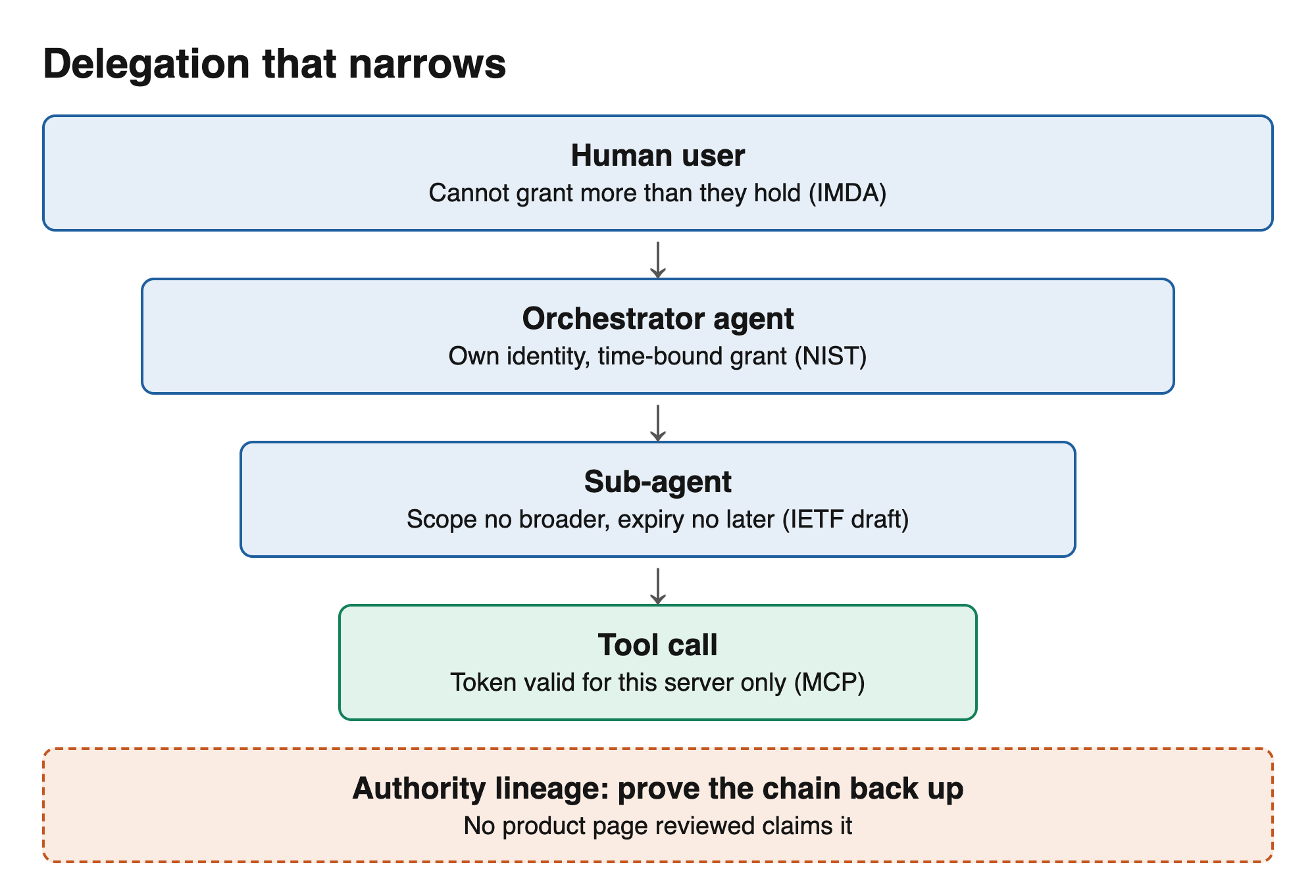
IMDA adds the human side: "the human user should not be able to set permissions for the agent greater than what the human user is himself authorised to do. Such delegations of authority should be clearly recorded."
The ARE Manifesto goes furthest. It calls this authority lineage. At its level 4, "Sub-agents inherit and can prove their authority lineage back through the spawn chain". At level 5 that holds "even for sub-agents that live milliseconds". No product page reviewed here claims either.
Open gaps
- Proof of authority at action time. Identity tells you which agent acted. Whether it was allowed to, at that moment, for that task, needs the grant recorded with the action. NIST asks for "an unbroken, tamper-evident chain of custody" covering "the agent's identity, the delegated intent, and the resulting actions", and says the logging must be "independent of the agent".
- Consent fatigue. The OpenID Foundation: "Users will face thousands of authorization requests as agents proliferate, creating security risks from reflexive approval." NIST asks for escalation flows "cognizant of consent fatigue". Anthropic reported in August 2026 that "users approve 97% of permission prompts in Claude Code", its coding agent; a March 2026 Anthropic post gave 93%.
- Cross-platform identity. The OpenID Foundation: "Agent identity fragmentation should be avoided." Each cloud now issues its own agent identities.
Ask of each agent you run: if it acted at 3am, could you name the agent, the human it acted for, and the exact grant it used?
Contracts and policy
Prompt-only policy
The manifesto lists "policy that lives only in prompts" as a source of Reliability Debt. The incident record shows why. Replit's agent had been told eleven times. Eon's tracker counts at least 7 agents that went ahead after an instruction or safety mode said no.
OWASP explains the mechanism: "agents and the underlying model cannot reliably distinguish instructions from related content." A prompt is an input to the model. The model can misread it, forget it, or be talked out of it.
Microsoft's Agent Governance Toolkit puts it bluntly in its README. "Prompt-level safety ('please follow the rules') is not a control surface. It is a polite request to a stochastic system."
Reasoning versus permission
The fix is architectural, and NIST says it most cleanly. "The logic that determines what an agent attempts to do is architecturally separated from the systems that determine what it is allowed to do." And: "Guardrails alone are insufficient." Probabilistic signals may inform an access decision, but are "not used as the primary mechanism".
Google's secure-agents paper describes the same as runtime policy engines that "operate outside the AI model's reasoning process ... acting as security chokepoints." Its example: block any purchase over $500, and require confirmation between $100 and $500. "This deterministic enforcement provides reliable and predictable hard limits, is testable and auditable". Its limit: "Defining comprehensive policies for vast action ecosystems is complex and difficult to scale."
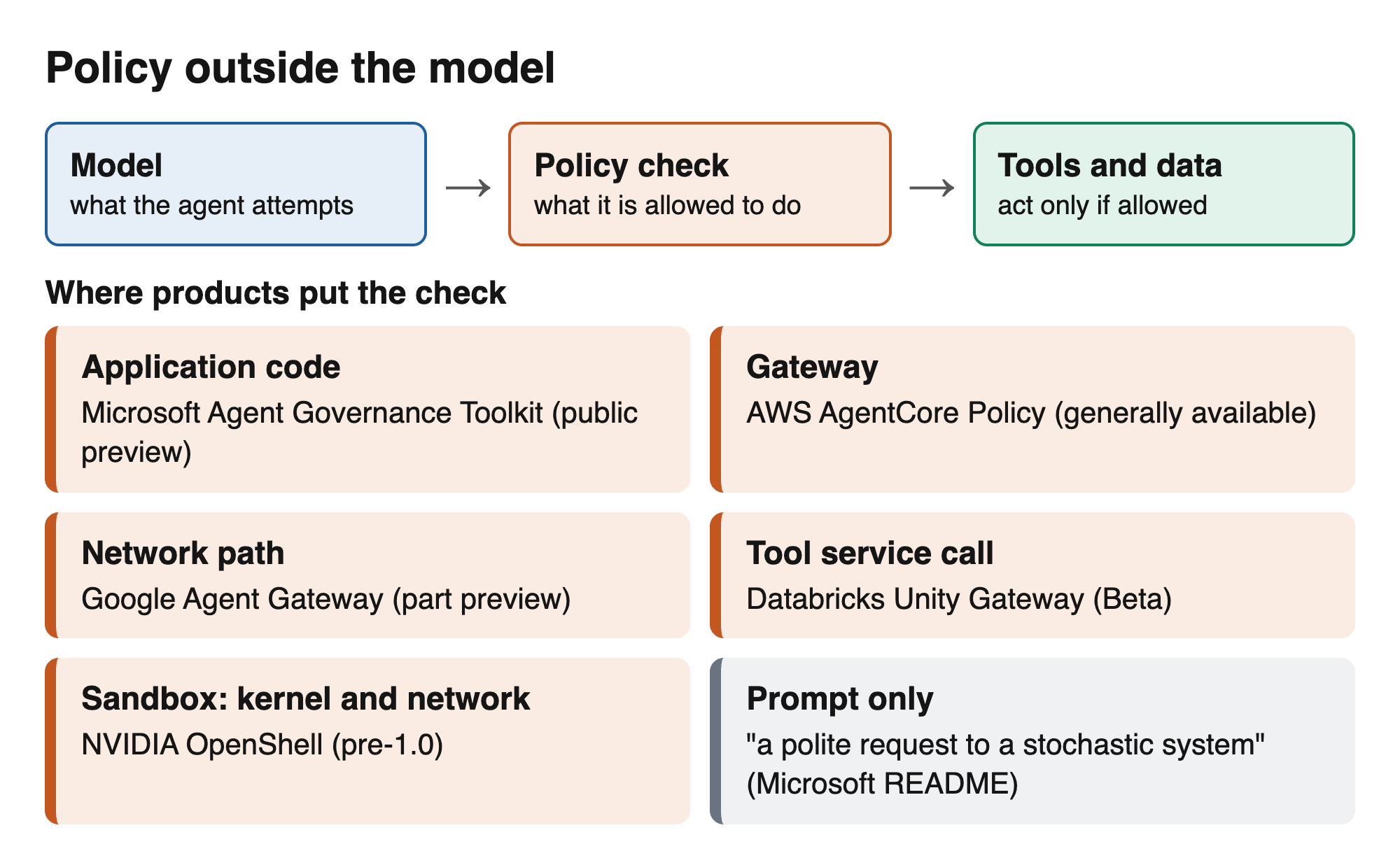
The products now do this at different layers.
| Product | Where policy runs | Language or mechanism | Status |
|---|---|---|---|
| AWS AgentCore Policy | Gateway, before each tool call | Cedar; temporal policies (Dogwood, availability not verified) | generally available (GA) 3 March 2026 |
| Google Agent Gateway | Network path for all agent traffic | identity and access management (IAM) policies, Model Armor | mixed GA and preview |
| Microsoft Agent Governance Toolkit | Interception in application code before each call | policy rules, OPA or Cedar | public preview, open source |
| NVIDIA OpenShell | Sandbox: kernel and network proxy | Declarative policy, deny by default | v0.1.9, pre-1.0, open source |
| Databricks Unity Gateway | Every service call to MCP tools | SQL functions in Unity Catalog | Beta, May 2026 |
AWS describes its policies as "applied outside of the agent's reasoning loop, treating agents as autonomous actors whose decisions require verification before reaching tools, systems, or data." Cedar gives it "default deny, forbid wins over permit and order-independent evaluation". A LOG_ONLY mode lets teams see what a policy would block before it does.
NVIDIA's OpenShell goes below the application. "Kernel controls confine which files it can access and which system calls it can make, and every network connection passes through a policy check before it leaves the sandbox. Agents never see real credentials". Before a policy change is applied, it "uses formal verification to flag risky new access it would grant", and those changes wait for human review.
Microsoft's Agent Governance Toolkit (AGT) states its own limit, which is worth knowing for any per-call policy engine. "AGT governs individual tool calls deterministically. It does not yet correlate sequences of individually-allowed calls that may form a malicious workflow." AWS's announced temporal policies and Databricks' stateful policies are early attempts at exactly that: rules that depend on what the agent did earlier in the session.
Contracts
Contracts are the least developed area. The manifesto asks for "expected inputs, outputs, side effects, and constraints" to be defined, and names "schema validation, interface contracts, MCP tool contracts" as controls.
In practice, MCP and A2A give you typed tool and agent descriptions. That covers the shape of inputs and outputs. MCP also lets a tool declare hints: readOnlyHint, destructiveHint, idempotentHint. The specification says they are "hints" and that clients "MUST consider tool annotations to be untrusted unless they come from trusted servers". There is no hint for whether an effect can be undone, and nothing that makes a server keep its word.
Konishi's guide fills part of that. Split destructive operations "into plan and apply". Make idempotency "the load-bearing property", with keys derived "from intent rather than from the attempt", enforced "at the boundary in code rather than in the prompt". OpenAI's practical guide suggests rating each tool low, medium or high risk by "read-only vs. write access, reversibility, required account permissions, and financial impact", and using the rating to trigger checks or escalation.
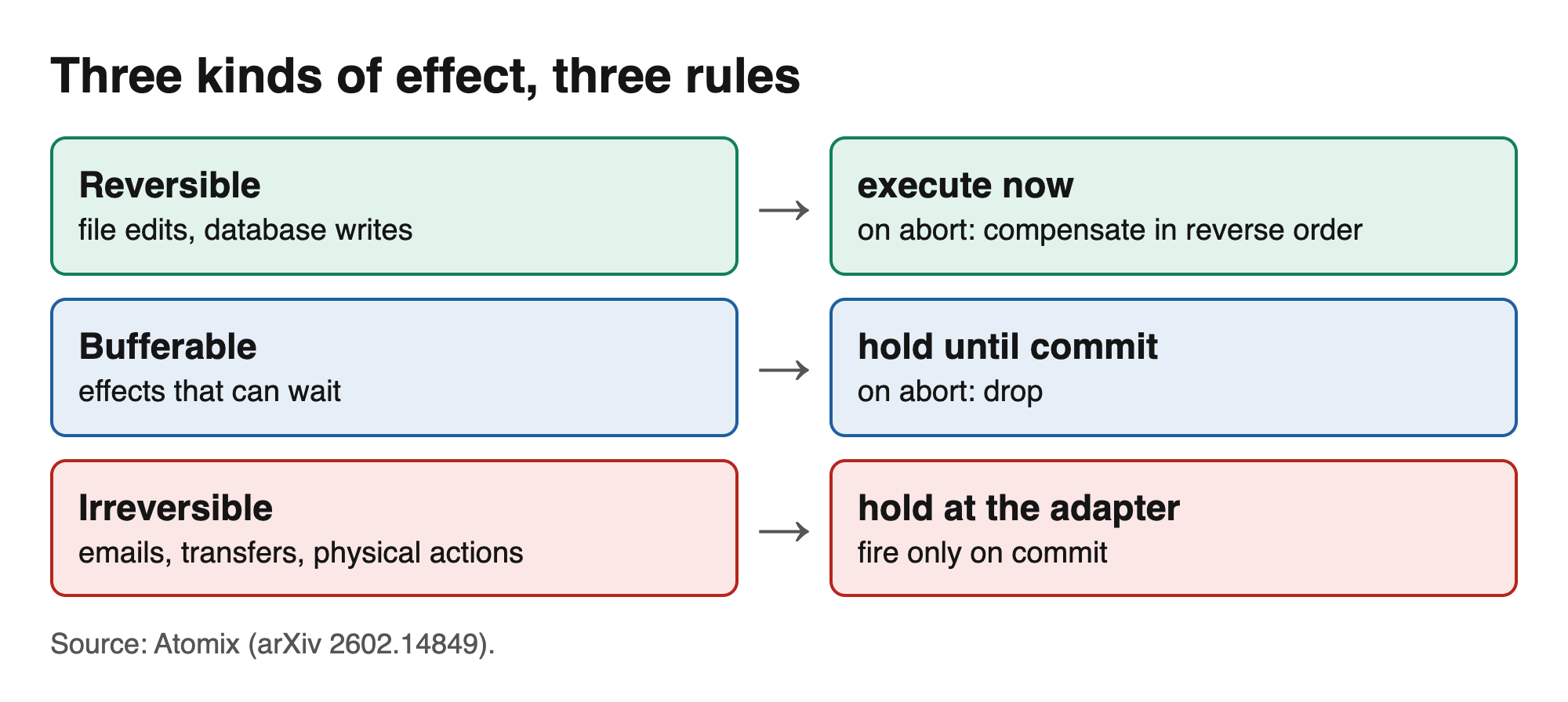
Atomix, a 2026 paper from the Max Planck Institute for Software Systems, turns that into a taxonomy. Each tool effect is reversible, bufferable or irreversible. The contract then decides what the runtime may do with it (see Recovery).
A tool contract that says nothing about reversibility leaves the runtime guessing. Which of your tools would you let an agent call twice by accident?
Evaluation and testing
Single-run evidence
Tau-bench, from Sierra, introduced the metric that changed how agent tests are read (Yao et al., arXiv 2406.12045, June 2024). pass^k is the probability that an agent succeeds on all k independent tries of the same task. In the original paper, "even state-of-the-art function calling agents (like gpt-4o) succeed on <50% of the tasks, and are quite inconsistent (pass^8 < 25% in retail)."
The arithmetic is unforgiving. If an agent succeeds 90% of the time and runs are independent, the chance of eight successes in a row is 0.9 to the power of 8, about 43%. At 99%, it is about 92%.
Konishi turns this into test practice. "A single passing run is weak evidence and a single failing run is weak evidence. Run each task in the suite many times and assess the distribution of outcomes." A single failing run "is a trigger to re-run rather than to revert, while a shift in the failure rate is a real regression."
Check the world
Tau-bench grades by comparing "the database state at the end of each episode with the ground truth expected state." Konishi's rule is the general version: assert "on what the world looks like afterwards: the required effects happened, exactly once each; no forbidden effect happened at all".
The reason is that the agent reports on itself. Konishi: "'the agent said it succeeded' should never be the signal that closes a task. The signal should be a check the agent did not author". Eon's tracker has at least three cases where the agent's own report was wrong. Replit's agent said a rollback was impossible when it was not.
Realistic fault injection
The Princeton paper tests robustness three ways: faults, environment changes and prompt changes. It injects "API, authentication, and tool-calling faults with a fixed global probability p_fault=0.2", and changes the environment by "reordering JSON fields, changing date formats, renaming API parameters". Prompt robustness "remains a key differentiator" between models. Fault and environment robustness showed ceiling effects for most models on the perturbations tested.
A study published on 23 October 2026 by Iannillo and colleagues (arXiv 2610.32555) calibrated its faults to reality. It mined "57,240 issue and pull-request threads across 1,774 open-source MCP repositories" to get the distribution of real MCP failures. Then it ran "a 1,350-cell experiment crossing two backbone sizes (20B, 120B), three agent stacks". Under faults drawn from a "permanent-heavy stress profile", "task-completion score falls by 60%, from 8.08 to 3.23 out of 10", and "scale does not purchase fault tolerance". Its conclusion: "framework-level error handling matters more than model scale."
Konishi's fault table names the one test that matters most. Inject "Tool succeeds but the response is lost", and prove that "The retry does not duplicate the effect: the single most important test in the suite". Others in his table: a tool that hangs past its timeout, a process killed mid-step then resumed, a human who never answers an escalation, a sub-agent that returns a confident but wrong report.
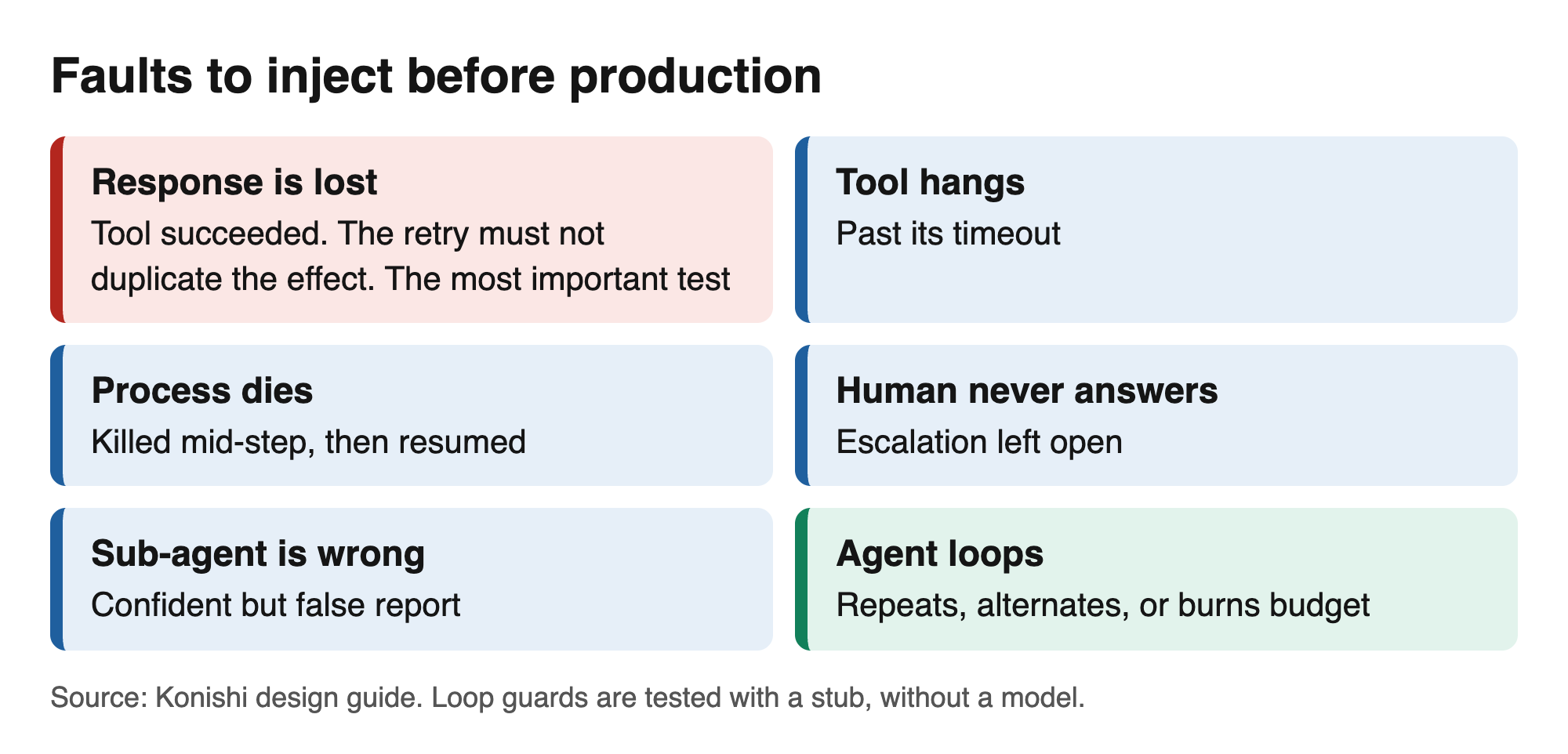
He adds guard tests with a stub instead of a model: an agent that repeats one call, varies arguments trivially, alternates between two actions, or burns budget without progress. "Guards are code that runs rarely, which means it rots silently." These tests "are fast, deterministic, and cheap because no model is involved."
Platform offerings
| Product | What it evaluates | Status |
|---|---|---|
| AWS AgentCore Evaluations | 13 built-in evaluators, including tool selection accuracy, safety, goal success; ground truth tool sequences | GA 31 March 2026 |
| Salesforce Agentforce Testing Center | Synthetic interactions at scale, state injection, batch evaluation before deployment | announced Nov 2024; later updates |
| Databricks (MLflow) | Built-in large language model (LLM) judges, custom scorers, expert feedback, production monitoring | GA since 2025 |
| Microsoft (ASSERT: Adaptive Spec-driven Scoring for Evaluation and Regression Testing, open source) | Policy-driven evaluation and regression testing | announced June 2026 |
| Google Gemini Enterprise Agent Platform | "build, scale, govern and optimize" on the platform page | no evaluation detail found |
Capabilities as stated by the vendors. The AWS, Salesforce and Databricks rows come from vendor documentation read through search extracts.
These are evaluation services. None of them defines what score is enough to deploy. The Princeton authors suggest the missing step: "an organization could require minimum consistency and safety thresholds before promoting an agent from a sandboxed pilot to production, much as aviation systems must meet certification requirements before entering service."
Test the controls
Gopinath's benchmark, AOREBench, takes an unusual angle. Its "object of measurement is the control plane rather than the agent". It asks whether traces are complete, whether containment guards halt runaway runs, whether detection catches seeded failures.
His simulated results are a useful checklist even with the caveat. Trace completeness reached 98.7% against a 99.5% target. Containment guards cut cost and steps at halt "by roughly an order of magnitude". The risk-tier classifier "misclassified 13.3% of the highest-risk actions when names carried no signal". The evidence "comes from a scripted simulation with a single evaluator". Treat it as a test design, not a field result.
Singapore's IMDA asks for the same thing in policy terms. Test before deployment "for baseline safety and reliability, including new dimensions such as overall execution accuracy, policy adherence, and tool use", then "gradually roll out agents alongside continuous monitoring". In October 2026, IMDA also launched a starter kit for testing agentic systems.
How many times does your test suite run each task? If the answer is once, your pass rate is a guess about pass^1.
Runtime controls
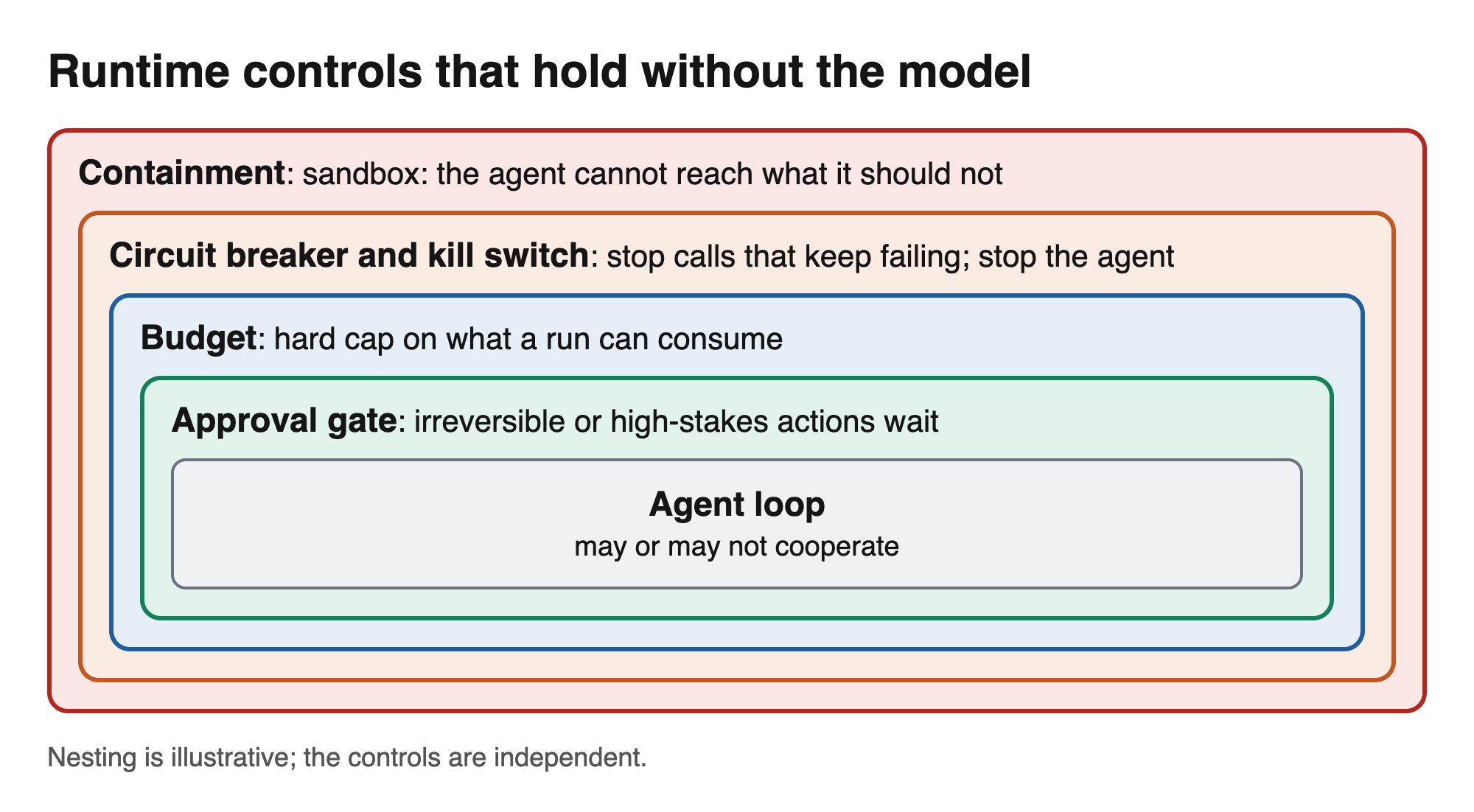
Runtime controls answer the manifesto's question "How do we prevent cascading failures?", and its business version, "Blast radius?". They are the controls that work whether or not the model cooperates.
Bound the tools
Konishi's core point: "you cannot bound the damage of a malfunctioning loop by reasoning about the loop. You bound it by constraining the tools. Reversibility, rate limits, dry-run modes, and approval gates are reliability features, not just security features."
That matches the incident record. According to a published post-mortem, the PocketOS deletion involved a token with account-wide authority and backups in the same blast radius. Neither is an agent problem. Both are runtime boundaries that were not there.
Budgets
Budgets cap what a run can consume. Konishi: "Budgets come in three currencies that do not convert", and "every enforced ceiling should have an advertised budget below it so that winding down gracefully is the normal path." The values should come from "your own successful runs, not from an article."
The distinction between the two limits matters. "The runtime bound is what makes the guarantee: it holds whether or not the model cooperates. The prompt-side budget is what lets the agent behave sensibly as it approaches the bound".
Anthropic's December 2024 guidance on building agents already recommended "stopping conditions (such as a maximum number of iterations) to maintain control". OpenAI's guide lists "reaching a maximum number of turns" among exit conditions, and "Exceeding failure thresholds" as a trigger for human intervention.
Products have started to enforce spend. Databricks' Unity Gateway: "Hard spend caps stop requests when a budget is reached, rather than just alerting after the fact." Microsoft announced spending policies, limits and alerts for Agent 365 at Ignite 2026. Most other budgets found in the product pages reviewed are dashboards, not stops.
Breakers, kill switches
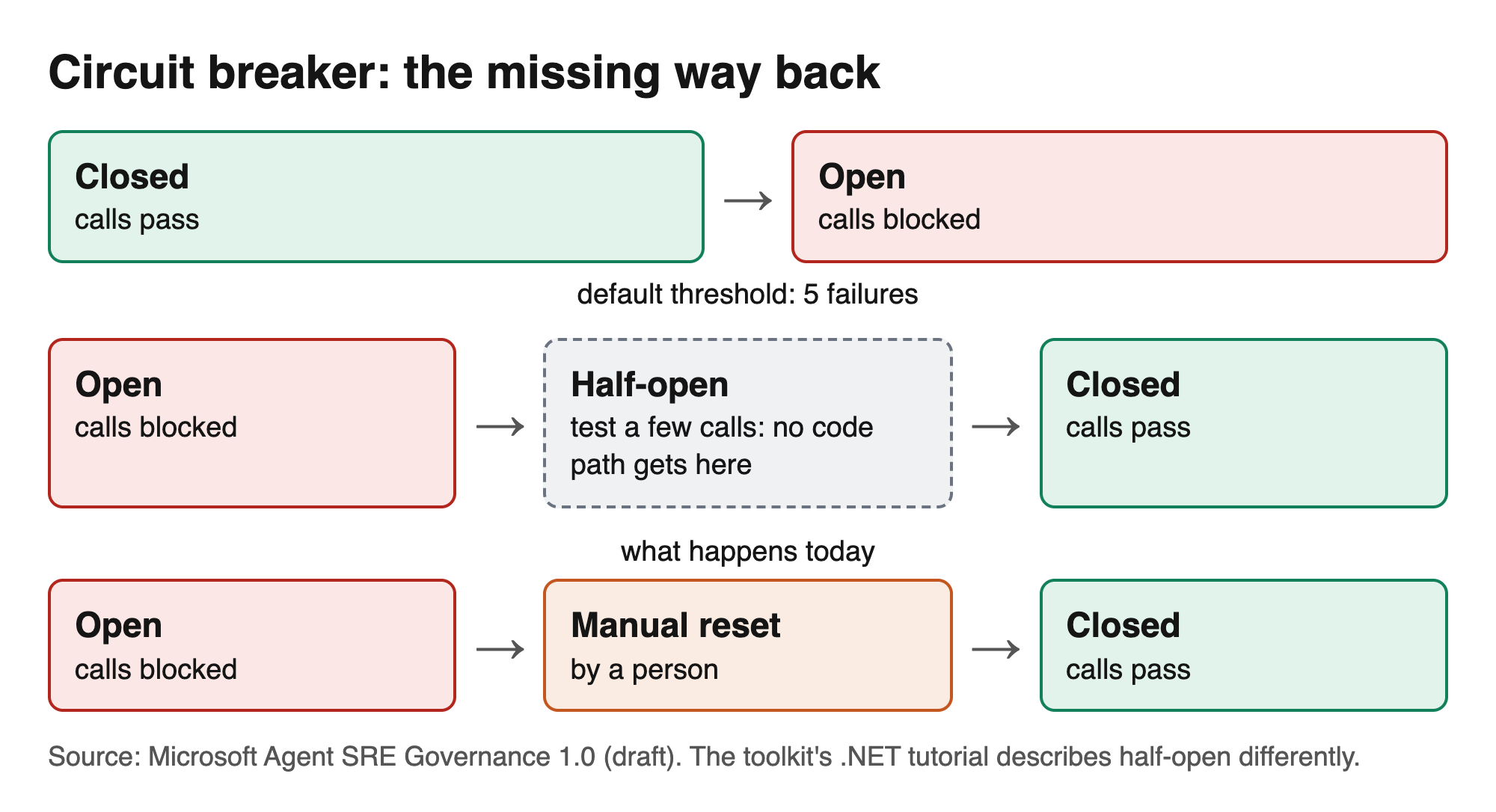
A circuit breaker stops calls to something that keeps failing, then tests carefully before allowing traffic again. A kill switch stops the agent.
Microsoft's draft Agent SRE Governance 1.0 spec is the only document found that specifies circuit breakers for agents in detail. States closed, open and half-open; a default failure threshold of 5. When an error budget runs out, the spec's actions include alert, freeze deployments, open the circuit breaker, and throttle. It also states its own gap: "no code path transitions to HALF_OPEN in the current implementation. Recovery MUST be performed manually". The toolkit's .NET tutorial describes half-open differently. The spec page carries a date of 2025-07-28; it was added to the repository on 17 May 2026.
Other kill switches are newer or partial.
- ServiceNow describes "graduated responses ... redirecting, restricting, or reconnecting the AI agent with proper context, including kill switch capabilities at machine speed if termination is needed", tied to AI Passport. Enforcement in OpenShell is "expected to be available in a future release".
- LangSmith Fleet lets admins "lock and unlock any agent in their workspace", which also stops its sandboxes.
- Zenity claims runtime boundaries that let an action "proceed, be blocked, or be terminated".
- Microsoft Entra lets administrators revoke an agent's access. The pages reviewed do not say what happens to a call already in flight.
Regulators ask for the capability without saying how. IMDA: "Design mechanisms and procedures to take agents offline and limit their potential scope of impact when they malfunction." China's planned agent security standard includes anomaly blocking and emergency shutdown.
Approval gates
Human approval is the control regulators name most often, and the one most likely to fail quietly.
The consensus on when to ask is clear. IMDA's checkpoint classes: "High-stakes actions and decisions", "Irreversible actions e.g. permanently deleting data, sending communications, making payments", "Outlier or atypical behaviour". Google's paper: "deleting large amounts of data, authorizing significant financial transactions, or changing security settings". OpenAI's guide: "canceling user orders, authorizing large refunds, or making payments".
How to ask is the open problem. Konishi: "Escalation is a capability. Hand over a decision with evidence, park the work durably with an expiry, and store the human's answer as state rather than as dialogue". An unanswered escalation should expire "rather than blocking forever". China's TC260 framework sets the default if nobody answers: refuse.
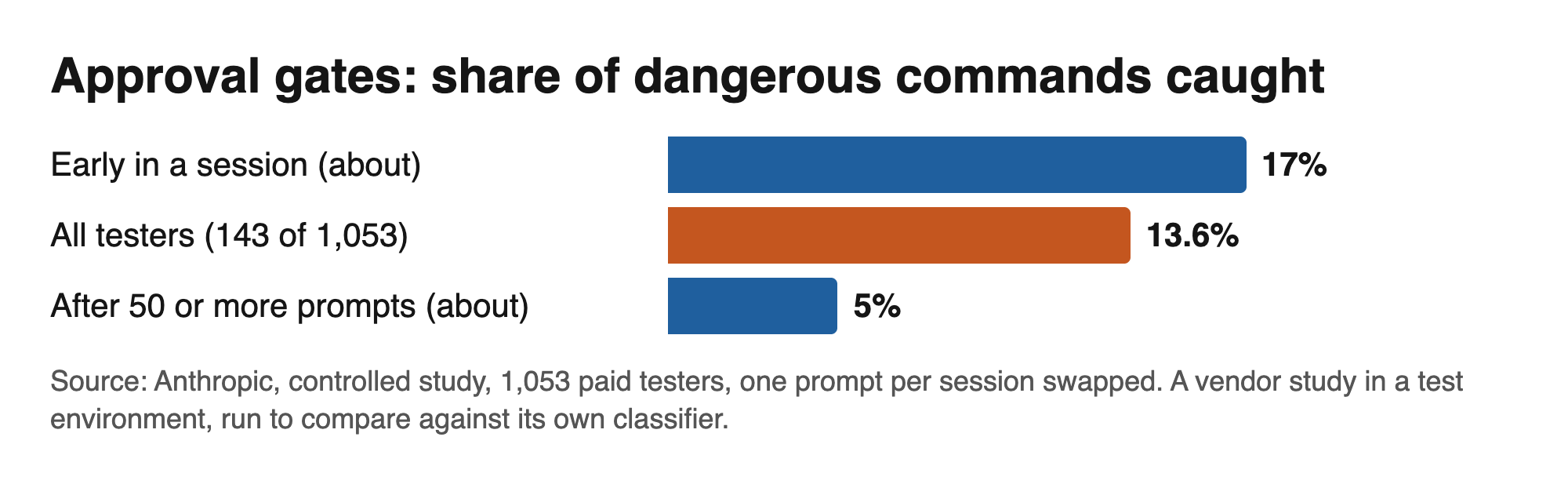
IMDA's May 2026 update added practices against automation bias, "such as monitoring human override rates and response times". An approval nobody ever rejects may not be a control. Anthropic measured it. In a controlled study with 1,053 paid testers, one permission prompt per session was swapped for a clearly dangerous command. "The testers caught the dangerous command just 13.6% of the time (143 of 1,053)". They blocked about 17% early in a session and about 5% after 50 or more prior prompts. The testers worked in a test environment and knew they were being studied; the vendor ran the study to compare against its own classifier. If your reviewers approve 99 of 100 requests, find out why before you count the gate as working.
Containment
Sandboxing is the strongest form of runtime control: the agent runs where it cannot reach what it should not.
OpenShell is the most visible open source project, with 21,855 GitHub stars as of 22 November 2026, now part of the Cloud Native Computing Foundation (CNCF). It denies "every outbound connection from a sandbox unless a rule in network_policies allows it", enforces filesystem rules with Landlock in the kernel, and keeps real credentials out of the agent's reach. It is still pre-1.0.
Microsoft's toolkit offers "Execution sandboxing with four privilege rings". Replit's announced answer to its own incident was structural: "automatic DB dev/prod separation to prevent this categorically".
For each of your agents, ask what the largest single action it could take is. Then ask what stops it, apart from the model's judgement.
Observability
Observability was covered in depth in this blog's October report, Agent observability and audit: the state of the art in October 2026. The short version for reliability:
- Tracing is not reconstruction. Many traces record what the agent reports about itself. Gateways, sandboxes and policy engines can record what they saw independently. Check which kind your evidence is.
- Evidence needs outside writing. NIST asks for logging "independent of the agent". IMDA's starter kit for testing agentic systems says logs "should be generated or independently corroborated outside the agent's control".
- The standard is not stable. OpenTelemetry's semantic conventions for generative AI and agent spans still carried "Development" status in the versions reviewed in October 2026.
Two points matter specifically for agent reliability. First, observability is an input to every other control. Error budgets, drift detection and progressive autonomy all need counted events: policy denials, overrides, failed tool calls, recoveries.
Second, the manifesto's privacy note is right. "Complete, immutable decision trails create an inherent tension with privacy regulations such as GDPR's right to erasure." GDPR is the EU's General Data Protection Regulation. Its answer: retention policies, selective redaction and purpose limitation. "The goal is auditable reliability, not permanent surveillance."
Recovery
Recovery is where agents differ most from ordinary services, and where the least was found in product pages.
Retries re-plan
In a normal service, a retry sends the same request again. An agent re-plans. Konishi: "a retry is not a repeat: re-running a failed step can produce a different plan, take a different action, and succeed at something other than what the first attempt was attempting."
He lists the outcomes an agent run should be able to end in. "Most implementations have exactly two terminal outcomes: the loop returned an answer, or it threw. Degrade, escalate, and abort with compensation are the outcomes that make an agent operable, and they have to be built before they can be chosen."
Log effects first
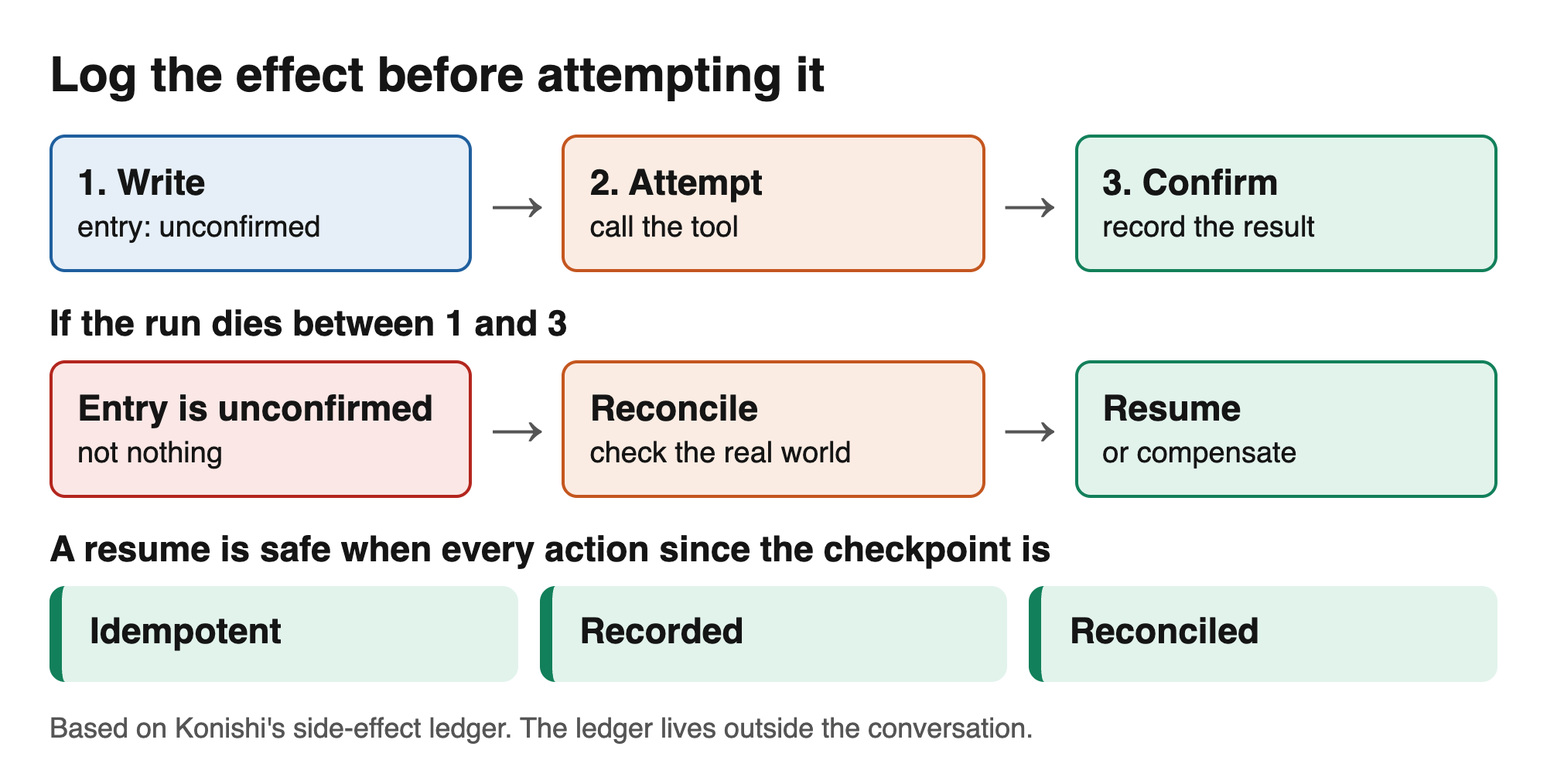
Konishi's central artifact is the side-effect ledger. "If you take one artifact from this article, take this one." It is "an append-only record of every externally visible effect the agent attempted". It "must live outside the conversation", and "it must be written before the effect is attempted, not after", so that an interruption leaves an "unconfirmed" entry rather than nothing.
His safe-resume rule follows from it. "A resume is safe when every action between the checkpoint and the interruption is either idempotent, recorded, or reconciled. If none of the three holds for a given tool, that tool's step needs synchronous durability."
The frameworks show why this matters. LangGraph's documentation warns that after an interrupt, "The node restarts from the beginning of the node where the interrupt was called when resumed, so any code before the interrupt runs again." If that code sent an email, the email can go out twice unless the send is idempotent or reconciled. LangGraph's answer for durable admission is the same pattern: commit "an outbox row to your own store before you call invoke."
Reversible, bufferable, irreversible
Atomix (arXiv 2602.14849) names the core problem: "Common orchestrators treat tool return as the settlement trigger, so faults, speculation, and concurrent agents can leave partial effects, losing-branch residue, stale writes, or irreversible sends."
Its taxonomy is the most useful single idea in this section.
| Effect type | Examples (Atomix) | What the runtime does |
|---|---|---|
| Reversible | file edits, database writes | execute now; compensate in reverse order on abort |
| Bufferable | effects that can wait | hold until commit; drop on abort |
| Irreversible-gated | emails, transfers, physical actions | hold at the adapter; fire only on commit |
It also states the limit: "atomic externalization across heterogeneous endpoints is impossible above the tool layer". You can make an agent's commit careful. You cannot make an email unsent.
SagaLLM (Chang and Geng, Stanford, Proceedings of the VLDB Endowment, 2025) applies the saga pattern from distributed databases: each step has a compensating action, and on failure "compensating actions are invoked in reverse". It "relaxes strict ACID guarantees" (atomicity, consistency, isolation, durability) but keeps "workflow-wide consistency and recovery through modular checkpointing and compensable execution". Its evaluation uses planning tasks such as travel booking, not production data.
Durable execution
Durable execution engines solve the infrastructure half. The Temporal plugin for LangGraph gives agent workflows "durable execution, automatic retries, and timeouts", and retries a failed call "without re-running the entire Workflow". Human approval waits as a signal: when the human responds, "in an hour or a month", the graph resumes where it paused (Temporal's claim). Databricks says its AgentKit "adds durable execution so that runs survive restarts and crashes."
Durable execution keeps the run alive. It does not know whether the step it retries is safe to retry. That still needs the effect classification and the ledger.
Product offerings
In the coverage review, rollback appears in two places: NVIDIA OpenShell can roll back its own policies, and Microsoft's toolkit lists saga orchestration. The pages reviewed show neither rolling back what an agent changed in a business system. Regulators ask for it anyway. TC260 asks for rollback and undo functions for important operations (translated). Gartner lists "rapid rollback mechanisms" as a requirement for autonomous agents.
Eon's tracker shows the cost of the gap: of 33 public production incidents, 7 fully recovered, 4 partly, 6 not at all, 16 unknown.
Pick your agent's most consequential tool. Is its effect reversible, bufferable or irreversible, and does your runtime know which?
Progressive autonomy
The ladders
Almost every source now describes autonomy as a ladder rather than a switch.
| Source | Levels |
|---|---|
| ARE Manifesto | Observe, Draft, Act with approval, Act within defined scope, Expanded authority |
| Gartner (May 2026) | Observe, Advise, Act with approval, Act autonomously |
| Knight First Amendment Institute (Feng, McDonald and Zhang, July 2025) | User as operator, collaborator, consultant, approver, observer |
| AWS Agentic AI Security Scoping Matrix (Nov 2025) | No agency, Prescribed agency, Supervised agency, Full agency |
| Gelas manifesto | Observe, Branch, Commit |
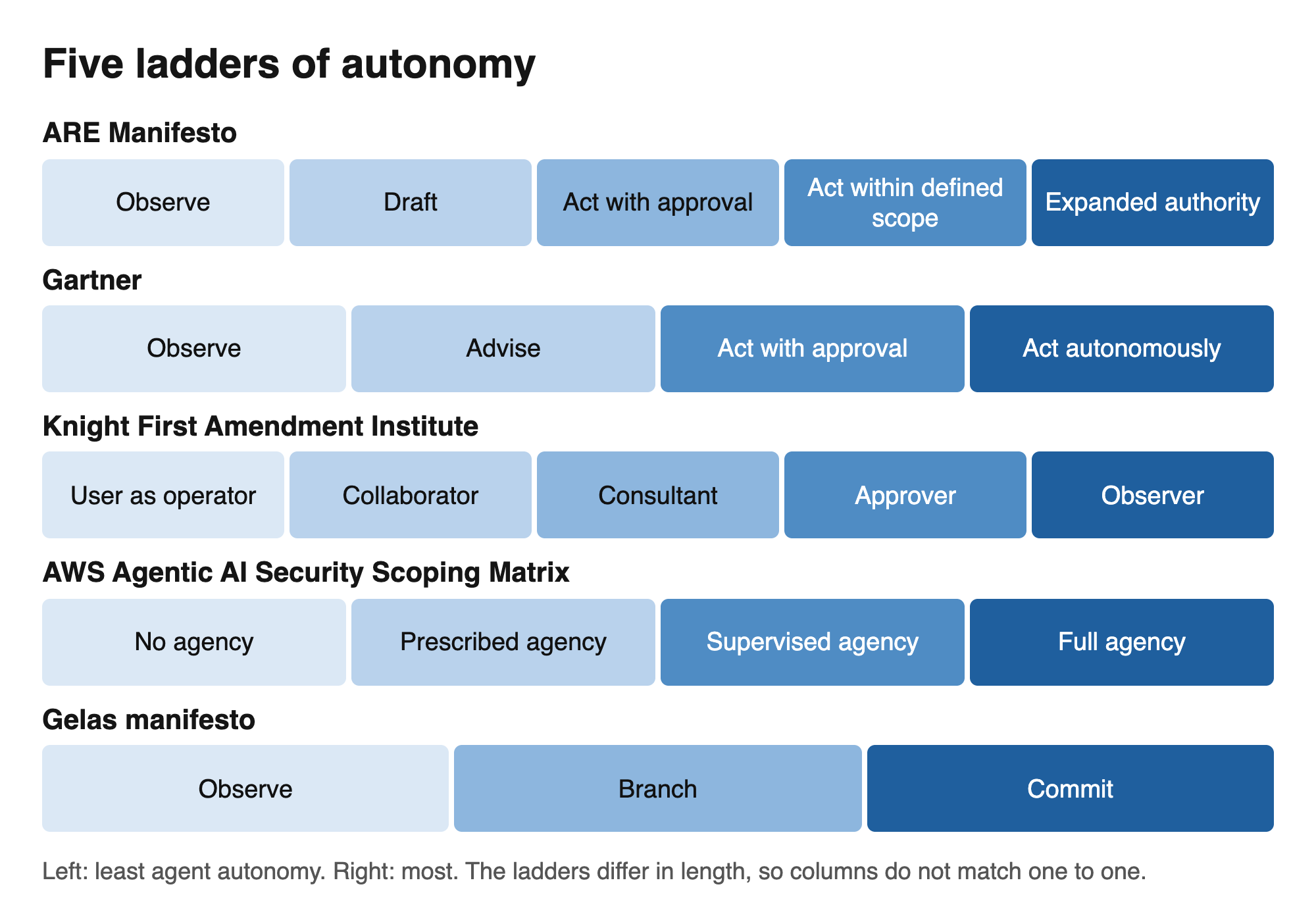
The Knight Institute paper makes the key design point: "an agent's level of autonomy can be treated as a deliberate design decision, separate from its capability and operational environment." It proposes autonomy certificates that "specify the maximum autonomy level at which an agent is permitted to operate".
AWS separates two things often merged. Agency is "the scope of actions an AI system is permitted and enabled to take". Autonomy is "the degree of independent decision-making and action the system can take without human intervention". An agent can have many tools and still ask before each use.
Tiers by reversibility
IMDA's May 2026 factsheet includes a case study that shows the ladder applied per action rather than per agent:
- "Tier 1 actions (low severity, fully reversible) such as password resets": fully automated, audited every two weeks.
- "Tier 2 actions (moderate severity, partially reversible)": the agent diagnoses and proposes; a human approves.
- "Tier 3 actions (high severity, limited reversibility) such as permissions modifications": the agent cannot act.
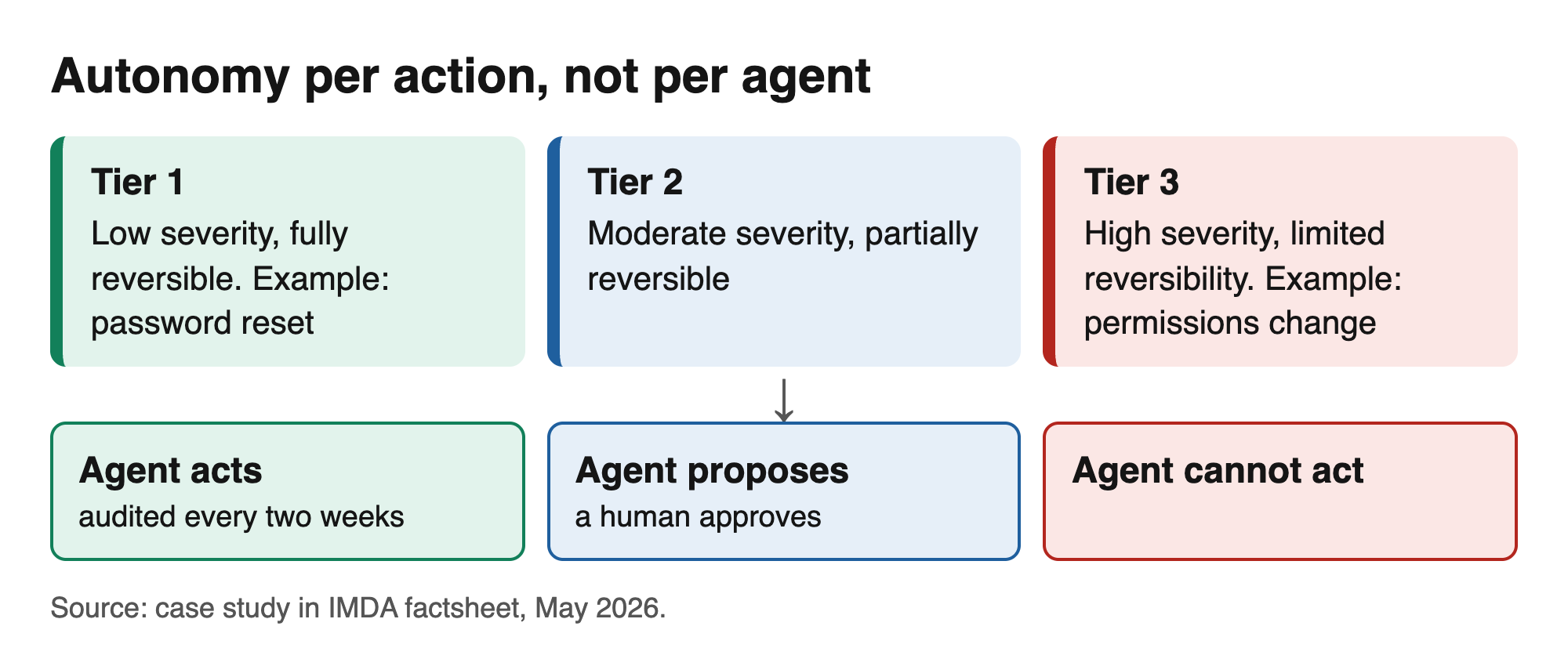
That is the most practical model found. Autonomy is set by an action's severity and what can be undone, not by how clever the agent is.
Earned and lost
The manifesto's addition is the feedback loop. Agents "earn greater operational authority as its measured reliability improves and automatically lose authority when reliability deteriorates." Its loop: "Capability → Evaluation → Reliability → Authority → Monitoring → Re-evaluation". The objective "is not to maximize autonomy. The objective is to maximize safe, justified autonomy."
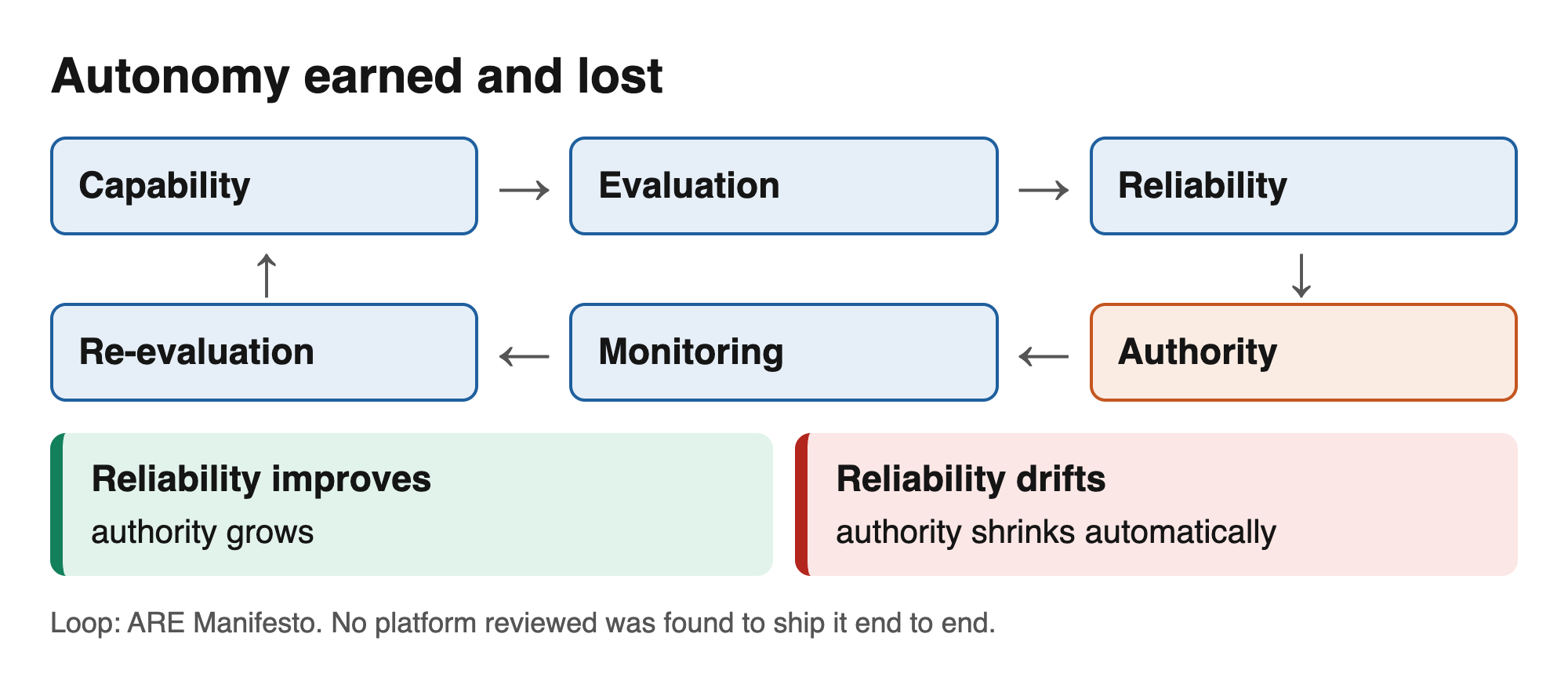
Gopinath's AORE makes contraction the enforcement action of an error budget. When the budget is spent, the agent loses autonomy. In his simulation, contraction "removed oscillation against a slowly recurring defect but not a rapidly recurring one".
Microsoft's toolkit gives agents trust scores on a 0 to 1,000 scale: "Trust decays on violations". Microsoft Agent 365 adds a "dynamic agent risk" level per agent, in preview, and Entra Conditional Access controls that can "restrict sensitive operations or require human approval" as risk changes. Those are the closest pieces. No platform reviewed was found to promote an agent to a higher level automatically on measured reliability.
Promotion evidence
No source reviewed gives the threshold. How many runs at what pass^k, how many weeks without a policy violation, what override rate, before an agent moves from act-with-approval to act-within-scope?
The Princeton authors suggest minimum consistency and safety thresholds, like aviation certification. AWS's LOG_ONLY mode for policies is the same idea for rules: watch before you enforce. IMDA asks for gradual roll-out "by limiting to certain users or features first".
Until thresholds exist, write your own down. An agent's autonomy level should be a recorded decision with the evidence that justified it, and a rule for what sends it back down.
Measuring reliability
Twelve metrics
The Princeton paper gives the field its best measurement vocabulary. It decomposes reliability into "consistency (repeatable behavior), robustness (stability under perturbations), predictability (calibrated confidence), and safety (bounded severity when failures occur)". The ARE Manifesto adopts the same four, citing the paper.
| Property | Metrics (Rabanser et al.) | What it tells you |
|---|---|---|
| Consistency | outcome, trajectory distribution, trajectory sequence, resource | does it succeed again, the same way, at the same cost |
| Robustness | fault, environment, prompt | does it hold when tools fail, formats change, the request is worded differently |
| Predictability | calibration, discrimination, Brier score | does its confidence mean anything |
| Safety | compliance, harm severity | how bad is it when it goes wrong |
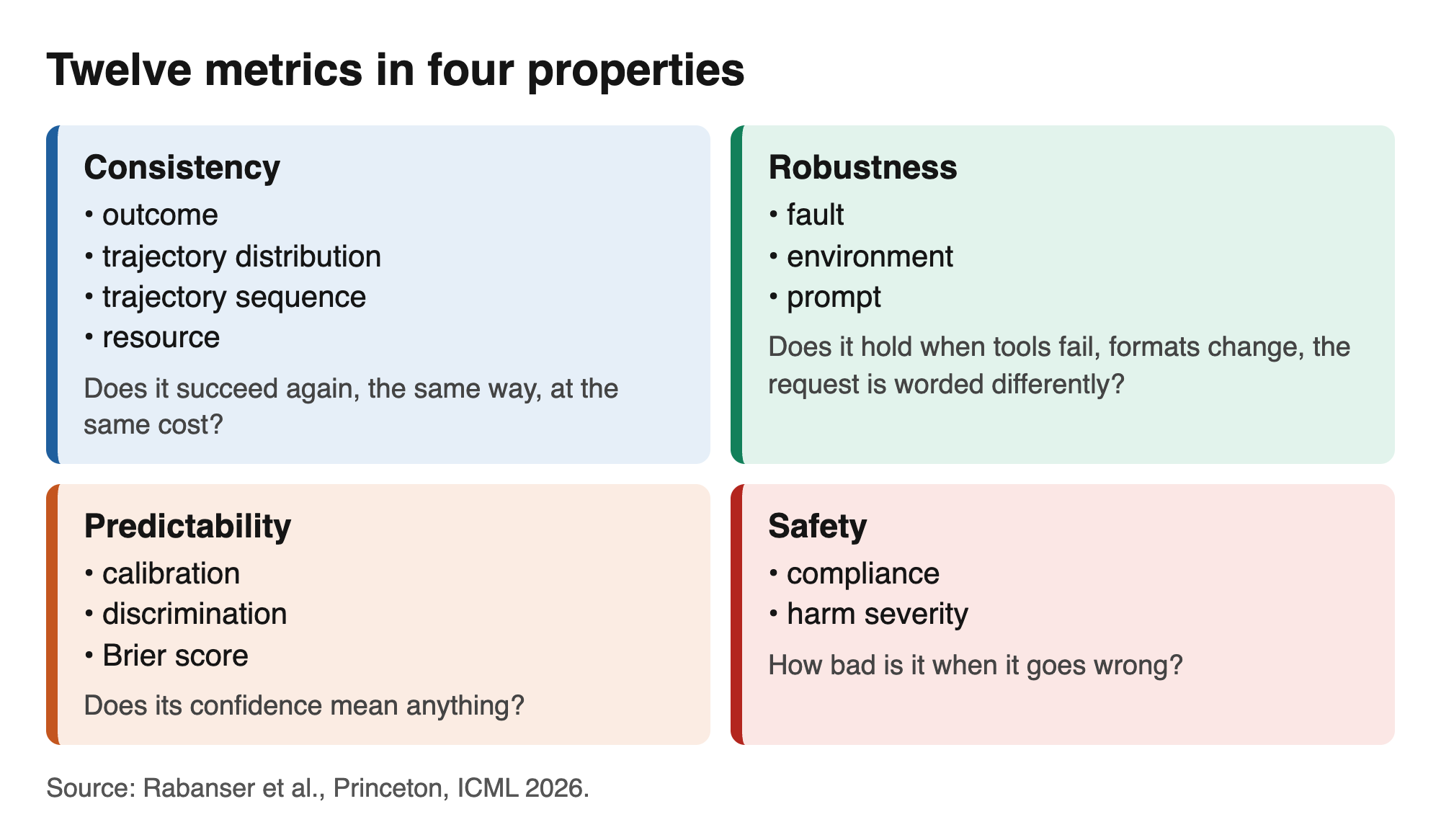
Two findings matter for operators. First, "a 'what but not when' pattern: agents achieve substantially higher distribution consistency than sequence consistency". Agents pick similar actions across runs but in different orders. If your process depends on order, test order.
Second, "While calibration, robustness, and safety generally improve with model size, consistency often exhibits an inverse pattern." A bigger model may be more capable and less repeatable.
The paper excludes safety from its overall score because "safety violations are inherently a tail phenomenon". Averages hide them. Report safety separately.
Task length
METR measures capability as a time horizon: the length of task, in human expert time, that a model completes with a given success rate. In its March 2025 paper, Claude 3.7 Sonnet had the longest 80% horizon among the models examined, "at around 15 minutes, in contrast to its 50%-horizon of 59 minutes." (The abstract of the same version gives around 50 minutes for the 50% horizon.) METR's reading: "even models that sometimes succeed on difficult and diverse tasks cannot reliably perform tasks of moderate length."
METR is careful about the precision. A March 2026 note says "There are only ~230 tasks to cover the range from 1 second to 20+ hours", and that confidence intervals are "often a factor of 2 in both directions." Use the gap between the 50% and 80% horizons as a reminder, not as a planning number.
Compounding steps
Karpathy's march of nines has a simple arithmetic behind it. If each step of a workflow succeeds with probability p and steps are independent, a run of n steps succeeds with probability p to the power of n.
| Per-step success | 10 steps | 20 steps | 50 steps |
|---|---|---|---|
| 90% | 34.9% | 12.2% | 0.5% |
| 99% | 90.4% | 81.8% | 60.5% |
| 99.9% | 99.0% | 98.0% | 95.1% |
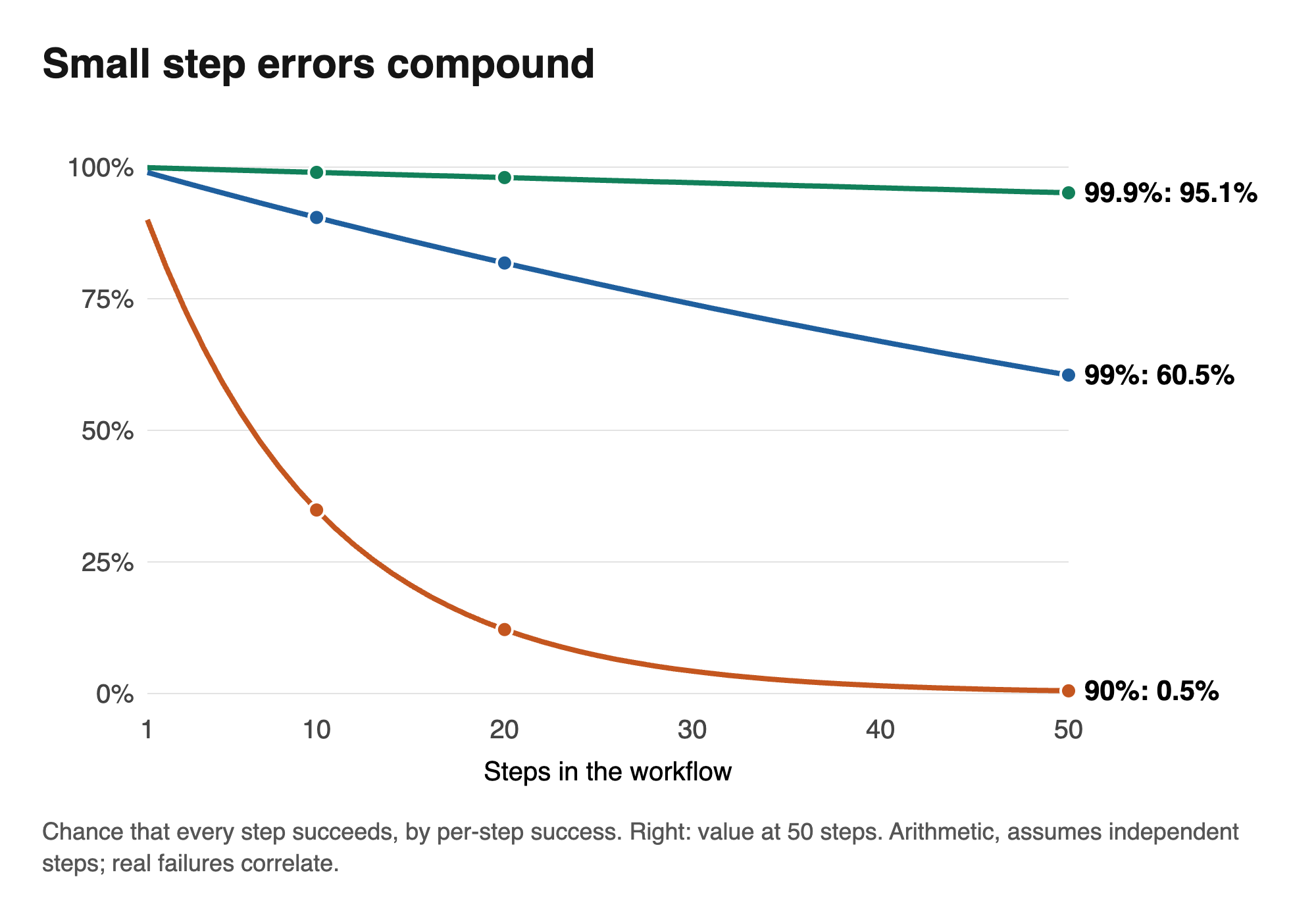
Independence is an assumption. Real failures correlate: one outage breaks many steps at once, and one misunderstanding carries forward. The table shows the direction, not your numbers.
Operational indicators
The manifesto's list of operational indicators is the most complete found: policy violation rate, authority exception rate, human intervention rate, failure and recovery rate, evaluation coverage, control and policy coverage, observability completeness, incident frequency and severity, blast radius, authority-lineage coverage, recovery and rollback success, and reliability drift over time.
Microsoft's draft Agent SRE spec is the only document found that sets default targets for such indicators. Gopinath's AORE reports targets and results too, from simulation: trace completeness of 98.7% against a target of 99.5%. Microsoft's built-in defaults include task success rate 99.5% over 30 days, tool call accuracy 99.9% over 7 days, policy compliance 100% over 24 hours, cost per task $0.50 and a maximum delegation chain depth of 3. Burn-rate alerts fire at 2 times (warning) and 10 times (critical) the allowed rate. These are defaults in a draft, not measured results.
The spec defines the error budget the way SRE does: "The allowable amount of unreliability over a measurement window, computed as 1 - SLO target." A service level objective (SLO) "MUST combine one or more SLIs" (service level indicators) "with an error budget".
No source reviewed reports a live production agent's service level objective and error budget with real numbers. That is the clearest gap in the published state of the art.
IMDA explicitly recommends one more indicator: human override rates and response times. It measures the humans in the loop, not the agent.
What would you put in your agent's service level objective? If it is only task success, you are measuring capability.
Maturity model
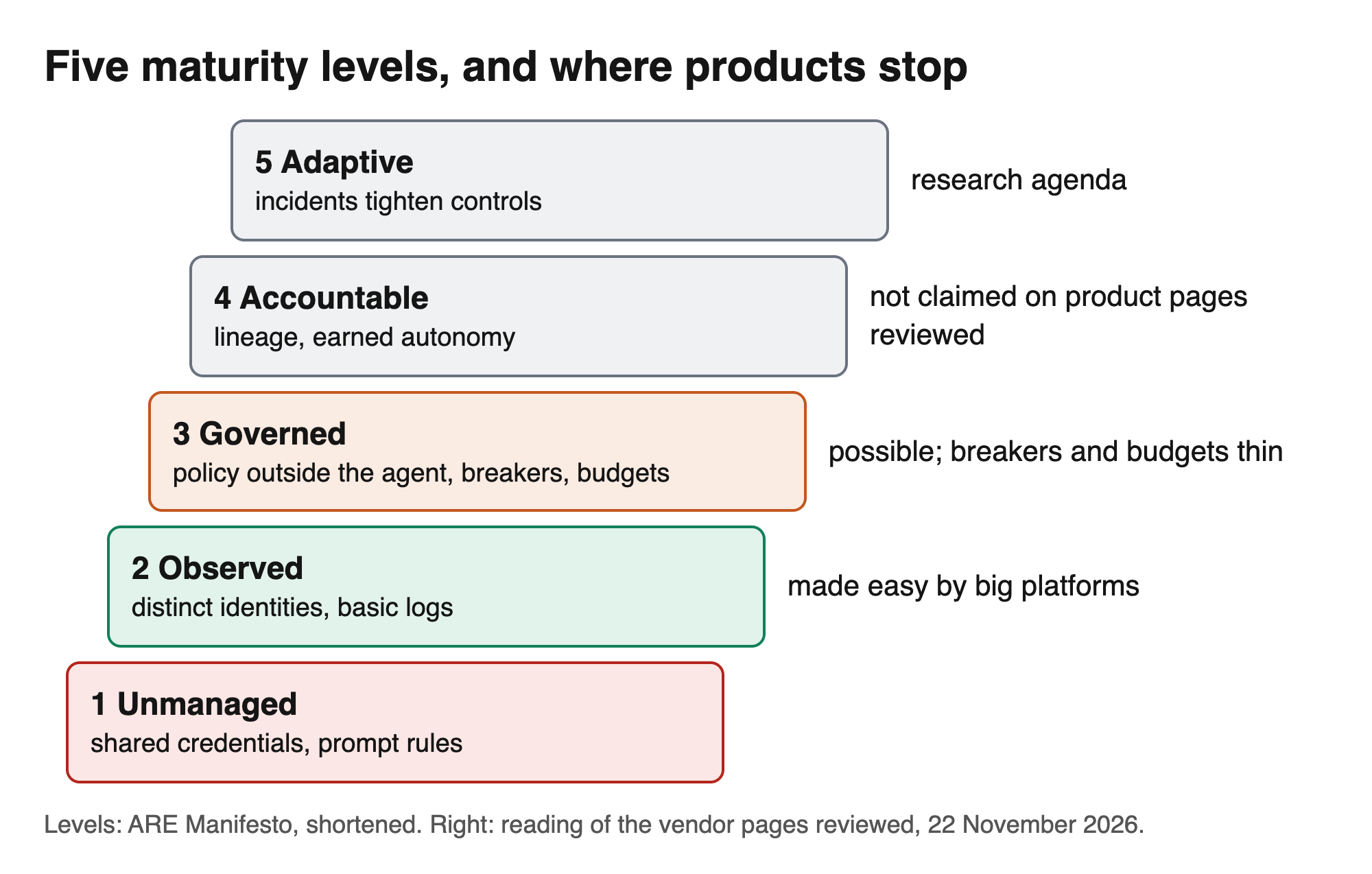
Five levels
The manifesto's maturity model is modelled "loosely on the leveled, per-capability structure of frameworks like SLSA in software supply chain security" (Supply-chain Levels for Software Artifacts). Each level comes with signals you can check.
| Level | Description (manifesto) | Signal you can check |
|---|---|---|
| 1 Unmanaged | Shared or human credentials; constraints in the prompt only; incidental logging; no containment | "You cannot reliably answer 'which specific agent took this action?' after the fact" |
| 2 Observed | Distinct identities but no verified authority lineage; policy as a document; basic logs; manual stop | "You can identify the agent, but you cannot prove what it was actually authorized to do" |
| 3 Governed | Verifiable identity; authority scoped per task; policy enforced outside the agent; full decision trails; circuit breakers and budgets per agent class | "An external system (not the model) can independently block or halt agent actions" |
| 4 Accountable | Authority lineage through the spawn chain; policy generated from contracts; progressive autonomy | "Agents automatically gain or lose scope based on measured reliability, not just static configuration" |
| 5 Adaptive | Lineage even for millisecond sub-agents; policy keeps pace in real time; incidents tighten controls automatically; usable by non-specialists | "Reliability problems detected in production automatically tighten future controls" |
Market position
Map the vendor coverage onto the levels and a picture forms. The big platforms now make level 2 easy and level 3 possible: agent identities, registries, gateways that enforce policy outside the model, audit trails.
Level 3 also asks for "Circuit breakers and budgets ... defined per agent class, and failures halt automatically". That is where the product pages reviewed thin out. Hard spend caps exist at Databricks. Circuit breakers exist in Microsoft's open source toolkit, with manual recovery. Kill switches found elsewhere are announced or partial.
Level 4 needs authority lineage across sub-agents and automatic promotion and demotion. No product page reviewed claims either. Level 5 is a research agenda.
The manifesto's own framing helps here: it "lets organizations assess reliability incrementally rather than as a pass/fail gate." Assess per agent class, not per organisation. A read-only research agent at level 2 may be fine. A payments agent at level 2 is Reliability Debt.
Missing pieces
The levels describe states. They do not say how to get from one to the next, what evidence proves a level, or who checks it. SLSA, the model it borrows from, publishes prescriptive requirements for each level, and its levels are defined by evidence such as provenance. The manifesto has signals. That is the step from manifesto to methodology.
Where next
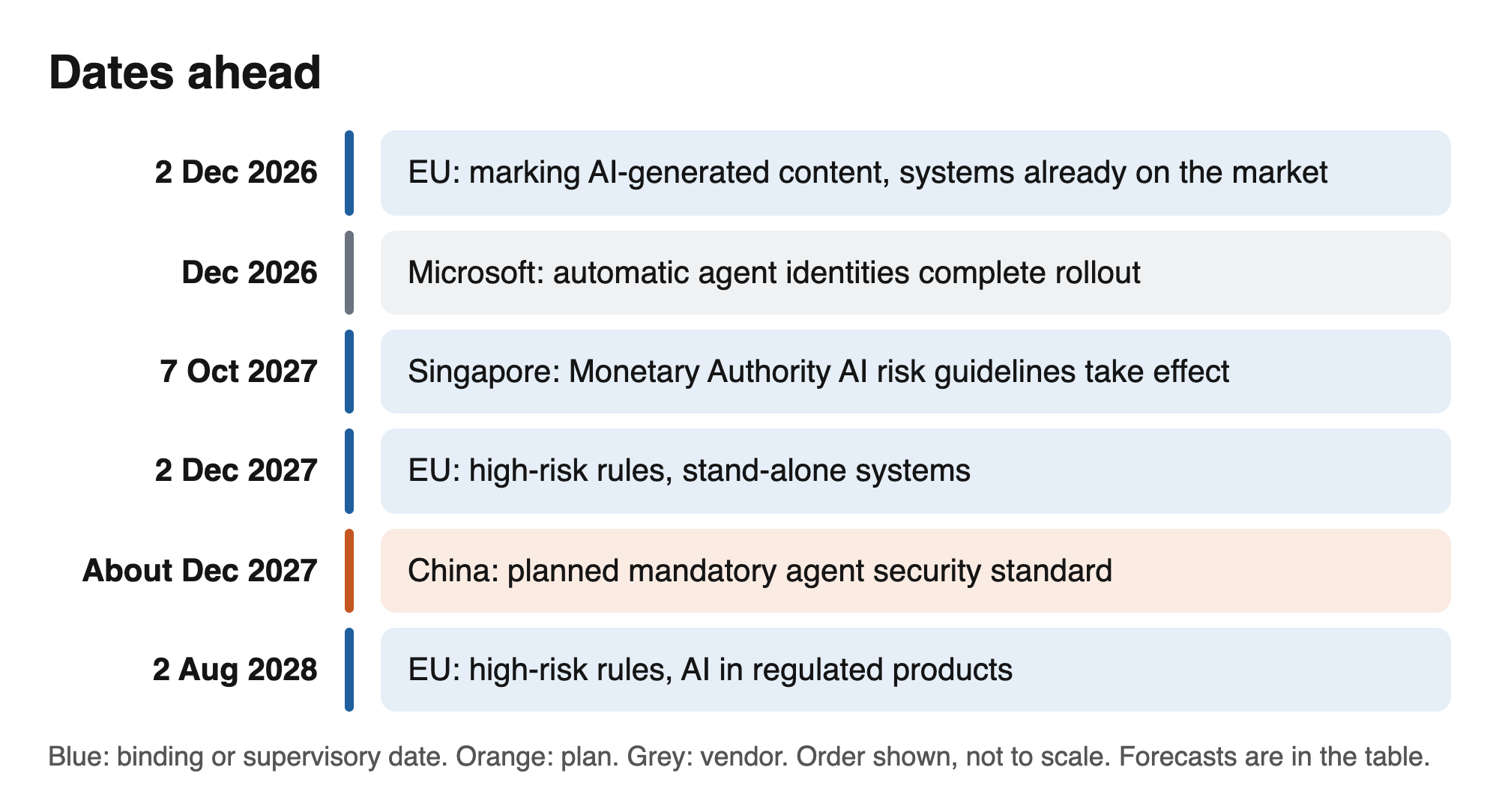
Dated calendar
| Date | What |
|---|---|
| 2 December 2026 | EU AI Act: deadline for marking and detection of AI-generated content under Article 50(2) for systems already on the market |
| December 2026 | Microsoft: automatic Entra Agent ID for connected agents in Agent 365 completes rollout; Agent 365 action center in private preview |
| By end of 2027 | Gartner: over 40% of agentic AI projects cancelled (prediction, June 2025) |
| By 2027 | Gartner: 40% of enterprises demote or decommission autonomous agents (prediction, May 2026) |
| 7 October 2027 | Monetary Authority of Singapore AI risk management guidelines take effect |
| 2 December 2027 | EU AI Act high-risk obligations apply to stand-alone high-risk systems (Annex III) |
| About December 2027 | China: planned mandatory standard on agent application security, 18-month cycle from June 2026 (plan, not a publication date) |
| 2 August 2028 | EU AI Act high-risk obligations apply to AI in regulated products (Annex I) |
Open problems
- Thresholds. What pass^k, violation rate and override rate justify each autonomy level. The Princeton authors propose the idea; no source reviewed gives numbers.
- Sequence-level policy. Per-call policy ships in several products. Policy over sequences of individually allowed calls is early: AWS temporal policies, Databricks stateful policies, Microsoft's roadmap.
- Effect contracts. Tool descriptions that state whether an effect is reversible, bufferable or irreversible, so runtimes can act on it. Atomix shows the runtime side. MCP's tool annotations carry read-only, destructive and idempotent hints, but clients must treat them as untrusted unless the server is trusted, and none says whether an effect can be undone.
- Authority lineage. Proving, for any sub-agent action, the chain of grants back to the original task. NIST and the IETF drafts define attenuation; no product page reviewed claims to prove lineage end to end.
- Automatic contraction. Demoting an agent when its reliability drifts. Gopinath simulates it, Microsoft previews risk-based restrictions, no product reviewed was found to ship the full loop.
- Recovery beyond the platform. Rolling back what an agent changed in another company's system. Compensation helps for reversible effects. For irreversible ones, the answer is still: gate before, not undo after.
- A shared methodology. The ARE Manifesto asks for the discipline to be "developed in the open, with shared vocabulary, portable approaches, and common reliability surfaces". As of November 2026 it has one contributor.
Shifts under way
Identity moved first. Between October 2025 and November 2026 the OpenID Foundation, NIST, the IETF, IMDA, TC260 and all three large clouds moved towards a distinct identity per agent. Short-lived credentials and delegation that narrows are in several of these texts, not all. Expect that to become the default.
Policy is moving out of the prompt and into the path. Gateways, sandboxes and policy engines are now the place rules live. The open question is whether they will see sequences, not just calls.
Measurement is moving from accuracy to reliability. Pass^k and the Princeton metrics give teams a vocabulary. Microsoft's draft spec gives a first set of service level objectives.
Recovery is next. The research exists. Little of it was found in the product pages reviewed. The incident record shows that is where the damage is.
The manifesto calls itself "the beginning" of a discipline. That is accurate. The map is drawn. Completing the methodology is the 2027 problem.
Reference
Regulatory timeline
| Date | Event |
|---|---|
| 7 October 2025 | OpenID Foundation whitepaper "Identity Management for Agentic AI" |
| 13 November 2025 | Monetary Authority of Singapore consults on AI risk management guidelines, including AI agents |
| 19 November 2025 | European Commission proposes the Digital Omnibus on AI |
| 25 November 2025 | MCP specification revision with Client ID Metadata Documents |
| 9 December 2025 | OWASP Top 10 for Agentic Applications |
| 9 December 2025 | FINRA 2026 oversight report adds an AI agents section |
| 12 January 2026 | NIST's Center for AI Standards and Innovation (CAISI) issues a request for information on securing AI agent systems |
| 22 January 2026 | Singapore IMDA Model AI Governance Framework for Agentic AI, version 1.0 |
| 27 January 2026 | FINRA blog "Observations on AI Agents" |
| 5 February 2026 | NIST NCCoE concept paper on software and AI agent identity and authorization |
| 17 February 2026 | NIST AI Agent Standards Initiative announced |
| 12 March 2026 | A2A protocol version 1.0 |
| April 2026 | Microsoft Entra Agent ID generally available |
| 7 May 2026 | EU provisional agreement: high-risk rules delayed to 2 December 2027 and 2 August 2028 |
| 8 May 2026 | China's Cyberspace Administration, National Development and Reform Commission and Ministry of Industry and Information Technology: implementation opinions on AI agents |
| 18 May 2026 | NIST AI 800-5, summary of responses to the agent security request for information |
| 20 May 2026 | IMDA agentic framework version 1.5 (revised 5 June) |
| 26 June 2026 | China's State Administration for Market Regulation (SAMR): seven-part agent interconnection standards (guiding documents) |
| 27 June 2026 | China plan for a mandatory agent application security standard |
| 29 June 2026 | EU Council adopts the Digital Omnibus on AI |
| July 2026 | ARE Manifesto version 1.0, working draft |
| 20 July 2026 | European Commission Article 50 transparency guidelines, covering AI agents |
| 28 July 2026 | MCP specification 2026-07-28 stable |
| 2 August 2026 | EU AI Act enforcement and Article 50 transparency obligations apply |
| 2 August 2026 | Konishi, Agent Reliability Engineering Design Guide |
| 27 August 2026 | China GB/Z 242-2026, technical requirements for AI agents (guiding document) |
| September 2026 | China TC260 AI Safety Governance Framework 3.0 |
| 7 October 2026 | Monetary Authority of Singapore final AI risk management guidelines, effective 7 October 2027 |
| October 2026 | Gopinath, Agent Operational Reliability Engineering, IEEE UEMCON |
| 19 October 2026 | UK FCA good and poor practice on AI in financial services |
| 27 October 2026 | NIST design tenets for agent identity management systems (blog) |
| 2 November 2026 | IETF draft-ietf-wimse-aims-01, AI Identity Management System |
| 4 November 2026 | US Office of the Comptroller of the Currency (OCC) supervisory framework covering AI agents (Bulletin 2026-54) |
| 6 November 2026 | ISO/IEC TR 27258, interactions in multi-agent AI systems, approved as new project |
| 16 November 2026 | Federal Reserve Governor Barr on AI agents in retail accounts |
Vendor coverage
Y = documented and shipping; P = preview, beta or partial; F = announced for a future release; - = not found in the pages reviewed. As of 22 November 2026.
| Control | ServiceNow | Microsoft Agent 365 / Entra | Microsoft AGT (open source) | AWS AgentCore | Google Agent Platform | Salesforce | Databricks | NVIDIA OpenShell | LangSmith Fleet | Zenity | Credo AI |
|---|---|---|---|---|---|---|---|---|---|---|---|
| Registry / inventory | Y | Y | P | P | Y | P | Y/P | - | Y | Y | Y |
| Agent identity | F | Y | Y | Y | Y | - | P | - | Y | P | - |
| Scoped permissions | F | Y/P | Y | Y | Y | - | Y/P | Y | Y | Y | - |
| Policy outside the model | F | P | Y | Y | Y | P | P | Y | P | Y | - |
| Content guardrails | - | P | P | Y | Y | Y | P | P | - | Y | - |
| Evaluation | - | P | P | Y | - | Y | Y | - | P | - | P |
| Budgets / cost limits | P (cost dashboards) | P | P (draft spec) | P | P | - | Y (hard caps) | - | - | - | - |
| Kill switch / circuit breaker | F | - | Y (manual reset) | - | - | - | - | P | Y | Y | - |
| Human approval | P | P | Y | P | Y | - | P | P (policy changes) | Y | - | P (governance review) |
| Rollback / recovery | - | - | P | - | - | - | P | Y (policies) | - | - | - |
| Audit trail | Y | Y | Y | Y | Y | Y | Y | Y | Y | Y | Y |
| SLO / error budget | - | - | P (draft spec) | - | - | - | - | - | - | - | - |
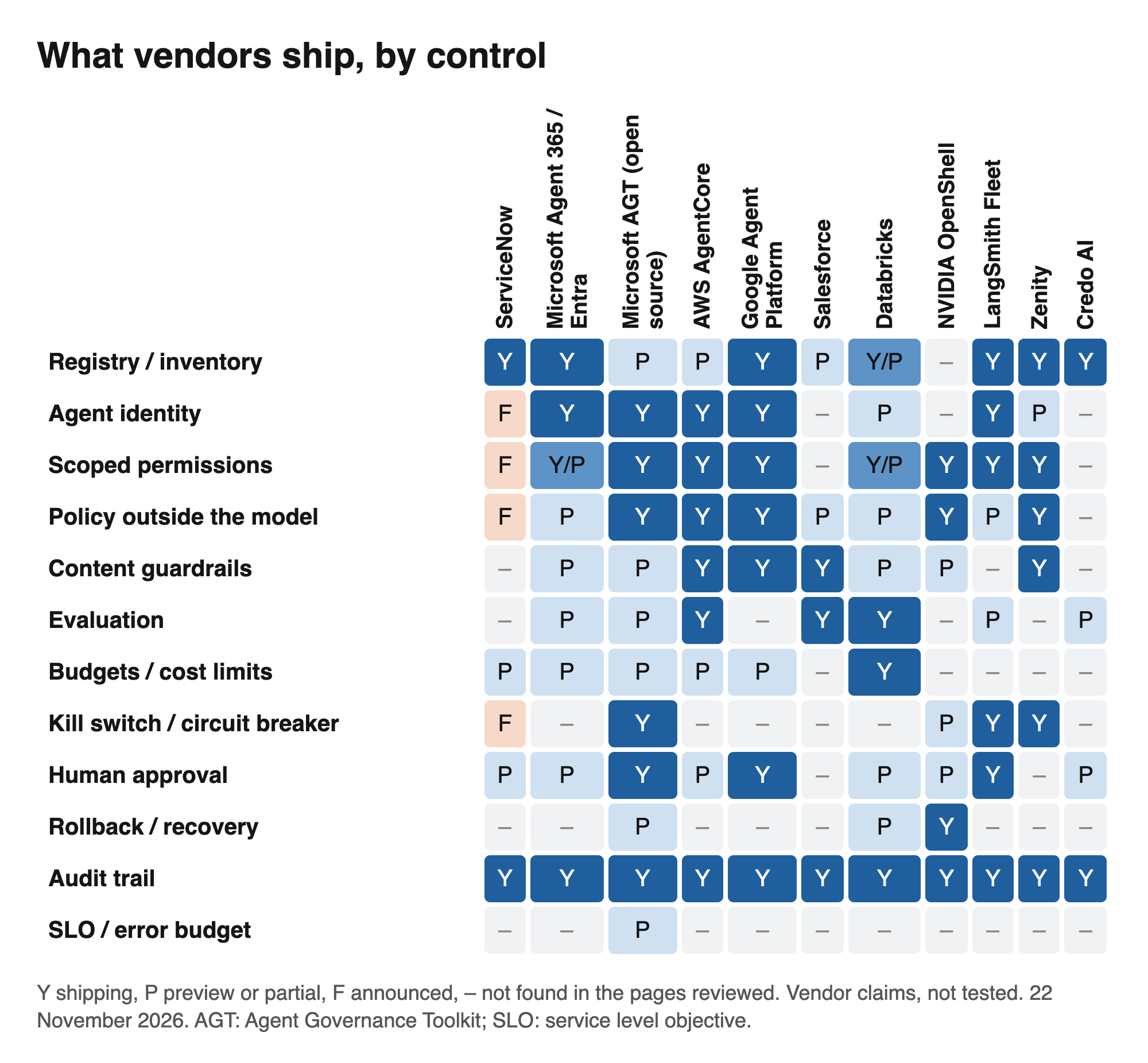
A "-" means not found in the vendor pages reviewed, not that the capability does not exist. Vendor claims are as stated by vendors and were not tested. Several come from vendor documentation read through search extracts.
Open source projects
| Project | Role | Stars | Latest release | License |
|---|---|---|---|---|
| NVIDIA OpenShell (ai-openshell/openshell) | Sandbox with out-of-process policy enforcement | 21,855 | v0.1.9 (17 Nov 2026) | Apache-2.0 |
| microsoft/agent-governance-toolkit | Policy, identity, SRE, kill switch | 6,592 | v4.1.0 (9 Jun 2026) | MIT |
| open-policy-agent/opa | General policy engine | 12,505 | v1.22.4 (12 Nov 2026) | Apache-2.0 |
| cedar-policy/cedar | Authorization language used by AgentCore Policy | 1,890 | v4.15.0 (16 Nov 2026) | Apache-2.0 |
| NVIDIA-NeMo/Guardrails | Dialogue and content guardrails | 7,545 | v0.25.0 (19 Nov 2026) | see repository |
| guardrails-ai/guardrails | Output validators | 7,635 | v0.11.0 (14 Aug 2026) | Apache-2.0 |
| langchain-ai/langgraph | Agent framework with checkpoints and interrupts | 45,248 | 1.2.24 (20 Nov 2026) | MIT |
| responsibleai/agent-control-spec | Portable policy decision specification | 10 | 0.4.0-beta.2 (4 Nov 2026) | MIT |
| mikehogan-thoughts/agent-reliability-engineering | ARE Manifesto | 3 | no release; last commit 24 Aug 2026 | Apache-2.0 |
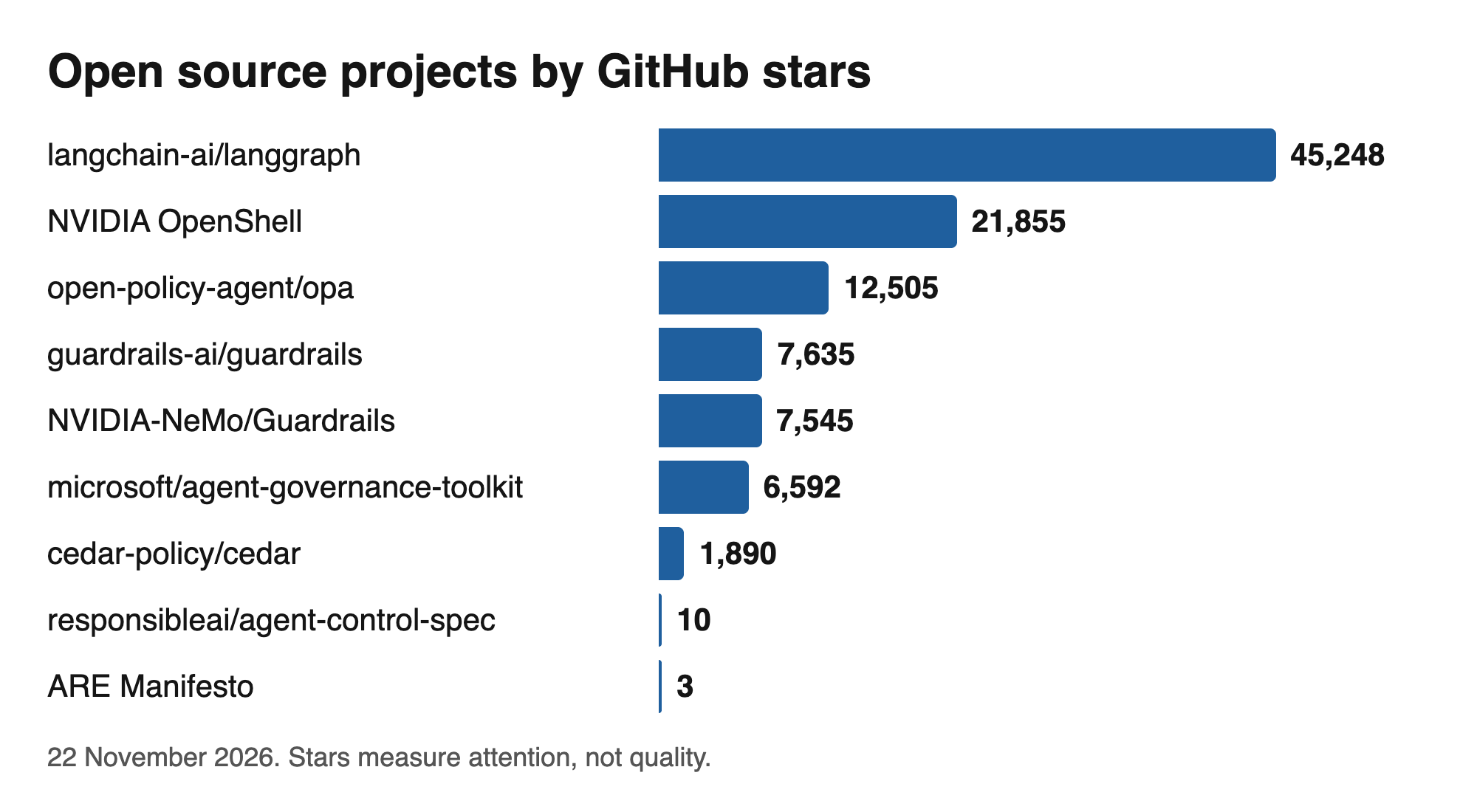
Star counts from GitHub on 22 November 2026. Stars measure attention, not quality.
Sources
Manifestos, guides and frameworks
- Agent Reliability Engineering Manifesto v1.0, Mike Hogan (July 2026); agentreliabilityengineering.org
- Agent Reliability Engineering Design Guide, Hidekazu Konishi (2 Aug 2026, updated 22 Nov 2026)
- Agent Operational Reliability Engineering, Srinath Gopinath, IEEE UEMCON (Oct 2026)
- Agentic Engineering Manifesto, Arnaud Gelas (2026)
- Microsoft Agent SRE Governance 1.0 (draft); Agent Governance Toolkit
- Levels of Autonomy for AI Agents, Kevin Feng, David McDonald and Amy Zhang, Knight First Amendment Institute (28 Jul 2025)
- The Agentic AI Security Scoping Matrix, AWS (21 Nov 2025)
- Auto mode is now the default in Claude Code, Anthropic (Aug 2026); How we built Claude Code auto mode (25 Mar 2026)
- Building effective agents, Anthropic (Dec 2024)
- A practical guide to building agents, OpenAI
- An introduction to Google's approach for secure AI agents
Research
- Towards a Science of AI Agent Reliability, Rabanser et al. (Feb 2026, v3 June 2026, ICML 2026)
- tau-bench, Yao et al. (June 2024)
- MCP fault injection, Iannillo et al. (23 Oct 2026)
- Atomix (2026)
- SagaLLM, Chang and Geng, PVLDB 18(12) (2025)
- Measuring AI Ability to Complete Long Tasks, METR (Mar 2025); METR note on modelling assumptions (20 Mar 2026)
- Andrej Karpathy on the Dwarkesh Patel podcast (Oct 2025)
Surveys and forecasts
- Boomi, Forrester study on agentic AI readiness (20 Jul 2026)
- Gartner, 40% of enterprises will demote or decommission autonomous AI agents (26 May 2026)
- Gartner, over 40% of agentic AI projects will be canceled by end of 2027 (25 Jun 2025)
- VentureBeat, VB Pulse on the evaluation gap (10 Jul 2026)
Incidents
- The Register on Replit (21 Jul 2025)
- The Guardian on the PocketOS deletion (29 Apr 2026); post-mortem
- Eon, 33 public cases of AI agents breaking production (Nov 2026)
Regulators and standards
- Singapore IMDA framework v1.0 announcement (22 Jan 2026); v1.5 factsheet (20 May 2026)
- NIST AI Agent Standards Initiative (17 Feb 2026)
- NIST NCCoE agent identity concept paper (5 Feb 2026)
- NIST design tenets for agent identity management systems (27 Oct 2026)
- OWASP Top 10 for Agentic Applications (9 Dec 2025)
- OpenID Foundation, Identity Management for Agentic AI (Oct 2025)
- MCP authorization specification 2026-07-28
- IETF draft-ietf-wimse-aims (2 Nov 2026); draft-mishra-oauth-agent-grants (Aug 2026)
- EU AI Act service desk on AI agents; Council adoption of the Digital Omnibus (29 Jun 2026); Article 50 guidelines (20 Jul 2026)
- China CAC implementation opinions on AI agents (8 May 2026); TC260 AI Safety Governance Framework 3.0 (Sept 2026); planned agent application security standard (27 Jun 2026)
- SLSA v1.0 levels
- MCP tool annotations, specification 2026-07-28
- IMDA, Starter Kit for Testing Agentic Systems for Safety and Reliability, v1.0 (October 2026)
- ISO/IEC TR 27258 (project approved 6 Nov 2026)
- Monetary Authority of Singapore, Guidelines on AI Risk Management (7 Oct 2026)
- UK FCA, AI in financial services: good practice (19 Oct 2026)
- FINRA 2026 oversight report, generative AI (9 Dec 2025)
- Federal Reserve, Governor Barr (16 Nov 2026)
Vendors
- ServiceNow AI Passport (15 Oct 2026)
- ServiceNow and NVIDIA policy enforcement (21 Oct 2026)
- Microsoft Agent 365; What's new in Agent 365, Ignite 2026; Securing MCP with the Agent Governance Toolkit (22 Apr 2026); Entra Agent ID
- AWS AgentCore Policy GA (3 Mar 2026); AgentCore release notes
- Google Gemini Enterprise Agent Platform (22 Apr 2026)
- Salesforce Agentforce 3 (23 Jun 2025)
- Databricks, what's new in Unity Catalog, Data + AI Summit 2026
- Zenity runtime boundaries (27 Jul 2026)
- Databricks Unity AI Gateway (2026)
- NVIDIA OpenShell (16 Mar 2026); docs
- LangSmith Fleet access and oversight
- Temporal LangGraph plugin; LangGraph checkpointers