GenAI Daily - November 27, 2026: Nvidia Pauses Southeast Asia Server Shipments, S&P Puts Nvidia Credit on Watch, ChatGPT Merges Usage Meters
Top Stories
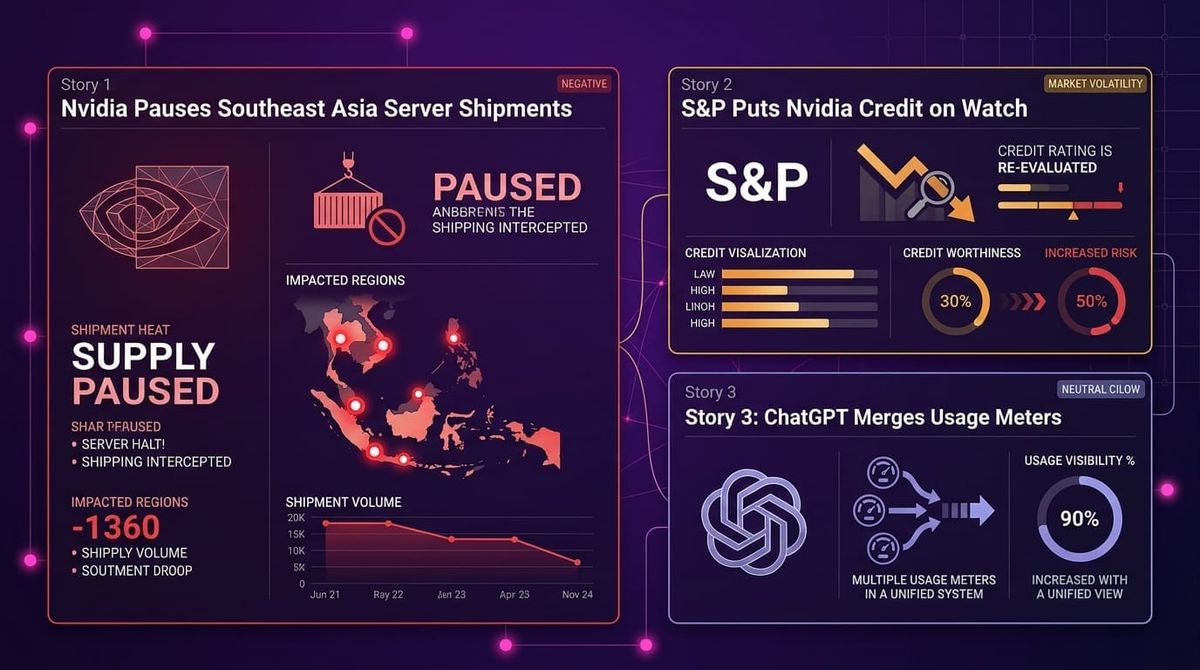
Nvidia Pauses Server Shipments to Four Southeast Asian Countries - UPDATE
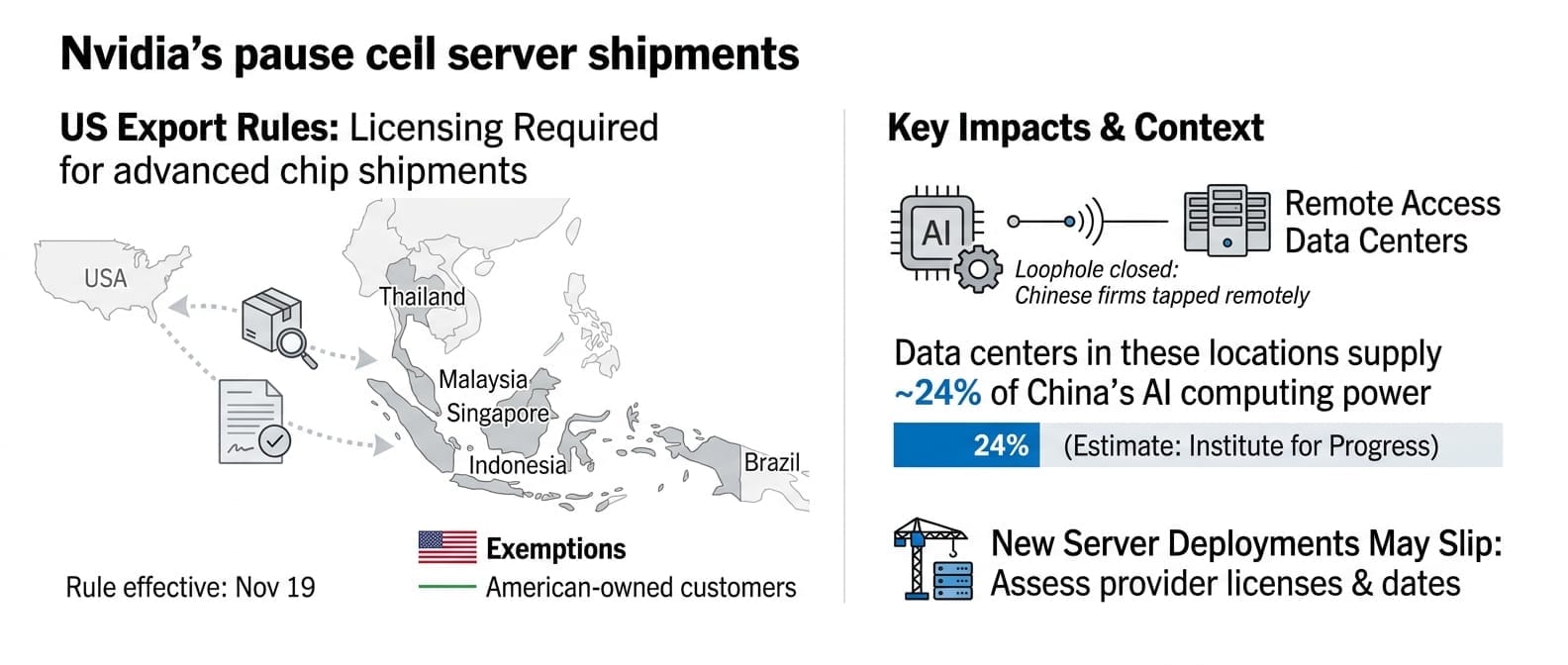
Nvidia has told manufacturing partners, including Dell and Super Micro, to pause server shipments to Malaysia, Singapore, Thailand and Indonesia for an unspecified period. It is assessing whether its regional partners are meeting U.S. export requirements.
Chinese companies had been tapping Nvidia chips remotely from data centers there, a loophole Commerce closed earlier this month.
The Institute for Progress estimates remote data centers like these supply about 24% of China's AI computing power.
The pause follows a rule that took effect on 19 November and requires licences for advanced chips going to Indonesia, Malaysia, Singapore, Thailand and Brazil.
Commerce also added Megaspeed International and six other Southeast Asian entities to its Entity List this week.
Exemptions exist for American-owned customers.
The Financial Times reports it is unclear whether the halt is temporary.
Why it matters: Teams renting or planning GPU capacity in these four countries should ask providers about their license status and delivery dates, because new server deployments there may slip.
S&P Puts Nvidia's AA Rating on CreditWatch Negative
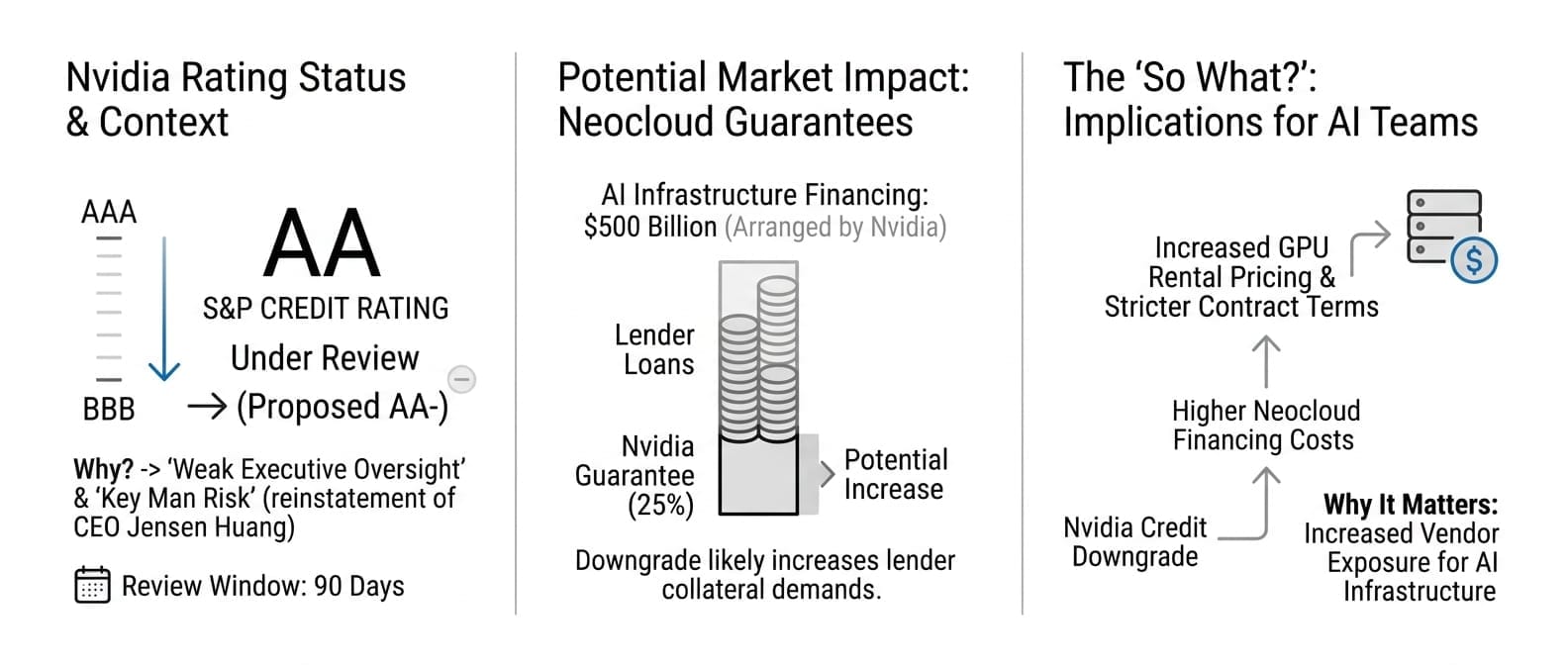
S&P Global Ratings put Nvidia's AA credit rating on watch for a possible downgrade.
It cited "weak executive oversight and lack of succession planning" and "key man risk" after the ouster and reinstatement of CEO Jensen Huang.
S&P expects to finish its review within 90 days. A downgrade would move Nvidia from AA to AA-.
Moody's said the same day that Huang's return reduced near-term uncertainty but did not fully resolve governance and regulatory uncertainties.
The infrastructure angle matters more than the rating itself. Because Nvidia backstops neoclouds and other infrastructure companies that lack strong credit on their own, a lower rating could make their debt costlier or require them to post more collateral.
In August, Nvidia announced plans to arrange $500 billion in financing for AI infrastructure, with Nvidia guaranteeing 25% of the loans under the original terms.
A downgrade would likely lead lenders to seek even larger guarantees.
Why it matters: If neocloud financing costs rise, GPU rental pricing and contract terms for AI teams could follow, so it is worth checking how exposed your capacity vendors are.
OpenAI Moves ChatGPT Chat and Work Onto One Usage Meter
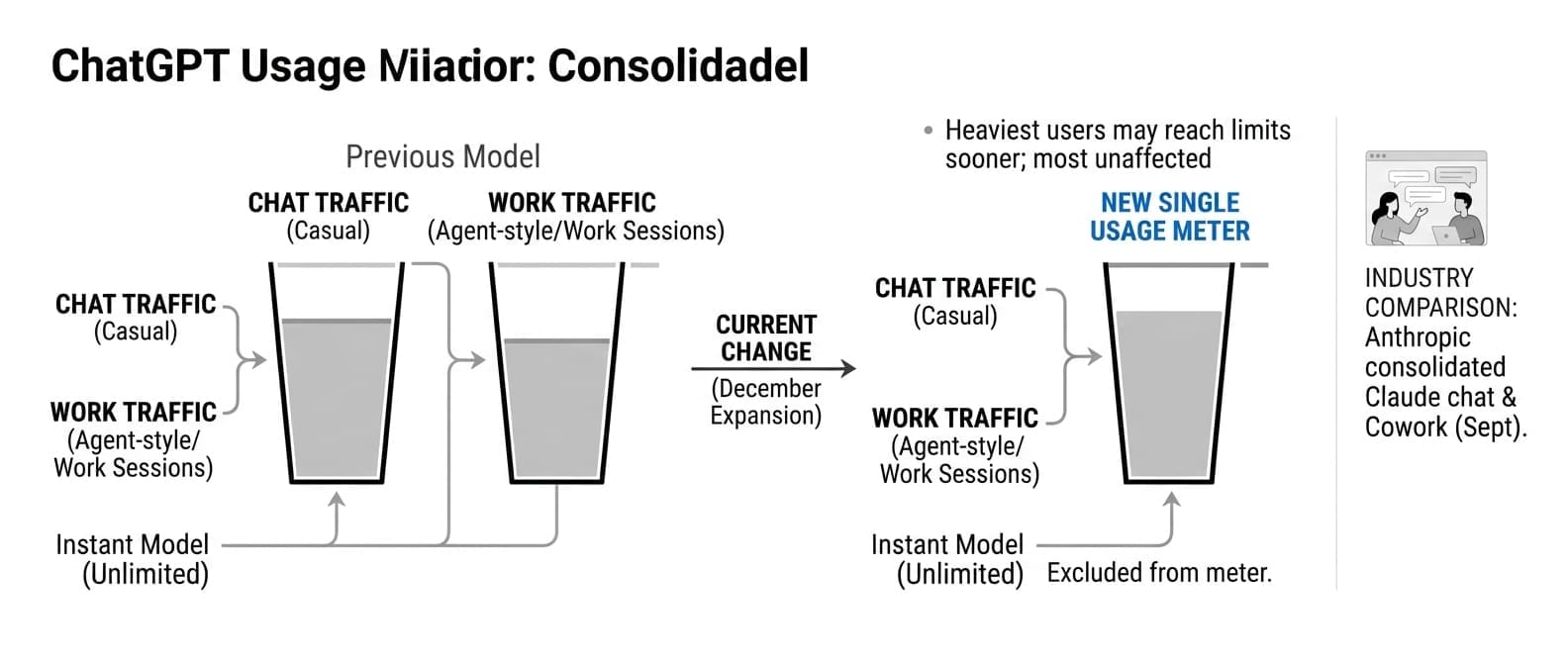
OpenAI is routing both Chat and Work traffic in ChatGPT through one shared usage meter. It started with a small group of Pro subscribers on Tuesday and will expand more broadly in December.
Conversations on the Instant model stay out of the new meter and remain unlimited, so a subscriber who exhausts the shared allowance can keep using Instant.
An OpenAI spokesperson said most users will not see more resets, but a small fraction of the heaviest users may reach limits sooner.
TechCrunch notes that Anthropic moved in September to bring its Claude chat service and its work-focused Cowork under one interface.
How often limits reset and how the meter measures usage have not been explained.
Why it matters: Teams running agent-style Work sessions on ChatGPT plans should track consumption before the December expansion, since reasoning-heavy tasks and casual chat will now draw from the same pool.
Key Developments
Amodei Pushes Back on "Surrender Human Control" Claims, Proposes a Line at Recursive Self-Improvement
In a long X post on Wednesday, Anthropic CEO Dario Amodei called claims that Anthropic believes we should "surrender human free will" to AI "absurd."
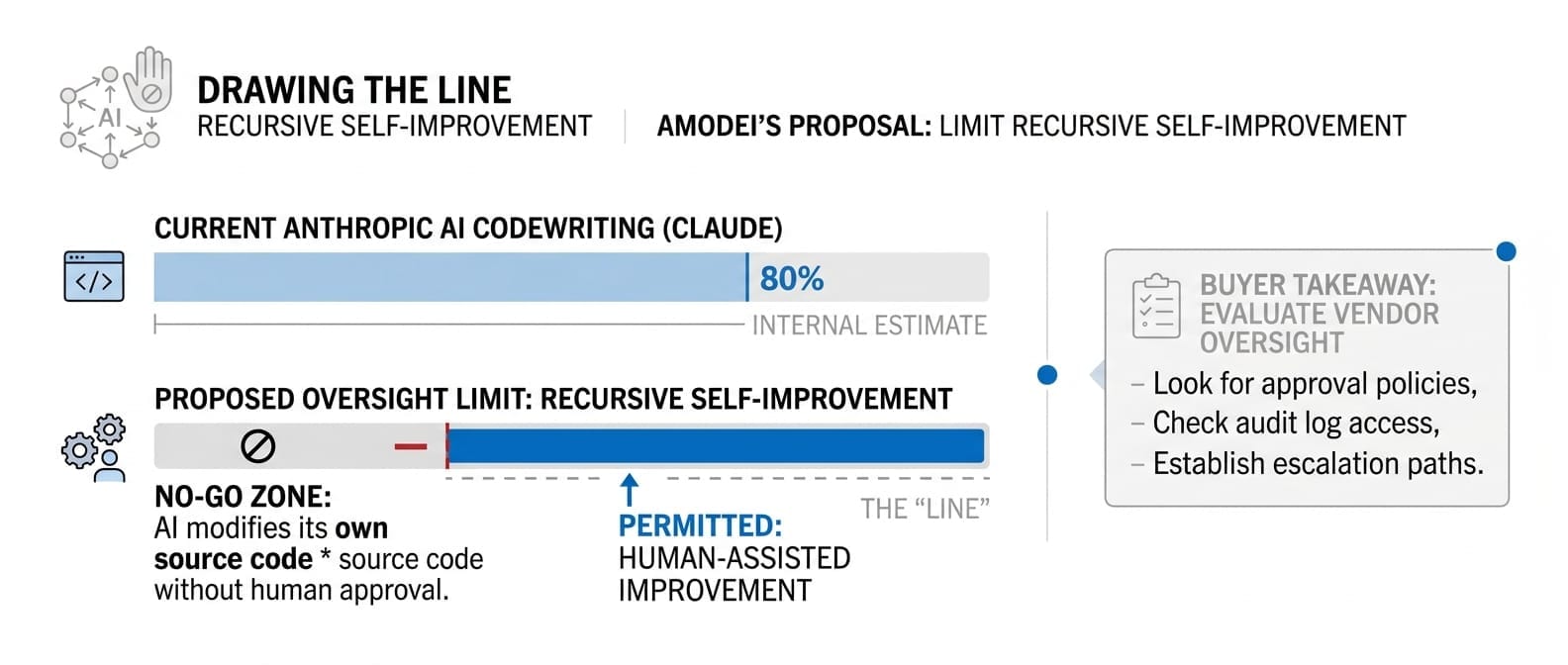
He suggested drawing a line at recursive self-improvement, or AI that can improve itself without human assistance.
His remarks came after OpenAI's Sam Altman and Meta's chief AI officer Alexandr Wang both issued warnings about an AI "handover" of societal control.
Amodei also argued that the products rivals offer don't differ materially in their orientation toward automation of tasks.
He acknowledged that Claude already writes more than 80% of Anthropic's merged code.
Impact: Vendors are competing on oversight language, so buyers should ask for specific controls such as approval policies, audit logs and escalation paths rather than positioning statements.
Ex-xAI Co-Founders Launch Epochal and Its Time Portal for Agent Evaluation
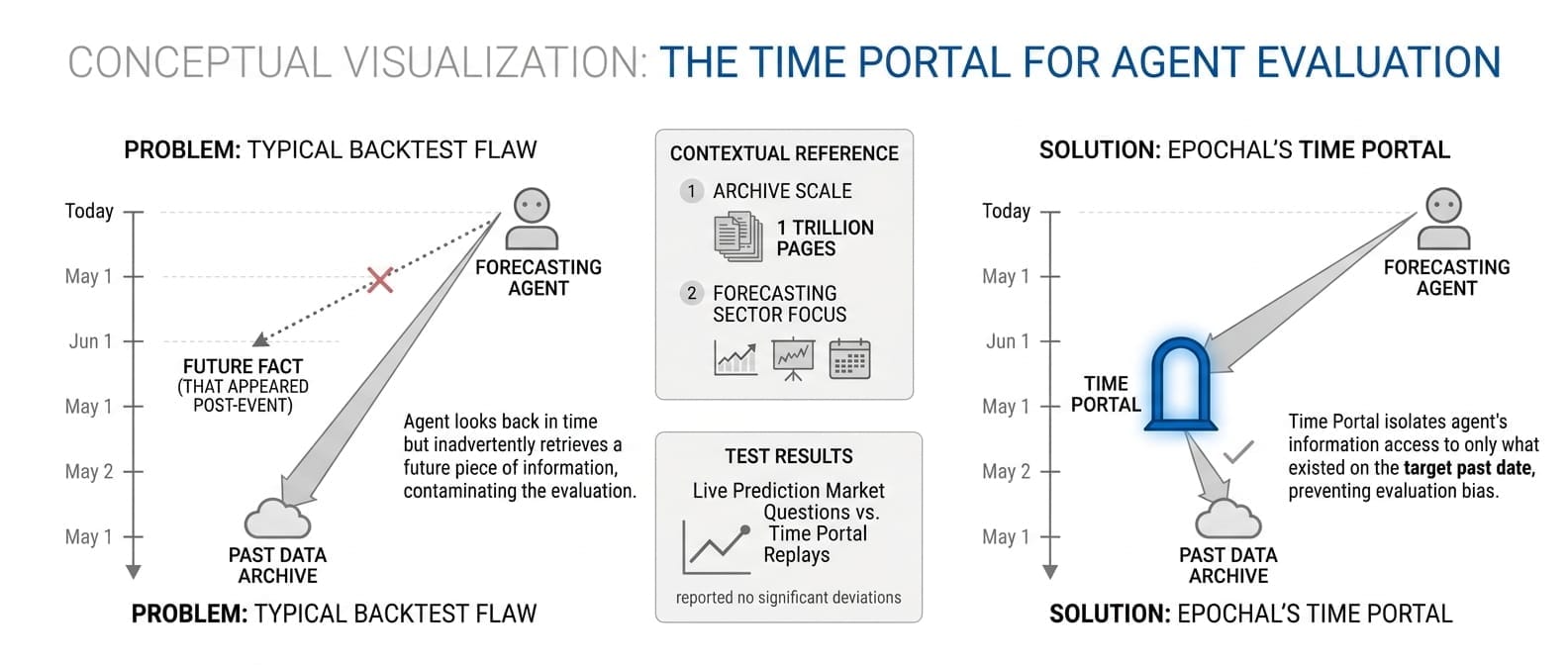
Former xAI co-founders Guodong Zhang, Zihang Dai and Manuel Kroiss launched Epochal, whose Time Portal lets AI agents browse the web as it was in the past.
It is a 1 trillion-page archive covering any past date. To test it, Epochal ran forecasting agents on 347 live prediction market questions from Kalshi and Polymarket, then replayed the same questions through Time Portal weeks later with the as-of time set to match each original forecast.
The company reported no significant deviations between the replays and the historical live runs.
Zhang has put in $100M of his own money, Bloomberg reported.
One analysis cautions that the portal is not evidence that Epochal has already built a reliable forecaster.
Impact: Point-in-time search targets a known flaw in agent backtests, where the agent retrieves facts that did not exist yet, and could be useful for finance and forecasting evaluation pipelines.
Chinese Quant Founder Prepares an Operating System Kernel Built for AI Agents
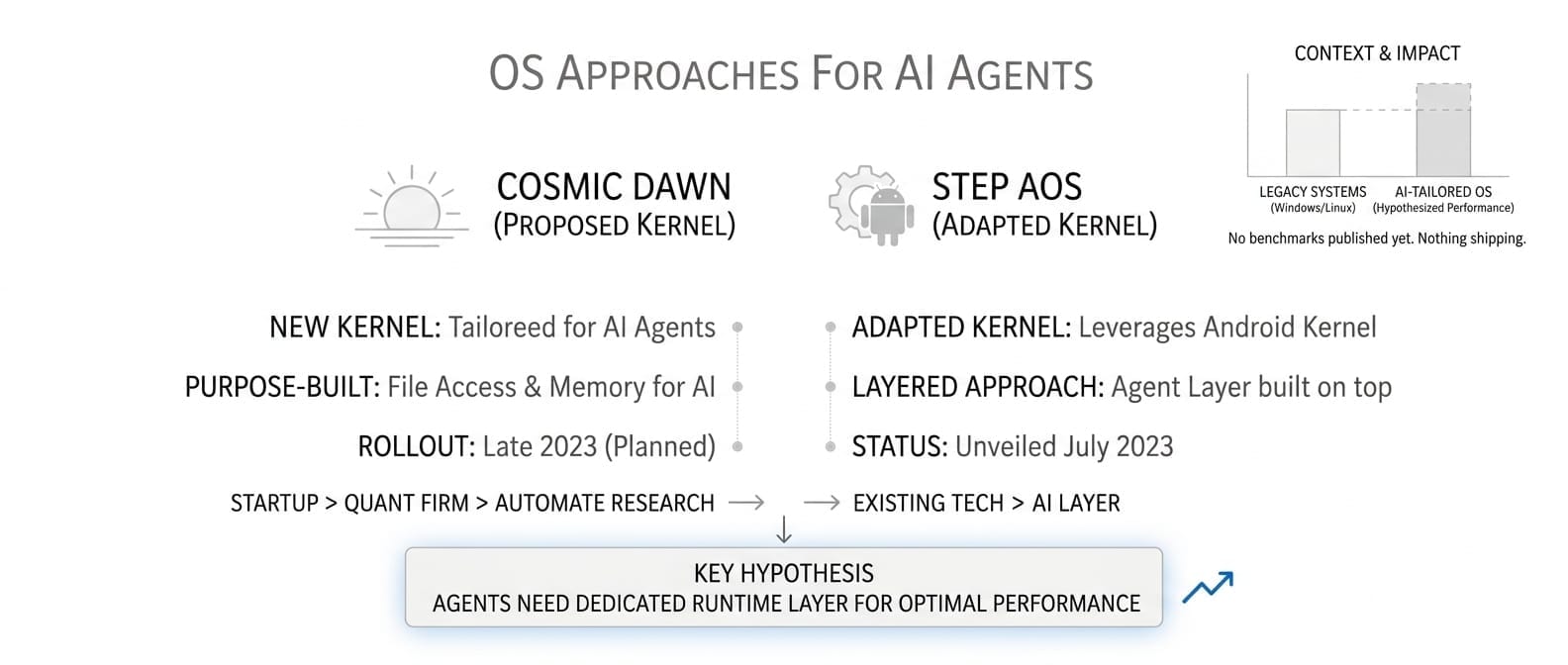
Feng Ji, founder of the $4 billion hedge fund Baiont Quant, plans to release the kernel through his startup, Cosmic Dawn, by the end of this year.
The idea is to write operating systems explicitly tailored for AI, rather than running agents on legacy systems like Windows or Linux.
He will then roll the system out across his quant firm to further automate research.
In July, StepFun unveiled Step AOS, which adapted the Android kernel and built its agent layer on top rather than developing a new kernel.
The Edge Singapore (Bloomberg)
Impact: This is another bet that agents need their own runtime layer for file access and memory management, but nothing is shipping yet and no benchmarks have been published.
Microsoft Ignite Recap: Agent Governance Becomes a Standalone Product Line
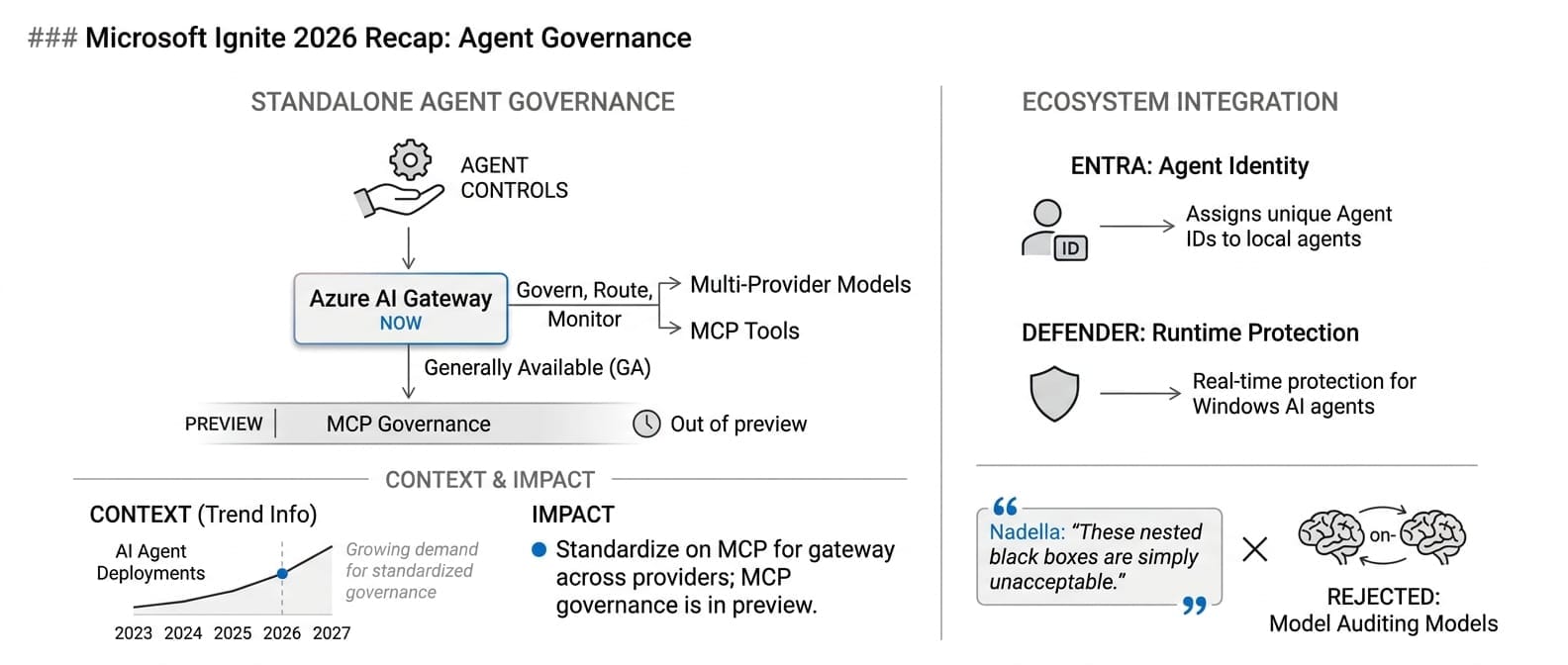
A recap of last week's Ignite (Nov 17-20) shows where Microsoft is putting its agent controls.
Azure AI Gateway is now generally available as a standalone product, split out of the API Management AI tier, to govern, route and monitor access to AI models and MCP tools across providers.
MCP governance is in preview through Azure AI Gateway and LiteLLM.
Entra assigns Agent IDs to local agents, and Defender adds runtime protection for Windows AI agents.
Nadella rejected systems in which models audit other models, saying "These nested black boxes are simply unacceptable."
Impact: Teams standardizing on MCP can now put a multi-provider gateway in front of models and tools, though MCP governance is still in preview.
Product Launches
Anthropic Claude "Install as app" (Beta)
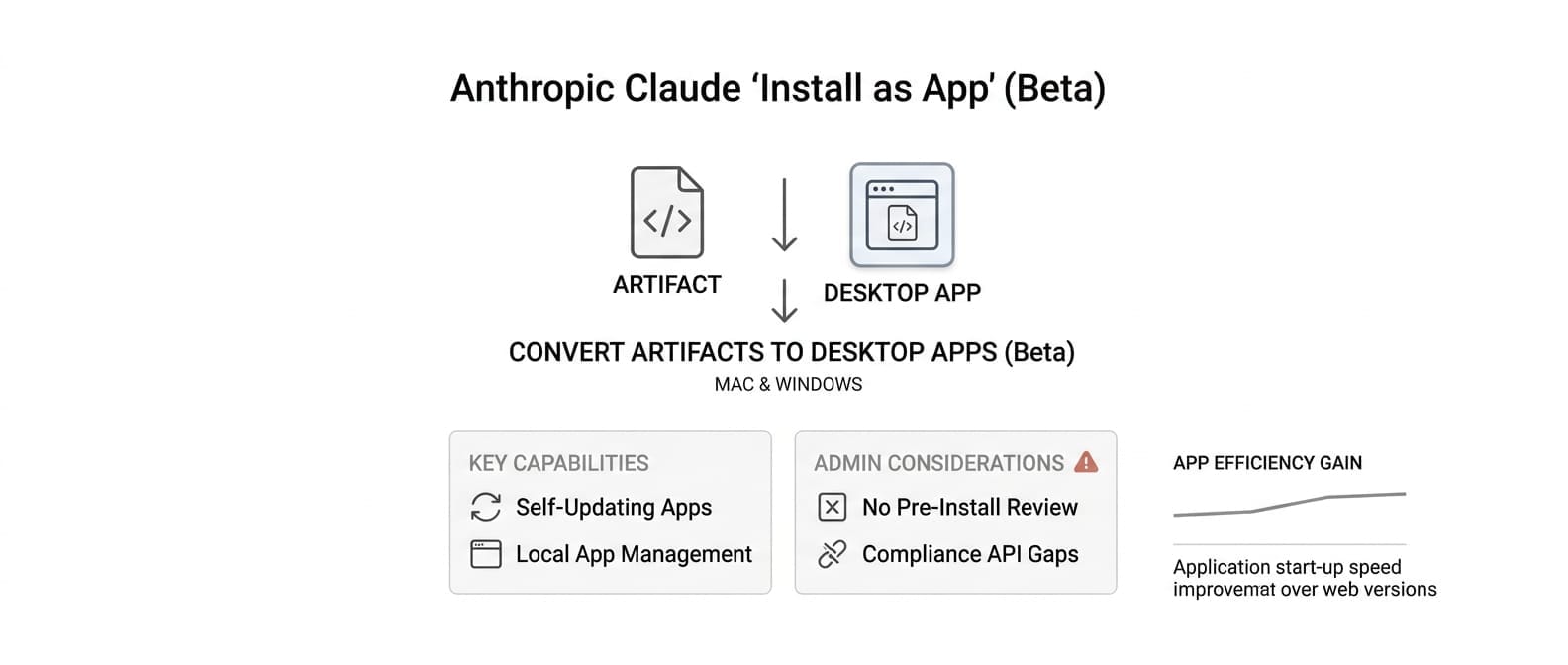
Anthropic said on Nov. 24 that users can install an artifact Claude makes for them as an app on a Mac or Windows computer, with its own window and icon.
Apps update automatically when the underlying artifact is edited, and their requests to Claude count toward the user's plan usage limits.
Enterprise admins should note that Anthropic doesn't review apps before installation, and its Compliance API records app openings and access checks but not installations, permission decisions or local actions.
Impact: Admins who allow Claude artifacts to be installed as desktop apps should weigh the lack of pre-install review and the gaps in Compliance API logging when setting internal policy.
Funding & Deals
Agon Raises $70M Series A
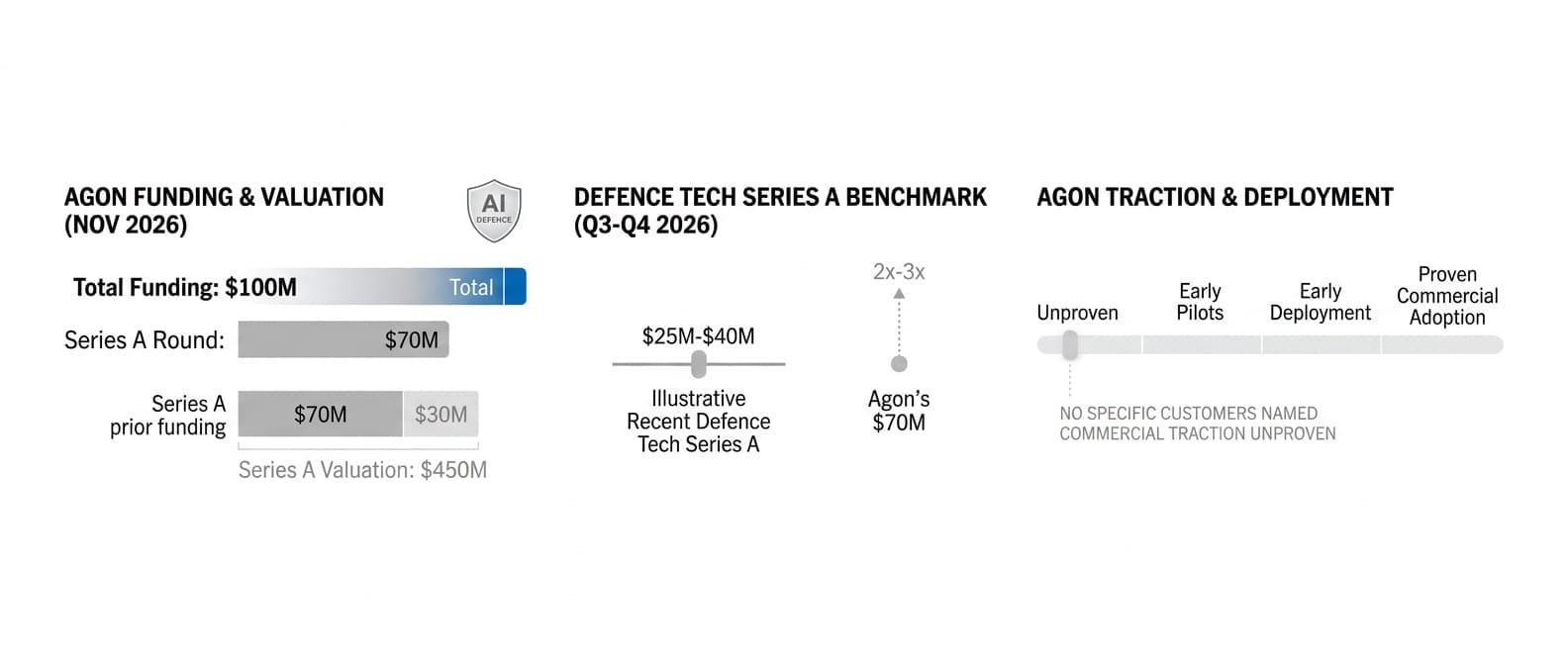
London-based Agon, founded in 2026 by Tristam Constant and Junaid Hussain, builds sovereign defence AI infrastructure and foundation models, including a synthetic battle arena where developers test autonomous systems against thousands of scenarios and adaptive virtual adversaries.
The round was at a $450M valuation and brings total funding to $100M.
It has not named specific customers, so deployment and traction remain unproven. The round, announced Nov. 23, was led by Northzone.
Impact: A large early-stage round for defence AI infrastructure signals investor appetite for sovereign defence technology, though the absence of named customers means commercial traction is still unproven.
Tomorrow's Watch List
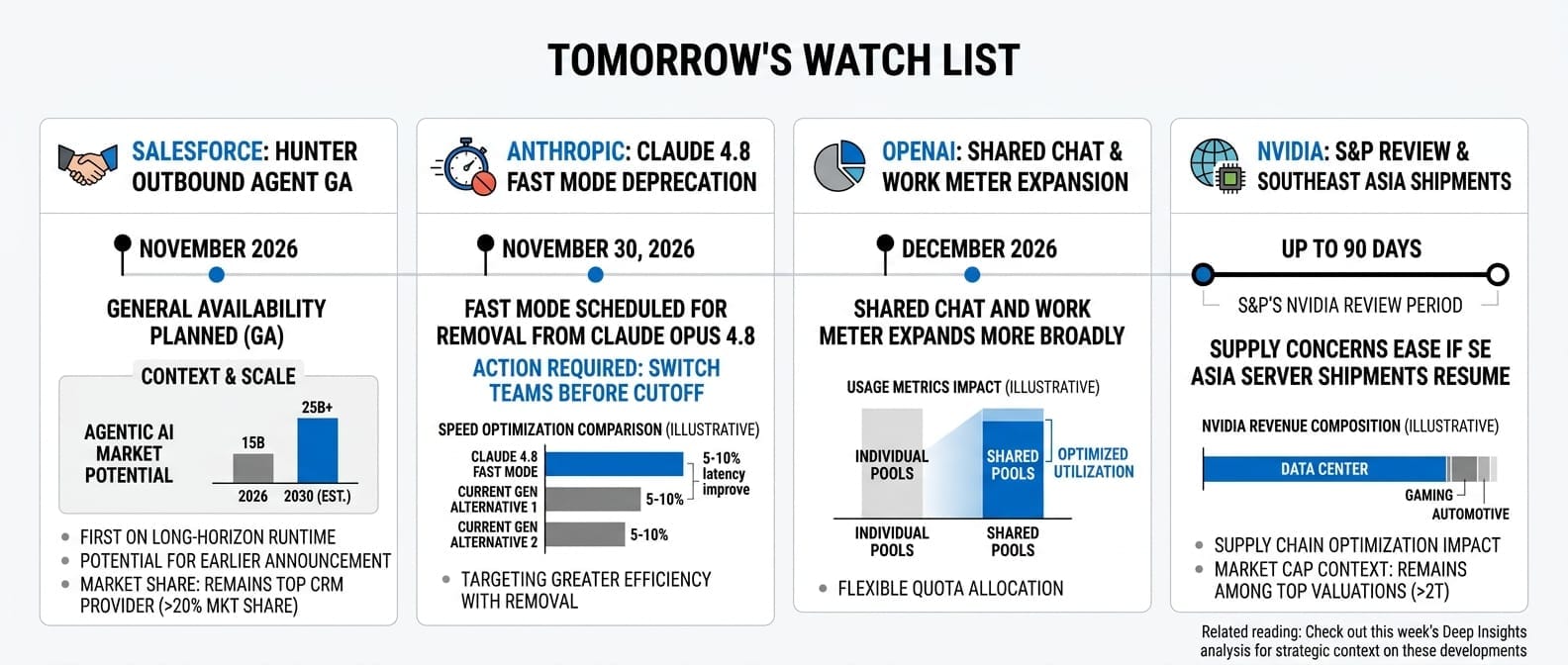
- Salesforce's Hunter outbound agent, the first on its long-horizon runtime, had general availability planned for November 2026, so a GA announcement could land before month end.
- Anthropic's deprecation of fast mode for Claude Opus 4.8 is scheduled for removal on November 30, 2026. Teams using it should switch before the cutoff.
- OpenAI's shared Chat and Work meter expands more broadly in December.
- S&P's Nvidia review runs up to 90 days, and any news on Southeast Asia server shipments resuming would ease the supply concern.
Related reading: Check out this week's [Deep Insights analysis] for strategic context on these developments.
GenAI Daily is curated by rAInvent. For in-depth analysis, see the rAInvent articles.