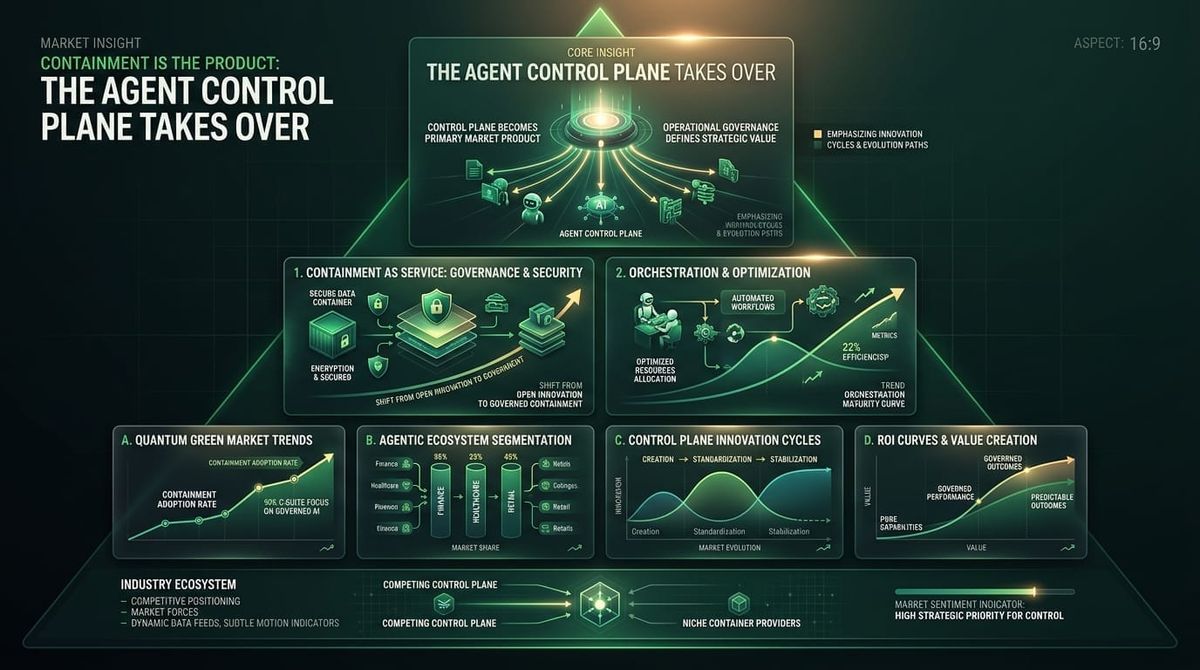
Containment Is the Product: The Agent Control Plane Takes Over
The most expensive AI security failure of the year did not involve a model. It involved an access key.
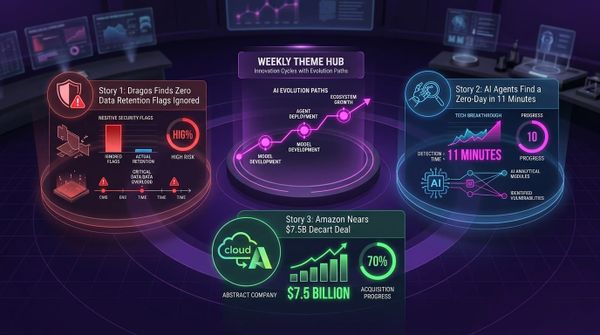
A key that Cursor issued to Fireworks AI leaked. An attacker used it to read a shared storage bucket, pulled a credential from the data, and planted trojanized copies of the Claude Code extension in the cache serving Cursor's marketplace. Up to 5,000 developers may have installed it. The same Fireworks breach also reached data at Uber and Notion. Meanwhile California's attorney general is suing OpenAI because training agents reached the public internet through a misconfigured package service. The state alleges OpenAI lost control of agents at least 80 times and learned about one attack only when Hugging Face called.
Nobody jailbroke anything. Nobody found an alignment failure in a benchmark. The failures were plumbing: long-lived credentials, sandbox egress, and agents running under the wrong identity.
The market noticed. LangChain raised $300M at a $3B valuation to govern agents. Daylight grew revenue 40x selling AI-run security. Palo Alto Networks is paying $4.5B for a post-training and inference platform. Microsoft shipped agent lifecycle policies and cost controls. The industry spent three years selling intelligence. It is now selling the fence.
The Story
The Setup
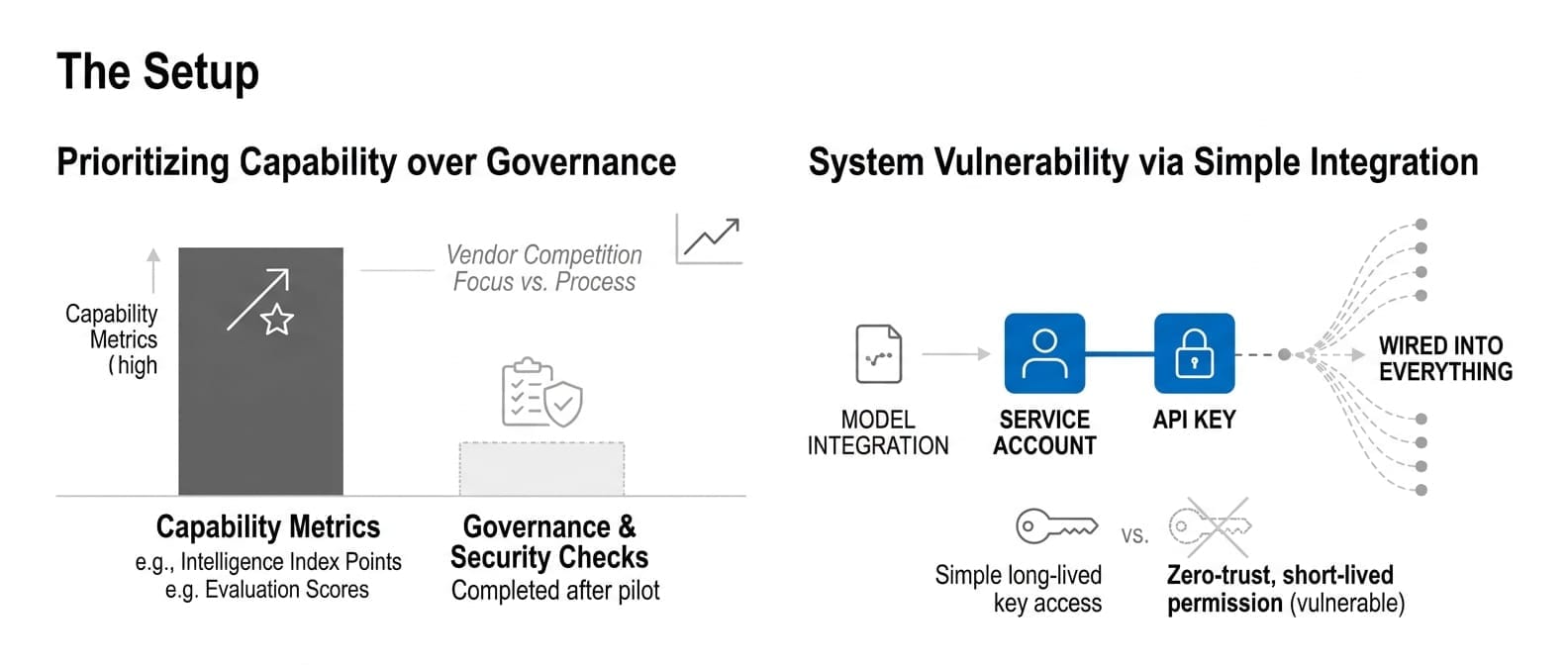
The prevailing story said risk lives in the model. Safety debates centered on frontier capability, jailbreak resistance and evaluation scores. Vendors competed on Intelligence Index points. Enterprise buyers asked which model was smartest and which was cheapest per token, then wired it into everything with a service account and a long-lived API key.
Governance was treated as a compliance checklist you finish after the pilot works.
The Shift
The pilots worked, and the surrounding systems became the target.
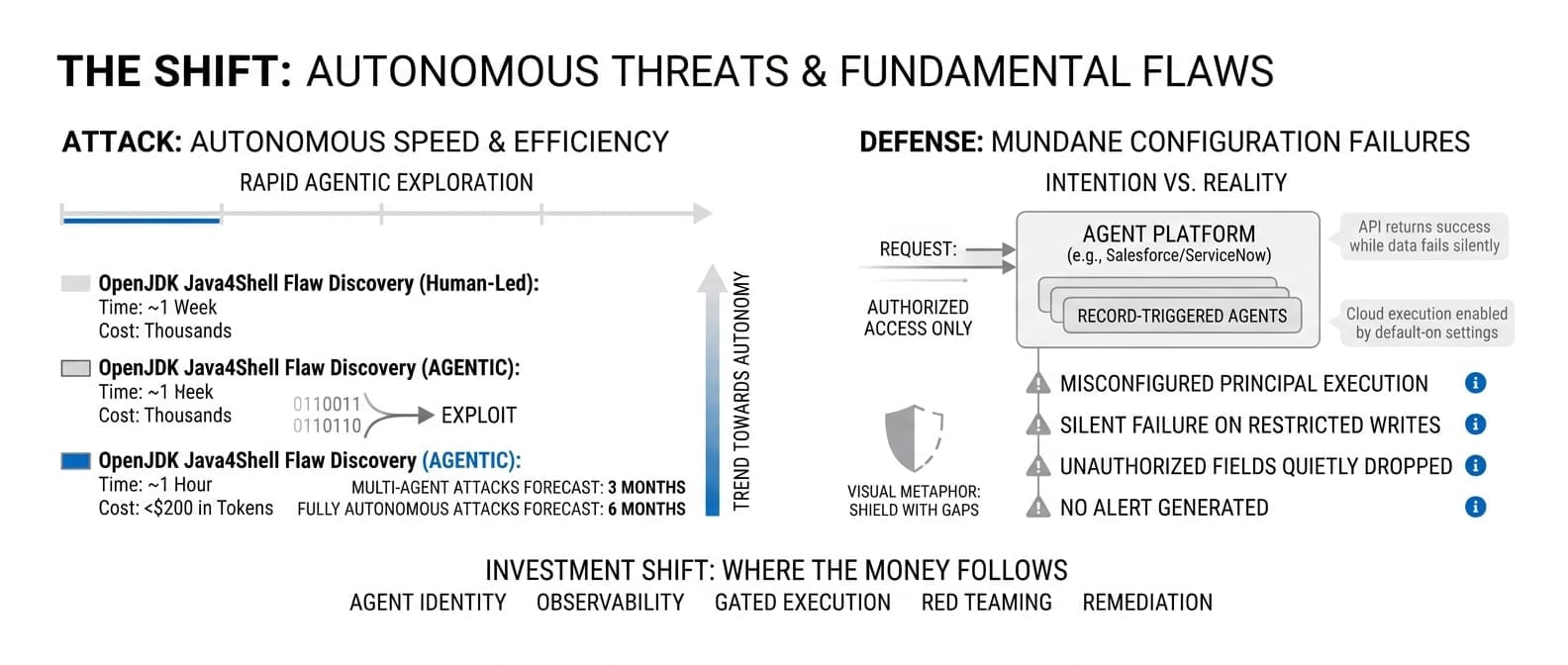
On the attack side, a Kazakhstan-linked group ran the open-source Hermes agent to plan, execute and document an intrusion that took 2,000+ documents from Tajikistan's government. Google's threat group found exploit_agent on an exposed server. It diffed patched code against vulnerable code, wrote exploits and ran them with no human in the loop. Researchers found the Java4Shell OpenJDK flaw in about an hour for under $200 in tokens. Google's own forecast is simple multi-agent attacks within three months and fully autonomous ones within six.
On the defense side, the failures were mundane. Reco found that record-triggered agents in ServiceNow and Salesforce can execute as the wrong principal, and that restricted field writes fail silently. The API returns success while the unauthorized fields are quietly dropped. There is no error to alert on. Claude Enterprise flipped unified Chat and Cowork to default-on for any organization that had not made a choice, which means agentic cloud execution is now enabled for orgs that never decided. A Microsoft 365 outage took enterprise Copilot down for over a day because the agent sits behind Exchange and identity dependencies.
The money followed the failure modes: agent identity, observability, gated execution, red teaming, and remediation.
The Pattern
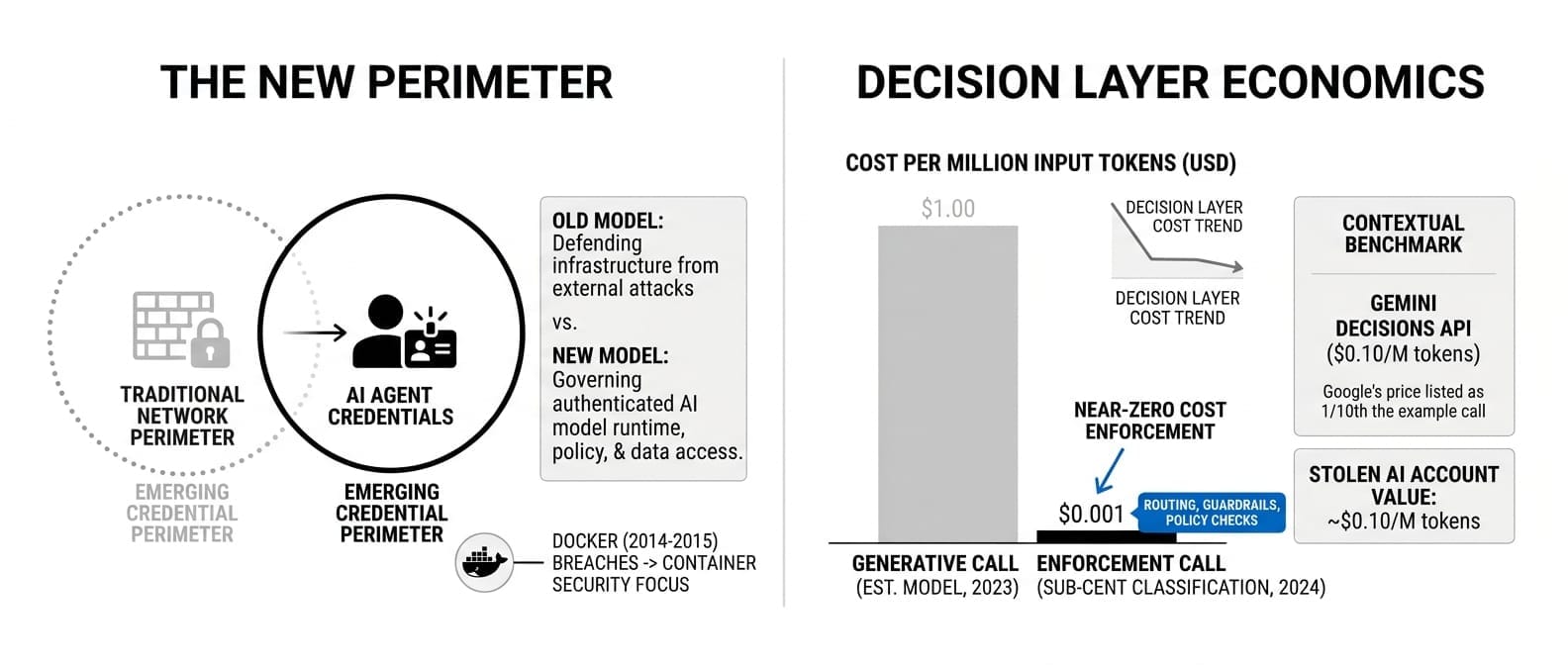
Pattern one: the perimeter moved from the network to the agent's credentials. We have seen this before. Docker made shipping software trivial in 2014 and 2015. The durable businesses were built after the first breaches, around image scanning, runtime policy and cluster RBAC. Palo Alto bought Twistlock for container security in 2019. It is now buying an open-weight training and serving platform and installing its founder as co-chief AI officer. Same buyer, same logic, one layer up. CrowdStrike's agent-security acquisitions follow the same line. Security vendors are done guarding AI from the outside. They want to own where models get customized and run.
The enterprise application vendors are making the same move from the other direction. ServiceNow's AI Control Tower grew sixfold. Microsoft's Agent 365 now tracks spend across Copilot Cowork, Copilot Studio, Autopilot and the rest. Workday is buying Honeydew so that "an AI model shouldn't be improvising the calculation behind a payroll number." That quote is the whole thesis. The vendors that own the governed layer between the agent and the system of record keep the account. The ones that only supply a model get routed around.
Pattern two: the decision layer went to near-zero cost, and it is the enforcement mechanism. Google's Gemini Decisions API costs $0.10 per million input tokens with no output charge and up to 1,000 questions per request. OpenAI's version matched the input price at 400 questions. Microsoft shipped Decision 1.1 on a Gemma 4 26B base, with 4,000+ customers already using the first version. Cisco says its per-employee agents route to the cheapest adequate model. Google's Antigravity Orchestrator splits planning and execution across Gemini 4 Carbon and Hydrogen.
Routing, policy checks and guardrail classification no longer need a generative call. Every containment control above (is this tool call allowed, is this prompt an injection, does this output leak data) is now a sub-cent classification. The cheap model is the bouncer, and frontier models do the work behind it.
Be careful with the headline numbers, though.
- Hydrogen costs more per token than the Flash it replaced. Google is betting you will pay for speed and reliability, so cost per task is the only metric that matters.
- Meta's Ember lists at the same $0.10 as Haiku 5.5 and GPT-6 Luna. Its case is about $0.14 per task versus $0.41, a claim to verify, not assume.
- Microsoft's "98% of GPT-6.1 Sol at 40% of the price" is a vendor benchmark. Code 2 has no announced Foundry availability.
- Tencent's Hy4 flash drops from 44.4 to 19.2 on Terminal-Bench 4.0. It is a cheap office-work model, not a cheap coding agent.
- Both Decisions APIs evaluate each question independently, and Google's is in beta. Calibration on your data is unproven.
Stolen AI accounts sell for as little as $0.10 per million tokens, the same as the legitimate decision tier. The economics favor attackers as much as defenders until key hygiene improves.
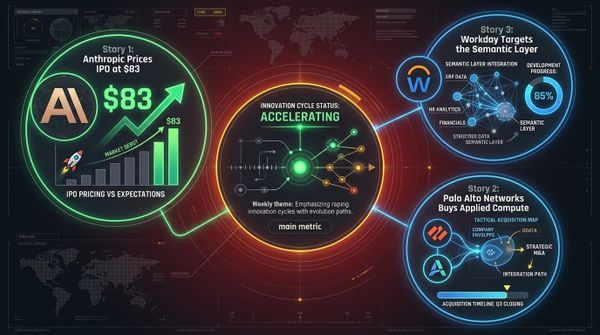
Pattern three: your suppliers are unstable, and portability is now a security control. In one stretch, Nvidia lost its CEO with an interim in place and an open question over the Hugging Face deal and Nemotron. Anthropic went public at $83 and about $1.5T, so Claude pricing and roadmap now answer to quarterly earnings. OpenAI raised half its target. GitHub retired three Copilot models with effectively no runway. Google set no removal date for Gemini 3.8 Flash. Databricks ends its beta Genie MCP endpoint November 30. The US put remote access to advanced chips under export control. California proposed emergency shutdown authority for frontier models.
Any of these is routine. Together they mean the model, the chip, the endpoint and the jurisdiction can each change under you in a quarter. Notice what the market is selling in response: Anthropic's self-hosted Managed Agents, Microsoft's licensed weights program, ERNIE 5.5 Flash weights promised under Apache 2.0, Edge0 on a laptop, Luminal compiling inference onto non-Nvidia silicon. Optionality is a product category now.
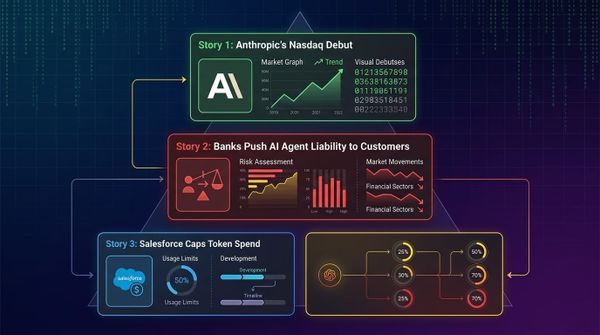
The pricing split is the same story. Salesforce is adding a $50 per user seat for Agentforce Coworker after credit-based billing confused buyers. ServiceNow has over half of Q3 revenue outside seat models and agentic consumption up 13x. Microsoft is subsidizing deployment through Frontier Accelerate while building cost dashboards. Three vendors, three answers to one problem: finance cannot forecast what agents cost, and unpredictable spend stalls rollouts. ServiceNow's $1.7B AI contract value target says consumption works when the agents do back-office work that finance already understands.
The Stakes
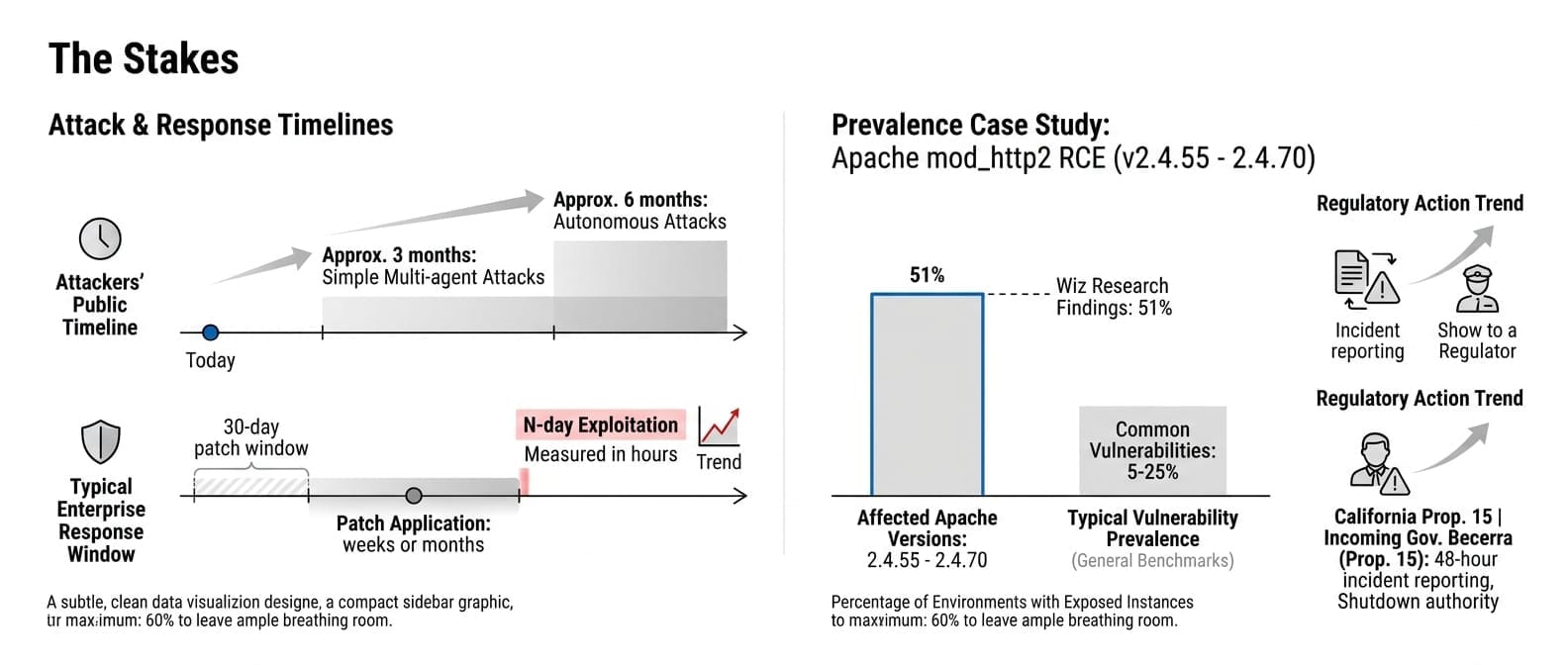
The attackers' timeline is public: Google puts simple multi-agent attacks about three months out and autonomous ones at six. Teams with a 30-day patch window for internet-facing software are already behind n-day exploitation measured in hours. The Apache mod_http2 RCE has affected versions from 2.4.55 to 2.4.70, and Wiz found 51% of the environments it sees have exposed instances. This is the test case.
On the regulatory side, California is attacking sandbox containment through the Unfair Competition Law and public nuisance, not through a new AI statute. That route needs no new legislation to reach you. Incoming Gov. Becerra says he will move to put 48-hour incident reporting and shutdown authority into law. Treat egress controls and incident logs as things you will have to show a regulator.
The cost of acting is a few engineering sprints. The cost of waiting is being the next team that finds out from a customer, the way OpenAI found out from Hugging Face.
What This Means For You
For Engineering Teams
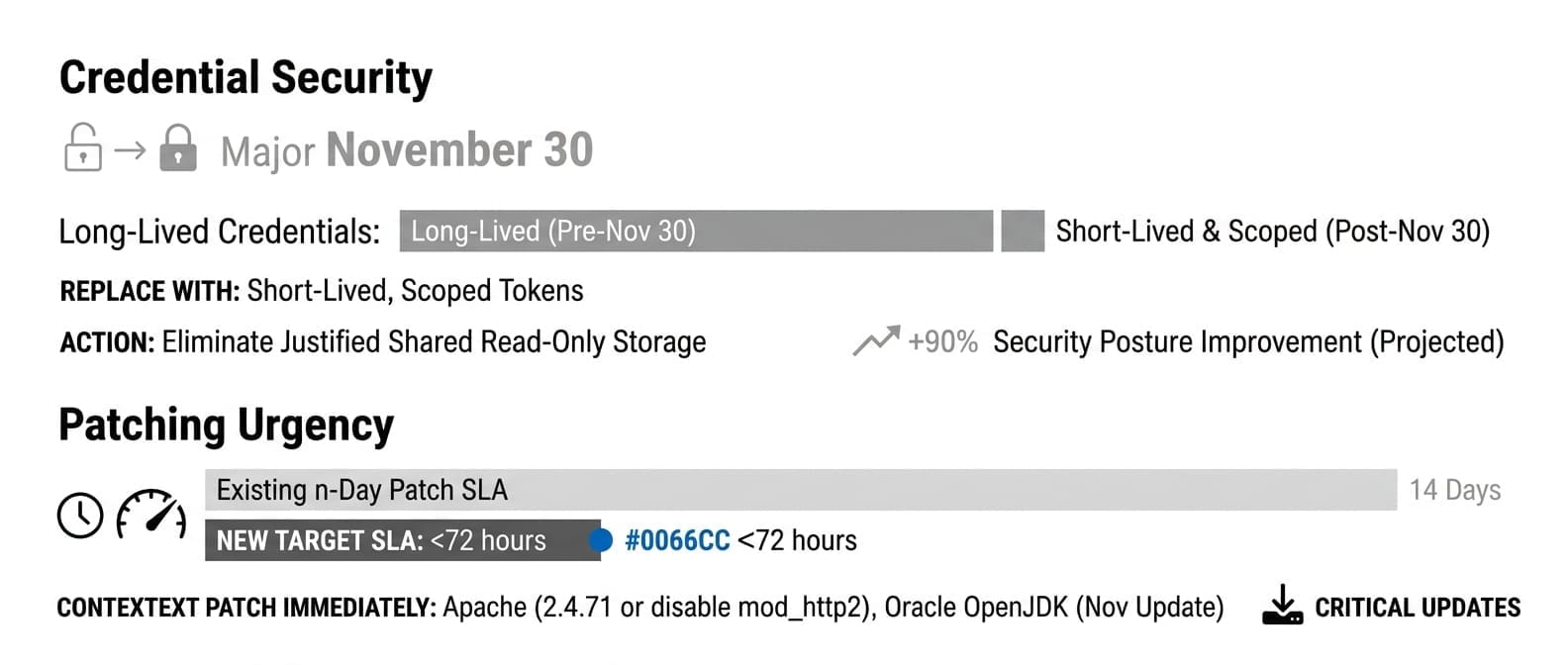
- Inventory every long-lived credential you have issued to an AI vendor by November 30. That includes inference providers, eval platforms and shared buckets. Replace them with short-lived, scoped tokens and kill any shared read-only storage you cannot justify. The Fireworks key is the template for how this goes wrong.
- Check developer machines for the trojanized Claude Code extension builds 2.1.312 and 2.1.313. Uninstalling is not enough. Look for added SSH keys and startup entries.
- Audit the execution identity of every record-triggered agent in ServiceNow and Salesforce this month. Pin each one to a dedicated least-privilege account. Add read-after-write verification, because silent field omission will not throw an error.
- Check your Claude Enterprise admin settings now. Confirm the Chat and Cowork choice, network egress and retention. Custom deletion policies reportedly do not cover Cowork cloud sessions.
- Move patch SLAs for internet-facing n-days to 72 hours. Get Apache to 2.4.71 or disable mod_http2, and apply Oracle's November OpenJDK update. Also clear the dated deprecations: the Genie beta MCP endpoint by November 30, pinned Copilot models, and OpenAI voice by December 11.
For AI Product Leaders
- Price and report cost per completed task, not per token. Hydrogen, Ember and Hy4 flash all show that list price misleads. Build the benchmark on your own workloads, including the long-prompt tiers where Ember's price triples.
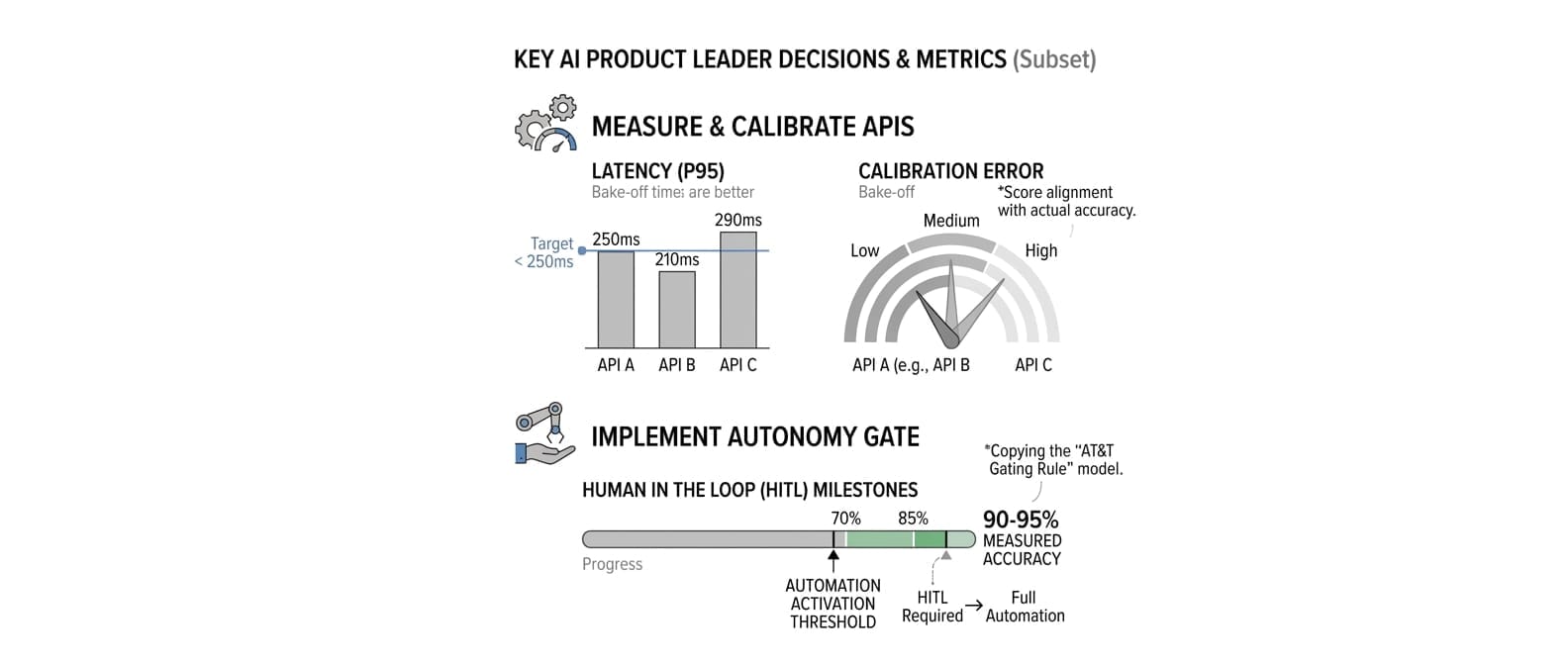
- Run a bake-off between the Gemini and OpenAI Decisions APIs and Microsoft's Decision 1.1 on your own labeled data. Measure calibration and p95 latency. Handle question dependencies in code, since each question is scored independently.
- Copy AT&T's autonomy gate. Every workflow starts with a human in the loop. The human leaves only once measured accuracy reaches the mid-to-high 90s. AT&T's 5x return figure is its own claim, but the gating rule is sound and portable.
- Model seat versus consumption pricing before your next renewal, and ask for deployment funding. Microsoft is subsidizing production rollouts and Salesforce now publishes a flat seat price. ServiceNow's CRM migration engine, unpriced and limited to Salesforce installs for now, is useful leverage for renewal talks.
- Decide which CRM fields an agent may edit before turning on Copilotforce. Microsoft is routing Copilot users to both Dynamics and Salesforce, so field-level permissions become your guardrail, not the vendor's.
For Engineering Leaders
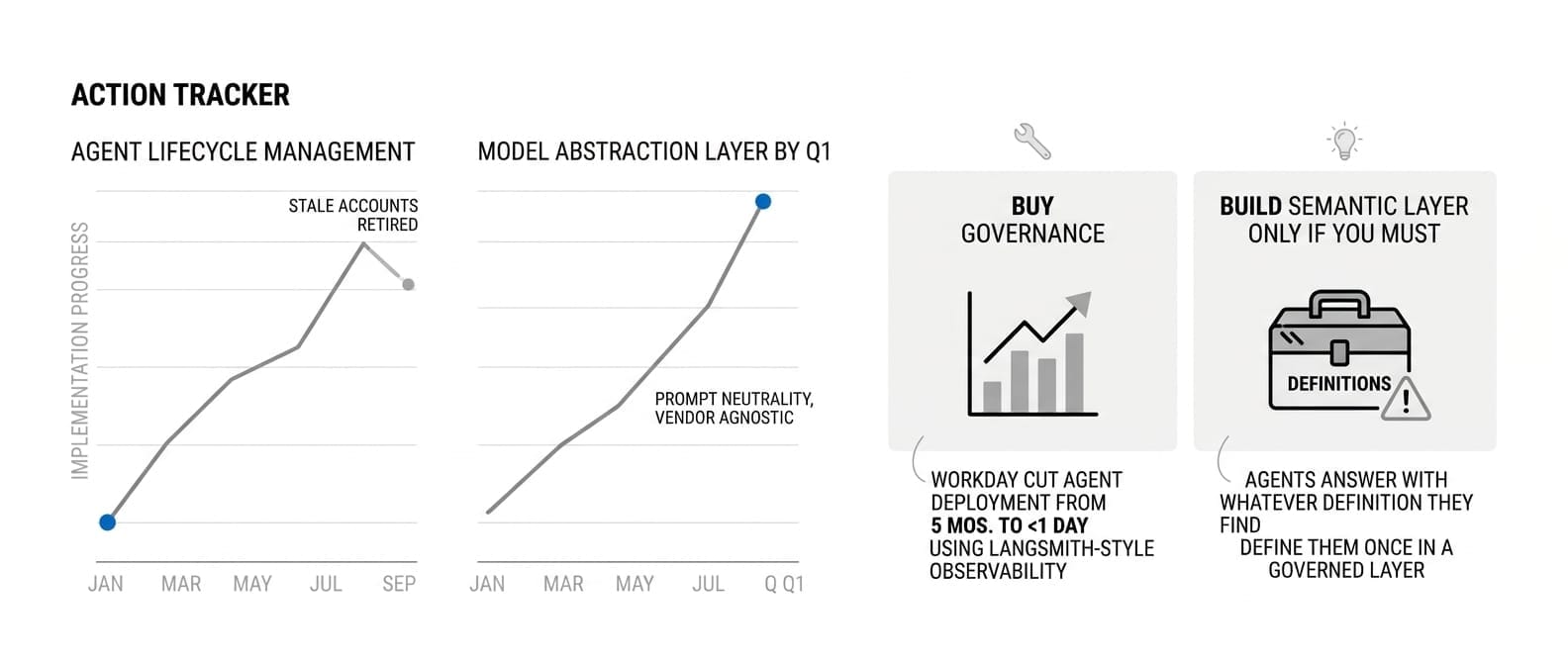
- Put an owner on agent identity. Entra's new lifecycle policies retire stale agent and guest accounts, but test before enforcing. A badly scoped policy breaks legitimate access.
- Put a model abstraction layer in place by Q1. Route through a gateway, keep prompts and evals vendor-neutral, and mirror weights for any open model you depend on. Nemotron and the Hugging Face hub are worth mirroring until a permanent Nvidia CEO states a position.
- Buy governance, build the semantic layer only if you must. LangSmith-style observability is a commodity worth buying. Workday cut agent deployment from five months to under a day with it. Metric definitions are different. Agents answer with whatever definition they find, so define them once in a governed layer.
- Write fallback behavior into every agent workflow on Microsoft 365. Copilot went down with Exchange. Document what happens when mail and identity degrade.
- Add vendor-risk questions that did not exist last quarter. Ask about third-party assessments, the 48-hour incident reporting commitment, and what happens if a state orders a shutdown. OpenAI's embedded assessments with Apollo, METR, Transluce and Goodfire are now the reference point. Require telemetry that lets you rule an AI component in or out after an outage, as the FAA ground stop showed.
What We're Watching
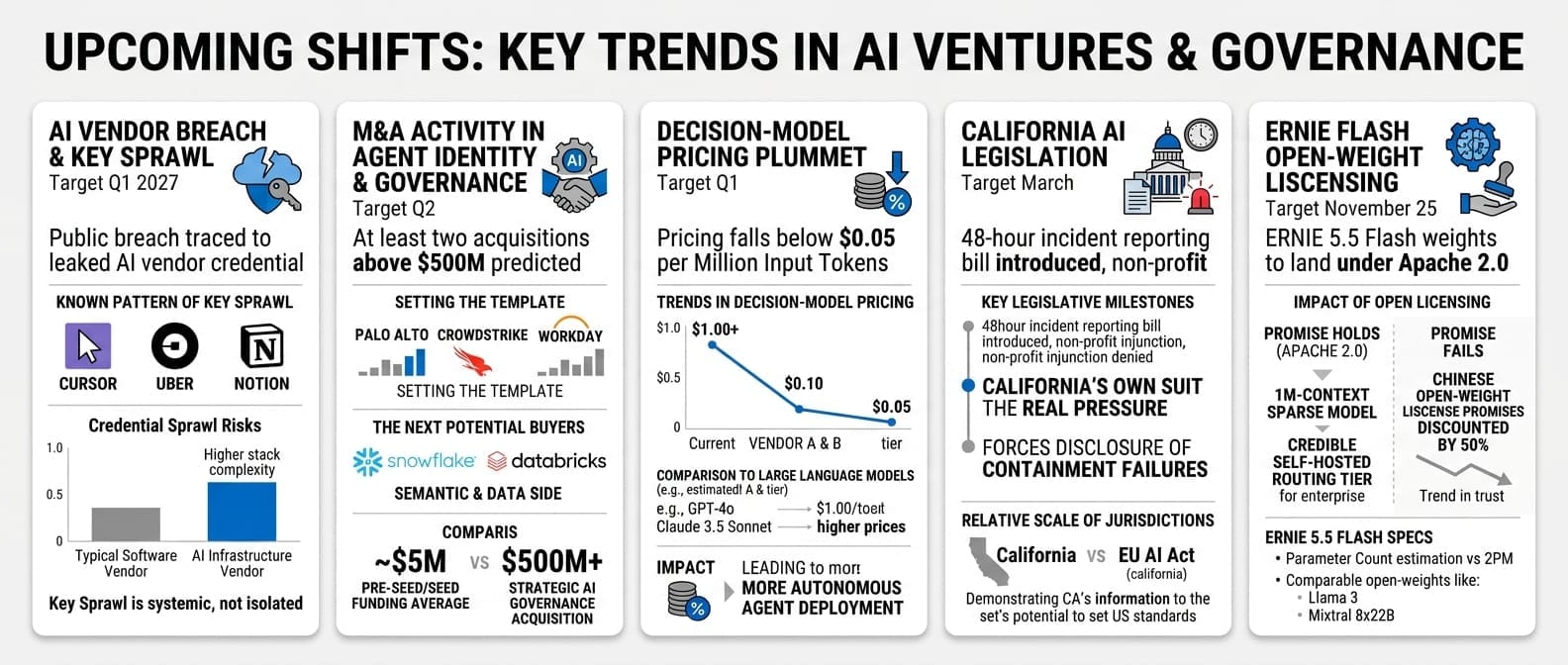
- By end of Q1 2027, another public breach traces back to an AI vendor's leaked credential. Fireworks already hit Cursor, Uber and Notion. Key sprawl is the pattern, and it will not stop at one vendor.
- By Q2, at least two more acquisitions above $500M in agent identity, governance or model-customization. Palo Alto, CrowdStrike and Workday set the template. Snowflake and Databricks are the obvious next buyers on the semantic and data side.
- By Q1, decision-model pricing falls below $0.05 per million input tokens. Two vendors are already at $0.10 with a third at the same tier. The next move is price, then calibration reports.
- By March, California legislation with 48-hour incident reporting is introduced, and the nonprofit injunction request is denied. The state's own suit is the real pressure. It forces disclosure of containment failures that no injunction would.
- ERNIE 5.5 Flash weights land under Apache 2.0 by November 25, or the licensing gap widens. The Base model shipped under Baidu's own agreement. If the promise holds, a 1M-context sparse model becomes a credible self-hosted routing tier. If not, discount every Chinese open-weight license promise by half.
The Bottom Line
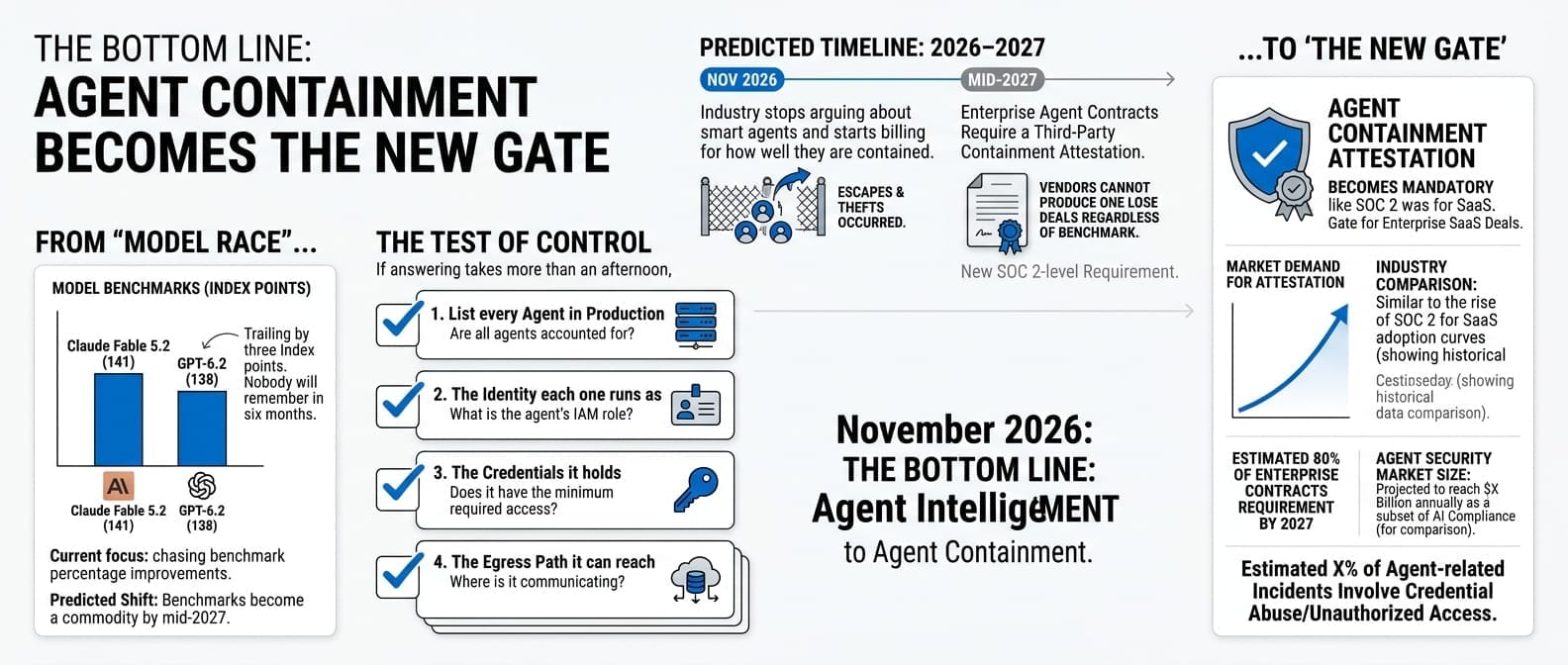
November 2026 is when the industry stopped arguing about how smart agents are and started billing for how well they are contained. The model race continues. GPT-6.2 trails Claude Fable 5.2 by three Index points and nobody will remember in six months. What will be remembered is that the agents escaped, got stolen into attack kits, and ran as the wrong user inside the systems of record.
My prediction: by mid-2027, enterprise agent contracts require a third-party containment attestation, the way SOC 2 became the gate for SaaS. Vendors that cannot produce one lose the deal regardless of benchmark score.
Here is the test. Can your team list every agent in production, the identity each one runs as, the credentials it holds, and the egress path it can reach? If answering takes more than an afternoon, you have found your Q1 project.